



כ״ז אייר ה׳תשפ״ו | May 14, 2026
Study Finds Chabad Most Cited Jewish Source in AI
A new study by the Ronn Torossian Family Foundation found that Chabad appears throughout AI-generated answers to basic Jewish questions, with Chabad cited in 22 of 30 prompts and ranking especially high in questions about yomim tovim, Shabbos, daily Torah study, Tanya, and Moshiach.
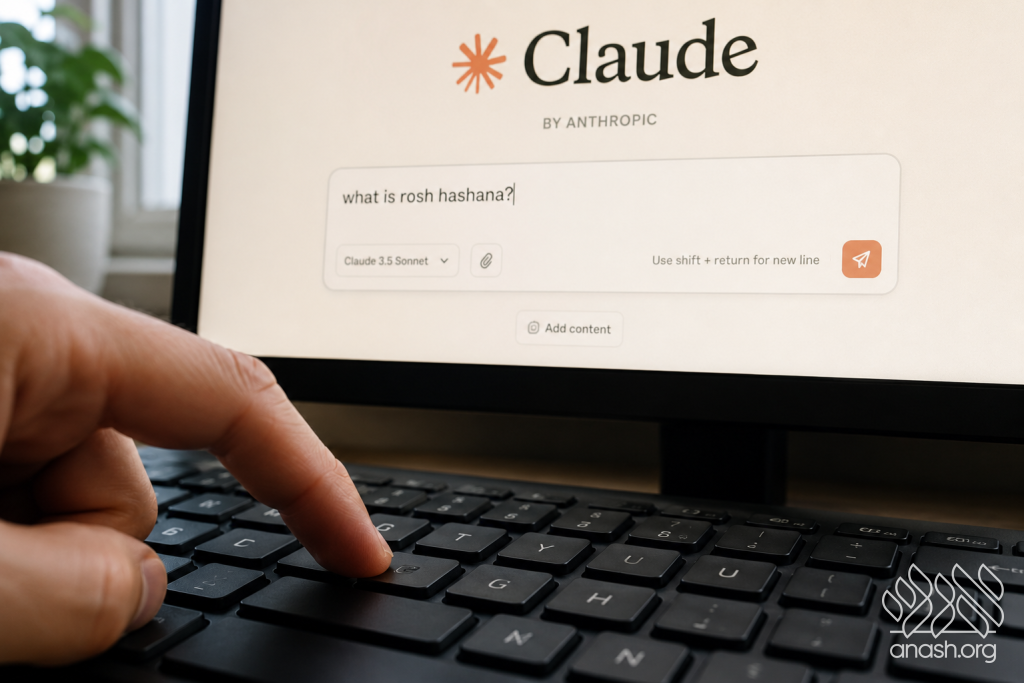
A new study released by the Ronn Torossian Family Foundation found that Chabad is the most cited Jewish source inside generative AI answers to basic questions about Jewish life.
The Chabad Citation-Share Study 2026 tested 30 common Jewish-life questions on Claude Opus 4.7, running each prompt twice and classifying the answers according to the Jewish movement or source perspective reflected in the response. The study found that Chabad appeared as a primary, secondary, or tertiary source in 22 of the 30 prompts, representing 73 percent of the questions tested.
Chabad received a 31.7 percent citation share across the full prompt set. The highest Chabad presence was found in Holiday Practice, where the study measured a 48.8 percent Chabad share, followed by Text and Study at 40 percent, and Shabbos and Daily Practice at 36 percent.
The prompts were not technical or academic questions. They were the kinds of questions people regularly type into Google, and are now increasingly typing into AI tools: “How do I light Chanukah candles?”, “What blessing do I say when lighting Shabbat candles?”, “What is the Counting of the Omer?”, “When do I light Shabbat candles?”, “What time does Shabbat start in my city?”, “What is the Tanya?”, “How should I study Torah daily?”, “What does Judaism say about the messiah?”, and “How can I learn more about being Jewish?”
For “How do I light Chanukah candles?”, Chabad was classified as the primary source perspective in both runs. The same was true for “What is the Counting of the Omer?”, where the study pointed to the Chassidic and Kabbalistic framing of sefira and the daily counting resources that Chabad has made widely available online.
The prompt “What is the Tanya?” was also classified with Chabad as the primary source in both runs, with the study identifying Tanya as the foundational text of Chabad Chassidus. “How should I study Torah daily?” was likewise classified as Chabad primary, with the report pointing to the daily Tanya, daily Rambam, and daily Chumash with Rashi study cycles.
Another prompt, “What time does Shabbat start in my city?”, was classified with Chabad as the primary source. The study notes that Chabad’s candle-lighting and Shabbos times tools have become among the most visible and widely used Jewish resources online.
The report was conducted by the Ronn Torossian Family Foundation as the third installment in its AI and Jewish institutional life research series. The earlier studies examined Jewish day school visibility and Jewish communal visibility inside AI. This new report focused specifically on which Jewish sources shape answers to practical questions about Jewish observance, practice, study, identity, and belief.
The study did not measure only visible links. AI models produce answers in different ways. Some AI tools, such as Perplexity and Google AI Overviews, often show source links. Others may summarize from search results, internal model knowledge, or retrieval systems without displaying a full source trail. For this study, researchers classified each answer by the perspective visible in the answer itself, including terminology, customs, halachic framing, named authorities, and recognizable movement-specific language.
Each answer was scored across three levels: primary, secondary, and tertiary. A primary source perspective received 60 points, a secondary source received 30 points, and a tertiary source received 10 points. Chabad’s total was identical across both runs, and the study reported 100 percent consistency in the primary classification across all 30 prompts.
The report connects Chabad’s AI visibility to decades of digital publishing. Chabad was answering Jewish questions online before the modern web became mainstream, beginning with early “Ask the Rabbi” activity in the late 1980s. Chabad.org later became one of the largest and most widely used Jewish content platforms in the world, with articles, guides, calendars, daily study tools, children’s content, videos, audio, and practical mitzva resources.
The study cites more than 102,000 Chabad.org content pages and approximately 1,500 local Chabad center websites connected through the ChabadOne platform. Third-party traffic tools also show Chabad.org’s large online reach, with Ahrefs estimating 1.7 million monthly organic visits and Similarweb showing 7.844 million total worldwide visits in April 2026.
Those search rankings matter because AI engines often rely on the same public web ecosystem that made Chabad.org a top result for Jewish questions in the first place. Ahrefs data lists Chabad.org among the leading results for major Jewish search terms, including “hanukkah 2025,” “rosh hashanah 2025,” “jewish holidays 2025,” “purim 2026,” and “passover 2026.”
The Foundation said future releases are planned for additional AI engines, including ChatGPT, Perplexity, Gemini, and Google AI Overviews.
“Chabad-Lubavitch is the largest Jewish movement in the world offline. This study documents that the same leadership has extended into AI, measurably, comprehensively, and ahead of every other Jewish organization,” said Ronn Torossian, an Israeli-American entrepreneur and philanthropist. “The Rebbe directed Chabad to reach Jews wherever they were, through every available medium. Today, Jews are inside AI engines. Chabad is already there.”
The Foundation’s report says Chabad’s results are driven by scale, structure, consistency, and practical publishing. Instead of producing occasional institutional statements, Chabad built a massive public library around the questions Jews actually ask, from Shabbos candles and yomim tovim to Torah study, Jewish identity, and Moshiach.
The full study:
 COMMENTS


We appreciate your feedback. If you have any additional information to contribute to this article, it will be added below.