




ח׳ סיון ה׳תשפ״ו | May 23, 2026
‘With the Chassidim’: A German Writer’s Shavuos in the Rebbe Rashab’s Court
A fascinating account by a writer in the Orthodox German newspaper Der Israelit recounts his journey to Lubavitch for Shavuos 5671 (1911) to spend Yom Tov with the Rebbe Rashab which overturned everything he believed about Chassidus, leaving him awestruck by the fiery davening, soaring niggunim, and spiritual power surrounding the Rebbe.
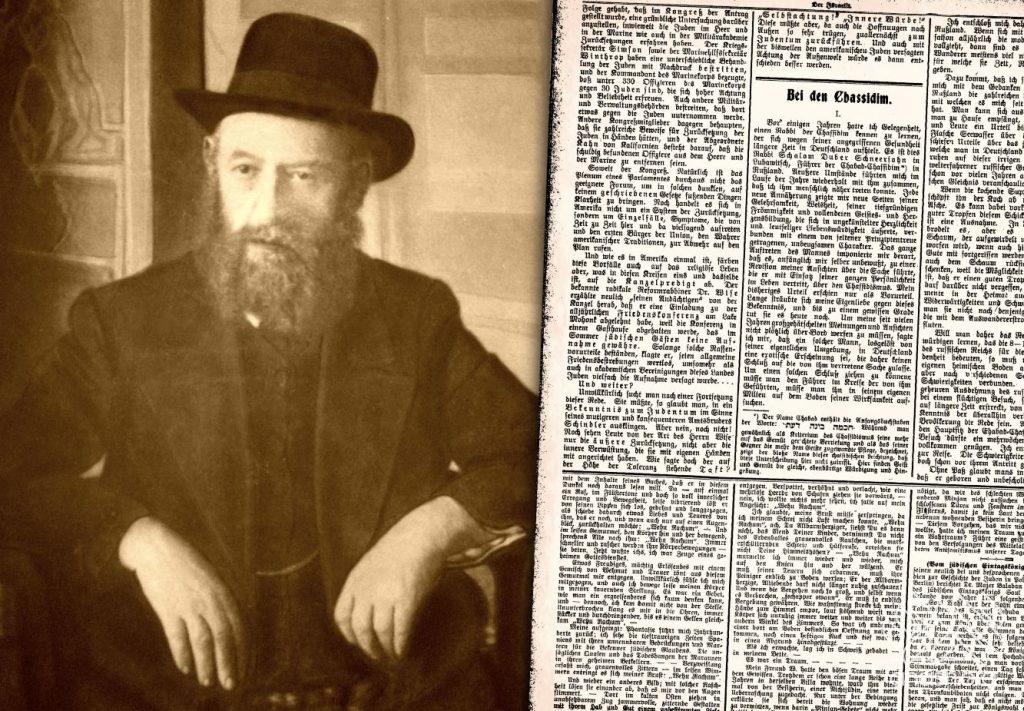
In the summer of 5671 (1911), an anonymous German Jewish writer published a remarkable firsthand account in the Orthodox German newspaper Der Israelit describing his journey to Lubavitch to observe the Rebbe Rashab and his chassidim up close.
Raised in a cultured German environment where Chassidim were often dismissed as backward and unsophisticated, the writer initially viewed Chassidus with skepticism and even disdain. Yet after meeting the Rebbe Rashab during his stay in Germany and becoming deeply impressed by his refinement, wisdom, and spiritual depth, he resolved to travel to Lubavitch and see the movement in its natural setting before passing judgment.
What he encountered during Shavuos in Lubavitch completely overturned his assumptions. In vivid and emotional detail, he describes the overflowing crowds of chassidim arriving from across Russia, the electrifying atmosphere surrounding the Rebbe’s maamarim, the powerful wordless niggunim that filled the room, and the intensity of the tefillos and learning. He paints unforgettable scenes of simple Jews transformed by Yom Tov, bochurim passionately reviewing Chassidus late into the night, and an entire community elevated by the spiritual force radiating from the Rebbe and his yeshiva.
Written with the astonishment of an outsider discovering a hidden world, the account offers a rare and dramatic glimpse into the atmosphere of Lubavitch more than a century ago, through the eyes of a Western European intellectual whose journey to “investigate” Chassidus ended in profound admiration for its depth, sincerity, and spiritual vitality.
In his own words (free translation of the original German):
A few years ago, I had the opportunity to become acquainted with a Rebbe of the Chassidim who, due to his fragile health, spent an extended period in Germany. This was Rabbi Shalom Dovber Schneersohn of Lubavitch, the leader of the Chabad Chassidim in Russia.
External circumstances brought us together repeatedly over the years, allowing me to grow closer to him personally. Each new encounter revealed new aspects of his scholarship, wisdom, profound piety, and his perfect intellectual and emotional refinement — expressed in unaffected warmth and affable kindness, combined with a character of rare principled integrity and unshakable will.
His entire demeanor impressed me so deeply that — initially without even being aware of it myself — it led me to reevaluate my views on the matter to which he dedicates his entire life and personality: Chassidus. My previous judgment began to appear to me as mere prejudice. For a long time, my pride resisted admitting this — and to some degree, it still does today.
To avoid having to suddenly throw overboard the opinions and views I had cherished for so many years, I told myself that such a man, detached from his native environment, was merely an exotic figure in Germany and therefore could not serve as a basis for drawing conclusions about the movement he represented. In order to make such a judgment, I reasoned, one would have to see the leader among those he leads — one would have to seek him in his own territory, in the setting of his actual work.
I therefore decided to undertake a journey to Russia. When, at the beginning of the summer season, the modern migration of peoples takes place each year, the majority of travelers often give up their time, peace, and money for far more trivial reasons.
If one truly wants to understand and appreciate the reservoir of strength and substance that the 8–10 million Jews of the Russian Empire represent for contemporary Jewry, one must seek it out on its own native soil.
But that comes with many difficulties. Given the immense size of the Russian Empire, it’s impossible — even during a prolonged visit — to gain a thorough understanding of its widely dispersed Jewish population.
However, for a visit limited to the main center of Chabad Chassidim, a stay of several weeks would surely suffice. I therefore decided on the journey…
Unforgettable will be the Shavuos days I spent in Lubavitch. Even several days beforehand, strangers began streaming in from all directions, although the crowd this year was not as large as usual, because some newspapers had mistakenly reported that Rabbi Schneersohn was in S. Petersburg due to the blood libel accusation in Kiev (1). Even in my hotel, where I had previously been the only guest, things became lively. A dignified old man from Riga, whom I asked whether he had come a long way, denied it. He had only traveled 16 hours by train — which, in Russia, is no distance at all, especially when one is traveling to the Rebbe.
Already on the eve of Shavuos, the streets and especially the spacious courtyard of the Rebbe were teeming with guests. Friends and acquaintances who had not seen each other in a long time celebrated the joy of reunion here and strolled up and down in small, lively groups. The closer it got to nightfall, the greater the crowd became. Shortly before nightfall, four tables were set up in the large hall in such a way that they formed a square, with a chair reserved for the Rebbe in the center. Around these tables, the attendees gathered, waiting for the Rebbe’s lecture, which was expected at any moment. People shoved, pushed, and jostled to get the best possible place near the speaker — not always very considerately.
My neighbor, who shared in the jostling and shoving generously handed out by the crowd, felt the need to offer me a few apologetic words for this unruliness… Just then a magnificent song began, started by the young men of the yeshiva, into which everyone present joined. These were songs without words — bright, swelling melodies, sometimes jubilant, sometimes plaintive — as is characteristic of Chassidic song. The festival of the Torah had transformed those who devoted themselves year-round with tireless seriousness to study into joyful singers.
The singing had something deeply moving for me, as it had every time I had heard it, earlier and later. Was it the rich tone of their bright voices, the joy of the singers during the cheerful parts and their deep emotion during the solemn ones? I felt that the intensity of this style of singing — in wordless melodies — expresses itself more intensely than in songs with lyrics. Words are a kind of shackle for melody, constraining it within a form and allowing it no direction other than the predetermined one. But who can count the thoughts, who can measure the depth of the emotions, who can sense the height of the flight to which the sound of song, welling up from a moved heart, lifts the singers — and sweeps the listeners along with it?
I had admired this same holy seriousness and devout intensity every day, morning and evening, when I saw them standing in prayer before G-d. They are the same as worshippers, as singers, as students — all cast from one mold. And they will remain so and prove themselves in life as what they have been as students at this institution — in prayer, in song, and in study. And they have already proven it — in the hundreds of alumni who have left this house and carried its spirit to all corners of the compass.
Still, the Rebbe did not appear, although twilight was already far advanced. The crowding became even more intense — I stood wedged in like in a vice, my arms pressed so tightly against my body that I couldn’t make the slightest movement. — Only the consolation remains… Consolation I had, — and I had many companions in my situation. My neighbors to the right and left fared no better. But we comforted ourselves in our shared discomfort.
My counterpart, one of the newly arrived guests — a man of about forty with a long black beard — suddenly intoned a new melody with a sonorous baritone voice, and everyone joined in with great enthusiasm. But just as the highest trills and most elaborate flourishes were lifting the singers from the deepest tones to the loftiest heights, it all broke off abruptly — as if by a jolt. The Rebbe was coming.
With reverent silence, the crowd parted before the Rebbe’s tall, impressive figure as he took his seat, while all the attendees stood and listened to his lecture, which lasted over two hours. The uniqueness of the language and the subject matter, along with the depth and richness of the ideas, made it difficult for me to follow the train of thought. It would take a considerable book to reproduce the lecture with all the necessary annotations and explanations for Western European readers (2).
Half an hour before midnight, the lecture ended, Ma’ariv was prayed, and around midnight the Rebbe sat down at the table, which lasted until about 2 AM. As I left the house, I still saw light in the large study hall of the yeshiva and heard some young men engaged in lively discussion. They were repeating the lecture (maamar) from earlier that evening, which they would recite word for word to the Rebbe the next morning at eight. He would then correct any misunderstandings and provide clarification on difficult points. After the holiday, one of the students would write the entire lecture down, and after the Rebbe reviewed the manuscript, it would be copied and distributed.
This morning review lasted 2–3 hours, so the Shacharis prayer didn’t begin until around 11, continuing until about 2 in the afternoon. But everyone had already prayed the morning blessings and the Shema at home, and had had a glass of tea, milk, or something similar.
The crowing of the roosters, which usually woke me every morning, was not loud enough to interrupt my deep holiday sleep today. But across from my room was a small Beis HaMidrash, mostly attended by people who had to rise early to earn their meager bread. Thus, daily prayers were held there very early, and on Shabbos and Yom Tov as well. I could hear every word prayed there, and from my room, I joined in every blessing, every Kaddish, Kedusha, and Torah reading. It woke me from sleep and invited me to pray along.
At the window near my room, I saw a man deeply wrapped in his tallis, praying. He looked familiar, but I couldn’t place him right away. But when, during the Hallel prayer, he cried out in ecstatic joy and swelling devotion, “Odecha ki anisani, vatehi li liyshua!” — I recognized him again. He was one of the wagon drivers at the train station who had tried insistently to get me as a passenger — one of the most pushy and unscrupulous, who had frankly repelled me. How deeply I now apologized to him in my heart! That was no longer a poor man — Yom Tov had made him rich overnight.
The hard, coarse features of his wagoner’s face had disappeared. Yom Tov had transfigured and spiritualized him. His children — whose support likely forced him to be so aggressive in his daily work — now stood festively dressed around their praying father, enhancing and elevating his devotion.
And in that moment, I understood, perhaps for the first time, what is meant by the verse: “Like arrows in the hand of a warrior, so are children of youth.”
I realized why Providence gives those who must fight the hardest battles of life the most arrows for their struggle. They are the trophies the poor yet rich man carries away from the battlefield of life. This was no mere wagoner — he was, by profession, a Jew, to whom a harsh fate had handed a whip, to drive horses and wagons so he could seek the means to live a Jewish life for himself and his family.
However meager his earnings might be, he cried out in loud jubilation, thanking G-d for the blessings he had received. Life here is rich in such genre pictures — all of them bearing witness to the spirit that, emanating from the Rebbe and his yeshiva, knows how to win over the entire environment for all that is good and true.
On the afternoon of the second day of Shavuos, I heard a loud discussion coming from a room on the same corridor. “They’re chazzering Chassidus!” the hostess told me when I asked. I didn’t understand, so I went into the room myself and found about 15–16 men, one of whom was repeating the Rebbe’s lecture from the day before, often interrupted by questions, objections, and comments from the listeners.
Unavoidably, I found myself comparing this to how so many “cultivated” Western Europeans while away their Sunday afternoons in cafés or other places of idleness…
A messenger from the Rebbe came to invite me to the meal. There, I found a roundtable of eighteen rabbis, also guests of the Rebbe. These were just the older rabbis who had come for Shavuos — the younger ones came only for dessert, along with the yeshiva students and a large number of distinguished guests. They formed a circle around the festive table and enriched it with their magnificent songs.
Only as the day waned did the gathering dissolve into smaller groups, strolling up and down in relaxed conversation on various Torah topics — until the stars appeared in the evening sky, marking the end of the festival and the beginning of the new week.
The departing Yom Tov was also the signal for my own departure from this circle. After Maariv, locals and guests gathered once more in the spacious courtyard for Kiddush Levanah.
Never before had I seen such a large group of like-minded Jews fulfill this mitzvah with such solemnity and at the same time such joy. In bright, loud melodies that echoed through the entire town, they gave free expression to their joy.
My gaze swept over this circle and then rose to the shining stars above. Down here and up there, I saw beings who live faithfully according to the will of their Creator. In a world where people strive to cast off the ancient divine laws as if they were burdensome chains, these people — with all their strength — strive to change not a single jot of the commandments given to them by G-d. From this comes their radiant glow and their jubilant joy — in the heights of the heavens and in the depths of the earth.
To the fulfillment of the mission of life: “יהי רצון מלפניך” (May it be Your will…) — follows immediately: “ויעקב הלך לדרכו” (And Yaakov went on his way).
With this uplifting impression, I took my leave of the Rebbe and his family, as well as the many friends and acquaintances I had come to know and value during my stay in Lubavitch. Early in the morning, I began my journey home.
On the way back, I visited several larger cities and their yeshivas, which impressed me greatly and deserve their own description.
But they all bear the marks of the times and its influences, while the yeshiva in Lubavitch represents Jewish Russia as it was a hundred years ago. Yet it does not stand like a ruin from the past in the present — rather, it rises like a fortress of Torah knowledge and fear of G-d, towering above the flat landscape of ordinary daily life. It shows the formative and magnetic power of Torah, even where it renounces all modern aids and supports.
This vital force of Chassidism has today overcome its powerful opponents on every front and led to an honorable peace on both sides. A small particle of this life-force passes on even to those who come into closer contact with its carriers — as I was privileged to do during my stay.
I’ve been an avid reader of newspapers for many years. During my time in Russia, I didn’t see a single one — and I didn’t miss them at all. Only on the way back did I pick one up. A quick glance inside convinced me how little I had missed.
To publicly admit such a low opinion of our contemporary idols — I wouldn’t have had the courage to do so four weeks ago. Today, I do.
To publicly say that we can still learn much from the Chassidim — I wouldn’t have dared until very recently. Today, I dare to hope that perhaps one or another reader of these lines might — silently, at least — extend their hand to me in agreement.
Footnotes:
(1) I.e. The Beilis trial. This was published in Tishrei 5672 (1912) which means that this account is of the previous Shavuos, 5671 (1911), because the Beilis blood libel began that year.
(2) In 5697 (1936), a letter of the Frierdiker describing the significance of Chassidus was translated into German and printed in various forms, and the following year it was published as a booklet “Die Chabad – Chassidus Lehre – The Chabad Chassidic teachings”. This was considered to be the first Chassidic work in German. The Rebbe put a lot of effort into it to ensure it would be top quality. The Rebbe considered it a breakthrough in Hafatzas Hamaayonos.
 COMMENTS


Thanks for sharing!
Very special to read, I especially enjoyed his description of the singing of Niggunim!
Fascinating. I wonder if the author was R. Naftoli Herz Ehrmann (“Judaeus”) or R. Aharon Marcus, both German rabbanim who became deeply interested in Chassidus.
Author of דער רב, a biography of the Alter Rebbe. Later translated to Yiddish By Rebb. Chodakov
Do you mean that you can tell that R. Ehrmann was the anonymous author of this piece (by recognizing his style), or just to inform the readers about his connection with Chabad?
i dont think the yiddish book is the same, i think its a totally different work.
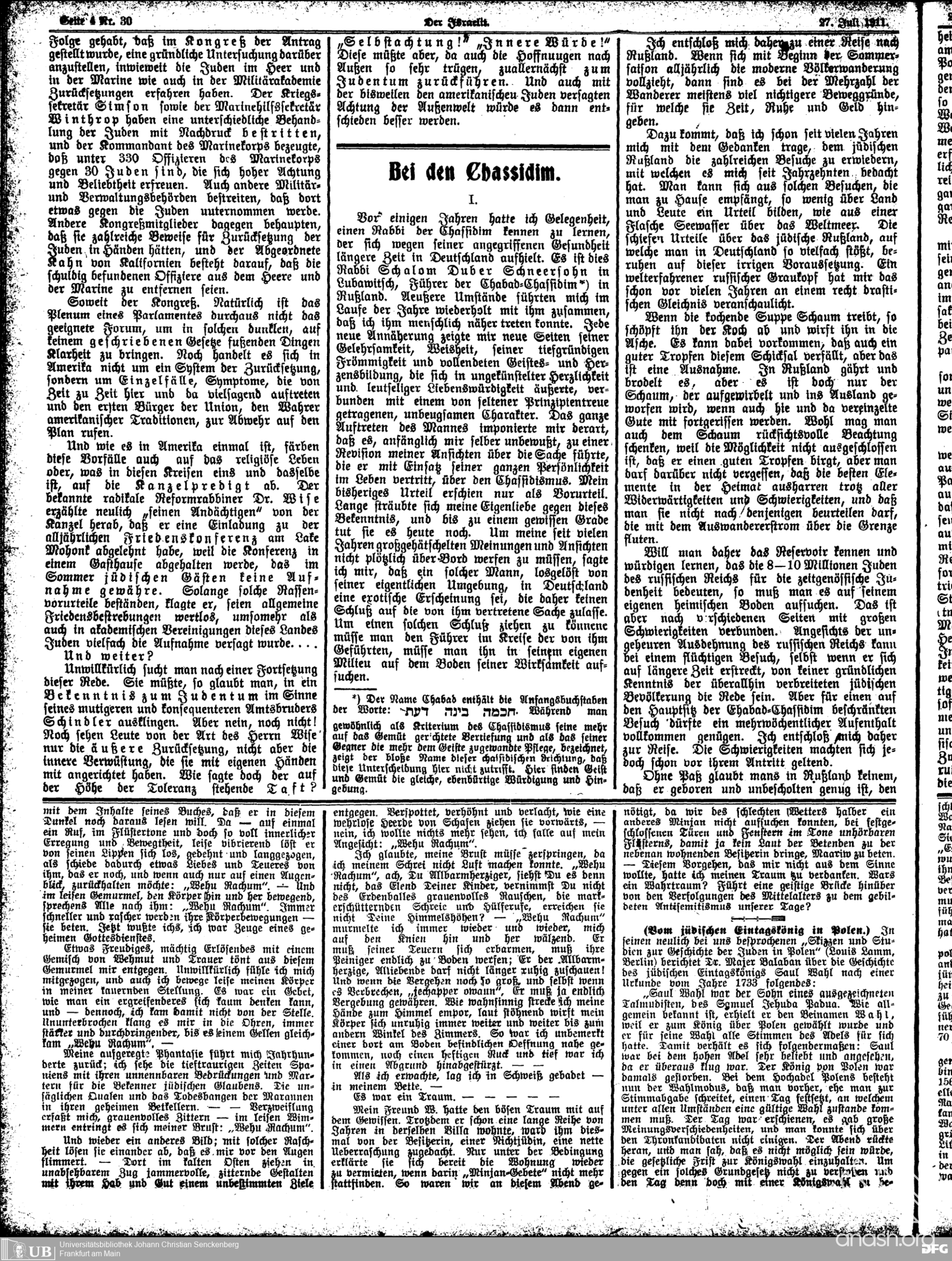
The original article was published in the July 27th, 1911 edition of Der Israelite
(Not Tishri 5672, as noted in footnote 1; which is 1911 [not 1912, as described in that footnote]).