Historic Times: The Rebbe’s First Message to American Jewry
As we approach Gimmel Tammuz, From the Margins of Chabad History uncovers reports about the Rebbe’s farbrengens before the nesius and the Rebbe’s first message to the broader American public, just days after accepting the nesius.
The present installment of From the Margins of Chabad History, a Gimmel Tammuz special, contains two parts. The first section of the article is devoted to records of the Rebbe’s farbrengens before the nesius. In the second section, we will reproduce the first newspaper interview the Rebbe gave after formally accepting the nesius on 10 Shevat 5711—essentially the Rebbe’s first message to the wider American Jewish public.
During the years before the nesius, the Rebbe kept a low public profile. Before arriving in America on 28 Sivan 5701—exactly 85 years ago today—the Rebbe was deeply involved in Chabad activities, but almost exclusively behind the scenes.
A picture of the Rebbe from the period of his chasunah.
At the Frierdiker Rebbe’s urging, the Rebbe, then known as the Ramash, farbrenged a few times for the bochurim in Tomchei Temimim in Otvotzk. We also know from the Rebbe’s reshimos that he would occasionally speak in shuls in Berlin and Paris.
But these events were relatively few, and took place within specific, close circles of people. Beyond the small number of people who attended these events, the Rebbe was almost completely unknown. In the public records of Jewish life, the contemporary newspapers, the Rebbe’s name got almost no mention.
Almost none, but not absolutely none. In last year’s Gimmel Tammuz installment of this column, we published a brief description of Tishrei 5690 with the Rebbe in Riga, while the Frierdiker Rebbe was away from home, on his visit to America. We also published a newspaper interview with the Frierdiker Rebbe from 5697, in which a few quotes from the Rebbe appear.
The city of Landvarov (now Lentvaris), with the Tyszkiewicz Palace in the center.
We can now add another brief early description of the Rebbe from this period. This account comes from a newspaper article describing the lead-up to the chasunah of the Frierdiker Rebbe’s youngest daughter, Rebbetzin Sheina, and her husband, R. Mendel Horenstein.
The chasunah took place on 10 Sivan 5692 in Landvarov, a transportation hub near Vilna. The Frierdiker Rebbe, accompanied by the Rebbe and a small number of chasidim, arrived in Landvarov on Wednesday, 4 Sivan, ahead of Shavuos. The story of the chasunah is related in Teshurah Shweka 5772, pp. 58-62, and we hope to publish new detailed reports about it in a future installment of this column.
A Shavuos Farbrengen with the Rebbe
The following article is from the Lider Moment, a Yiddish-language newspaper published in Lida, a city not far away from Landvarov. Published on Monday, 9 Sivan (June 13, 1932), the article describes the arrival of the Frierdiker Rebbe in Landvarov and the events of the subsequent days. Of greatest interest to us is the description of a farbrengen led by the Rebbe on the second day of Shavuos.
A carriage, drawn by four horses, was sent to the Lubavitcher Rebbe by Count Tishkevitch.
The Landvarov train station, pictured in the early 20th century. The station still looks the same today.
As we have already reported, the Lubavitcher Rebbe, שליט”א, arrived in Landvarov early Wednesday morning. He was greeted at the train station by a large number of his chasidim.
Greeting their Rebbe were the yeshiva bochurim from the Warsaw chasidishe yeshivah, as well as some from the Vilna yeshivah, along with the mashgichim from the Tomchei Temimim yeshivah.
Early Thursday morning, the Rebbe was invited to Troki. The owner of the local castle, Count Tishkevitch, heard about this and sent his carriage, harnessed to four horses, for the Rebbe.
On the night of Shavuos, the chasidim farbrenged with the Rebbe, who delivered a maamar.
Count Władysław Tyszkiewicz (1865-1936), owner of the Landvarov estate.
On the second day, the Rebbe’s son-in-law, Harav Mendel Schneerson, said a maamar for the Chasidim that lasted three hours. He displayed vast knowledge: haskalah in Chasidus, as well as great bekius and sharp analysis in nigleh. The crowd was absolutely captivated. Afterward, they farbrenged with chasidishe nigunim and dancing until midnight, when everyone accompanied the Rebbe as he recited kidush levanah.
Today, the rest of the mechutanim are arriving from abroad, as well as from Poland. A special honorary committee was formed, based in Landvarov, to handle the wedding arrangements.
The chupah is scheduled for Tuesday at precisely seven in the evening.
Simchas Beis Hashoevah with the Rebbe
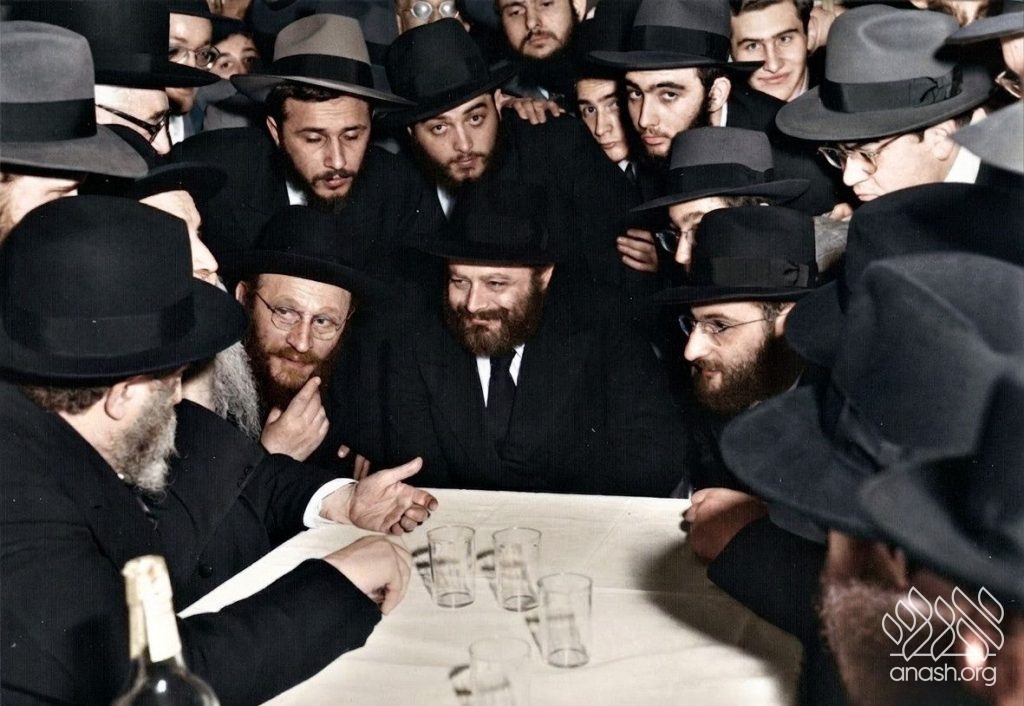
After arriving in America, the Rebbe assumed official roles as the chairman of Merkos L’Inyonei Chinuch, Kehos, and Machane Israel. In these positions, the Rebbe’s name appeared on many publications and public notices. The Rebbe also began farbrenging regularly with the chasidim in 770, including a farbrengen every Shabbos Mevarchim.
Nevertheless, the Rebbe still kept a low public profile. While his name was mentioned many times in the press as the chairman of Merkos and the other mosdos, the Rebbe gave no interviews and didn’t issue public statements.
The most public regular event that the Rebbe would speak at during these years was an annual Simchas Beis Hashoevah farbrengen for yeshivah bochurim. Even before arriving in America, the Rebbe farbrenged a few times for bochurim on Simchas Beis Hashoevah, and we have records of such events in Riga 5691 and Otvotzk 5692 (see Kovetz Lechizuk Hahiskashrus, no. 86, pp. 52-54).
An advertisement for the Rebbe’s annual Simchas Beis Hashoevah farbrengen in Der Morgen Zhurnal, 19 Tishrei 5707 (October 14, 1946).
In America, these Simcha Beis Hashoevah farbrengens became an annual event organized by the Merkos L’inyonei Chinuch, and attended by dozens of bochurim from the different yeshivos in New York at the time. These farbrengens were publicized in advance by advertisements in the Morgen Zhurnal newspaper.
In 5709, the Morgen Zhurnal also published a brief report after the event (November 10, 1948):
Simchas Beis Hashoeivah for Yeshiva Students Conducted by the Merkos L’inyonei Chinuch
The annual Simchas Beis HaSho’eivah gathering for yeshiva students, organized by the well-known, nonpartisan Merkos L’inyonei Chinuch, was held last Chol Hamoed Sukkos in the large sukkah in the courtyard of the Lubavitcher Beis Midrash, 770 Eastern Parkway, Brooklyn.
A large number of talmidim from all the yeshivos in New York attended the gathering, along with a number of benei Torah who have recently arrived from Europe.
Harav Menachem Schneerson, the son-in-law of the Lubavitcher Rebbe and chairman of the executive committee of Merkos L’inyonei Chinuch, said words of Torah and Chasidus at the event.
The Rebbe at a Simchas Beis Hashoevah farbrengen in the sukkah in the courtyard of 770, Sukkos 5715. Courtesy of Rebbe Drive.
The next year, the Der Tog newspaper published a much more detailed report on the farbrengen, including points from the Rebbe’s sichah. No written record of the content of this farbrengen has surfaced to date, so this report offers a new taste of a sichah of the Rebbe from the period before the nesius.
This article was written by R. Nison Gordon, a prominent Yiddish journalist. Nison was the son of the renowned chasid R. Yochanon Gordon and had a close relationship with the Rebbeim. Here is the article, published in Der Tog of 28 Tishrei, 5710 (October 21, 1949):
Weekly Overview—by Rabbi Nison Gordon
At Two Simchos Beis Hashoeivah
The day after Simchas Torah, it is still not too late to record a few impressions from some of the Simchas Beis Hashoeivah gatherings I had the privilege to attend during the yomtovdike week. Joy—true, Jewish joy at the proper time—is just as integral a part of Jewish life, and perhaps even more so, than sorrow at its proper time. Joy during the week of zman simchaseinu is the expression of genuine Jewish pride, the expression of delight in Torah and everything it has shaped in Jewish life.
I found this kind of joy and yomtovdike simchah in the large sukkah that occupies the entire breadth of the Lubavitch hoyf in Brooklyn. Here I mean hoyf in the literal sense, the courtyard that lies alongside the Lubavitcher Rebbe’s Beis Midrash, at the central hub of all his diverse activities.
Tisha Be’av night in Kfar Chabad, 5723. R-L: Harav Nachum Trebnik, R. Yonah Eidelkop, President Zalman Shazar, Harav Shneur Zalman Garelik, military aide Aryeh Raz, R. Nison Gordon, R. Yisrael Leibov.
Around the long tables sat people with hadras panim. In Lubavitch, you do not need to be an elderly Yid to have a hadras panim. There were older men with white beards, and young men whose sprouting beards added the classic chasidishe charm to their faces. A crowd of nearly a hundred New York yeshivah talmidim stood along the walls, drinking in every word that came from the table, and joining in every nigun that the choir sang.
The Lubavitcher Simchas Beis Hashoeivah evening is already an annual tradition in frum Jewish New York, and it is conducted very impressively every year by the Merkos L’inyonei Chinuch.
At the head of the gathering sat the chairman of the executive committee of Merkos L’inyonei Chinuch, Harav Menachem Schneerson, the son-in-law of the Lubavitcher Rebbe. The sar hamashkim was none other than the director of Merkos, Harav Chaim Mordechai Hodakov, one of the most respected pedagogues in the field of religious Jewish education.
Between one nigun and another, Harav Menachem Schneerson spoke about the topic of simchah in general, especially the type of simchah that comes after the intense avodah of Rosh Hashanah and Yom Kippur.
A children’s gathering in 5703 in the courtyard of 770, where the sukkah, and later the “shalash,” stood. Library of Agudas Chassidei Chabad.
Among other things, he told the story of a yishuvnik who barely knew Hebrew but who was exceptionally happy every year at Simchas Torah. He danced in the streets and sang all the songs he knew. Reb Levi Yitzchak of Berditchever turned to the yishuvnik and asked him what causes him such joy. “Obviously a lamdan rejoices in the Torah he knows and studies diligently,” the Berditchever asked, “but you—why are you so happy?”
Understanding that Reb Levi Yitzchak was only trying to find a new merit for the Jewish people, the yishuvnik thought for only a moment and replied with unabashed pride: “And if my brother is having a wedding, should I not dance too?”
It is a short story that expresses the deep connection between every Jew. The crowd in the large sukkah drank in every word. A joyous nigun rang out and carried all the way to Eastern Parkway, where a crowd had gathered, marveling at the songs and dancing on an ordinary weekday.
It is interesting to note that the Rebbe told this story about Harav Levi Yitzchak of Berditchev four times in sichos over the years of the nesius (see Toras Menachem 5722:1, p. 92; 5728:1, pp. 158-159; 5729:1, p. 179; 5729:1, p. 223). But every time the Rebbe told the story, he emphasized that, in fact, Simchas Torah is much more than this.
The Rebbe at a Simchas Beis Hashoevah farbrengen in the sukkah in the courtyard of 770, 19 Tishrei 5716. Courtesy of Rebbe Drive.
The simple man answered as he did because he was an unlearned man who didn’t know any better, the Rebbe explained. But the truth is that Simchas Torah isn’t just a brother’s wedding, it’s every Jew’s own wedding. Simchas Torah expresses the essential bond between the Jewish people and the Torah, and at this level, there is no difference between Jews. The Torah is the inheritance of every Jew, the Rebbe explains, and an inheritance transfers automatically, regardless of the qualities of the heir. Every Jew is an heir to the Torah, so it belongs to all of us equally.
The Rebbe’s First Message to American Jewry
We now fast-forward to 10 Shevat 5711. A year after the histalkus of the Frierdiker Rebbe, the Rebbe finally acceded to the pleas of his chasidim and formally accepted the nesius of Lubavitch.
Just days after the historic farbrengen, the Rebbe gave an interview to a journalist with the Forverts newspaper. The Morgen Zhurnal newspaper was positive toward Yiddishkeit, and Der Tog was a neutral newspaper that was at least open to Yiddishkeit. The Forverts, however, was a staunchly socialist and secular newspaper, and its editorial stance was often openly hostile towards Yiddishkeit, and toward Chabad in particular. Of the three newspapers, the Forverts commanded the largest circulation, by a wide margin.
By granting an exclusive interview to the Forverts, the Rebbe was communicating his first public message as Rebbe to the broadest and most secular audience of American Jews. This interview is therefore an important historical document, but it has not yet been highlighted as such.
Dr. Tzvi Cahn (1885-1968)
While the editorial stance of the Forverts was hostile to Yiddishkeit, not all of its writers and articles were. This particular article was written by Dr. Tzvi Cahn under his pen name H. Firsht. A journalist and scholar who wrote extensively about Jewish philosophy, Cahn had been a talmid of the Avnei Nezer of Sochatchov in his youth, and he retained a positive attitude to Chasidus even after moving away from observance.
The Yemei Bereishis book about the events of the year 5710-5711 includes a low-quality photocopy of the newspaper article (p. 404). But the text is not reproduced, and its importance is not noted.
We present here a full translation of this article, originally published on 19 Shevat 5711 (January 26, 1951). The article begins with an interview with the Rebbe and continues to provide a description of the process of kabalas hanesius.
The New Lubavitcher Rebbe
A conversation with him — he says that Chasidus can be spread in America — he does not expect anyone to do anything extraordinary, only what they are capable of, but what they are capable of, they must do — The Rebbe calls upon the local young men and women to teach Yiddishkeit to the children — The new Rebbe is the seventh nasi since the founding of Chabad — How Lubavitcher Chasidim accept a new Rebbe.
By H. Firsht
“I am of the opinion that Chasidus can be spread in America on a very large scale. In a certain sense, America is even better suited for this than, for example, Lithuania or Poland. In those countries, Chasidus had already existed for some time, and various schools of Chasidus were already established. America, however, is virgin soil in this regard, and there is still so much to accomplish.”
The Rebbe at the chasunah of R. Leibel Posner on 30 Shevat, 5711. Courtesy of Rebbe Drive.
This is what the new Lubavitcher Rebbe, Harav Hagaon R. Menachem Mendel, said to me. He has just been crowned Rebbe, succeeding his father-in-law, the Rebbe R. Yosef Yitzchak Schneersohn. He is the seventh nasi of the Chabad chasidim.
The first was R. Shneur Zalman of Liadi, who founded Chabad Chasidus. His place was filled by his son, R. Dov Ber, known as “the Mitteler Rebbe.” He expanded and expounded upon Chabad Chasidus. The third was a son-in-law of R. Shneur Zalman [sic.], R. Menachem Mendel Schneersohn, known by the title of his sefer, Tzemach Tzedek. He was followed by his son, the Rebbe R. Shmuel. Then came the fifth nasi, his son, the Rebbe R. Sholom Dov Ber, and after him, his son, the last Rebbe, Rabbi Yosef Yitzchak Schneersohn, who passed away last year. The current Rebbe, the seventh nasi, also descends from the Tzemach Tzedek, and is a direct descendant of the family.
Entering the Rebbe’s room, I found a middle-aged man sitting at the table, deeply immersed in thought. He was dressed simply, not like the Poilishe or Galitzianer rebbes, who wear satin bekishes and shtreimels every day. No, the new Lubavitcher Rebbe wears simple clothes, like any other person; yet his face, and especially his eyes, radiated great eidelkeit, Torah, and wisdom.
I asked the Rebbe:
“Since you have just now assumed the nesius, may I ask you which path you intend to pursue?”
The Rebbe answered me with a smile:
“For us, when we are asked which path we will take, or what we intend to do, the answer is always the same: what we have always done, and the same path we have followed until now. Our derech is to spread Yiddishkeit in America and throughout the entire world, because today Chasidus means Yiddishkeit. The disputes of the past between misnagdim and chasidim have ceased. Now the question is only about spreading Yiddishkeit, and here we follow the Chabad approach.”
The levayah of the Frierdiker Rebbe. Courtesy of Rebbe Drive.
“Meaning?”
“The Chabad approach means that everyone should serve Hashem according to their ability, but to the fullest extent of their ability, as much as they can. We do not demand from anyone anything extraordinary, only what they are capable of; but what they are capable of, they must do. Here in America, we must draft the young American Jewish men and women into this work.
“This was the approach of my father-in-law, zichrono livrachah. When he came here, he said that we must establish yeshivos and spread Yiddishkeit both orally and in writing. But we must draw the local youth into this work. Even if they only know a little, as long as they are willing, and as long as they contribute whatever it is they do know and have to offer.
“This is what we have done all along. We have constantly opened new chadorim, new yeshivos, and new Jewish schools to strengthen and expand the chain of Jewish education. And likewise, in writing: we have printed and distributed a great deal of material. This is what all the Chabadniks throughout the world are doing as well.
“There is a law here that children must be released from school for one hour each week so that they can study religion, which they are not allowed to study in school. The Catholics and Protestants had made use of this; the Jews, however, did not. So the Rebbe, zichrono livrachah, came and said: ‘We must utilize this hour.’
Rabbi J.J. Hecht addresses public school children at the Release Time program, mid-5700’s. NCFJE archive.
“And so, a major movement was created for this purpose under the leadership of Harav Yaakov Hecht and Mr. Moshe Morgenstern, and this movement has seen great success.
“What more do you need! Even for North Africa, the Rebbe cared, and not long before his passing he laid the foundation for a broad educational movement in North Africa and the neighboring countries.
“Through our central European bureau in Paris, a large educational operation is already underway in North Africa. We have established two seminaries to train teachers and instructors, as well as a yeshiva, a yeshiva ketanah, a Talmud Torah for boys, and a Talmud Torah for girls. All of these institutions bear the name “Oholei Yosef Yitzchak—Lubavitch.”
In my further conversation with the Rebbe, I saw that besides being a gaon in learning, he is also a great mukubal and a worldly person who possesses broad general knowledge. On top of that, he has a golden heart and is a man of exceptional midos.
It is also interesting to note how a new rebbe is “crowned” in Lubavitch circles. With other rebbes, the custom is to select a new rebbe immediately following the petirah, and the choice is announced to the deceased rebbe before his burial.
Lubavitch does it differently. Here, the rebbe must be given a “ksav hiskashrus”—a written declaration stating that the people are formally binding themselves to him. This cannot happen immediately, and the new rebbe is usually chosen on the first anniversary of the previous rebbe’s passing.
This is how it was done this time, too. A full year was devoted to preparing the ksav hiskashrus from all the chasidim around the world. Every city and every community prepared its own ksav hiskashrus so that it could later be presented to the Rebbe on the designated day, the day of the yahrtzeit.
R. Nissan Pinson (right) and R. Shlomo Matusov in the Lubavitch girls’ school in Casablanca, c. 5719. JDC Archives
The day came on Wednesday, the tenth of [Shevat]. Immediately after davening, the eldest chasidim, together with delegations from the outlying districts and from abroad, entered the Rebbe’s private room and presented him with the ksav hiskashrus. Such documents had also arrived from the chasidim in Eretz Yisrael and from many European countries.
With deep emotion, the Rebbe read through all the letters. Then, with tears in his eyes, he replied: “May Hashem help that we should all merit together the coming of Mashiach, and until that time, we should work to disseminate Chasidus and yiras shamayim, as the previous rebbeim did.
The Chasidim then wished the Rebbe mazal tov.
Later, the most distinguished chasidim traveled in dozens of buses to the Rebbe’s Ohel, located in Montefiore Cemetery. There, the chasidim recited a special Maaneh Lashon, and the new Rebbe read the kvitlach that he received from the chasidim.
The Rebbe at the Ohel on Yud Shevat 5711. Courtesy of Rebbe Drive.
One of the elder Chasidim then read a kvitel in the name of all the chasidim, which was addressed to the previous Rebbe. In this kvitel, they informed the late Lubavitcher Rebbe at his grave that his son-in-law, Harav Menachem Mendel Schneersohn, had become his successor, and they asked him to be a meilitz yosher for his successor and for all Jews.
However, the official assumption of the rebbistive only took place later that evening, when the new Rebbe delivered a chasidishe-style maamar to a large crowd of hundreds of chasidim, and the audience swelled with delight.
The new Lubavitcher Rebbe then spoke about his great father-in-law: what he had wished to accomplish in America, and the work that remained unfinished, which he hopes to continue. He also explained that Chabad Chasidus consists of ahavas Hashem, ahavas haTorah, and ahavas Yisrael.
The crowd then sang the nigunim of all the previous Chabad rebbes, and especially the nigun of the Alter Rebbe. When the Rebbe stepped out of his room later that evening, the chasidim accompanied him with song, with the nigun of “ki besimchah seitzeu uveshalom tuvalun.”
For the occasion of the new Rebbe’s ascent as the seventh nasi of Chabad, hundreds of telegrams arrived for the Rebbe from all corners of the world. Among them were messages from the Chief Rabbi of Israel, Harav Yitzchak Herzog; the Chief Rabbis of Tel Aviv, Harav Unterman and Harav Toledano; Minister Moshe Shapira; R. Yaakov Rosenheim, President of Agudas Yisrael World Organization; R. Aryeh Leib Gelman, president of Mizrachi; and many others. Greetings also came from Harav Hagaon R. Yisrael Rosenberg, president of Agudas Harabbanim, and from Harav Hagaon R. Eliezer Silver of Cincinnati, a member of the presidium of Agudas Harabbanim.
To view all installments of From the Margins of Chabad History, click here.
For additional exclusive content, follow the column on X: x.com/ChabadMargins
COMMENTS
We appreciate your feedback. If you have any additional information to contribute to this article, it will be added below.






 COMMENTS


We appreciate your feedback. If you have any additional information to contribute to this article, it will be added below.