




כ״ח תשרי ה׳תשפ״ז | October 9, 2026
What Are You Still Pushing Away?
As we return to our regular lives after the Yomim Tovim, the Rebbe’s correspondence about Yaakov Zerubavel offers a timely lesson in the courage it takes to reconsider a familiar way of living. From a shiur by Rabbi Mendel Shapiro of Los Angeles.
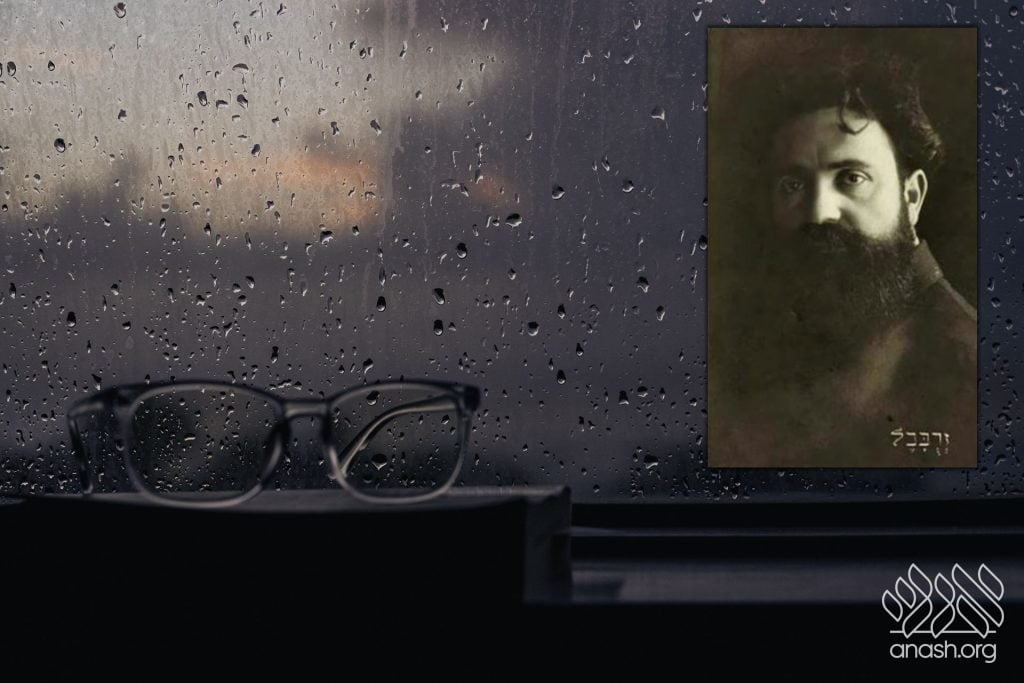
From a shiur by Rabbi Mendel Shapiro, Mashpia in Yeshivas Ohr Elchanan Chabad, Los Angeles
Prepared by Rabbi Levi Gelb
By the time Tishrei is over, most of us have something we know we need to work on. It may have come to mind during Ne’ilah, in the sukkah, or while listening at a farbrengen. We thought about how we speak at home, a learning seder we haven’t kept, or the attention we give our phones when our families are trying to talk to us. For a little while, we allowed ourselves to look at it honestly.
Then the regular schedule returns. Work has piled up, the children need things, and the same pressures are waiting where we left them. The thought that felt important a week ago gets put aside. We still intend to deal with it; we just haven’t found the right time.
A letter of the Rebbe about Yaakov Zerubavel gives us something to consider before we put it aside again.
*
Zerubavel was a prominent writer and activist in Eretz Yisrael, known for his fierce opposition to religious life. Rabbi Dovid Avraham Laselbaum, who was related to him through Zerubavel’s wife, recalled an incident at a family bris where Zerubavel pointedly refused to cover his head, even though the other guests did. He was forceful about his views, and Laselbaum, a young man facing an influential older relative, was reluctant to discuss Yiddishkeit with him.
In a letter dated 8 Kislev 5718, the Rebbe urged Laselbaum to speak with Zerubavel about reconsidering his conduct. Habit, the Rebbe explained, was a major force behind his behavior. Doubts had already arisen within him, but he kept suppressing them. The Rebbe described a familiar human difficulty: “People are afraid to examine once again the correctness of their way of life, for this requires particular courage.”
The letter also addressed his fear of ridicule. The same strength he had used to defend his positions could help him acknowledge his mistakes. His talents could bring good into the world, and a change in him could influence others. The Rebbe saw possibilities in a man with a long history of opposition, and asked him to use the abilities he already possessed.
There was an extraordinary detail in the letter as well: a dream in close proximity to their conversation would serve as a sign that the time had come for Zerubavel to reconsider his path.
As Laselbaum later recalled in his published account, he eventually went to Zerubavel’s office and read the Rebbe’s letter aloud. Zerubavel stood and listened without arguing. As Laselbaum was leaving, he asked, almost casually, for a copy.
In the follow-up letter, dated 4 Adar 5718, the Rebbe approved of Laselbaum’s avoiding debate and instructed him to provide the copy if Zerubavel took the initiative and specifically requested it. Later, Zerubavel pressed him for the missing copy, and received it. On a subsequent visit to Kfar Chabad, Laselbaum recalled, he came with his head covered—a noticeable change from his conduct at the family bris.
*
The story is remarkable, but the Rebbe’s description of someone suppressing his own questions is close to home. We know what it feels like to notice something uncomfortable about ourselves and quickly find a reason to move on.
Perhaps we answered someone sharply. We felt bad about it, then remembered how tired we were and how difficult the day had been. Those are real considerations. A person who is exhausted needs rest, and someone carrying too much may need help. Still, after accounting for all that, there may be something in our conduct that deserves attention. The explanation can become so familiar that we stop examining the behavior.
We can think about changing many times without ever letting the thought change what we do. Looking more closely might mean apologizing, rearranging our evening, or admitting that something we have defended for years isn’t serving us well. Even a small change can be uncomfortable when we have become used to saying, “That’s how I am.”
The Rebbe’s words about courage are worth taking seriously. A person can stand up to other people quite easily and find it much harder to question himself. It takes strength to reconsider a position, especially when others know us for it. Yet that strength can be put to good use. The determination we bring to work or to something we enjoy can also help us keep a learning seder or follow through on a decision at home.
*
Shabbos Bereishis brings this into practical focus. The Rebbeim taught that the way we establish ourselves on this Shabbos sets the tone for the entire year. After weeks of tefillah, teshuvah, and simchah, we are beginning to see how our good resolutions will fit into an ordinary week. The learning has to happen on a busy evening; the patience has to be there when someone tests it.
It helps to choose one matter that came to mind during Tishrei and give it a practical next step. If we want a regular shiur, we can settle on a time and arrange to learn with someone. If we owe an apology, we can have the conversation. If we keep reacting badly in a particular situation, we can think ahead about how to handle it and ask for help where we need it.
There will still be work to do, and we may have to revisit the same issue more than once. But we can begin while the thought is still with us. As we return to our regular lives, it is worth remembering the question we meant to get back to during Tishrei—and making time to answer it.
Based on Igros Kodesh, vol. 16, letters 5907 and 6090, and Rabbi Dovid Avraham Laselbaum’s published account.
 COMMENTS


We appreciate your feedback. If you have any additional information to contribute to this article, it will be added below.