




ג׳ אלול ה׳תשפ״ו | August 16, 2026
What a Shabbos in Greensboro Taught Me About Chabad
“I am writing this down because this Shabbos was truly beautiful. It meant a great deal to me and to my children. I write partly for myself, so that I will remember, and partly for some friends who are not great fans of Chabad. I have no intention of convincing them that they are wrong. But at the very least, a person should understand clearly what it is he is opposing.”
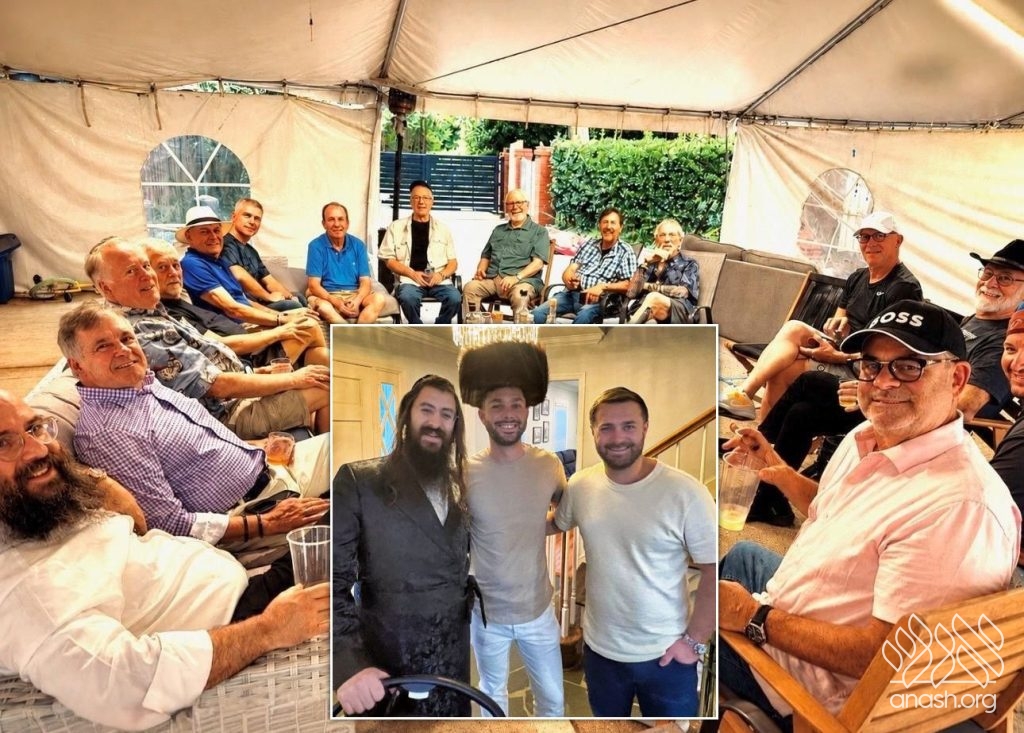
By Rabbi Chaim Ozer Geldzahler
I am writing this down because this Shabbos was truly beautiful. It meant a great deal to me and to my children. I write partly for myself, so that I will remember, and partly for some friends who are not great fans of Chabad. I have no intention of convincing them that they are wrong. But at the very least, a person should understand clearly what it is he is opposing.
We had taken the family on a road trip. The idea was simple: get into the car and drive. With practically the entire eastern United States under severe storm warnings, we headed southwest, from New Jersey through Delaware, Maryland, and Virginia, and finally to Charlotte, North Carolina.
Early Wednesday afternoon, we were at a safari park, riding in a wagon pulled by two strong black horses and feeding giraffes, zebras, deer, bison, and various other wild and domestic animals. There may even have been a red heifer. We were looking for black hairs, and from the wagon it looked kosher to me.
Somewhere between one giraffe and the next, I began thinking about Shabbos. I messaged a Chabad friend to ask whether he knew anyone in the area. He contacted someone, who contacted someone else, until eventually my phone rang while I was still sitting on the back of the Baal Shem Tov’s wagon with some holy chassidim, all of them preoccupied with feeding an enormous bull.
The caller was Rabbi Yosef Plotkin, the Chabad shaliach in Greensboro, North Carolina, about two hours from where we were. I explained that, baruch Hashem, I was not stranded or in need. We were simply a large family traveling for pleasure, and he should not feel obligated to go to any extraordinary trouble for us. He invited us with complete generosity: we would sleep at the Chabad House and eat the Shabbos meals in his home. “Just come with enough time to settle in before Shabbos.”
We arrived two hours before Shabbos. Rabbi Yossi met me there, with the typical Chabad look, flowing beard and all. He showed us where we would be staying, on the second floor of the Chabad House. It was a beautiful place. The first floor housed the shul, kitchen, dining room, library, playroom, and a pantry full of kosher food and ingredients.
The rabbi told us that there would be no minyan Friday night. The other guests would be arriving for the meal at 7:30, and we should be ready. That evening we met an older couple, Marc and his wife; their older son, Eric; their younger son, Martain, and his wife, Carley; and a young baal teshuvah named Ethan, already sporting the beginnings of a beard.
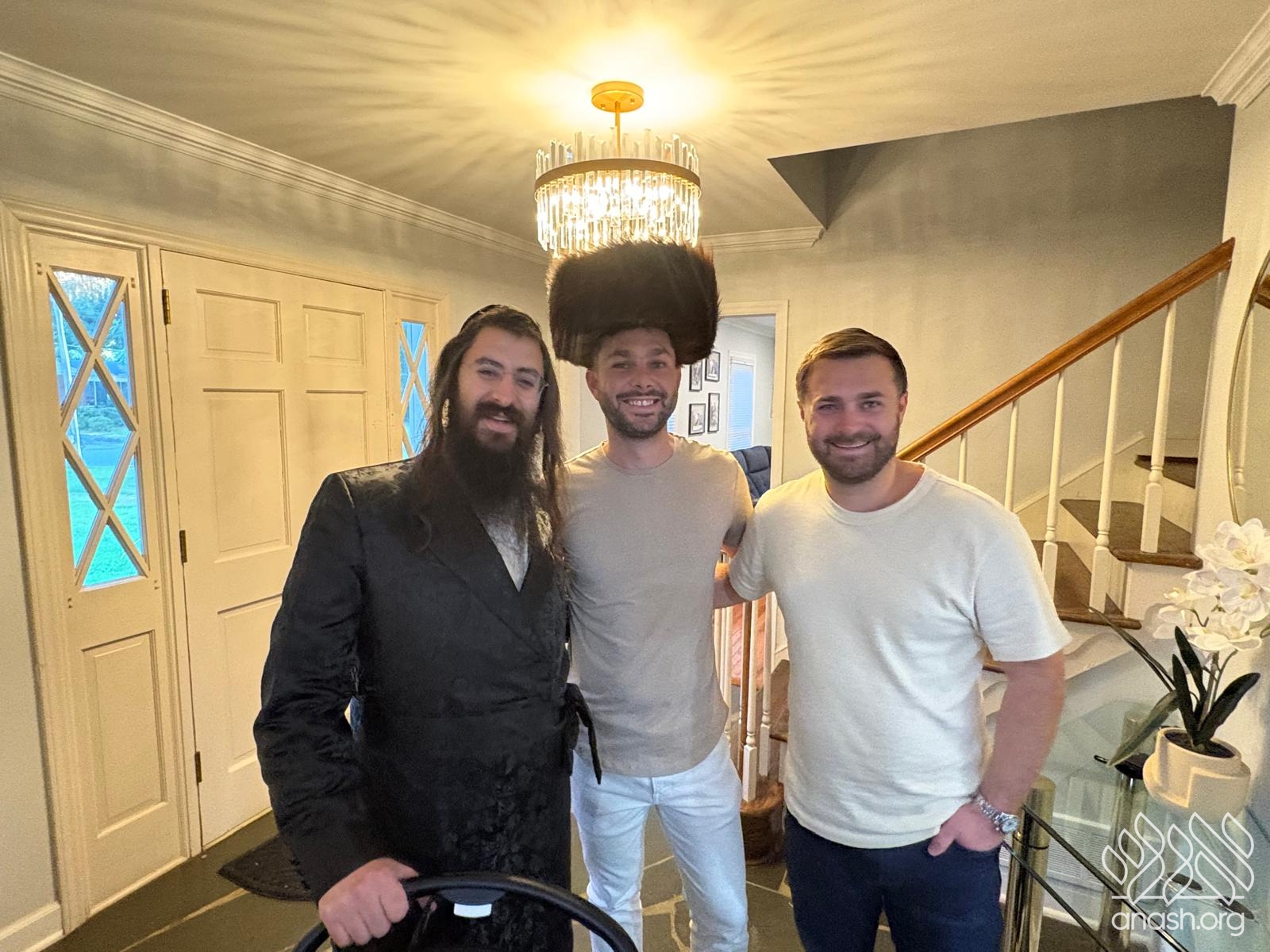
The guests were delighted to see a shtreimel and took pictures while it was still before sunset. We spoke about the meaning of the shtreimel, which perhaps contains much of the Jewish story. Legend has it that a duke in Poland decreed that the Jews living on his lands must wear an animal’s tail on their heads as a symbol of shame, something like a dunce cap. The Jews made a crown out of it—and eventually an industry.
Then the women were called to light candles. They stood together, shoulder to shoulder, their hands covering their eyes, and thirteen-year-old Chaya Mushka recited every word of the brachah along with them. The rabbi made Kiddush, we all washed, and we were served a royal feast. But the heart of that Shabbos, for me, was not the food. It was the conversations: with the shaliach and shlucha, with their guests, and later with the people who came to shul.
What Makes Jews a Family
After we had spent a few minutes talking about this and that, one of the guests asked the rabbi how long the two of us had known each other.
“Ten minutes,” Rabbi Plotkin answered.
There was a slightly uncomfortable silence. They had been certain that we were childhood friends.
I said that, truthfully, his answer was not entirely accurate. I told them that I had once been standing at the Kosel, speaking with someone about how “we have been waiting for two thousand years.” The man looked at me with a mixture of puzzlement and scorn and said, “You’re barely twenty years old. What do you mean, two thousand years?”
That was when I understood that a Jew who tries to connect himself to Klal Yisrael, to the story of Knesses Yisrael, is not merely twenty or forty or sixty years old. His soul might reside in a young and tender body, but he is carrying something ancient beyond time. In that sense, Rabbi Plotkin and I had known each other forever. We were connected to the same story, and what we shared was far greater than what separated us.
This is true of all Jews, and perhaps especially of chassidim of the same Rebbe. There was a famous dispute between the Alter Rebbe and Reb Baruch of Mezhibuzh, the grandson of the Baal Shem Tov, over who was the Baal Shem Tov’s true descendant: the spiritual grandson or the blood descendant. From the Baal HaTanya, I am both. My mother descends from him through two separate lines. My father was a true chossid of the Alter Rebbe and of the Rebbe, ztz”l, and brought that spirit into our home. He constantly hosted chassidishe farbrengens with chassidim of old, including Reb Mendel Futerfas, Reb Yoel Kahan, Reb Zalman Yudkin, and others.
That led us into a long discussion about what it means to be a Jew connected to Klal Yisrael—which, in my opinion, is perhaps the most critical question facing the American Jew of the twenty-first century.
As an example, I mentioned kidney donation, a subject especially close to my heart—or perhaps I should say, to my kidney. I told them that my brother had donated a kidney to someone he had never met.
They were astonished. They said that they could never give a kidney to a stranger, and I agreed with them. Only a madman gives one of his organs to a stranger. That is why, throughout the world, relatively few people donate kidneys to complete strangers.
So how do we explain the fact that among Torah-observant Jews there have been literally thousands of such donations? By some estimates, Orthodox Jews, though a tiny fraction of the American population, account for nearly one in five altruistic kidney donors in the United States. Nothing comparable exists in any other religion, community, or nationality.
Rabbi Adin Steinsaltz would say that Judaism defies the usual categories. It is not merely a religion, because one can be an irreligious Jew; according to halachah, one can even be a Christian Jew. It is not a nationality, because Jews are citizens of virtually every country in the world. It is not a race, because there are Yemenite, Moroccan, Polish, and Ethiopian Jews. So what is Judaism? It is a family.
And that is the point. Someone gives an organ to a person he has never met because the recipient is not truly a stranger. He is his brother or sister. I could see tears in their eyes.
Then Marc commented, “You’re right, Chaim. Do you know where else you see something like that? Yossi and Hindy open their home and their hearts. We’re all sitting here eating a Shabbos meal together. For so many years, their house has always been open. I wouldn’t miss this gefilte fish for anything—and this atmosphere is unlike anything else in the world. Where else does this happen?”
His new daughter-in-law, Carley, added, “When I’m walking down the street and see another woman wearing a Magen David necklace, I want to hug her. Do you think a Christian feels the same way every time he sees someone wearing a cross? I doubt it.”
We spoke about Hatzalah, Bonei Olam, and the many other Jewish chesed organizations. None of them could exist without something deeper beneath them: the knowledge that another Jew is family.
And so a handful of Jews sat together in a far-flung corner of the world, hundreds of miles from any established Jewish center, illuminated by the holy Shabbos candles, speaking about Ashreinu, mah tov chelkeinu—how fortunate we are, how good is our portion, and how beautiful our inheritance.
What Is the Talmud?
Martain, the younger son, asked the rabbi, “What exactly is the Talmud?”
The rabbi thought for a moment and answered, “A good analogy would be a livestream from the beis medrash that was not switched off for five hundred years.”
He elaborated. On a page of Talmud there are two primary parts. There is the Mishnah, the law—the halachah: do this; do not do that. But then come the reasons, the implications, the questions, and the inconsistencies. One person offers an explanation; another rejects it. I say the reason is X, which would imply A, while someone else says the reason is Y, which would imply B.
But nobody can simply say whatever comes into his head. I must bring evidence from an earlier generation, from a story about a sage, or from a halachic source. The other person may distinguish between the cases, challenge my proof, or offer a counterargument. That ongoing conversation is called Talmud.
And it is not limited to technical halachah. It contains everything Jews discuss in the beis medrash: stories of tzaddikim, medicine, advice about earning a livelihood, guidance for shalom bayis—everything good Jews have ever spoken about among themselves.
“But how much authority do we give it?” Martain asked.
The rabbi answered, “These were extraordinarily wise men and holy tzaddikim. We had better take them seriously.”
He then quoted several teachings that we had recently learned in the Daf, including one that a man must sometimes spend beyond what he can afford on jewelry for his wife. The women enjoyed hearing that very much, and the men also understood that it was probably good advice.
I added that “Talmud” is not really the name of a book. It is the name of a discipline. What we were doing at that very table was also a form of Talmud. The rabbi says something, and the others refuse to let him off easily. They challenge him and ask questions. But they do not argue merely from the gut. They think deeply, try to understand both sides, and search for honest and reasonable support for each position. That conversation itself is Talmud.
Marc responded, “That’s exactly what we do at our Friday farbrengen.”
“What farbrengen?” I asked.
I suddenly remembered that when the rabbi had shown me our room earlier, he had mentioned that he had just come from a farbrengen. I had found that a little strange. It was not a special Chabad day, and in any case, it was Friday afternoon.
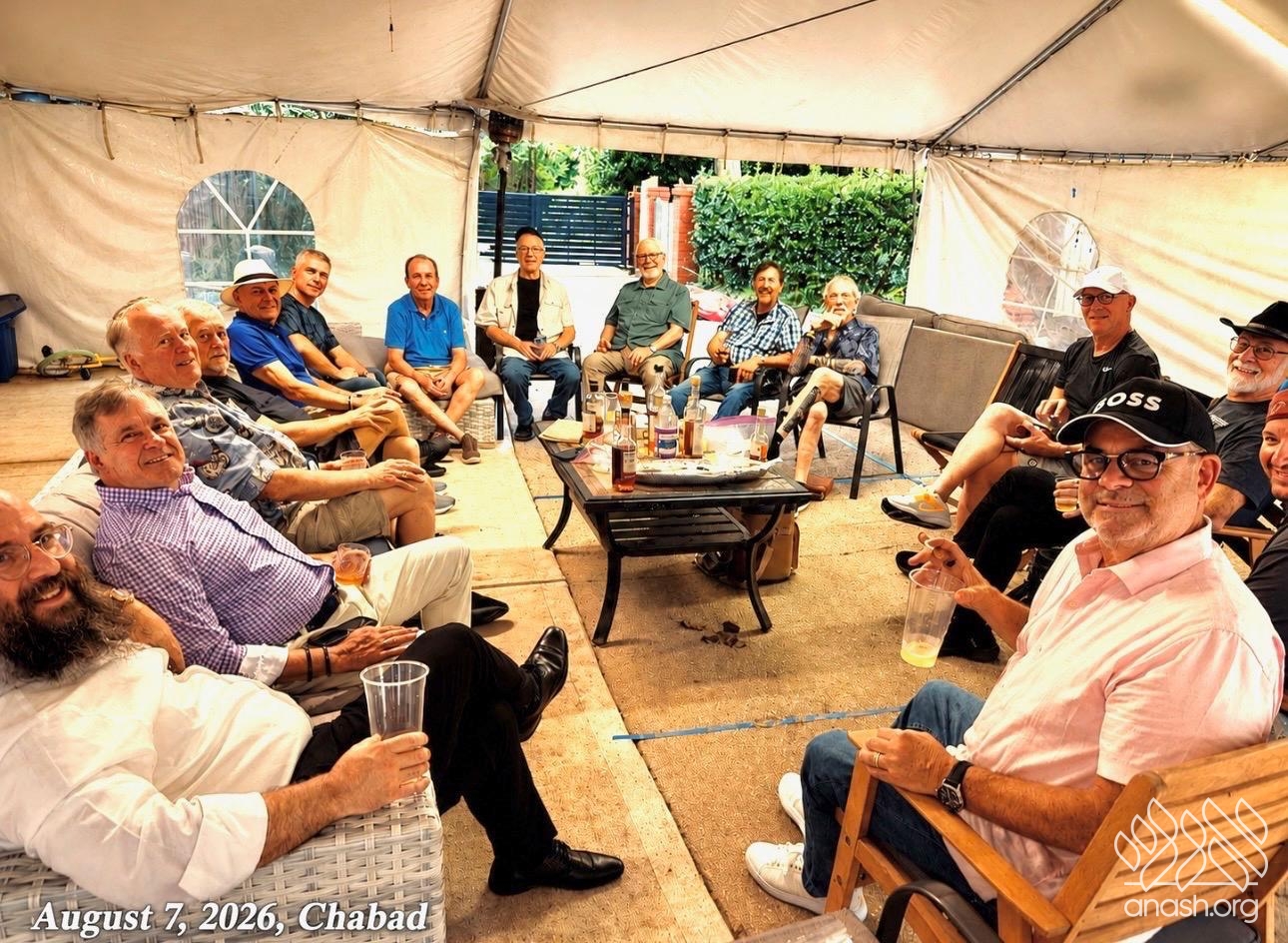
“A long time ago,” Marc explained, “I told the rabbi that a few friends and I get together on Friday afternoons. We have cigars and brandy. I asked if he wanted to host it at Chabad. He was very happy to, and we began calling it our farbrengen. Since then, we have had our cigars and farbrengen every week. Some of the men who come would never attend a shiur or a minyan. But there we speak about real things—about life itself—honestly and without makeup.”
The rabbi agreed. “Sometimes the conversation begins with the parashah,” he said, “but the real point is the questions and answers. There is sometimes more genuine Judaism discussed over those cigars, just before Shabbos, than in a formal speech delivered inside the beis medrash.”
I found myself thinking about the shlucha. If I left my house consistently on Friday afternoon, I might not be invited back for Shabbos. And that is only my own little domestic Shabbos, which is difficult enough for one person to manage. Here she was preparing a feast for a houseful of guests, preparing the food for the entire community the next day, making beds, arranging linens, and taking care of everything else.
But I understood that this was her shlichus. Yossi had been sent to the cigars, Hindy had been sent to the kitchen, and Chayale had been sent to create a day-camp program. Each one had a mission. They were not simply living in Greensboro. They were conscious and focused, every day and every moment: We are here because the Rebbe sent us here. For what purpose? We would return to that question later.
Can AI Replace a Rabbi?
Eric, the older brother, then asked, “Do you think artificial intelligence will eventually replace rabbis? If someone wants to know a halachah or hear a Torah idea, AI already knows more than both of you do. It has all the information from all the rabbis in the world put together.”
The rabbi explained that Torah was not given to bots, and Torah is not a database. Of course, Torah contains knowledge, and perhaps one day that knowledge will become completely accessible through artificial intelligence. But beyond knowing Torah, there is learning Torah. When a Jew learns Torah, he does not merely receive information. He changes the structure of his mind and connects himself to God.
When you encounter a Jew who is constantly learning Torah and shaping his life around it, you are encountering an ish Eloki—a godly person. That can never be replicated.
I added that, in my opinion, the rabbi will be among the last professions to disappear. When you enter a shul on Shabbos morning and the rabbi embraces you, or when you are struggling with something and he looks you in the eyes, you feel the truth, the integrity, and the way Torah gives life to him and guides him. That is real and alive. It is the opposite of artificial.
AI may be able to produce Mishnah. Talmud—never. Talmud is the livestream. It is Torah as experienced and lived by human beings: “From my flesh, I behold God.”
Several hours later, the meal finally ended. There had been many other conversations that I have already forgotten. We escorted the guests to the door, but most of my family quickly turned back. It seemed that they did not want to watch what would happen next.
Only my daughter Rachalli remained. She could not help herself. With disbelief in her eyes, she watched Jews who had just lit Shabbos candles, washed their hands, answered amen to Kiddush, and eaten a beautiful Shabbos meal climb into their cars. It disturbed her deeply. I noticed, but said nothing.
Ethan’s Story
We walked back to the Chabad House with Ethan, who was also sleeping there. Rachalli and I sat on one sofa, while Ethan sat across from us. I asked him to tell me his story. How does a young man in the permissive, free society of America choose to bind himself to Torah and mitzvos?
He told us that it did not begin with a beard. In retrospect, he said, had he known where it would lead, perhaps he would never have begun the journey.
He had attended a university about an hour away. His parents, who lived in New York City, were not Reform; they were traditional Jews. They went to shul occasionally and perhaps made Kiddush, but they did not keep Shabbos or kosher.
After October 7, his Jewish identity became much stronger, and he felt a need to connect to his God and his people. He began keeping Shabbos while still in college, but it was terribly difficult. His friends would go out to non-kosher restaurants, both on and off campus, and spend the night partying, while he remained alone in his room with his friend Jonathan.
Before he began keeping Shabbos, he had once driven to the Chabad House and was familiar with the place. Later, after deciding to observe Shabbos, he called and asked whether he could stay there for the weekend. The Plotkins immediately said yes. For an entire year, he and Jonathan slept at the Chabad House every Shabbos and ate the meals with the Plotkins. Slowly, they became more and more observant.
Then Ethan began keeping kosher. There was no kosher food available at his college, so he lived on fruits and vegetables. The administration was angry with him, but he insisted that they were obligated to provide properly kosher food. It became an enormous battle. Eventually, they arranged a large refrigerator and a weekly delivery containing three kosher meals a day. The food was not as tasty as the fresh, hot meals from the cafeteria, but it was food nonetheless—a small price to pay for Judaism.
Then came his graduation. Naturally, the ceremony was scheduled for Shabbos. By then he was fully keeping Shabbos and did not want to attend. The shaliach insisted that he must go. His parents had paid a great deal for three years at a top college, and it was important to them to see him graduate. Ethan and the rabbi sat together and examined every stage of the ceremony, working out what he could and could not do so that he would not violate halachah.
On Friday afternoon, Hindy arrived with five large boxes filled with everything he could possibly need: challah, wine for Kiddush, candles, cholent, chicken, fish, cake, and snacks—an entire Shabbos packed into those boxes with love.
With tears in his eyes, Ethan said, “You should know, if I had missed that graduation, it would have been a terrible mistake. The shluchim are genuinely wise people—and genuine tzaddikim.”
Rachalli listened to every word. Then she whispered in my ear, “But are those people we saw tonight Jews or goyim? How could they get into their cars?”
I said to her, “You grew up in a Shabbos-observant home. Did you accomplish something in order to have this Shabbos?”
“No.”
“Did you ever have to fight for kosher food?”
“No.”
“So let us focus on the things you do struggle with: lashon hara, jealousy, davening properly. Are you perfect in all those things?”
“No,” she answered.
“Does that make you a goy?”
“Of course not. Hashem knows I’m not perfect.”
“So are you constantly angering Hashem because you are not perfect?”
“No. He knows that I’m always trying to become better.”
“Exactly. Understand that for these people, driving on Shabbos is the default. That is how their parents lived. Every new mitzvah they perform is a step they are taking in order to improve, to become better, and to come closer to Hashem. Yes, they still drive. But there was once a time when Ethan drove here too. Look at him now. He keeps kosher, and you heard how hard he fought for it. Have you ever had to fight with an institution until it agreed to provide you with kosher food? Do you know for certain that you would have had the strength to remain locked in your room while all your friends were out enjoying themselves?”
“No,” she answered. “I don’t think I could have.”
“I think you could have,” I told her. “But the important point is that a Jew cannot be measured only by where he has arrived. He must also be measured by the distance he is traveling and by how many steps he is taking. A person can be born into the holiest home, do everything exactly as his father did, and never move a single millimeter toward Hashem. That is not avodas Hashem. Avodas Hashem means moving closer.”
Ethan continued his story. “After college, I went to the Chabad yeshivah in Morristown. They have a program for baalei teshuvah. We learned Gemara most of the day—more Gemara, and then still more Gemara.”
He brought me a Gemara opened to Eilu Metziyos. “Look,” he said. “This was the first Gemara I ever learned. It was so difficult. I had no idea what they wanted from me. Now it is the thing I love most. Now I can learn Gemara independently.”
He told us that at first he had been very strict about cholov Yisrael, growing his beard, and various other chumros. Then he decided that it was not for him and gave some of it up. Eventually, he decided to study the sources carefully and determine whether these practices were truly worthwhile. After learning the subjects, he accepted most of them again.
“What do you do when you go home?” I asked. “What do you eat?”
“You have to be a mensch,” he answered. “In yeshivah they spoke to us about that constantly. Some people come home and immediately announce that everything is treif. It causes tremendous stress and strife. If your family goes out to eat, you have to go with them. You can eat only fruits and vegetables and drink a beer. Eventually, if you are respectful of your parents and your family, they will respect you too. Maybe they will choose to go only to kosher establishments. You have to act wisely and carefully. In the end, Hashem helps.
“You should know that my parents made their kitchen completely kosher on their own initiative. They bought everything new and kashered the entire kitchen. My parents now keep Shabbos and attend a more serious shul. My sister has several children, and when she saw how much the yeshivah had helped me, she realized that religious Jews were not all crazy, as she had once assumed. She now sends her children to Jewish school.”
I looked into Rachalli’s eyes, and now she understood too. There was something much larger here. These were not outsiders. They were part of the same story. As we say every morning: “All are beloved, all are mighty, all are holy, and all seek to fulfill the will of their Creator with awe and reverence.”
Rachalli was relatively easy to convince. My wife was more troubled.
“I don’t understand how they don’t feel that they are being taken advantage of,” she said. “They are here to bring Jews closer. Yet that new daughter-in-law sat at the table and openly told the shlucha that she buys meat at the regular market. Her mother-in-law joked that she keeps Shabbos until they get home, because her son is the one driving. They have been connected to this Chabad House for nearly twenty years! If it were me, I would feel that they were taking advantage of me.”
I did not know what to answer.
The Rebbe’s Children
On Shabbos morning, before davening, I spoke with Yossi about various things. During the conversation, he said that those who had originally opposed Chabad often had a more complicated relationship with it today.
“There are now many roshei yeshivah whose children, or people very close to them, are no longer observant,” he said. “I often wonder: Suppose the son of a rosh yeshivah from Bnei Brak wandered in here after not putting on tefillin for two years. Would his father ask me whether his body was perfectly clean? Would he ask what value the mitzvah had if the boy had a tattoo on his arm? Would he say it was worthless because the boy had a cheeseburger in his bag that he intended to eat afterward? He would not ask any of those questions. He would pay me everything he possessed to invite his son for Shabbos, let him hear Kiddush, and have him make one brachah.
“Why? Because it is his son. He understands that his son has a holy neshamah, and that a mitzvah is something tremendously holy and heavenly. Well, what can I tell you? To the Rebbe, seventy years ago, they were already all his children. He understood even then the power of a single mitzvah. That is why he sent me here.”
Responsibility for Klal Yisrael
People began arriving for davening. The rabbi davened aloud, while most of the congregation either answered quietly or followed along in their siddurim. The average age was probably around fifty-five, although some were younger and came with children. It was not always clear to me who had arrived on foot and who had come by car.
Before Krias HaTorah, the rabbi spoke about the three periods of forty days and nights that Moshe spent in Heaven and explained how they correspond to Torah, tefillah, and teshuvah. One member asked whether it was physically possible to survive for forty days and nights without food or drink. It was the sort of question that might sound silly, yet I found myself wishing that people would not be afraid to ask such questions.
After davening, everyone sat down together for the Shabbos meal. There I met an Israeli from Tel Aviv who appeared to be Shabbos observant and was a passionate follower of Moshe Feiglin. He explained why, even if his vote would be “wasted,” he was prepared to cast it for the sake of truth, divine justice, and what he believed to be right. Every genuine act, he said, has value in itself. It is one more step in the correct direction.
His way of speaking and carrying himself reminded me of Netanel Ellinson. To my surprise, he had never heard of him, so I told him that he now had someone new to look up.
He spoke very warmly about Chabad but was somewhat bitter toward the chareidi community. His complaint was not about the army per se. He felt that chareidim do not accept enough responsibility for Klal Yisrael. They move into their enclaves and separate themselves from the broader Jewish public, perhaps because they imagine themselves to be the only authentic public.
I told him that there was some truth in what he said. But in a society undergoing a profound fracture, every side moves toward an extreme. One person says that the chareidi is a fool, a parasite, uneducated, unemployed, and unwilling to serve in the army. The other says that secular Jews are pig-eating wicked gentiles living in Sodom and Gomorrah. The poison in the atmosphere forces everyone into increasingly extreme rhetoric, but most of it is demagoguery.
When the winds calm down, the chareidi can allow himself to acknowledge that he owes tremendous gratitude to his secular brother for his sacrifice and army service, and perhaps bring himself to share responsibility for the larger Jewish public. And the secular Israeli can reach a place where he respects the contribution of Torah and the need for an authentic Jewish character within the state, and seeks to preserve and fund it.
Steve’s Question
Later, I sat with Steve, who calls himself the “self-appointed president” of the congregation. He drives to shul.
“Do I think it is the right thing to do?” he asked in his heavy South African accent. “I know that it isn’t. I’m not Reform.”
“By the way,” he continued, “what do you think about Reform Judaism? Imagine a Jew living in the middle of nowhere who has two options. He can drive on Yom Kippur to a Reform temple and hear a woman cantor over a microphone after she has just finished drinking her coffee. Or he can stay home, go nowhere at all, and watch football.”
“What does he gain by going to such a place?” I asked.
“At least he retains some Jewish identity,” Steve answered. “Some sense of belonging.”
I told him that I was genuinely conflicted. I understood his argument. But imagine that I grow frustrated with my son, who sits on his phone and plays video games day and night, and I want to teach him to form a real relationship with another human being. If I send him to a disreputable bar where the relationships are unhealthy and destructive, have I truly helped him?
Reform Judaism is a distortion, a corruption. Perhaps it is better to remain unsatisfied than to accept a knockoff version and imagine that one possesses the real thing. Besides, Reform now recognizes intermarriage. The very institution that claims to be preserving Jewish identity may become the instrument that destroys it entirely.
We both sat in silence.
Steve came out of his thoughts. “That is what I see as Chabad’s most important contribution. It offers authentic, unapologetic, halachic Judaism while receiving every Jew warmly and with open arms. I once attended an Orthodox synagogue where the rabbi announced that anyone who drove on Shabbos should not come. The following week, he had no minyan.
“Here, somebody once asked the rabbi how many people had walked to shul. I heard him answer, ‘I did not see a single person drive a car into the beis medrash.’ In fact, he makes a point of arriving before everyone else and leaving after everyone is gone. Everyone here knows that driving is not proper and that it is something we must work on. But in the meantime, we are given a place where we are accepted and invited to grow, each at his own pace.
“You should know, my wife is frumer than I am. We have a completely kosher kitchen. I have two sons who keep Shabbos, and a daughter who does not keep Shabbos but also has a kosher kitchen. Perhaps one day I will also keep Shabbos completely.”
“And then there is my forever twenty-one,” he said wistfully. “My son was killed in a motorcycle accident.
“You know, all my children were deeply involved with Hillel and Chabad on campus. They brought in the rabbis, headed the outreach, and organized the programs. All except our youngest. He used to say that he couldn’t care less about religion, so he was not involved in the outreach at all.
“But he ran the Chabad kitchen. He was always there, volunteering, taking responsibility, keeping the place running. Do you know how much work and stress go into running a kitchen? If he truly did not care at all, would he have spent so much of himself there? He simply had his own way of showing how much he cared, and how deeply he belonged.”
The Purpose of Shlichus
After everyone had left, my wife and I remained with Yossi and Hindy. I told my wife to ask them the question she had asked me: “How do you not feel taken advantage of?”
Yossi answered, “What would make you feel that you were not being taken advantage of?”
“If I felt that I had made progress with people,” she said, “that I had brought them toward a goal. Not that they ate a good meal, satisfied themselves, and then continued along the same path.”
“So what is your agenda?” Yossi asked. “What would you consider a success worth all the cooking and effort?”
“That they should keep Torah and mitzvos.”
“Why do you care whether they keep Torah and mitzvos?”
“Because they are Jews, and a Jew is obligated to keep Torah and mitzvos.”
“Certainly,” Yossi said. “But why does that matter to you personally? What does it accomplish? Why is it important enough that you would dedicate your life to this mission?”
Then Yossi said, “Let me tell you our story. The Alter Rebbe writes that the purpose of the creation of this physical world—and of all the spiritual worlds—is that Hakadosh Baruch Hu desired a dwelling place in the lowest realm, a dirah betachtonim. Therefore, every time a Jew performs one mitzvah, he brings the Shechinah into the physical world. He sanctifies himself and the world around him. There is a spiritual atomic explosion every time a Jew makes a brachah, lights Shabbos candles, or puts on tefillin.
“My mission has an immediate purpose. If two couples and several other Jews came into our home, lit Shabbos candles, heard Kiddush, spoke words of Torah, ate a Shabbos meal, and sang zemiros—and during those hours they were not watching television, driving, or eating non-kosher food with their friends—then that alone was worth my coming here twenty years ago. That itself is the purpose.
“Of course, we understand that one mitzvah leads to another. A single mitzvah does not exist in a vacuum. Sometimes we can see the results openly, as we did with Ethan. His mitzvos led to countless other mitzvos. His nieces and nephews now learn Torah every day, and an entire family became Torah observant.
“But often the process is much quieter. Someone hears Kiddush here. Then he begins coming during the week to put on tefillin. Later he decides not to eat pork. After that he stops eating shrimp and other non-kosher animals and limits himself to chicken, even if it still is not kosher chicken. Slowly, slowly.
“But again, that is the power of the mitzvah. It is the mitzvah’s accomplishment, not mine. My shlichus is to help as many Jews as possible perform as many mitzvos as possible. Every time a Jew performs one mitzvah, he makes this world into a dwelling place for Hakadosh Baruch Hu. And the lower the place in which that mitzvah is performed, the greater the pleasure Above when a dwelling is created there.
“That brings us to Mashiach, because Mashiach is the completion of this process—the ultimate dwelling place for God in the physical world. That is why Mashiach is so central to the Rebbe’s entire agenda.”
My wife then asked, “But as human beings, how do you not feel used? Anyone who spends his life serving others eventually feels his resources being depleted. You have no privacy. There are always guests, always another Jew arriving at your door. You have no real vacation. How do you not burn out?”
Yossi smiled. “You are right,” he said. “A person who serves others will eventually burn out. But that is true of an ordinary, limited human being. Such a person does not begin to be depleted only after twenty years. Every small act already takes something from him. Each time he gives, he is diminished slightly, until eventually he reaches his limit.
“But if a person is connected to an infinite power, then his strength and ability are also beyond calculation. ‘A person’s emissary is considered like the person himself,’ states the Talmud. We are not here through our own strength. Anyone who understands shlichus knows that it is not humanly possible. It is beyond ordinary logic. But because we are connected to the Rebbe, we are connected to an enduring, godly power that does not run out.”
Come and see: this was not the dreamy language of a young yeshivah bochur, nor an ideal floating somewhere in the heavens. This was the lived Torah of a couple who had gone on shlichus when she was twenty-one and he was only slightly older.
Their home was filled with tranquility, happiness, humility, good middos, and warmth. They worked extraordinarily hard, around the clock. Yet they did not merely possess a vague “sense of mission.” They lived with the consciousness that they remained connected to the one who had sent them, and that consciousness produced real and visible results.
I also told Yossi that I was uncomfortable with the way Chabad constantly speaks about giving the Rebbe nachas, language that can sometimes sound jarring. He explained that in their minds, the Rebbe is the general in the army of Hashem. A genuine general has no agenda other than the agenda of the King. His greatness lies precisely in how faithfully he represents the King and how completely he nullifies himself to the King’s will.
As a simple soldier, I want the general to guide me, train me, and transform me into a better soldier for the King. The more pleased the general is with my service, the more certain I can be that I am advancing the King’s own purpose.
We certainly had disagreements about the centrality of the Rebbe and about Mashiach, but this was how Yossi understood it.
Shneur’s Room
We continued discussing the Rebbe, Mashiach, and whether every chassid or talmid is meant to believe that his own rebbe could be Mashiach. Eventually it was time for Shalosh Seudos. They set the table with all kinds of delicacies, and I washed. We spoke and sang, and the children recited the Twelve Pesukim. Hindy said that the pesukim should be recited as a zechus for Shneur.
It was not the first time that day that Shneur’s name had been mentioned. In fact, they said, that day was his birthday. I looked around the table. Mendy was learning in yeshivah in France. Levi, still under bar mitzvah, was home from Detroit; he came home approximately once a month. Their daughters, Chaya and Chavy, learned in Brooklyn and returned home only a few times a year. That was another price of shlichus: from the time the children were very young, their parents hardly saw them.
I understood that the story of Shneur was not simple. In the middle of the meal, I got up and walked around the house. I saw pictures of a Hachnasas Sefer Torah. In one corner stood a screen, and above it were the words, “Shneur’s Room.” The screen displayed pictures of a little boy, perhaps one or two years old, suffering from cancer. The pictures showed different stages of his illness and treatment. They were difficult to watch.
“Who is Shneur?” my son Leizer asked Hindy.
“He is our son,” she answered, “whom Hashem wanted to have near Him, so He took him back.”
The children recited the pesukim loudly and passionately: Bereishis bara Elokim… Shema Yisrael… Ve’ahavta l’reiacha kamocha… Veyadata hayom… Ki karov eilecha… Yagati umatzasi… Vehinei Hashem nitzav alav… And finally, la’asos lo dirah betachtonim—to make this world a dwelling place for Hashem.
An army must constantly repeat its principles, its mission, and its agenda.
Among the children was a boy named Teddy, whose yarmulke did not always remain on his head and whose family, for now, was not particularly observant. They chose him to recite Shema Yisrael. He waited until someone brought him a yarmulke. Then, with pride, he proclaimed, “Shema Yisrael, Hashem Elokeinu, Hashem Echad.”
That moment contained the entire story of shlichus.
Yossi and I learned a sichah, a wonderful discussion about hekdesh and the mitzvah of tzedakah in halachah and avodah. My wife and Hindy learned another sichah about the mann, “not by bread alone,” and the limitless nature of spiritual nourishment. They were having difficulty understanding it. Chayale sat there, concentrating deeply on the Yiddish text. Then she explained the entire sichah clearly and with genuine understanding, much to her parents’ delight.
After Havdalah, we watched some maros kodesh of the Rebbe and his father, since it was his father’s yahrtzeit, and then we said goodbye.
What I Took Home
There were many more conversations, most of which I have already forgotten. But this was the essence of my Shabbos at the Chabad House. It was a Shabbos that shattered stereotypes—perhaps some of mine as well. It challenged us to think more broadly, to accept responsibility for another Jew and for Knesses Yisrael, to think about Mashiach and redemption, and to demand more from ourselves.
It challenged us not to be small, not to be weak, and not to define ourselves by our limitations, but by the chelek Eloka mima’al mamash within us. To know that Hashem dwells within us, and that when we attach ourselves to Him, we are connected to something infinite. Not to remain enclosed within our own four cubits—except, of course, the four cubits of halachah—but to fulfill: “Ufaratzta yamah vakedmah, tzafonah vanegbah—and you shall spread westward and eastward, northward and southward.” And through us: “Venivrechu vecha kol mishpechos ha’adamah—all the families of the earth shall be blessed.”
Perhaps the best way to frame the entire experience is with an idea I heard from the mashpia Rabbi Yoske Twersky, a descendant of a great Chassidic dynasty. He asked, “What is so unique about our Rebbe?”
A young couple in love is walking through the suburbs of Moscow. They are the children of Jews who were lost to their people and the grandchildren of Communists. Suddenly, they pass an enormous menorah standing in the city square. The young man turns to the woman and says, “You know, I think I remember my grandfather lighting something like that at around this time of year. It seemed terribly important to him.”
She answers, “Yes, I remember something too. My grandmother used to light candlesticks every Friday night. Perhaps we should find out what all of this meant.”
And far above—”He Who is enthroned on high, Who lowers Himself to look upon heaven and earth”—the One Who sits in Heaven watches them and smiles.
“Our Rebbe,” Rabbi Yoske concluded, “brought Hakadosh Baruch Hu more smiles than anyone else.”
Of course, we can still debate whether one may recite a brachah over a menorah standing in a city square. Perhaps Hakadosh Baruch Hu smiles at that discussion too. But that first smile produces another smile, and then another—an endless chain of smiles without measure or end.
That is what I felt throughout this Shabbos. During every conversation I had, I felt that Hakadosh Baruch Hu was listening and smiling. It was a particular kind of smile: a smile with tears in its eyes. A smile that seemed to say, “How wonderful to see that you are interested in Me again. Welcome home, My children.”


 COMMENTS


Beautiful
Brings to mind the line from the camp song
“A normal man can’t do the things his shluchim do…”
Beautiful Moshiach Now
Thanks for sharing❤️