




כ״ח מרחשון ה׳תשפ״ז | November 7, 2026
Historic Yechidus With Gerrer Rebbe on Coalition Politics Released
A historic, never-before-released transcript of a private yechidus between the Rebbe and Reb Yaakov Aryeh Alter, today the Gerrer Rebbe, has just been made public, shedding new light on the Rebbe’s extensive involvement in Israeli politics and guidance to leading figures in the political arena.
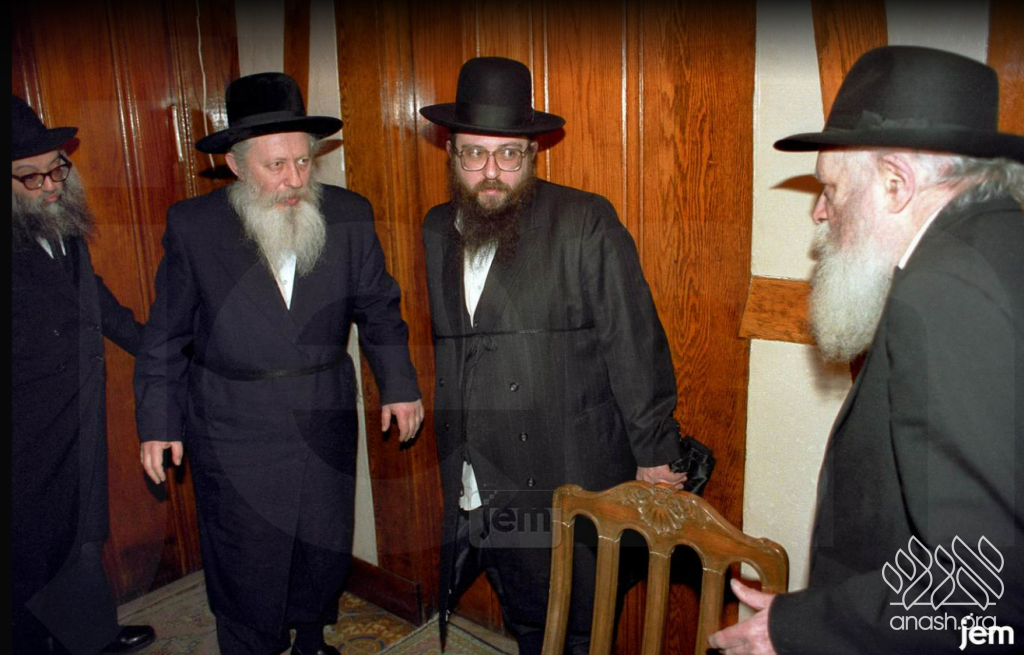
A historic, never-before-released transcript of a private yechidus between the Rebbe and Reb Yaakov Aryeh Alter, today the Gerrer Rebbe, has just been made public, shedding new light on the Rebbe’s extensive involvement in Israeli politics and guidance to leading figures in the political arena.
The conversation carries particular relevance to today’s heated Israeli political climate, with many of the same questions surrounding coalition politics, political alliances, and the representation of Yiddishkeit remaining as pressing as ever.
The rare exchange, which took place on 6 Adar II, 5749 (1989), came just months after the highly contentious Israeli elections, held following the well-known political split within Agudas Yisroel.
The Rebbe instructed that people vote for Agudas Yisroel, and thanks in large part to the campaign conducted by Chabad, the party secured five Knesset seats, a tremendous achievement at the time. Chabad-affiliated Knesset member Eliezer Mizrachi, who was fifth on the party’s list, entered the Knesset.
On 14 Teves, a national unity government was formed under Yitzchak Shamir and Shimon Peres, with Shamir serving as Prime Minister. A little over a year later, the political maneuver known as the Targil HaMasriach took place, when Peres attempted to bring down the government and form an alternative coalition.
The newly released yechidus includes the Rebbe advising Reb Yaakov Aryeh Alter, then one of Agudas Yisroel’s leading figures, on the party’s place in the governing coalition, its dealings with political partners, and the challenges of securing the interests of Yiddishkeit within the Israeli government.
Harav Alter, who became Gerrer Rebbe in 5756, visited the Rebbe in 5749 as the son of the then-Gerrer Rebbe, the Lev Simcha. It was his second visit to the Rebbe, the first having taken place in 5737.
The second visit came at a time when the Rebbe had generally stopped receiving people for private yechidus. Nevertheless, Harav Alter was welcomed by the Rebbe into Gan Eden Hatachton, where the Rebbe even moved a chair for him to sit on.
After a brief discussion, part of which was filmed, everyone except Harav Alter and the Rebbe was asked to leave the room. The two then held a private yechidus lasting approximately 20 minutes, which, until now, had never been made public.
According to journalist Chaim Shaulzon, who released the transcript, an unidentified individual secretly recorded the yechidus and later gave the recording to him for publication.
Below is one portion of the transcript, which has now been made public. Additional portions, as well as the original audio recording, are expected to be released soon.
During other parts of the yechidus, the Rebbe asks about the welfare of the Lev Simcha, leading to an extended discussion on the subject. The Rebbe also asks Harav Alter whether he assists his father and, if so, in what ways.
At the conclusion of the yechidus, the Rebbe escorted Harav Alter outside 770. Harav Alter walked backwards so as not to turn his back to the Rebbe. As they were leaving, the Rebbe thanked the driver, saying, “Thank you for bringing such a choshove guest.”
Click here for an album of photographs from the visit.
The transcript below is a free English translation based on the transcript published by journalist Chaim Shaulzon, who is solely responsible for the accuracy of the published text. Portions that remain unclear in the original transcript have been marked with a question mark (?).
Transcript of a yechidus between Rabbi Yaakov Aryeh Alter and the Rebbe on 6 Adar II, 5749 (1989):
Rabbi Yaakov Aryeh Alter: I wanted to ask the Rebbe about remaining in the governing coalition. Should we continue sitting in the coalition, or should we leave? Things have not been going well for us in recent days.
The Rebbe: Generally speaking, I say that I do not know. The situation there is subject to so many changes that things can change from one day to the next, and even within the same day. Therefore, if the principle of “a judge has only what his eyes see before him” applies in every situation, how much more so in a matter where one sees such frequent changes.
However, generally speaking, from what appears to be happening there, when one is on the inside, one can accomplish more than when one is on the outside.
Therefore, first of all, it is appropriate to speak discreetly. There is no need for a confrontation. Things can be handled “with pleasantness and with peace.”
Secondly, when outside the coalition, they are upset with everyone. When one is inside the coalition, however, they cooperate, because it is in their interests or serves their interests. In the meantime, they actually carry out what needs to be done.
Furthermore, when a coalition is being formed there, in Eretz Yisroel, everyone knows from the outset that it is not bound by anything. Today things can be one way, and even on that very same day they can become something else. Consequently, the other side takes this into account. It is not that they have the matter firmly in their hands, but they know that things are not necessarily fixed.
When you traveled, …how were things then?
Rabbi Alter: I arrived yesterday morning.
The Rebbe: Was it already clear then, or was it still…?
Rabbi Alter: Agudas Yisroel(?) is in…
The Rebbe: Are they negotiating over internal matters, or external matters?
Rabbi Alter: They are negotiating, but not very much… They don’t want to give anything.
The Rebbe: What are they willing to give?
Rabbi Alter: They are willing to give very little. As far as matters of Yiddishkeit are concerned, they want to give very little. Even regarding the matters they signed agreements with us on… The Likud deceived us very badly.
The Rebbe: And they themselves know that they depend on the “balance of power,” as they say.
Rabbi Alter: Yes. But they made an alliance with the Ma’arach together. Now they are not so dependent on us. The two of them joined forces, the major parties, and therefore they are no longer dependent on us. At first, they thought they would go it alone, and they were very dependent on us. But they kept making promises and making promises, and until now they simply haven’t fulfilled them.
The Rebbe: Even between themselves, there is no genuine peace.
Rabbi Alter: No. There is no peace, as the possuk says, “There is no peace, says Hashem.”
The Rebbe: The main thing is that each of them knows this. One should not believe them about anything, because “today he says one thing, and today he says another.” This is written about on the other side.
But nevertheless, it is the month of Adar, and regarding all these matters, the mazal is “strong.”
Rabbi Alter: Yes, “the mazal is strong.”
The Rebbe: Or “the mazal is powerful,” meaning that it is mighty. This is a Jewish mazal, and the mazal begins with “light, which is Torah, and honor, which is tefillin,” since the entire Torah is compared to tefillin.
Rabbi Alter: My daughter-in-law… I made a wedding… My daughter-in-law is already at the end of her ninth month. May Hashem help that everything should go well.
The Rebbe: Amen. May it be at an auspicious and successful time. May she merit healthy and viable offspring.
 COMMENTS


We appreciate your feedback. If you have any additional information to contribute to this article, it will be added below.