




כ״ד תשרי ה׳תשפ״ז | October 5, 2026
The Partisan Who Never Stopped Fighting
From the forests of Nazi-occupied Europe to the establishment of Chabad institutions in Eretz Yisroel, Reb Zusha Wilmowsky devoted his life to rescuing, building, and inspiring. Forty years after his passing, his remarkable story remains an example of courage, determination, unwavering hiskashrus, and extraordinary simcha.
Some individuals leave behind institutions. Others leave behind stories. And a select few leave behind an approach to life that continues to inspire long after their passing.
Reb Zusha Wilmowsky, affectionately known throughout Lubavitch as “Zusha the Partisan,” belonged to that last category.
His life spanned two dramatically different chapters of Jewish history: the destruction of European Jewry during the Holocaust and the subsequent rebuilding of Jewish life in Eretz Yisroel. He participated in both.
As a young man, he joined Jewish partisans fighting for survival against Nazi Germany. After the war, he redirected that extraordinary determination toward strengthening Jewish education, developing Chabad institutions, and carrying out the Rebbe’s directives.
His legacy is inseparable from the development of Chabad in Eretz Yisroel during its formative decades.
Forty years after his passing, his life presents a striking example of someone who refused to accept seemingly insurmountable obstacles as a reason to stop working.
Reb Zusha was born to Rabbi Yosef Yitzchok and Rebbetzin Mariaisha Wilmowsky. His father served as a rabbi in Izyum before the family relocated to Poland, where he became the rabbi and Av Beis Din of Selets.
Reb Zusha received a traditional yeshiva education. Following the outbreak of World War II and the Soviet occupation of eastern Poland, he crossed into Lithuania, where he continued his studies at the Baranovitch Yeshiva under Rabbi Elchonon Wasserman, Hy”d.
There, he studied alongside Reb Dovid Gershovitz, a friendship that would become particularly significant during the war. The German invasion brought their yeshiva studies to an abrupt end.
While staying in the Lithuanian town of Semilishok, Reb Zusha learned from his host family of an impending Nazi operation against the local Jewish population. Rather than immediately fleeing, he reportedly went from house to house warning Jewish residents of the danger before escaping himself.
As the war continued, Reb Zusha eventually found himself in the Lida Ghetto and subsequently in a nearby forced-labor camp. There, he was reunited with his former yeshiva companion, Reb Dovid Gershovitz. The two secretly escaped and joined the Jewish partisan unit commanded by Tuvia Bielski.
The Bielski partisans were distinguished by a remarkable objective: alongside their military resistance against the Nazis, they dedicated themselves to providing refuge for Jews escaping persecution. More than 1,200 Jews were sheltered in its forest community, with the majority being women, children, and elderly Jews.
Reb Zusha participated in defensive operations, food-gathering missions, and efforts to rescue Jews from the ghettos. He entered ghettos and helped people escape through underground sewer passages.
He survived the war but emerged with gunshot wounds to his legs, injuries that required prolonged treatment. His experiences as a partisan would become an enduring part of his identity.
After the war, Reb Zusha arrived at a displaced-persons camp in Cremona, Italy. There, he became acquainted with Reb Schneur Zalman Levin, a Chabad chossid with whom he helped establish a synagogue for Jewish refugees. It was through this relationship that Reb Zusha became closely acquainted with Chassidus Chabad.
Upon arriving in Eretz Yisroel, he entered Yeshivas Achei Temimim in Tel Aviv, studying under the guidance of the mashpia Reb Chaim Shaul Brook, despite being much older than the other bochurim.
However, his activities soon extended far beyond the walls of the yeshiva.
In 5709 (1949), as Chabad families began establishing themselves in Lod, Reb Zusha played a central role in founding Yeshivas Tomchei Temimim there.
The institution was established to provide a Chassidishe education to the children of Chabad families, including recent immigrants from the Soviet Union.
He assumed responsibility for its practical administration and traveled extensively to secure the financial resources necessary for its survival.
In a letter to the Frierdiker Rebbe dated 11 Elul 5709, he reported that he had already spent approximately eight months working on the yeshiva’s behalf. The Frierdiker Rebbe responded before Rosh Hashanah 5710, expressing satisfaction with Reb Zusha’s devoted efforts and the success of his work.
But his efforts were only beginning.
During the early 1950s, Reb Zusha became instrumental in establishing Reshet Oholei Yosef Yitzchok, the network of Chabad educational institutions in Eretz Yisroel.
The initiative emerged through correspondence with the Rebbe, who encouraged the establishment of educational institutions operating within the Chabad framework. Reb Zusha helped transform those instructions into practical reality.
Within months, the network had established four educational divisions offering Torah instruction during the afternoon. By the beginning of the 5713 academic year, these had developed into schools.
Reb Zusha initially managed the network and subsequently continued serving on its leadership after Rabbi Dovid Chanzin assumed its management.
His involvement extended to the founding of Neshei U’Bnos Chabad in Eretz Yisroel and supporting the activities of Tzeirei Agudas Chabad. He also played an important role in developing Kfar Chabad, where he served as secretary of the village committee.
Yet his activities were not limited to organizational development. For decades, he traveled throughout Eretz Yisroel, visiting Chabad communities, schools, institutions, and individual shluchim. He encouraged their work, assisted with practical difficulties, and maintained extensive correspondence with the Rebbe concerning developments throughout the country.
In 5737, he was formally appointed to an inspection role, providing additional structure to his extensive travels and reporting.
His concern extended to the needs of individual families, whether they required housing assistance, medical help, or other practical support. For Reb Zusha, strengthening Lubavitch meant strengthening both its institutions and its people.
*
The Rebbe’s Partisan
In Tishrei 5721, Reb Zusha traveled to New York to spend the Tishrei with the Rebbe.
During a farbrengen preceding Rosh Hashanah, the Rebbe publicly referred to Reb Zusha as a partisan.
The Rebbe explained that a partisan does not become preoccupied with whether a particular task appears great or insignificant. His responsibility is to carry out the mission assigned to him. The Rebbe connected this approach with the work necessary to bring Moshiach.
During that same farbrengen, the Rebbe asked Reb Zusha to assume responsibility for organizing shiurim for the orchim.
The name subsequently became an enduring part of his identity. Over the years, the Rebbe affectionately referred to him as “Mein Partisan,” my partisan.
It was a description particularly suited to his approach. His activities did not necessarily follow conventional organizational structures. He traveled wherever assistance was needed, identified opportunities, solved problems, and helped others advance their work.
He maintained connections with Chabad mosdos throughout Eretz Yisroel and worked closely with shluchim, rabbonim, and communal leaders.
Published photographs also document his relationships with senior Israeli officials, including President Zalman Shazar, with whom he worked on matters involving Chabad institutions.
The courage that had once sustained him in the forests of wartime Europe had found an entirely different expression. He had exchanged the struggle for physical survival for a lifelong campaign devoted to Jewish continuity.
*
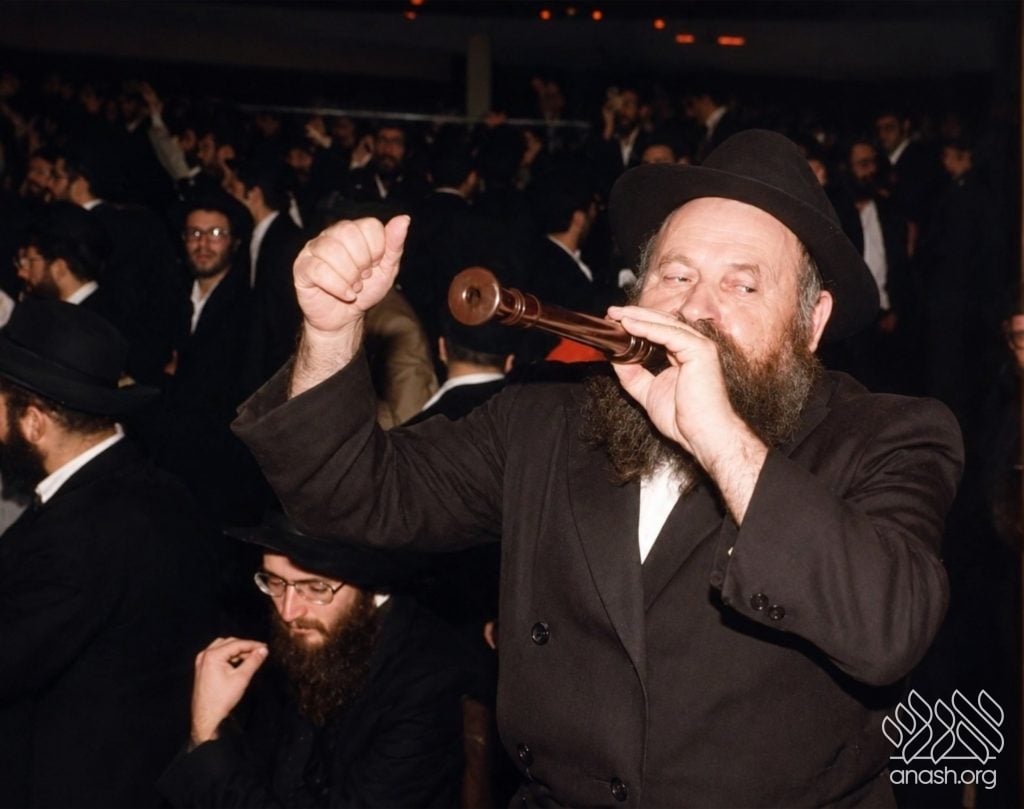
There was another quality for which Reb Zusha became especially recognizable: his extraordinary enthusiasm and simcha.
For many years, he traveled to the Rebbe for Tishrei, becoming a familiar presence during the month’s farbrengens, davening, and Simchas Beis Hashoeivah celebrations. He would often be seen standing behind the Rebbe during farbrengens, encouraging the singing and bringing energy to the assembled Chassidim.
His animated participation during Kos Shel Bracha and his dedication to the celebrations of Tishrei became particularly memorable features of his personality.
The same man who had experienced the horrors of the Holocaust became widely remembered for bringing joy to others.
*
His Final Tishrei
In Tishrei 5747, Reb Zusha again traveled to spend the Yomim Tovim with the Rebbe. As in previous years, he participated in the activities and celebrations surrounding 770 Eastern Parkway.
On the night of the second day of Sukkos, he attended the Simchas Beis Hashoeivah celebrations in Crown Heights, but left earlier than usual.
Reb Zusha returned to 770 and entered the nearby sukkah. There, he suddenly became unwell and passed away. It was the night of 16 Tishrei 5747.
His sudden passing shocked the Lubavitch community. His levaya departed from 770 the following day, and he was buried near the Ohel.
The place and timing of his passing were indicative of his lifelong dedication to the Rebbe and his remarkable enthusiasm during Tishrei.
Reb Zusha’s life has been preserved in the 384-page biography The Partisan. The volume contains recollections, photographs, documents, and correspondence relating to his remarkable activities
Yehi zichro baruch.
 COMMENTS


We appreciate your feedback. If you have any additional information to contribute to this article, it will be added below.