



כ״ד תשרי ה׳תשפ״ז | October 5, 2026
New 48-Part Course Explores the Rebbe’s Methodology in Rashi
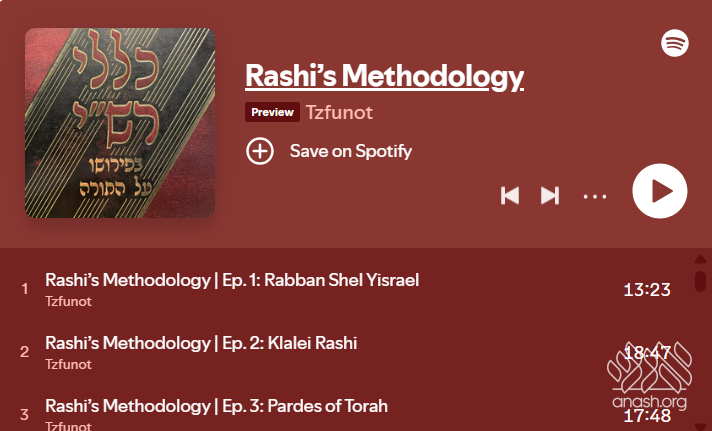
As the new cycle of learning Chumash with Rashi begins with Parshas Bereishis, a new 48-part course titled Rashi’s Methodology explores the Rebbe’s novel approach to understanding Rashi and the principles that guide his commentary on the Torah. Presented by Rabbi Binyomin Bitton, the episodes range from approximately 5 to 40 minutes, making the course accessible for regular learning alongside the weekly study of Chumash.
As the new cycle of learning Chumash with Rashi begins with Parshas Bereishis, many of us will once again be encountering Rashi’s commentary on the Torah, week after week. But what if we could learn not only what Rashi says, but also understand more deeply how Rashi approaches the Torah?
Rashi’s Methodology is a 48-part course exploring the Rebbe’s novel approach to understanding Rashi and the principles that guide his commentary on the Torah.
The course is presented by Rabbi Binyomin Bitton, Director of the Tzfunot Institute, and explores the Klalei Rashi developed by the Rebbe—the principles and methods that illuminate Rashi’s approach to Peshuto shel Mikra.
As Rabbi Bitton explains, “The goal of the course is not simply to explain another Rashi. It is to help us begin looking at Rashi differently—to recognize that there is a methodology behind his commentary, and to give the learner the tools to discover and apply that methodology when learning Rashi on their own.”
The Rebbe developed hundreds of Klalei Rashi, which are organized in the sefer Klalei Rashi. Rather than attempting to cover the vast number of principles and sub-principles, the course focuses on a selection of fundamental klalim and develops them through a carefully chosen series of examples.
Among the principles explored are the idea that Rashi seeks to address all the questions that arise from the peshat of a verse; the significance of Rashi repeating a particular explanation; and the principle of explaining a drash in a way that also accounts for the straightforward meaning of the verse.
The course also examines the remarkable precision of Rashi’s dibbur hamaschil, including the exact choice of words he quotes from the verse, his references to specific sources in the Gemara and elsewhere, his mention of the names of Chazal, the way certain halachic insights are incorporated into his commentary, and the way Rashi incorporates deeper, mystical and inspirational dimensions of Torah within his commentary—the Wine of Torah.
Each klal is introduced and then explored through actual examples from Rashi. In this way, the learner does not encounter the principles only as abstract concepts, but sees how they are reflected in Rashi’s commentary and how they can be applied when learning other Rashis.
The course covers a broad range of examples from throughout Chumash. Among them are Rashi’s explanations concerning the light in Noach’s Teivah and the wood used in the Mishkan. It also explores such subjects as Pharaoh’s dreams, Ketura, Sarah’s tent, the thickness of the Kaporet, Yaakov’s messengers, Miriam the Prophetess, Nadav and Avihu, Avraham’s Eshel, and the relationship between Tzohar and the deeper dimensions of Torah.
The 48 episodes range from approximately 5 to 40 minutes, making the course accessible for regular learning alongside the weekly study of Chumash.
As the new Chumash cycle begins, Rashi’s Methodology offers an opportunity to approach the weekly study of Rashi with a deeper appreciation of the Rebbe’s teachings and a new perspective on Rashi—not simply to learn more Rashi, but to learn how to learn Rashi.
The complete 48-part course is available on the Tzfunot Podcast:
 COMMENTS


Artscroll just put out a Hebrew Rashi
The rebbe’s birurim are not mentioned in that sefer.
No reason to argue with them, it’s just needed that a talented chabadnik should do the whole Rashi according to the rebbe’s shita.
No Rashi left behind
By doing so we finish off what the rebbes holy rotzan was,
Every Rashi has to learned in that fashion …
Eventually it should be the curriculum in every chabad cheder and girls school
this was largely done in the eishel avrohom chumash, where it generally focuses on the basic pshat approah to Rashi, brings the Rebbe’s explanations, and is very geshmak to use.
though it’s not perfect: 1. seems to only quote from ביאורים לפירוש רש”י על התורה, which is only mugadike sichos, so its missing a huge amount of the Rebbe’s explanations. 2. he uses certain klolim that the Rebbe specifically negates (ציטוט תיבות הראשונות בהסדרה נוגע פירוש רש”י, פירושי רש”י במקומות שונים צריכים להתאים א’ עם השני). if im wrong please correct me 🙂
This is being done by a Chabad Chossid in Yerushalaim Reb Avraham Zajac. At the moment towards the end of Chumash Bamidbar.
So far a few parshiyos have seen print, named חומש פשוטו של מקרא
If want to sponsor the project – the Zchus of bringing the Rebbe’s novelties to the world can be yours!