



י׳ אייר ה׳תשפ״ו | April 27, 2026
‘No Zambians Want to Be Rabbis,’ He Assured Them
After denied visa petitions and many challenges, Rabbi Mendy and Rivky Hertzl settled in Lusaka, where a small, scattered Jewish community had been waiting for the first permanent Chabad presence in Zambia.
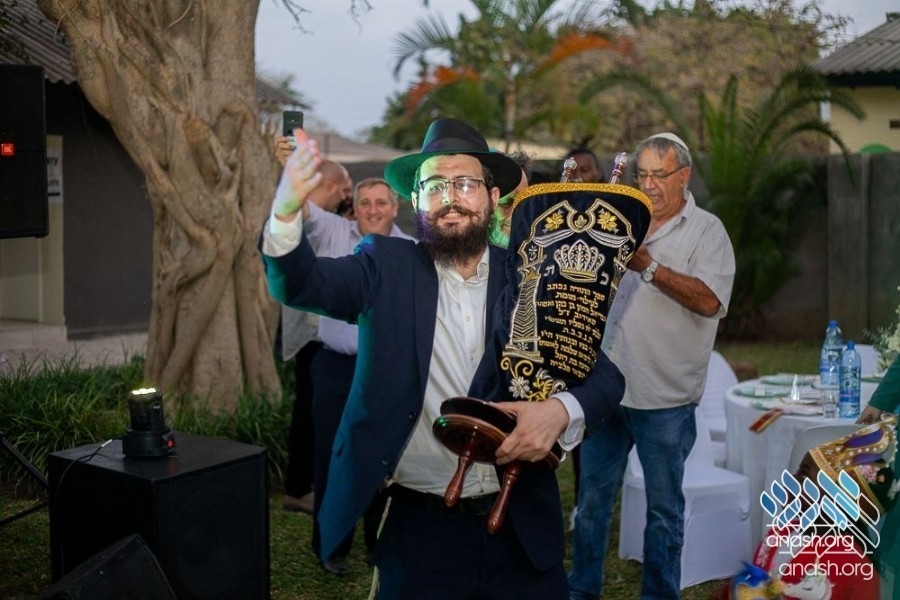
When Rabbi Mendy and Rivky Hertzl applied for work visas to establish a Chabad House in Lusaka, the answer came back: no.
They tried again. Again: no.
The officials reviewing the application didn’t quite know what to make of the young couple. What is a rabbi? Why are you coming here? Would a foreigner be taking a Zambian job?
“We said, ‘No, don’t worry about it,'” Rabbi Hertzl recalled. “‘No Zambians want to become rabbis.'”
But there were Zambian Jews who wanted exactly what the Hertzls were offering — kosher food, mezuzos, tefillin, lulav and esrog, matzah for Pesach, and a place where being a Jew in Lusaka felt natural, close, and alive.
For Rabbi Mendy, the dream of shlichus had begun early. He was raised in a family of shluchim in northern Eretz Yisroel — his parents, Rabbi Sholom Ber and Rebbetzin Devorah Hertzl, established Chabad in Rosh Pina near Tzfas and later built Chabad of the Golan Heights. His maternal grandfather, Rabbi Aryeh Leib Kaplan, had been sent by the Rebbe to Tzfas in the early seventies. The pasuk of Lech Lecha — going out from one’s home and comfort into the unknown — was not an abstraction. It was a personal calling.
“To go and do the Lech Lecha in the strongest way was always the strongest dream and wish,” Rabbi Hertzl said. “Since I was born it was crystal clear — it was not a question.”
Rivky Hertzl grew up with an equally unusual version of normal, only on the other side of the world. Her parents, Rabbi Yosef and Rebbetzin Esther Greenberg, were sent by the Rebbe to Anchorage, Alaska, in 1991, to serve the roughly three thousand Jews living there at the time. The Chabad House was in their home. Moose were a regular fixture on the walk to shul. In the long summer days, Shabbos could end at 2:00 in the morning.
“You can’t vacuum the floor, you can’t really clean up much after — you kind of just go to sleep and deal with it in the morning,” Rivky recalled. “We were making Havdalah Sunday morning in the summer.”
She was teaching Hebrew school by the age of eight or nine. Shlichus was simply home.
The two met in late 2020 in the quiet of the Covid year. Mendy was learning in Crown Heights; Rivky was working at Chabad of Charlotte, North Carolina. Early in their relationship, Mendy asked how far she was prepared to go. The inspiration behind the question came from a conversation he had had two years earlier at the Kinus Hashluchim, when a bochur described outreach work in Lagos, Nigeria — the experience of building Yiddishkeit from nothing, in a place with no infrastructure at all. “To me, that was the dream,” Rabbi Hertzl said. “To come to a place that there is no infrastructure for regular Jewish life and to start to do whatever I can to make this place better.”
He put the question to Rivky directly: was she prepared to go even to Africa?
“Of course,” she said.
They married in early 2021 and set about searching the world. They opened Google Maps alongside the Chabad.org locator and went through continents, countries, and cities — checking for gaps, reaching out to head shluchim, and asking whether anyone needed a young couple ready to start from scratch. There were no takers.
Then the picture changed. The head shlucha to Central Africa, Rebbetzin Miriam Bentolila, passed away, and her husband, Rabbi Shlomo Bentolila — who had been sending visiting shluchim to Zambia for thirty years — publicly announced that in her memory, he wanted to open a permanent Chabad House there.
“My husband is into geography,” Rivky said. “I was not. I never heard of the country in my life.”
The Hertzls began calling Rabbi Bentolila, again and again. Other couples were also interested, and the selection process was taking time. In the meantime, they explored Italy, Australia, Alaska, and the Pacific Northwest. But Zambia kept pulling them back in a way neither of them could fully explain. “It’s not something that we can even explain,” Rivky said. “It’s like a shidduch.”
Rabbi Bentolila eventually invited them to come for Purim and Pesach — a month and a half on the ground — to see whether Zambia was truly right for them. The timeline seemed daunting: leave their jobs, their kollel, their apartment. Mendy called his mashpia, who told him plainly: a decision for life requires a real trial.
In March 2022, they boarded a plane. They landed in Lusaka twenty-four hours before Purim.
“I’m not a person who looks for adventures,” Rivky said. “So when we came to Africa, everything was new.”
They had no meat, no dairy, no fish — just whatever they had managed to gather. In a single night, they learned how to sift flour and check brown eggs, made hamantaschen and a pareve pasta bar, and the following evening hosted a Purim party for twenty-five to thirty people. Within days, the community was already asking: Are you staying?
The following weeks were a rapid education. They learned how to import frozen kosher food from South Africa by car or bus — sometimes delayed, sometimes spoiled — and assembled enough for a first community Seder with thirty people. They also came to understand what they had stepped into historically. Zambia’s Jewish story stretches back more than 120 years, to Jews who had settled in the ranching and mining industries. At its peak, the community had nine shuls across nine cities, and nine Jewish cemeteries to match. For decades, those who remained held on to tradition without a rav and without a mikvah.
In 1968, the Rebbe had sent a young South African yeshiva bochur — Yerachmiel Glazer — to strengthen Jewish life there. Glazer later told Rabbi Hertzl that when he arrived, the community celebrated Pesach, Shavuos, and Rosh Hashanah, but not Purim. He helped arrange their first Purim celebration. But by the early seventies, Zambia had severed ties with Israel and moved toward a one-party socialist government, and most of the remaining Jewish families left. In recent years, Israelis, South Africans, and Americans began returning — for business, diplomacy, and extended stays — and the community quietly began to grow again.
By the end of Pesach 2022, the Hertzls had their answer.
“We felt that it’s our place,” Rivky said. “There’s so much to do here, and we felt that what we’re doing has a meaning to it here.”
They stayed a full month longer than planned — past Lag Ba’omer. They returned to New York, packed up their apartment, gave away what they could, and traveled to Alaska, where Rivky was expecting their first child, planning to return to Lusaka in time for Chanukah.
Then came the visa denials.
For months, the Hertzls navigated Zambian bureaucracy from outside the country, waiting. They arranged for bochurim and visiting couples to cover Tishrei, Chanukah, and Purim while the application sat in limbo. “We were just sitting on our hands,” Rabbi Hertzl said.
The approval came on a Thursday. By Sunday night, they were on a plane — three weeks before Pesach.
In March 2023, Rabbi Mendy and Rivky Hertzl arrived in Lusaka as the first permanent Chabad shluchim to Zambia.
Their opening goal was simple and unglamorous: make sure every Yid in town knew that Chabad was there. “Our first priority as shluchim is to make sure that every Yid in town is connected with us,” Rabbi Hertzl said. “Everyone in town knows our number, knows who we are, and feels comfortable to come and visit.” Just a place, Rivky added, where a Jew could walk in and feel that this was theirs — to daven, to make hamantaschen, to simply be Jewish without explanation.
Today, Rabbi Hertzl estimates there are about forty Jewish families in and around Lusaka, more than half of them permanent residents. The rest arrive for weeks, months, or years through business, the American or Israeli embassies, or other connections. Events that once drew thirty people now regularly bring sixty or seventy.
For Sol Israel Radunski, the Hertzls’ arrival meant more than he had expected. Sol was born in Livingstone, practically under the spray of Victoria Falls, into a community of some 170 Jews with a shul, a rav, and a shochet. He attended Jewish school in Cape Town, studied in London, and lived across several continents before returning to Zambia in 1996. By then, the community had shrunk to perhaps twenty families who still wanted to identify as Jews. He is today the chairman of the Council for Zambia Jewry and was among those who helped the Hertzls secure their work permits. He describes himself as secular, not Chabad. He now attends every yom tov and wraps tefillin from time to time.
“I would never have ever imagined becoming as included in a dynamic Jewish environment if it had not been for them,” Sol said. “I probably would not have allowed myself to be exposed to Jewish tradition.”
Michal Savyon-Cohen is Israeli, raised in Tel Aviv in a traditional family. She came to Zambia when her husband took a CEO position at a limestone quarry. Her oldest son asked Rabbi Mendy to be his bar mitzvah teacher. “He told me that the moment he started the lessons with Rabbi Mendy, it was just like talking to someone who will always understand him.” The bar mitzvah was celebrated in Lusaka with a room full of Israelis and Jews who had come from around the world to mark a simcha for a boy most of them had never met. After the family returned to Eretz Yisroel, Rabbi Mendy continued teaching her second son over Zoom. Michal recently began lighting Shabbos candles for the first time in her life.
Not everything has gone smoothly. Last Sukkos, the Hertzls’ lulav and esrog — shipped from South Africa — cleared the border and then got stuck at customs in Lusaka on Erev Sukkos. Officials called it “the flowers” and demanded paperwork from multiple agencies. The clock was running. Rivky got the woman in charge on FaceTime and spent more than an hour negotiating. “At one point I said, ‘I’ll give you my whole bank account — tell me how much, just give me the number,'” she recalled. After several more agents and another round of payments, the lulav and esrog arrived at their door two hours before Yom Tov.
The community has grown faster than either of them anticipated. Their home could no longer hold the holiday crowds — Rosh Hashanah, Sukkos, and Simchas Torah last Tishrei each drew close to seventy people — and they recently moved into a larger house, with an Airbnb across from the shul that is nearly always full for Shabbos. Plans for a mikvah and expanded preschool and Hebrew school programs are underway.
But perhaps the detail that has stayed with Rivky most is not a number. It is a little girl who calls their house “the candle-lighting house.” “Can we go to the place where we light candles?”
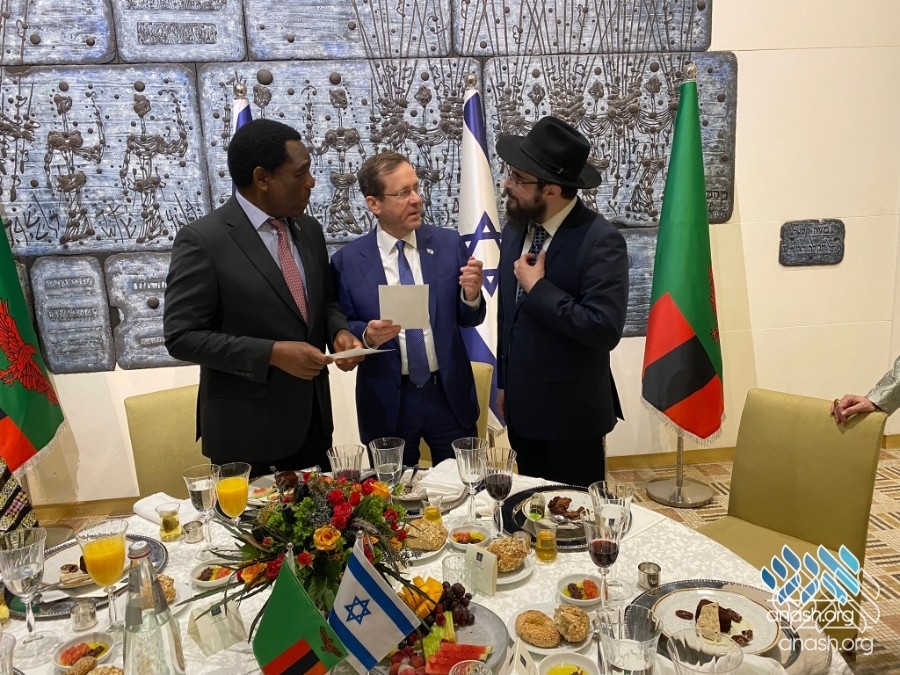
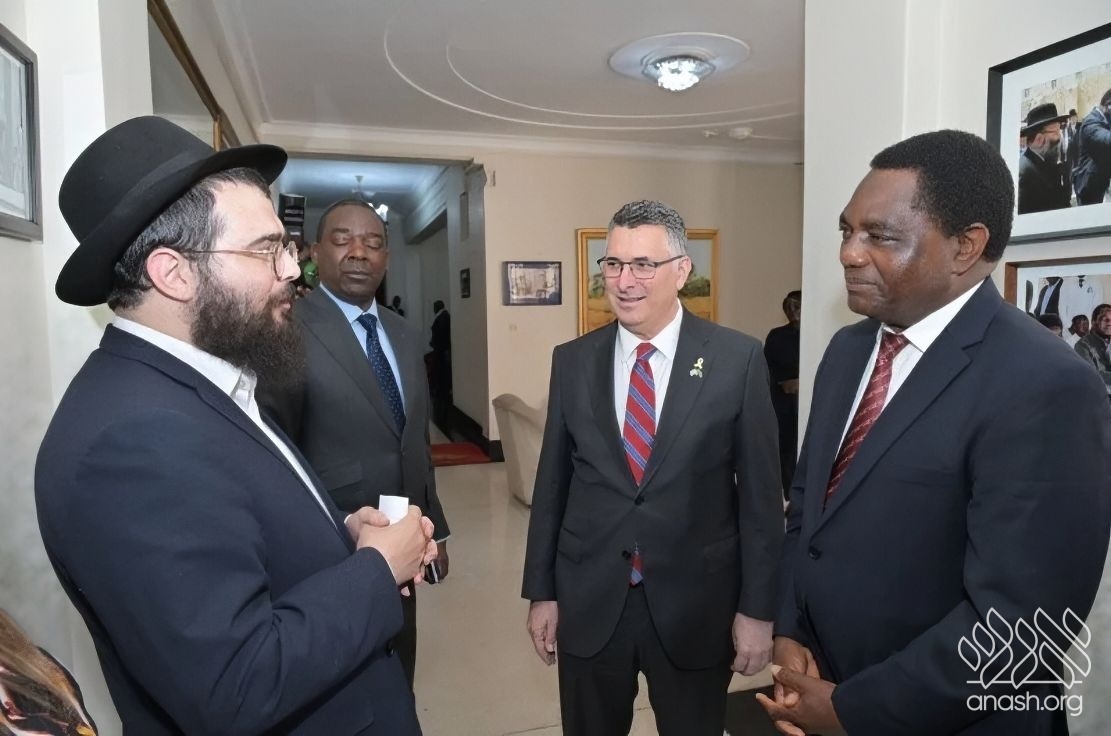
Zambia is a majority-Christian country, and Rabbi Hertzl says the community has encountered nothing but warmth — support for Jews, for Eretz Yisroel, and genuine curiosity about Judaism. Emails arrive daily from non-Jews asking about the Sheva Mitzvos, about conversion, about whether non-Jews have a share in the World to Come. In 2023, the Hertzls met Zambian President Hakainde Hichilema in Eretz Yisroel and presented him with a menorah.
The Hertzls now hold original letters that the Rebbe sent to Glazer — the bochur sent to Zambia in 1968 — and on harder days, those letters are a quiet source of chizzuk. “Every time we have doubts and hardships,” Rabbi Hertzl said, “we say: I have this original letter in my hand. It’s always strengthening.”
The path to Zambia began with denied petitions, confused bureaucrats, months of waiting, and a leap into the unknown. What the Hertzls found on the other side was exactly what they had spent two years searching the world for: a place that needed them.
“We have a beautiful gift that we got from the Rebbe — shlichus,” Rabbi Hertzl said. “We are standing on the front lines to bring Moshiach, because we want to bring Moshiach as soon as possible.”
Adapted from episode 64 of Lubavitch International’s Lamplighters podcast, “They Looked Everywhere – And Chose Zambia.“
 COMMENTS


We appreciate your feedback. If you have any additional information to contribute to this article, it will be added below.