




י״ז סיון ה׳תשפ״ו | June 2, 2026
Correct Placement of the Tefillin Shel Yad?
Ask the Rov: Where is the correct place for tefillin on the arm? Rabbi Chaim Hillel Raskin responds.
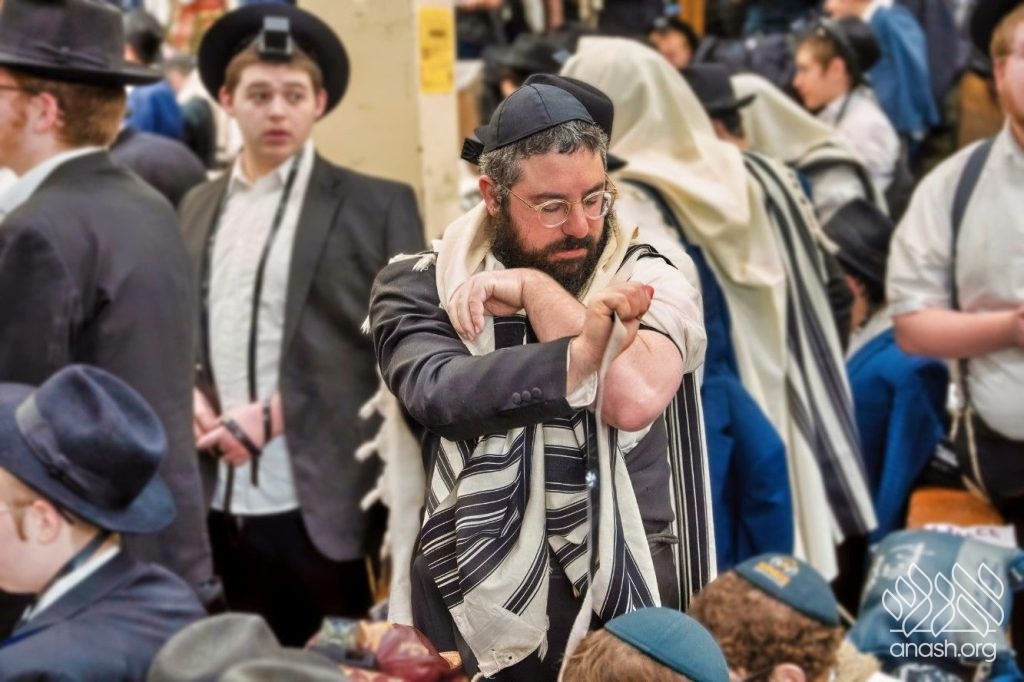
Where is the correct place for tefillin on the arm?
Chazal teach us that the tefillin shel yad are placed on the bulging flesh of the upper arm, in the section called the kibores (bicep). The Torah instructs us to “Place Hashem’s words on your heart,” and the kibores sits directly opposite the heart, at chest level.1 For this reason, the bayis must also be tilted slightly inward, so that, when the arm hangs naturally, the bayis points to the heart.2
Even within the bulge, Shulchan Aruch and Alter Rebbe rule that the tefillin must sit on the lower half of the bone running from the armpit to the elbow. The Gra holds that the entire bulge is acceptable, even above the bone’s half-point, but this is a da’as yachid.3
Within the bone’s lower half, the tefillin must sit on the kibores itself (the bulge of muscle), not near the inner elbow. Though the exact distance varies based on the individual’s build and where his bulge tapers down , it generally means leaving 2-4 cm above the inner elbow .4 (The sleeve must be rolled up sufficiently to accomplish this.)
Measuring from the armpit to the inner elbow, most adults come in at 18-20 cm, making the lower half 9-10 cm. Standard Lubavitch batim have a footprint of 7-8 cm (including the titura and maavarta), leaving very little leeway to clear the lower limit. On a bar mitzvah bochur with a smaller arm, it would appear to be an issue.
Some suggest getting smaller shel yad bayis for bar mitzvah bochurim, prioritizing halachic placement over the hiddur of large batim5 (especially since the hiddur seems specific to the shel rosh). The bayis could be made narrower while keeping the regular height.
Others understand that the measurement runs from the outer elbow to where the arm meets the shoulder bone (identified by feeling the shoulder while rotating the straightened arm). They point to the Alter Rebbe’s description “between the elbow and the shoulder.”6 When measuring the inside of the arm, it is necessary to raise the arm to include the space hidden under the arm. Measuring this way yields a larger upper arm and puts the halfway mark higher. Adults average 30-32 cm, and bar mitzvah bochurim average around 24 cm, with smaller ones measuring 20-22 cm. Even a 20 cm arm has a lower half of 10 cm, leaving room for a standard bayis of 7-8 cm plus 2 cm of clearance above the elbow.
The entire titura and maavarta must fit within the acceptable zone, though some suggest the maavarta alone can extend higher when there’s no other option.7 For smaller arms, the titura and maavarta can be made thinner to fit better.
As for the Mishnah Berurah’s caution against “large” tefillin that often sit outside the acceptable zone,8 he was referring to tefillin larger than today’s. Indeed, the Mishnah Berurah himself writes that the appropriate size for the bayis (including the titura and maavarta) is between 2-4 fingerbreadths wide.9
See Sources (open PDF)
 COMMENTS


The entire biceps is Ok. As long as it’s leveld to the Heart
נגד הלב ממש.