A Journalist’s Fascination with Lubavitch From Siberia to Paris
After their Great Escape from Soviet Russia and a period in German and Austrian DP camps, 1000 Lubavitcher refugees converged in Paris in 5707–5708. Local Yiddish journalist Yitzchak Shmulevitsh was amazed by their devotion to Torah and each other, and documented their work to establish a yeshivah and a girls’ school, as well as the eventual departure of many of them to Eretz Yisrael. Part III of a series.
In Sivan of last year, we launched a series marking 80 years since the Great Escape from Soviet Russia. Over the course of eight months from Sivan 5706 to Teves 5707, around 1000 Lubavitcher chasidim escaped from Russia, using false identities of Polish wartime refugees returning home.
Part I of the series related the background of the escape itself and the experiences of the first group of refugees who left Russia in the summer of 5706 and spent around a year in the Pocking Displaced Persons camp in Germany.
Part II related the story of the second group, who left Russia in the early months of 5707 and spent several months in Austrian DP camps.
A large majority of both groups eventually converged in Paris, spending a few years there until they found new permanent homes. Now, the third and final installment of the series tells the story of the Paris period, from 5707 to 5709.
Map of The Great Escape
Large numbers of chasidim began arriving in Paris in Iyar of 5707. Their journey and subsequent accommodations were coordinated by R. Binyamin Gorodetzky, appointed by the Frierdiker Rebbe to direct aid and resettlement efforts for the refugees, with the assistance of the American Joint Distribution Committee.
The Rebbe at a farbrengen with chasidim in Hotel Prima, Paris. Lag Baomer 5707.
The early arrivals in Paris were housed in the Prima Hotel and Château Boucicaut, a large estate in the southwestern suburbs of Paris. Some refugees also spent time in Paris’s National Hotel. The earliest groups had the merit of meeting the (future) Rebbe, who had come to Paris to greet his mother, Rebbetzin Chanah, and accompany her to America. On Lag Baomer of 5707, the Rebbe farbrenged with the refugees in the Prima Hotel.
The chasidim who arrived in 5708 were placed in Hotel Moderne and Hotel des Marronniers (Bezons), and in a large estate in Sèvres, a suburb in the southwestern outskirts of Paris. Some families also lived in Brunoy, where the yeshivah was established. Many of the earlier arrivals moved to these locations as well.
A map pinpointing the locations of the accommodations for chasidim in post-war Paris, with pictures of the buildings.
Yitzchak Shmulevitsh
We will relate this part of the Great Escape story through the lens of Yitzchak Shmulevitsh (Icek Shmulewitz), France correspondent for the American Yiddish Forverts newspaper. Born in Kielce, Poland, in 5671, Yitzchak Shmulevitsh received a traditional frum chinuch before joining the socialist Bund party.
When World War II broke out, Shmulevitsh fled to Russian-occupied territory, surviving the war in Siberia and Uzbekistan. After the conclusion of the war, he returned briefly to Poland before settling in Paris in 5706, where he served as a correspondent for the Forverts. Moving to New York in 5714, he continued writing for the Forverts until his death in 5747, focusing on the Holocaust and the experiences of its survivors.
Yitzchak Shmulevitsh. Courtesy of the Shmulewitz family.
Shmulevitsh was not fully observant, but he was deeply committed to the Jewish people and culture. He sent his children to frum schools, and many of his descendants are frum. Shmulevitsh maintained a long-standing friendly relationship with Lubavitch, and wrote often about Chabad chasidim with great admiration.
In honor of 10 Shevat 5730, the twentieth yahrtzeit of the Frierdiker Rebbe and the anniversary of the Rebbe’s nesius, Shmulevitsh wrote a tribute to Lubavitch, in which he gave an overview of his acquaintance with the movement. We will cite his impressions and reflections from this article, before turning to his articles documenting the Paris period in real time.
Here is the relevant section from the 12 Shevat 5730 (January 19, 1970) article, titled “With Lubavitcher Chasidim in Siberia, Paris, and Brooklyn.”
Lubavitcher Chasidim are no strangers to me. I have encountered them in different places and under different circumstances.
With Lubavitchers in Far-Off, Frozen Siberia
I first heard the word “Lubavitch” in a Soviet concentration camp somewhere in the eternally frozen reaches of Siberia.
It was at the beginning of the Second World War. I had been hauled off to that camp by the Soviet authorities as a refugee who had fled the Nazis in Poland, as had many other Jewish war refugees.
In that concentration camp, one of countless such camps under Stalin’s rule, there were several thousand men of every race, nationality, and color. Besides the exiled Jewish refugees from Poland, there were also many Russian Jews.
Among the latter were a few remarkable individuals whose conduct inspired admiration. Despite the severe punishment they risked, these Jews did everything they could to avoid working on Shabbos or Yom Tov. They survived on little more than bread and water.
People would ask one another: “Who are these Jews who display such extraordinary devotion and mesiras nefesh in preserving their Yiddishkeit?”
“They are Lubavitchers,” came the quiet reply, “and they have quite a pedigree. When it comes to their devotion to Yiddishkeit, nothing frightens them.”
It was then, too, that I first heard the name of the previous Lubavitcher Rebbe, R. Yosef Yitzchak Schneersohn, who had succeeded in escaping from under Communist rule.
From Soviet Asia to Paris
Later, after I was freed from the concentration camp in frozen Siberia, I found myself, like so many other Jewish war refugees, wandering through the perpetually warm Soviet Middle East.
There, too, we encountered Lubavitchers. And once again, they stood apart from the others. Wherever Jewish refugees had settled, these Jews were among them. But their bearing and their conduct were strikingly different.
Despite the harsh conditions of life in those years, the Lubavitchers did everything to preserve religious Yiddishkeit. They even maintained secret places for davening, something the Soviet authorities regarded as one of the gravest offenses.
A train of Polish refugees departs from Buchara to Poland, 2 Sivan 5706. United States Holocaust Memorial Museum, courtesy of Shlomo Liwer.
I would meet these hidden, steadfast Jews, who inspired the deepest respect. They observed Shabbos and the Jewish holidays right under the noses of the NKVD agents.
At the same time, the Lubavitchers brought Torah, spiritual inspiration, comfort, and hope to other Jews as well.
Soon after the Second World War, when the Jewish war refugees began leaving Soviet Russia, other Jews left with them too. Among these were a considerable number of Lubavitcher Chasidim, young and old. These Jews, who had already experienced the bitterness of the Soviet regime firsthand, did not remain in Poland for long. Most of them soon made their way to Paris.
The Melody of Torah in Old Chateaus
By the end of 1946, I was already in Paris, France’s lively capital. At the time, large numbers of Jewish refugees were arriving there, most of them from Poland, after long periods of wandering and crossing one border after another.
Among the new arrivals were also hundreds of Lubavitchers. Many of them were rabbonim and yeshivah bochurim, with beards and payos. In Paris, this was a sensation. It was the first time such Jews had been seen there. People would relate how these Jews had continued their religious activities in secret under Soviet rule.
Not far from Paris, amid gardens, fields, and villas, in a hilly countryside shaded by broad, leafy trees, lies the town of Brunoy.
Soon after the war, the Jewish Labor Committee in America established there the well-known Vladeck Preventorium for Jewish orphans rescued from the Nazis.
Across from the Vladeck Preventorium, in a large old château, a palace where French noblemen had once lived, the Lubavitchers established an entire “shtetl” of their own.
Children learning in Brunoy. Courtesy of the JDC Archives.
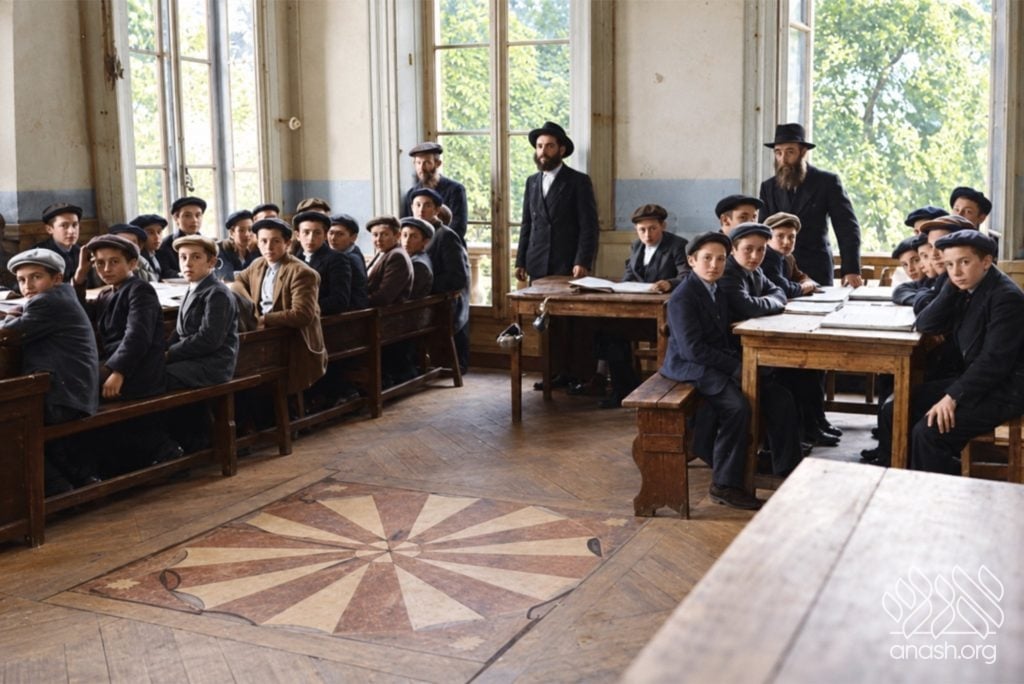
There was a large yeshivah there, where hundreds of bochurim studied. At this yeshivah they trained sofrim, shochtim, and other klei kodesh, while also teaching relevant trades. These students were all the children of Lubavitcher families.
These Jews, who had risked their lives to preserve Yiddishkeit under the Soviet regime, had risked everything to save their children as well.
From that château in Brunoy, one could constantly hear the sound of learning, the melody of Torah.
In another town on the outskirts of bustling Paris, the Lubavitchers also operated Beis Rivkah and Beis Sarah schools for girls.
The charming Jewish girls, born under Soviet rule, with their deep, intelligent eyes, sat absorbed in their studies, poring over various seforim. The song I heard back then from those Lubavitcher girls still echoes in my ears today:
אומדערמידליך און אומדערמאטערט, האלטען מיר דעם פאן צעפלאטערט דעם פאן פון תורה שווארץ אויף וייס פון חכמה, בינה, דעת.
[Tireless, never growing weary, We keep our banner flying high, The banner of Torah, black on white, Of Chochmah, Binah, Daas.]
*
Beis Rivkah in Paris
Yitzchak Shmulevitsh’s first article about the chasidim in Paris takes us back to the same girls’ school we just read about.
Girls’ schools were a new phenomenon for the Russian chasidim. These chasidim had been moser nefesh for decades to educate their children in the path of Torah and Chasidus, but for girls this education had been limited to the home.
Beis Rivkah–Beis Sarah teachers and students in Paris. Library of Agudas Chassidei Chabad.
After the chasidim left Russia, the Frierdiker Rebbe and the Rebbe—as director of the Merkos L’inyonei Chinuch—instructed them to establish schools for girls under the names Beis Rivkah and Beis Sarah, in addition to the chadorim and yeshivos for the boys.
Classes for girls were arranged in Pocking and other DP camps, but they weren’t fully developed as proper schools. More attention was given to girls’ schools in Paris, at the urging of the Rebbe, who spent three months in Paris from Adar to Sivan 5707. Classes were arranged in the Jewish quarter of Paris, the Pletzl, as well as in Sèvres, where a large group of Anash lived.
In the following article, published in the Forverts on 1 Tammuz 5708 (July 8, 1948), Shmulevitsh describes the girls’ school in Sèvres. He begins by expressing his amazement at the very notion of a frum school for girls in the decidedly secular city of Paris, and then describes the administrators and teachers he met, the curriculum and operations of the school, and its students.
A Cheder in Paris for Frum Jewish Girls from Russia
I must admit that when I was first told that here in Paris there was a school for girls where Jewish girls were being educated and raised in a genuinely religious spirit, I was somewhat taken aback. I found it difficult to believe.
It seemed almost inconceivable to me that here, in sinful, decadent Paris, where our youth is distant from Yiddishkeit and is drifting ever farther from the Jewish people, there should actually be a cheder for girls raised in a religious Jewish spirit. And what sort of girls were they? Girls from Russia, who for years had known nothing of Yiddishkeit.
But when I later visited this remarkable cheder myself, and saw with my own eyes these upright Jewish girls, the whole story became more astonishing to me still.
Not far from Paris, in a magnificent old aristocratic château, where French noblemen lived centuries ago, there now reside some twenty-odd Jewish families: men, women, and children.
The estate in Sèvres where dozens of Lubavitcher families lived between 5708-5711. Courtesy of the JDC archives.
These Jews are part of the large group of Lubavitcher Chasidim who had spent their entire lives in Russia. Throughout those years, under the Soviet regime, they secretly maintained a religious life: educating children, davening, and sustaining batei midrash.
Then, in 1945, when thousands of Polish Jews began returning from Russia to Poland, thousands of Russian Jews also managed, by various means, to make their way out. Among them were many hundreds of religious Jews. They traveled through Poland, passed through camps in Austria and Germany, and have now reached France. I described this entire episode in detail last summer in one of my articles in the Forverts.
When these religious Russian Jews prepared to head out into the world two or three years ago, they hurriedly gathered together many orphans from religious homes, some fully orphaned and others who had lost one parent. Their fathers had fallen at the front while serving in the Red Army, had remained behind in concentration camps or prisons, or had simply disappeared without anyone knowing what had become of them.
They also gathered children whose religious parents had been unable to escape Russia themselves, but who at least wanted to save their children. All of these children were taken along.
The religious Jews who undertook this mission risked their own freedom and their own future. They carried these children with them across roads and borders, through every danger and obstacle, all the way to free France.
And now, with the children safely in a free country, their guardians have established for them a boarding school, an educational institution organized in the form of a modern religious cheder.
The supervisor and administrator of this girls’ cheder, as well as several similar institutions, is a man of about fifty named Moshe Kamenetzky. Like others of his kind, he too had been secretly connected with the Lubavitcher Chasidim in Russia for decades. But this did not prevent him from becoming highly skilled in his profession. By day he worked in a knitwear factory; in the evenings, he would gather with other Jews in some hidden room and learn Torah with fervor.
The administration of Beis Rivkah in Paris. L-R: Menuchah Lazaroff, unknown, Mrs. Slavin, unknown, R. Dovid Kok, R. Moshe Zalman Kamenetsky, R. Nisson (?) Pinson, R. Yisrael Leibov, R. Yankel Lipsker, Mrs. Vaks, Rivkah Lis (Lieberman), unknown.
During the war he even served as a supervisor in a Moscow factory, and was awarded the distinction “For Valiant Labor” in recognition of his abilities.
Today he is doing important work as the administrator of this religious educational institution in Paris. He handles everything with deep devotion and care, and the children regard him like a father.
The educator in this cheder is a beautiful young woman named Menuchah Lazaroff. She comes from distant Russia, where she lived before the war with her husband, who was killed at the front while serving in the Red Army.
After losing her husband, Menuchah Lazaroff immediately connected with the religious Jewish community. She and her husband had themselves lived a religious life in secret all those years, and she now joined the Lubavitcher Chasidim on their journey into the free world. Along with the others, she wandered across the roads of Europe, and with them she has now reached Paris.
There is always a sadness in her eyes for her young husband who was lost, and for her family. Yet she never ceases thinking of the orphaned children. She does everything she can to make their lives easier and cares for them like a mother.
Menuchah Lazaroff (5676–5768) and her husband R. Eliezer Gershon Lazaroff. Mrs. Lazaroff went on to serve as an educator for many decades in Eretz Yisrael and Crown Heights.
Among the many religious teachers and educators here, all of whom cover their hair with tichelach, is a woman named Gisa Matlin. The daughter of a prominent rov in Ukraine, and with a brother who now serves as a rov in Tel Aviv, she received an advanced education at Moscow University. Throughout those years, she too remained secretly connected with the religious Jewish community in Russia. Today she devotes herself to teaching the girls Tanach, Chumash, and Jewish religious studies generally.
The third woman here is also from Russia, a woman named Golombovitch. A widow herself, and deeply scarred by life, she shows the children boundless devotion and warmth. She teaches them Yiddish—how to speak it, read it, and write it—and instills in them a love for the Yiddish language, literature, and culture.
A special teacher also comes twice a week to teach the girls English and French. From time to time, the girls are taken into Paris as well, where they are introduced to various cultural institutions and achievements, including museums and the like.
Bella Golombovitch (5675-5764), the widow of R. Pinye Marozov, the son of the Frierdiker Rebbe’s mazkir, Harav Chonye Marozov. She continued her chinuch work in Eretz Yisrael, teaching and writing children’s books.
The children in the cheder range in age from six to eighteen. They are deeply religious, and I was genuinely amazed to see how strictly they observe all the laws of Jewish life. The girls will not touch any food before first washing their hands and saying the appropriate berachos, and after every meal they bentch properly.
On Friday night, candles are lit, Shabbosdike foods are served, and the girls sing zemiros late into the night. There are no classes on Shabbos; the day is set aside for rest. In the afternoon, however, they go for a walk, and their teachers speak to them about Jewish life. All the Yomim Tovim are likewise strictly observed. And, of course, before going to sleep they recite Krias Shema, and upon waking they say Modeh Ani.
These very same girls, born in Russia and raised in the various Soviet youth organizations, now give the impression of the rabbonishe and chasidishe daughters of an earlier generation in the towns and shtetlach of Russia, Lita, and Poland.
They are so strictly religious that they keep a distance from men; shaking hands with an unfamiliar man is, of course, completely out of the question.
The Forverts article includes this picture of a Beis Rivkah class. The teacher is Mrs. Vaks.
This cheder is called “Beis Rivkah – Beis Sarah.” It bears these names because the Lubavitcher Rebbe’s mother was named Sarah and his grandmother Rivkah. The names of the Rebbe’s mother and grandmother appear throughout the building, looking down from the walls and continually inspiring the spirit in which the children are taught and raised.
In the large, airy dormitory rooms hang various pieces of handmade work with religious themes. The small tables are covered with tablecloths embroidered with Hebrew words, and siddurim, chumashim, and other seforim can be found in various places.
In every room and at every table, the girls study eagerly all day long. Here, in an old French château, where ancient works of art still hang on the walls, and original carved decorations remain visible, the singsong voices of girls learning Chumash ring out, just as the voices of boys once rang through the chadorim of our alte heim.
Alongside the religious books, however, the tables are also scattered with Yiddish textbooks sent from America, as well as notebooks filled with various assignments written in Yiddish.
Beis Rivkah, Paris. The teacher is Mrs. Vaks. Library of Agudas Chassidei Chabad.
Outside, on the streets, the laughter and singing of young people out for a stroll ring out, while at that very same hour these religious girls sit indoors, happily studying with their teachers.
At lunch, the children constantly sing songs with Jewish religious themes. And when you ask their names, you hear: Sarah, Rachel, Leah, and Rivkah, not Betty, Jacqueline, and Jeanette, the sort of names you so often hear among nonreligious Jewish children.
The youngest child in this girls’ cheder is six years old and comes from Moscow. Her name is Rochele Sa—ke. Her father is still in Russia, while her mother died during the war in far-off Central Asia. Realizing that he himself could not get out of Russia, her father’s first concern was to save his child, and he entrusted her to the Lubavitcher Chasidim.
When I visited the home, the children and their teachers were celebrating Rochele’s sixth birthday. They danced, rejoiced, and sang one song after another without stopping. Again and again, the songs were religious in spirit. Among them was one with the following words:
פאַרזאמעלט אייך שוועסטער אַלע צוזאַמען, אַרום דער תורה געגעבען אין פלאַמען ארום די לוחות אַלטע, נייע שווערט אַ שבועה שוועסטער געטרייע
די תורה, די תורה איז אונזער לעבען די תורה, די תורה איז אונזער שטרעבען אונזער ציל דער הויכגעשעצטער ביז דער רגע, ביז דער לעצטער.
פאַרפֿרעמדט געװאָרען שוין גענוג, דאָס פאלק, די תורה רופט צוריק, צוריק צו דעם, וואָס הייליג טייער בויען, שאפען מיט יונגען פייער.
די תורה, די תורה …
אומדערמידערט און אומדערשראקען פֿאַר דעם קלאַנג פון די שטאלענע גלאַקען קעמפען מיר מיט אונזער וואַפען תורה, וויסען, בויען און שאפען.
די תורה, די תורה …
אומדערמידלעך און אומדערמאַטערט, האַלטען מיר דעם פֿאָן צעפלאַטערט דעם פֿאן פון תורה שװאַרץ אויף ווייס פון קדושה, חכמה, דעת.
די תורה, די תורה …
[Gather, sisters, all together, Around the Torah, given in flames. Around the Tablets, ancient yet ever new, Swear an oath, devoted sisters:
The Torah, the Torah is our life, The Torah, the Torah is our striving, Our most cherished and exalted goal, Until the final moment, until the very last.
Estranged for far too long, The people, the Torah, call us back, Back to that which is holy and dear, To build, to create, with youthful fire.
The Torah, the Torah . . .
Untiring and unafraid, Before the sound of steel bells, We fight with our own weapons: Torah, knowledge, building, and creating.
The Torah, the Torah . . .
Tireless and undaunted, We hold our banner fluttering high, The banner of Torah, black upon white, Of holiness, wisdom, and understanding.
The Torah, the Torah . . .]
“Rochele Sa—ke” mentioned in Shmulevitsh’s article is Rochel Sassonkin (Dunin), the daughter of R. Asher (5668-5748), and granddaughter of Harav Nochum Shmaryahu. This picture shows the Sassonkinfamily after leaving Russia. Standing (L–R): Feiga Sassonkin (Friedman), Rachel Kleiman (Zamir), Avraham Yitzchak Sassonkin, Zalman Kleiman. Seated (L–R): Feiga Bart (née Kleiman), Rebbetzin Malka Sassonkin, Harav Nochum Shmaryahu Sassonkin, Mordechai Bart. Seated on the floor: Rochel Sassonkin (Dunin). Library of Agudas Chassidei Chabad.
Although these children did not spend the war years in ghettos, bunkers, or hiding with Christians, as Jewish children in Poland and France did, they too endured their share of hardship.
They passed through years of wandering and displacement, from the bitter cold of Siberia to the scorching heat of far-off Uzbekistan. Later, in fear and under the cover of dark, snowy, and rainy nights, they trudged along roads across nearly all of Eastern Europe. Afterward came the hardships of the camps in Austria and Germany, until at last they managed to reach France.
Now they dance, laugh, and rejoice, because they know that they are finally in a place of safety, in a free world.
I asked what the ultimate plan was for these girls. The day would eventually come when they would finish cheder and need to learn a trade, go out into the world, and become independent. In such circumstances, might they not stray from the path, rendering all the work being invested in them now useless?
But the directors and educators of this girls’ cheder have already thought carefully about the future, so that their present efforts should not be wasted. According to their long-term plan, once the girls complete their schooling, they will begin learning various trades.
Members of the administration of Beis Rivkah in Paris. L-R: Mrs. Vaks, R. Yankel Lipsker, R. Binyamin Gorodetsky.
They will not, however, be sent out to factories or workshops somewhere in the city. The plan is to install machinery here, in the boarding school itself, where the girls can learn their trades and afterward continue working independently, remaining here until the time comes to arrange suitable marriages for them.
When I finally left this remarkable cheder for Russian girls and found myself once again amid the noise and bustle of lively Paris, I could still see before my eyes the image of those charming Jewish girls, their blue eyes absorbed in the pages of their religious books.
It is difficult to say what the future will bring, or what still awaits these tender Jewish children. One thing, however, is certain: they will grow to be upright Jewish women, deeply bound to their people and their heritage. And not only they. Their children, too, will certainly follow along the same path.
Indeed, Shmulevitsh’s prediction could not have been more accurate. Those tender Jewish children he met in Paris went on to become upright Jewish women, the backbone of the post-war international Lubavitch community. Many thousands of their descendants continue to follow their path today.
The Yeshivah in Brunoy
Immediately upon arriving in Paris in Iyar of 5707, the chasidim established a yeshivah in the Rothschild shul in Boulogne, Paris. In Av of 5707, Harav Shlomo Chaim Kesselman arrived in France with a large group of bochurim, and they were settled on a large estate in Brunoy, in the southeastern outskirts of Paris.
Brunoy became the new home of the yeshivah, and it was bolstered a few months later with the arrival of Harav Nissan Nemanov and bochurim from Pocking. In an article published in the Forverts on 6 Tishrei 5709 (October 9, 1948), Yitzchak Shmulevitsh describes the yeshivah and its talmidim.
The Lubavitcher Yeshivah in Paris Providing Shochtim for the Entire World
Paris has now become the center of religious Jewish life in Europe. And this is not merely because there are large numbers of Jews here with beards and peyos, dressed in the traditional religious Jewish manner, or davening three times a day.
The Rothschild shul, 43 Rue des Abondances, Boulogne-Billancourt, Paris.
Paris has now become a center where hundreds of rabbonim, rebbes, lamdanim, shochtim, and other klei kodesh are being trained for Jewish communities throughout the world.
In a number of suburbs around Paris there are now dozens upon dozens of yeshivos, chadarim, and Talmud Torahs, where hundreds of young men study Torah day after day, preparing themselves to eventually assume religious positions in communities wherever observant Jews live.
The students at these yeshivos include young survivors from Poland, Hungary, Romania, Czechoslovakia, and elsewhere. Most numerous among them, however, are Lubavitcher Chasidim, or children of Chasidim, originally from Russia, who in the aftermath of the recent war have found themselves scattered in various parts of France.
Not long ago, while visiting a small town not far from Paris, I came upon a scene that, at first, left me unable to believe my own eyes.
Before me unfolded a sight one would only have been able to see decades ago in the alte heim, in the towns and shtetlach of Lita, Poland, or Russia.
Brunoy, 5700s.
When I opened the tall, broad gate of the property and took my first steps inside, I found myself looking out over the spacious grounds of an old French château.
Across the estate stood many tall, massive old oaks, their full branches heavy with leaves, and greenery all around. Off to one side stood a large white building, old, worn, and dilapidated. Glancing through its windows, I saw rows of American military cots covered with dark blankets. A strange silence hung over the entire building, as though no one lived there at all.
While the house was silent, outside there was a great commotion. From every direction came the sound of chasidishe melodies, sung by voices young and old.
I looked around, but couldn’t see anything. For a moment, I could almost imagine that I had somehow found myself in an old Jewish shtetl in Poland, with the melodies of nearby chadorim and yeshivos drifting toward me…
I walked farther into the grounds, among the trees of the château, and there, beneath the shade of the great old leafy oaks, I saw long, simple tables set up across the estate, their surfaces piled high with seforim.
Harav Yosef Goldberg teaching a class in Brunoy.
Lining both sides of the tables were long, rough wooden benches, where boys and yeshivah bochurim of a range of ages sat. Here were boys of five, six, and seven learning Hebrew and Chumash; and alongside them were bochurim in their twenties, even approaching thirty, already accomplished in their learning and advanced in their studies, well versed in Jewish law, custom, and the religious way of life.
All day long, the younger students and the older yeshivah bochurim sit there learning with great enthusiasm. At the heads of the tables sit the roshei yeshivah, watching carefully that the students make no mistakes in their learning and that they grow into faithful, observant Jews.
And above them, the tall, massive old oaks of the French château seem to sway along, while the breeze murmurs a quiet melody of its own…
Brunoy, after the arrival of Harav Nissan Nemanov in 5709.
As it turns out, this is part of the largest yeshivah not only in France, but in all of Europe.
On one side of the grounds I noticed a small building, with more long, bare wooden tables standing outside it. Quiet sounds came from within. I walked closer to see what was there, when suddenly a sizable group of older yeshivah bochurim emerged, all with small beards and yarmulkes on their heads.
Each of them came out carrying a new, long, sharp chalaf. For a moment I was somewhat taken aback. The sight made a strange impression on me.
Picture the scene: before you stands a group of around fifteen young men, each holding a long, gleaming chalaf in his hand.
They had also brought sharpening stones with them, and immediately set to work. They began sharpening the slaughtering knives, slowly running them back and forth over the whetstones.
R. Yisroel Duchman shechts a chicken for kaparos in Brunoy. Courtesy of the JDC archives.
It turns out that this yeshivah has a special program for training shochtim to serve in communities throughout the world, wherever religious Jews live. Once they complete their studies, these shochtim are sent to different places to perform shechitah and provide kosher meat.
This yeshivah for shochtim is supported by the Joint. The chalafim that the young men constantly carry and practice with were specially brought from Frankfurt, Germany. And to ensure that the knives could be sharpened properly, the Joint also brought in special sharpening stones all the way from New York.
In fact, just recently thirty-four fully trained shochtim departed Paris. They were a specially selected group of Lubavitcher Chasidim, thoroughly versed in all the laws of shechitah.
These thirty-four shochtim flew from Paris to Dublin, Ireland, to carry out the shechitah of cattle donated by the Irish government as a gift to the Jewish survivors in Germany and Austria. The displaced Jews will receive a million pounds of kosher meat from this program. The flight and the entire journey from Paris to Ireland were organized by the Joint.
A group of Lubavitcher shochtim boarding the plane to Ireland. L-R: R. Heshel Tzeitlin, R. Shimon Stillerman (?), R. Zalman Shur, R. Chaim Meir Minkowitz, R. Yisrael Losh (?).
The plan for the Irish government to provide a million pounds of beef for the Jewish displaced persons in the camps had already been arranged in 1947 by Dr. Yitzchak Herzog, Chief Rabbi of Eretz Yisrael. Harav Herzog, who had previously served as Chief Rabbi in Dublin, Ireland, appealed directly at the time to the Irish premier, Éamon de Valera, who agreed to the proposal.
And so, thirty-four shochtim from the Lubavitcher yeshivah in Paris have now flown to Ireland. Over the course of twelve weeks, they will shecht the cattle and prepare kosher meat for Yom Tov for the Jews in the camps…
But the training of shochtim in Paris did not end with this. Other Lubavitcher young men have already taken their places, and in the grand old château in the Paris suburbs the religious work continues.
Moving among the bochurim is a Russian Jew, once a “Stakhanovite,” a model worker in a shoe factory in a distant town somewhere in Belorussia. He was once known as Boris Yefimovich; here he is now Reb Berel Yankel, serving as mashgiach over the young shochtim.
He makes sure that they learn shechitah properly, and he constantly inspects the chalafim they hold in their hands. He teaches them how to sharpen the knives so that not even the slightest nick should remain on the blade, chalilah.
(We have been unable to identify “Reb Berel Yankel,” described as a mashgiach for the bochurim learning shechitah. It is possible that Shmulevitsh misremembered the name, or coined it himself for a person whose name he didn’t know.)
The yeshivah in Brunoy. Seated in the front row, from left to right: Harav Nochum Trebnik, Harav Zalman Levitin, Harav Zalman Shimon Dvorkin, Harav Nissan Nemanov, Harav Yisroel Noach Belinitsky, and Harav Peretz Mochkin (second from right).
*
Traveling to Eretz Yisrael
Most of the chasidim from Russia initially wished to settle in America, where they would finally be reunited with their Rebbe. The Frierdiker Rebbe and his askanim made great efforts to obtain visas for the chasidim, but were unsuccessful in securing entry permits for large numbers of them.
As it became clear that America would not be an option for most of the chasidim, the Frierdiker Rebbe instructed them to prioritize Eretz Yisrael as their final destination. Under the British mandate, immigration to Eretz Yisrael had been severely restricted, but with the establishment of the State of Israel in 5708, the gates of the land were flung open to all Jewish refugees looking for a new home.
The first group of chasidim to travel to Eretz Yisrael departed Paris on 8 Shevat 5709, taking a train to the port city of Marseille. Counting around 30 families, the group boarded the MS Transilvania on 14 Shevat and arrived in Eretz Yisrael on 18 Shevat.
MS Transilvania, the ship that brought the first group of Lubavitcher chasidim to Eretz Yisrael on 18 Shevat 5709.
Among the better-known members of this group were the three Feldman brothers, Zalman, Avraham, and Shmerel; R. Yisrael Leibov; and R. Zalman Bronstein. Menuchah Lazaroff and Bella Golombovitch, the teachers mentioned in the earlier article about Beis Rivkah in Sèvres, were also part of this group.
Yitzchak Shmulevitsh was at the train station in Paris when they departed, and described the scene in an article published in the Forverts on 25 Shevat 5709 (February 24, 1949). Most of this article was cited in Toldos Chabad BeRussia HaSovyetis, ch. 120.
How Lubavitcher Chasidim Are Traveling from Paris to Eretz Yisrael
For two years, the Lubavitcher Chasidim lived in Paris and the surrounding areas. For two years, they maintained their chadorim, yeshivos, and other religious institutions there. For two years, they struggled and endured a difficult life, supporting themselves on the modest assistance allotted to them by the Joint, while their presence here added color and unique character to Jewish life in Paris.
Now they are leaving Paris and setting out for Eretz Yisrael.
During those two years, they did not merely sit and study Torah. They also prepared themselves, and their children, for practical life, learning various trades for their future lives in Eretz Yisrael.
The train from Paris’s Gare de Lyon station to Marseille, the port of departure for Eretz Yisrael, Australia, Argentina, and elsewhere, usually leaves at 8:30 PM, and departing passengers normally arrive about an hour beforehand. This time, however, a great commotion had already begun by 6:00. Hundreds of people began streaming toward the platform, even before the train itself had pulled in.
Gare de Lyon station in Paris.
The entire station suddenly took on a different appearance. French onlookers stood staring in amazement, shrugging their shoulders, unable to comprehend what was happening.
From every direction came groups of Lubavitcher chasidim, with beards and payos, dressed in traditional religious style. They walked in separate groups of men, women, young girls, and bochurim. The stream included elderly people, middle-aged adults, and children. There were also many very young children, some only a few months old, being carried in the arms of their fathers or mothers.
At first glance, the whole scene looked like one long Jewish religious procession. Images of Jewish life from another age pass before your eyes, and for a moment you could imagine that an entire Jewish shtetl was coming out to welcome, receive, or perhaps bid farewell to a gute Yid, a Rebbe…
By 7:00 PM, an hour and a half before the train’s departure, the entire length of the platform alongside the cars was lined with hundreds of Lubavitcher and other chasidim, together with their entire families.
They had come to bid farewell to friends and relatives. After all, they had lived together in Russia for decades, all the while carrying on their religious work in secret. Despite every hardship and danger, they had raised a new religious generation, deeply attached to its faith and heritage. Later, they endured the harsh and bitter years of war together, and then they finally broke free from behind the sealed Soviet wall into the great, open world.
This picture from the JDC archives bears the caption “Portrait of a young refugee living in a hotel rented by JDC for the surviving members of the Lubavitch Rabbi’s family.”
And so, these hundreds of Lubavitcher chasidim had come to take leave of their friends who were departing for Eretz Yisrael.
At around 7:00, the boarding began, and the passengers started taking their places in the cars. Three large special railway cars had been reserved for the departing Lubavitcher chasidim, a group of 140 people.
Then began the process of schlepping the sacks, bundles, luggage, containers, and other belongings. The Paris office of the Joint, which had cared for these people and supported their institutions throughout this period, also made sure that the Lubavitchers would be provided with everything they needed in their final moments before departing for Eretz Yisrael.
A representative of the Joint was present at the station, supplying the travelers with the necessary provisions. Children, elderly people, and those in frail health were provided with special food. The representative also saw to it that the departing passengers had suitable seats so they should not suffer any discomfort.
Once all the bundles, sacks, and luggage had been stowed in their places aboard the train, the passengers themselves began to board.
There was no pushing, no commotion. Everyone entered the cars calmly and made their way to the seats assigned to them. The elderly went first, followed by the middle-aged, and only then the young people and children. One person helped the next climb aboard, supporting them by the arm before getting on themselves.
This picture from the JDC archives bears the caption “Portrait of a young refugee living in a hotel rented by JDC for the surviving members of the Lubavitch Rabbi’s family.”
The very first to board was a Jew of about eighty. With his long gray beard and dignified countenance, he inspired great respect in everyone around him, and all stepped aside to let him pass.
Before the outbreak of the war, he had worked as a watchman at a factory somewhere in his Ukrainian hometown, while secretly, at the same time, living as a fervent Lubavitcher chasid. Now he was an accomplished scholar, a leader of an advanced Lubavitcher yeshivah.
Everyone called him Reb Sholom.
Behind Reb Sholom came two elderly women, already somewhat stooped, with tichelach on their heads. They did not walk alone. They were being led by young Lubavitcher girls of fifteen or sixteen, wearing their long black hair in braids. Each old woman was supported by two girls, one on either arm.
The first of the two old women was from Zhitomir. She had five sons and one daughter. Four of her sons had fallen at the front while serving in the Red Army. The fifth, her only surviving son, was somewhere in a Soviet labor camp. Her daughter, together with her husband and two children, was now with her. All of them were traveling together to Eretz Yisrael.
After the elderly and middle-aged passengers had boarded, the younger people followed, and the boarding was complete.
Kaparos in Brunoy. Courtesy of the JDC archives.
While the Lubavitchers and their families were busy stowing their belongings and settling into the train cars, the hundreds who had come to see them off were not standing around idle. The platform rang with song and dancing, drawing over every French passenger who happened to be at the Gare de Lyon that evening to watch the scene with a smile.
At first, a quiet chasidishe nigun was heard, softly hummed by a few yeshivah bochurim. Before long, the older Chasidim joined in, and the melodies rose louder and louder across the station.
With such a large crowd, separate groups soon began to form. Each sang a different chasidishe nigun at full voice, and together they created a remarkable symphony of heartfelt Jewish religious song, the kind that could be heard on Shabbos or Yom Tov in the courts of the various Rebbes in bygone days.
And they did not only sing. After they had sung for a while, they started dancing as well. Small circles formed. Many of the men were holding little children in their arms and dancing with them.
So they sang and danced and rejoiced together, their voices rising to the heavens. For the moment, everyone seemed to forget entirely that they were standing in one of the largest railway stations in Paris.
Brunoy. Courtesy of the JDC archives.
Everyone danced: the elderly, the middle-aged, the young men, and the children. Only the women and girls did not dance. They stood off to the side, watching it all with smiles.
Young girls, sweet Jewish children, shyly climbed onto the iron railings of the station and onto crates that had been set nearby, watching everything with great interest and clapping their little hands. The scene looked like Simchas Torah in a beis midrash in the alte heim, when the girls of the shtetl would climb up to the windows to watch the hakafos.
Once they had settled their baggage, the departing passengers also began clapping along to the rhythm from the train windows. Even the venerable, gray-haired Reb Sholom joined in. Inside his narrow train car, he began to dance, singing and clapping to the beat.
Even many Polish Jews, displaced people who had arrived in Paris some time earlier, joined in the singing and dancing. These were people who had spent the war years in the Central Asian cities of the Soviet Union—Tashkent, Samarkand, Buchara, Kokand, and others—where they had grown close to the Lubavitchers living there. Now they had come to bid farewell to their dear Lubavitcher friends, with whom they had shared so much of the suffering and the joy of the recent war years.
The clock showed 8:30. A bell rang, and the moment of departure drew near. Voices called out with joy and words of farewell:
Baking matzos in Paris.
“Travel in good health, Reb Sholom, and may you have much success!”
A young girl leaned her head out of a train window and called to a friend:
“Stay well, Soreleh! We’ll see each other soon in Eretz Yisrael. Write me a letter!”
From every direction came cries of farewell:
“Travel in good health! Be well and happy! Much success! We’ll see each other again soon…”
The final whistle sounded. The train was due to leave.
But it could not.
The well-wishers were practically clinging to the train windows, stretching out their hands toward their departing friends and calling to them at the top of their lungs. Only with great difficulty did the railway officials manage to pull the crowd away from the cars, and at last the train began to move out of the Paris station…
The train gradually disappeared into the darkness of the night, carrying with it these former wanderers, people who had roamed along all types of illegal and dangerous routes, but were now, at last, traveling as free people, with visas for Eretz Yisrael that they had received in Paris.
(The identity of “Reb Sholom,” described as the elder and leader of the group, is unclear. A review of the list of travelers does not show any elder chasid by this name, or any other well-known elder chasid. The best candidate may be R. Yosef Milgrod, a shochet from Kyiv and the father-in-law of R. Yisrael Leibov, who was born in 5630.)
Brunoy. The teachers standing in the back are R. Nochum Labkovsky, R. Zalman Katzenelenbogen, and R. Aizik Krasik.
The group described in this article was the first and largest to travel to Eretz Yisrael. A few months later they became the founders of Kfar Chabad, where most of them settled. Additional groups followed them to Eretz Yisrael over the next two years.
Of the chasidim who remained in France, many were eventually able to reach America, while others settled permanently in France. Smaller numbers moved to other countries.
These 1000 refugees from Russia became the foundation upon which the post-war international Lubavitch community was constituted, and a high percentage of Lubavitcher chasidim today are their descendants.
To view all installments of From the Margins of Chabad History,click here.
For additional exclusive content, follow the column on X:x.com/ChabadMargins
COMMENTS
We appreciate your feedback. If you have any additional information to contribute to this article, it will be added below.







 COMMENTS


We appreciate your feedback. If you have any additional information to contribute to this article, it will be added below.