The Refugees Who Astonished the Jewish World: Part II
In Sivan 5706, chasidim began to flee the Soviet Union for the free world. As we mark 80 years since the Great Escape, From the Margins of Chabad History continues a series documenting the vibrant chasidishe life of the escapees in the refugee centers and DP camps. Part 2 of the series is devoted to life in the Austrian DP camps in 5707.
Marking 80 years since the Great Escape of 1000 chasidim from the Soviet Union, the previous installment of this column launched a series documenting the experience from a unique perspective: previously unknown contemporary accounts by people who encountered the chasidim on the many stops of their long journey to security.
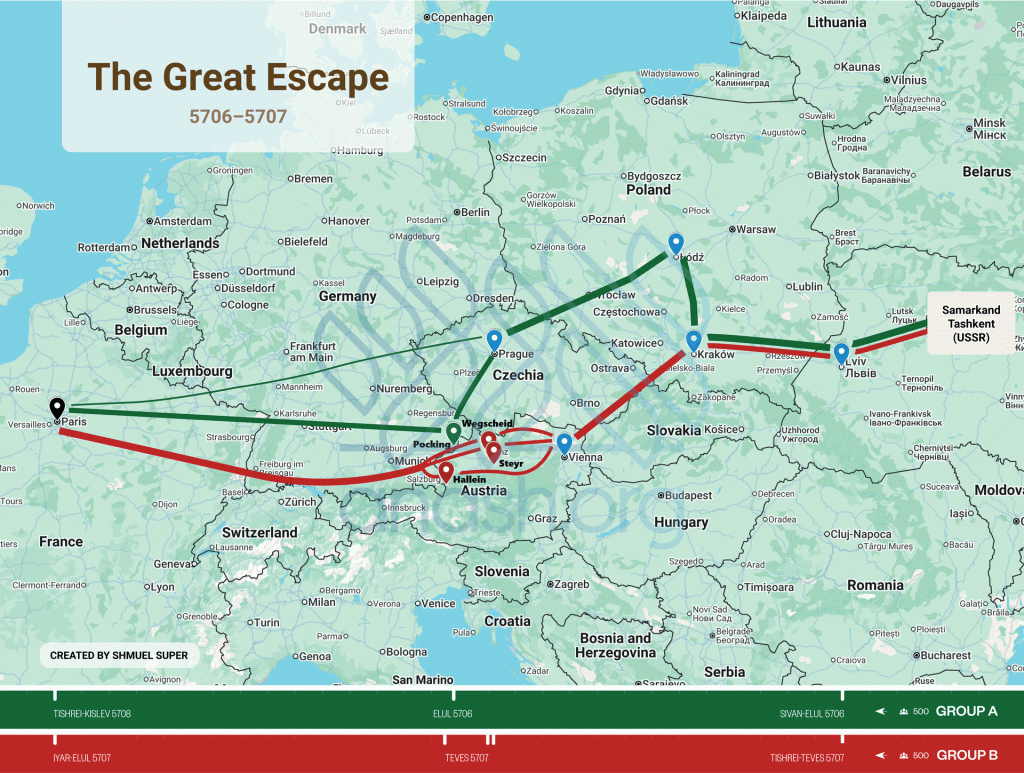
Map of the Great Escape
The first article in the series provided a general overview of the escape. Then it focused on the experiences of the first group of chasidim to leave Russia, between Sivan and Elul of 5706, most of whom settled in the Displaced Persons’ camp in Pocking.
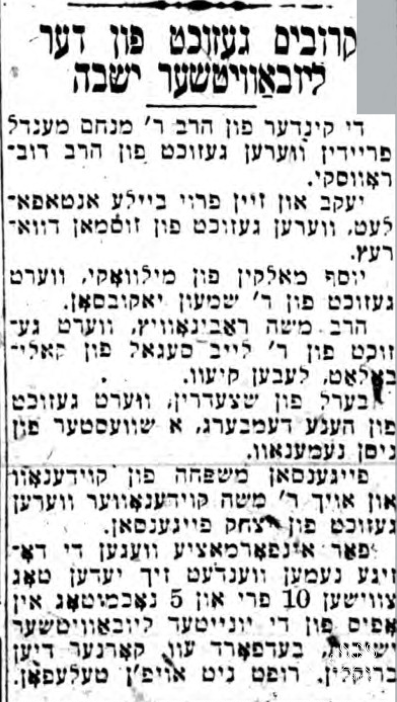
A report in the Der Tog newspaper in New York with a list of Lubavitcher refugees in the DP camps searching for their American relatives. 16 Tammuz 5707 (July 4, 1947).
The present article is devoted to “Group B,” the chasidim who left Russia in Tishrei-Teves of 5707. After crossing the border into Poland, these chasidim spent a few weeks in Vienna before settling in three Austrian DP camps: Wegscheid, Steyr, and Hallein.
The conditions in these DP camps were terrible, and the chasidim were divided into smaller groups, but they nevertheless succeeded in establishing yeshivos and reconstituting vibrant chasidishe communal life. Arriving in these camps around Teves 5707, they spent 5-9 months there before relocating to Paris over the course of Iyar-Elul 5707.
Our primary source for this installment of the column is the series of articles written by R. Uriel Tzimmer in the Yerushalayim-based Kol Yisrael newspaper, an Agudas Yisrael-affiliated publication that reflected the viewpoint of the chareidi Jews of the yishuv hayashan in Yerushalayim.
R. Uriel Tzimmer (5681-5722) was a man with a remarkable life story of his own. Born in Vienna to a modernized Jewish family, his family moved to Eretz Yisrael when he was 13. As a teenager, he joined the yishuv hayashan circles in Yerushalayim.
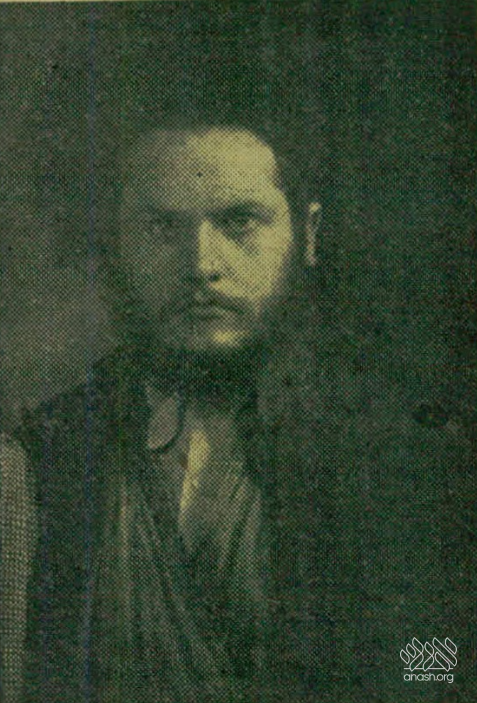
R. Uriel Tzimmer as a young man, wearing the traditional Yerushalmi clothing.
A staunch ideologue and committed activist, in Tishrei 5707, R. Uriel and his wife picked up and traveled to Europe to assist the survivors, working on behalf of Agudas Yisrael. The couple spent almost a full year in Europe, returning to Eretz Yisrael in Elul 5707.
It was in Europe where R. Uriel had his first significant exposure to Lubavitcher chasidim. In the previous installment, we published his account of his first encounter with the refugee chasidim, during Tishrei 5707 in Paris. Over the course of the next year, he met the chasidim in the Austrian DP camps as well, and described them beautifully in the regular article he submitted to the Kol Yisrael newspaper.
R. Uriel was profoundly impressed by the chasidim he met in Europe, and these encounters served as the catalyst for his connection to Lubavitch. After he moved to America in 5712, he became a devoted chasid of the Rebbe, working on behalf of the Rebbe in a range of roles, including translating the Tanya to Yiddish and editing the first publications of Likutei Sichos.
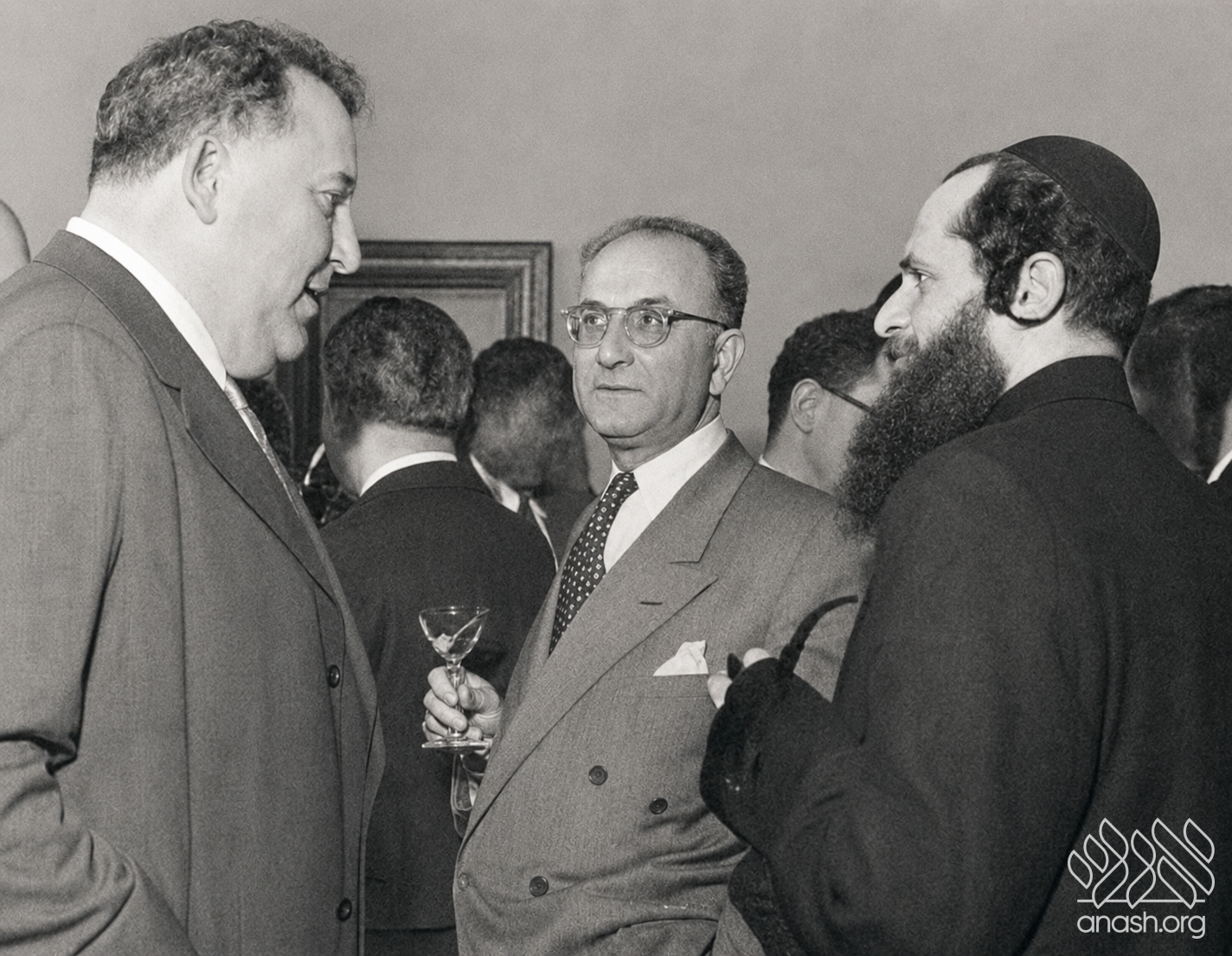
Fluent in many languages, R. Uriel also served as a translator at the United Nations. Here is seen speaking to Trygve Lie, the first Secretary General of the UN (left).
Vienna
Our first article from Uriel Tzimmer comes from Vienna. Published in Kol Yisrael on 4 Iyar 5707 (April 24, 1947), the article describes his encounter with the Lubavitcher chasidim in Vienna a few months earlier, in Kislev-Teves, immediately after they left Russia.
Vienna—The City of the Dead
By our correspondent traveling through Europe, Uriel Zimmer
First Impressions
I could find no other name for this city, once perhaps the most splendid of all the large cities of Central Europe.
The Russian uniforms, the smell of vodka, and the Russian words we heard at the border all signaled the atmosphere we were entering. We were reminded of the days of Stalingrad, of the “scorched earth.” And indeed, that is exactly what we found here.
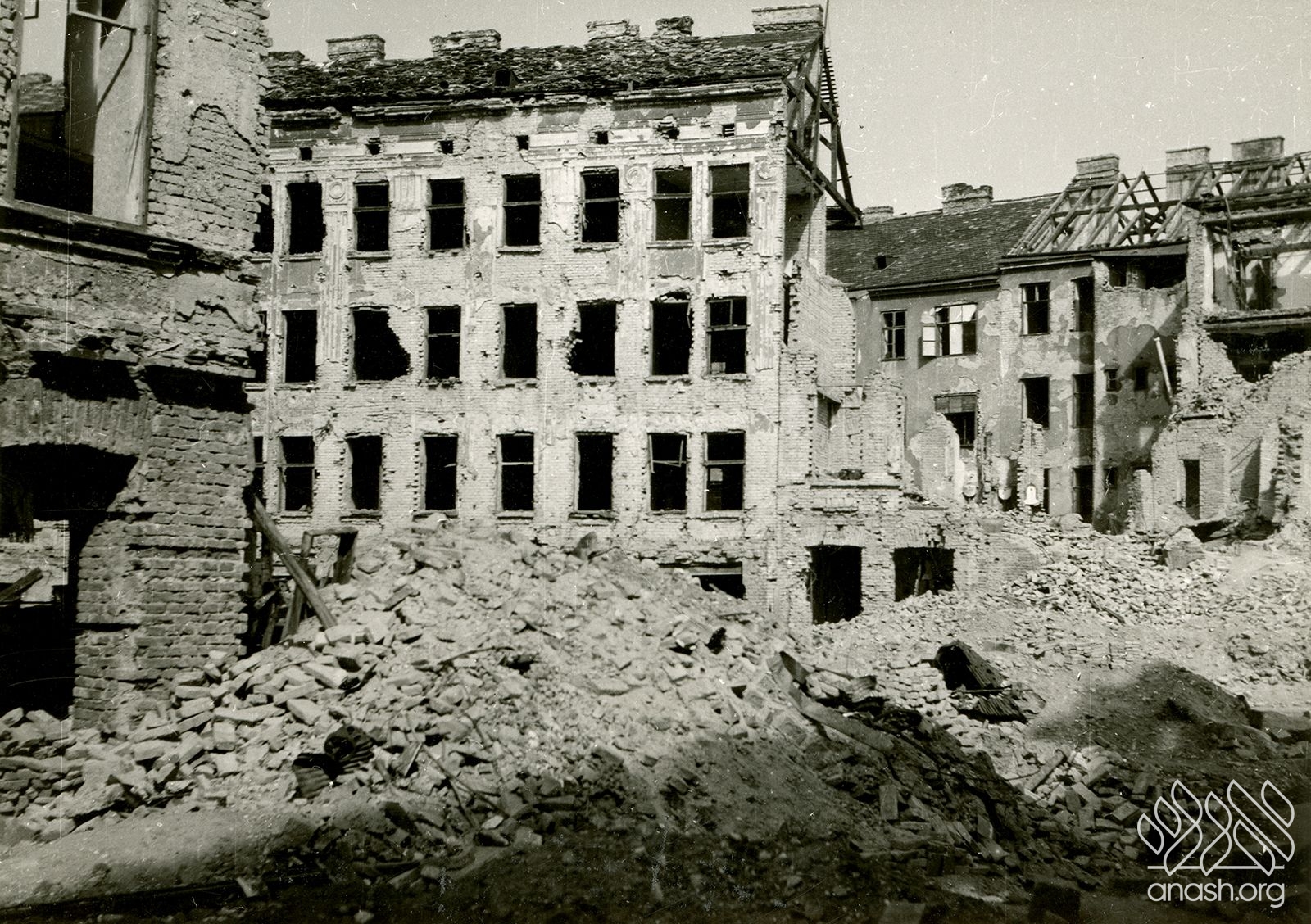
Rubble on a Vienna street after World War II.
Ruined houses, entire streets laid waste, heaps of rubble at every turn. Is this the city once famed for its vibrancy? Is this my birthplace? I could barely recognize it.
A Night’s Lodging
The cold and the snow do nothing to lift the spirit. A hotel is impossible to find. The privilege of my British passport was of no help; even that could not alter the reality, or, more precisely, the absence of any normal reality. The hotels are all either unfit or filled to capacity.
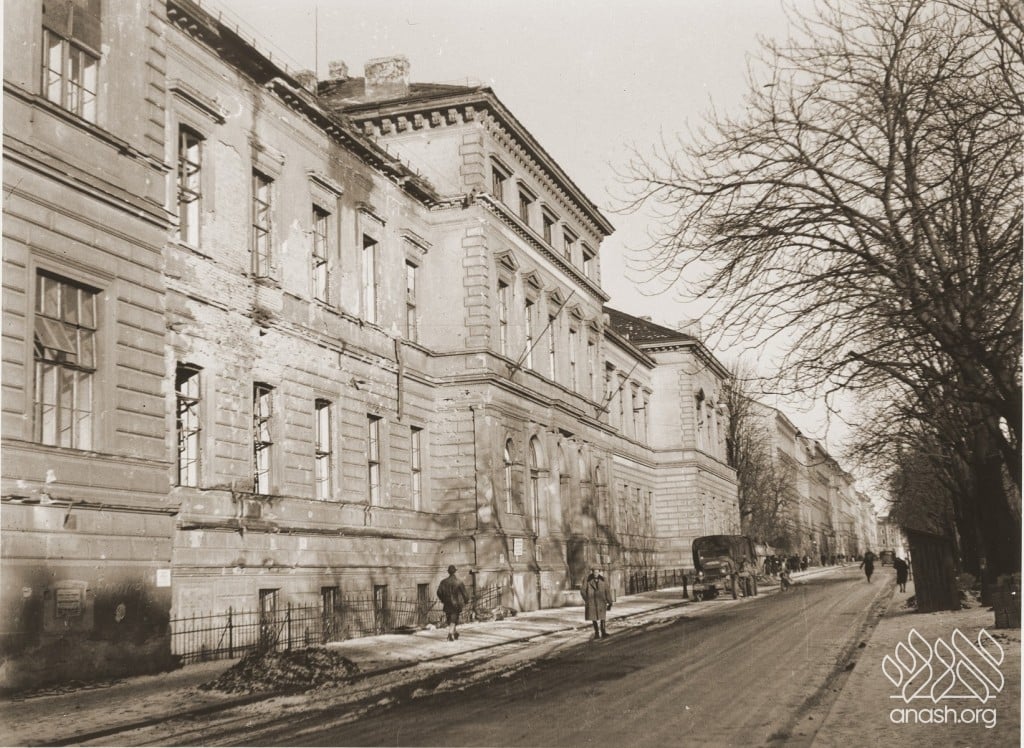
We made our way to the Rothschild Hospital, now serving as the center for the refugees. I set aside the passport that had disappointed me and went to seek out my fellow Jews.
Indeed, lodgings were arranged for us in one of the transit camps. These camps house our brothers, survivors of the sword, as they pass through Vienna on their long road of suffering. But to where? These are large rooms, poorly heated, where several families live together. Words cannot capture the conditions, not from a sanitary standpoint, nor from any other.
Among Chasidim
I found myself among a group of Chabad chasidim, refugees from Soviet Russia. Indeed, only such spiritual giants can sit and learn a perek Tanya or chazer maamarim of Chasidus until after midnight in such a stifling atmosphere.
Rothchild Hospital, Vienna
Wherever you go—in France, or in the camps throughout Austria and Germany—you encounter these Jews, “temimim” in the fullest sense of the word. Thirty years of persecution had rendered their native land repulsive to them, so they took up the wanderer’s staff. Some had held important positions in the Soviet government, and some possess an advanced secular education. They are all complete yerei shamayim, not only inwardly, but outwardly as well: with beards and peyos, and particular about the finest details of every minhag. Had I not seen it with my own eyes, I would not have believed it.
What a world of difference. Only a few short years ago, the Lubavitcher Rebbe שליט”א visited Vienna, and a magnificent reception was held in his honor. Now these chasidim have ended up here destitute, with nothing to their name.
In the company of these chasidim I spent most of the night, and the light of Chasidus banished the cold of the winter night from our hearts.
Steyr
Our next Uriel Tzimmer report comes from the DP camps in the vicinity of Linz, Steyr, and Wegscheid. Wegscheid only gets a brief mention, highlighting the terrible material conditions and mentioning tensions between the Lubavitcher chasidim and the other frum, Agudas Yisrael-affiliated, residents of the camp.
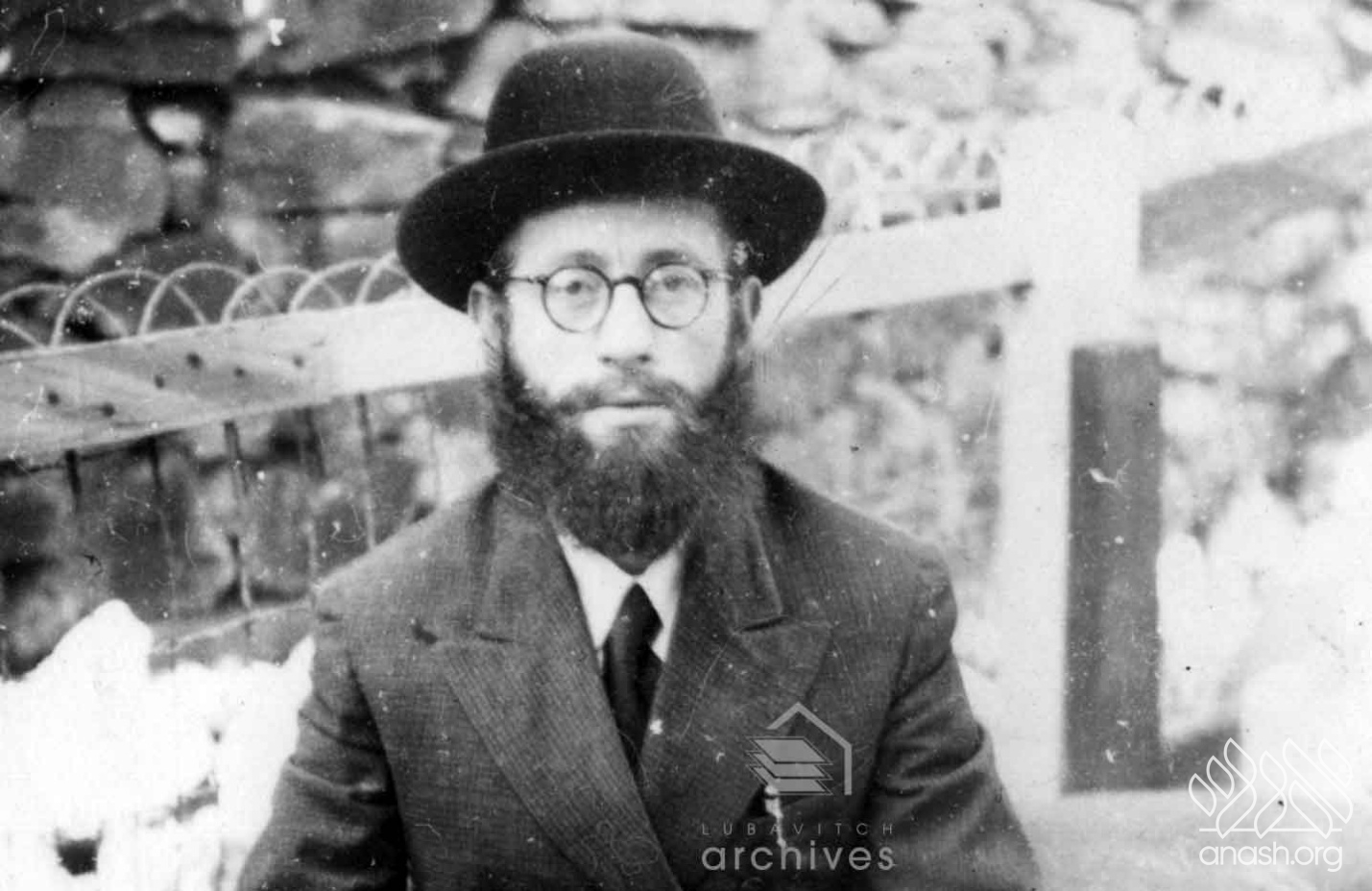
Harav Yisrael Feldman (5679-5756). R. Feldman was later a shliach sent by the Frierdiker Rebbe to Milwaukee, Wisconsin. Credit: Lubavitch Archives
Tzimmer then continues on to Steyr, noting that the conditions there were also bad but better than at Wegscheid. He also notes that “The rov of the camp is a young rov of Polish extraction, a talmid of tomchei Temimim in Warsaw named Yisrael Feldman.”
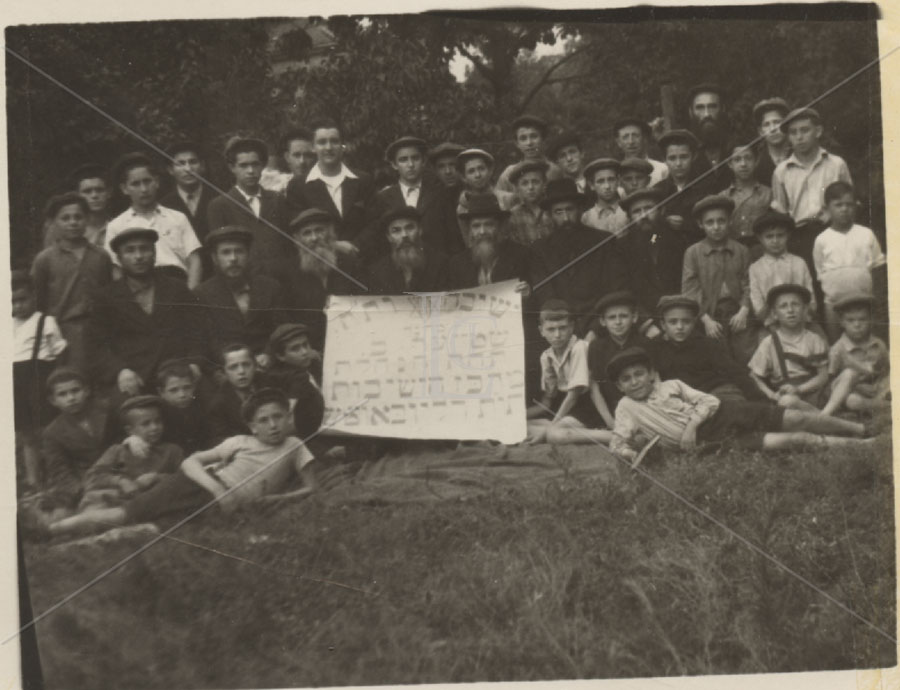
In the next section of his article, Tzimmer gives us a beautiful description of a chasidishe life in Steyr, including a farbrengen led by “Reb Betzalel the shochet.” This is Harav Betzalel Wilschansky, later sent by the Frierdiker Rebbe to Australia, where he served as a shochet in Melbourne and Sydney. Wherever he went, R. Betzalel was always the life of the farbrengen.
Split across installments published on 5 and 12 Elul 5707 (August 21 and 28, 1947), this article describes an encounter that took place a few months earlier, as R. Betzalel moved to Paris in Iyar of 5707.
Nusach Chabad
R. Betzalel and Chaya Wilschansky
The time for the seudah is approaching. The olam gathers by Reb Betzalel the shochet, a Chabad chasid. They sing in the Chabad style and “take mashkeh” in the Chabad style—lechaim velivrachah. Even the mashkeh is in the Chabad style, made from a Russian recipe, something like vodka. They smoke maparkes—cigarettes rolled from newspaper—and then burst into a dance, Hupp-Cossack.
The olam keeps growing. They move down into a larger hall—singing, dancing, rejoicing, bitul hayesh, forgetting their troubles, becoming refined, and bonding.
Suddenly, Reb Betzalel the shochet stands up and begins to speak words of musar on various matters. He hands out slaps with laughter tinged with tears, cautions about neglect in matters of pidyon shevuyim and other lapses. “Do you know, Berel”—they all speak directly, “you,” without honorifics—“do you know the taste of davening? Do you have any idea what real davening is? If you learned in Lubavitch even for a moment, you can never forget that moment for the rest of your life.”
They continue dancing and singing until kelos hanefesh, until bitul hayesh. The circle grows tighter and tighter, the voices rise higher—Kol dodi dofek… You forget everything around you, and a deep, overwhelming joy fills your entire being.
Wegscheid DP camp
Meanwhile, night falls. The hour is late, and the body begins to make its demands; the abundant mashkeh also weighs on the limbs. More and more people step out of the circles, offering support from the sidelines. Everyone’s faces are alight, the entire atmosphere is burning with a holy fire—vechol karnei reshaim agade’a, teromamnah karnos tzadik… The new nigun ignites every heart once again.
The Alter Rebbe’s Niggun
At last, the storm settles. The mood is uplifted; a kind of exalted holiness envelopes everyone present. From a corner, the nigun begins—the well-known nigun of four bavos, the nigun of the Alter Rebbe, the nigun that corresponds to the four worlds: Atzilus, Beriah, Yetzirah, and Asiyah. Everyone joins in as one, and a powerful melody surges upward, a melody filled with awe and kedushah. The atmosphere is elevated, and they sing the Alter Rebbe’s nigun with deep dveikus.
Old and young sway together, eyes closed, lifted upward. The first stanza, which corresponds to the world of Asiyah, tells of hardship—of persecution, imprisonment, deportation camps. But as the melody unfolds, that layer begins to fade. By the time the final stanza is reached, you forget everything. You forget that you are inside a camp surrounded by electrified barbed wire, that you are in a blood-soaked land, in a camp of poor, destitute, exiled people.
When the nigun ends, they rise to daven Maariv.
A Glimmer of Light
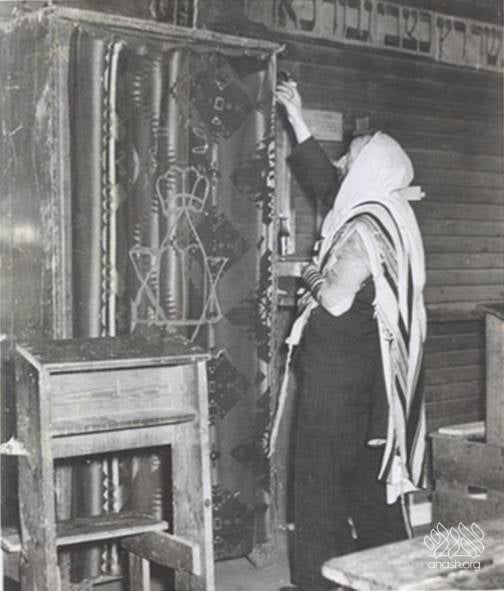
A man in a shul in an Austrian DP camp. Judging by the talis and tefillin, this appears to be a Lubavitcher chasid.
Yes, amid the suffering and hardship we endured during the war years, within this sea of darkness, there is a glimmer of light. Some of the Russian Jews have returned to the embrace of their people, among them, in particular, Chabad chasidim. Wherever you go, you encounter them, these remarkable Jews, whose very existence is a mystery that defies explanation. I already spoke about them at length in one of my earlier articles (“Among Exiled Brethren”), but the more I meet them, the more my admiration grows.
They can be divided into three categories. The first are those aged forty and above, people who absorbed Torah and Chasidus in the days of the old Russia, when that land was still a center of Torah and avodah. The elders among them studied in the great yeshivos of Russia, whether of the misnagdim or in Lubavitch. These people preserved the embers of Yiddishkeit throughout all the years of the anti-religious regime, despite threats, dangers, and imprisonment at the hands of the Yevsektsiya.
The second group consists of younger people, up to about age 30. These are people who were born after the revolution or were small children at the time. Their entire Yiddishkeit is an underground Yiddishkeit. Nevertheless, they too studied Torah and Chasidus. Their parents spent most of their money on educating their children, entirely in secret, and they succeeded. In order to avoid suspicion, some of these people were forced to pursue advanced secular studies. As a result—unintentionally and under pressure—a new type of chasidishe yungerman emerged: a chasid inwardly and outwardly, yet at the same time possessing an advanced secular education.
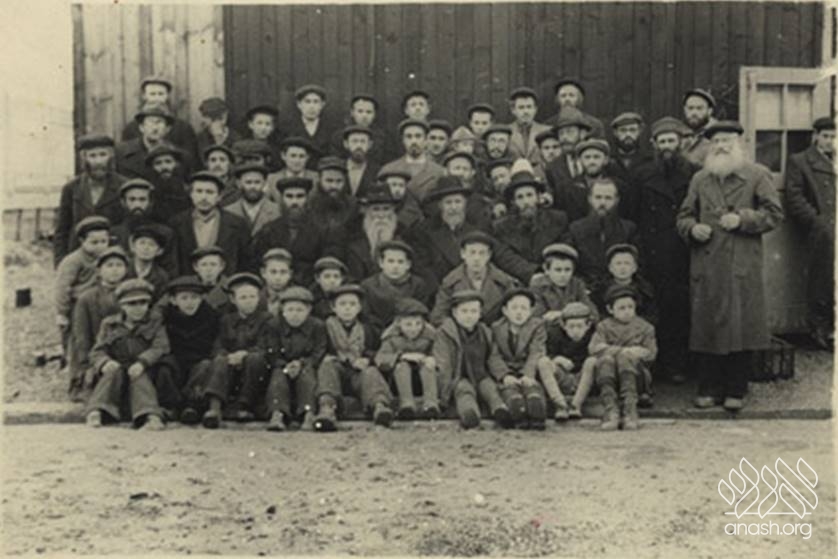
The yeshivah and cheder in Steyr. Sitting to the right of the sign appears to be R. Betzalel Wilschansky. Library of Agudas Chassidei Chabad.
These young people are exceptional material for Agudas Yisrael, and most of them have already found their way to it instinctively. They conveyed warm regards from Reb Mordechai Dubin שליט”א.
The third group consists of young children, roughly up to bar-mitzvah age. Their education took place mainly in the past few years, when the persecutions of the Yevsektsiya subsided somewhat, and their parents were able to do even more for their chinuch. High hopes can be pinned on these children, for it is impossible to describe in words what and who these Jewish children are—these tzon kodoshim.
A Woman of Valor
When speaking of the Steyr camp, we cannot fail to mention a certain woman—Mrs. Beila, the director of Beis Yaakov. She is also one of the refugees from Russia, the widow of a Lubavitcher chasid. She has taken it upon herself to care for the chinuch of the girls, to instill in their hearts yiras Shamayim and a knowledge of halachah, like Sarah Schenirer, ע”ה.
Steyr DP Camp
She gathered the girls and runs an institution similar to the Beis Yaakov Hayashan in Yerushalayim. She was overjoyed when she heard about Sarah Schenirer, the Beis Yaakov movement, and the like, as she had been unaware of this all these years. She does all of her work quietly, without publicity or fanfare, in keeping with the way of Jewish women, kol kevudah bas melech penimah. She has chosen to run her activities and school under the umbrella of Bnos Agudas Yisrael, finding it to be the proper framework.
“Mrs. Beila” is Bella Golombovitch (5675-5764), the widow of R. Pinye Marozov, the son of the Frierdiker Rebbe’s mazkir, Harav Chonye Marozov. During the war years, Bella and her family fled the Nazi invasion and lived in a small village in Tajikistan, where her husband tragically died of disease in 5704.
When the chasidim left Russia, Bella devoted herself to the chinuch of the girls, serving as a teacher in Vienna, Steyr, Hallein, and Paris. She continued her chinuch work in Eretz Yisrael, teaching and writing children’s books. The story of her life is related in So’arot Bidemamah, vol. 2, pp. 206-226.
Hallein
Our final stop is Hallein, the DP camp just south of Salzburg, Austria. In an article published on 16 Elul 5707 (September 1, 1947), R. Uriel Tzimmer describes his encounter with the chasidim there, centering around a chasidishe bar-mitzvah farbrengen.
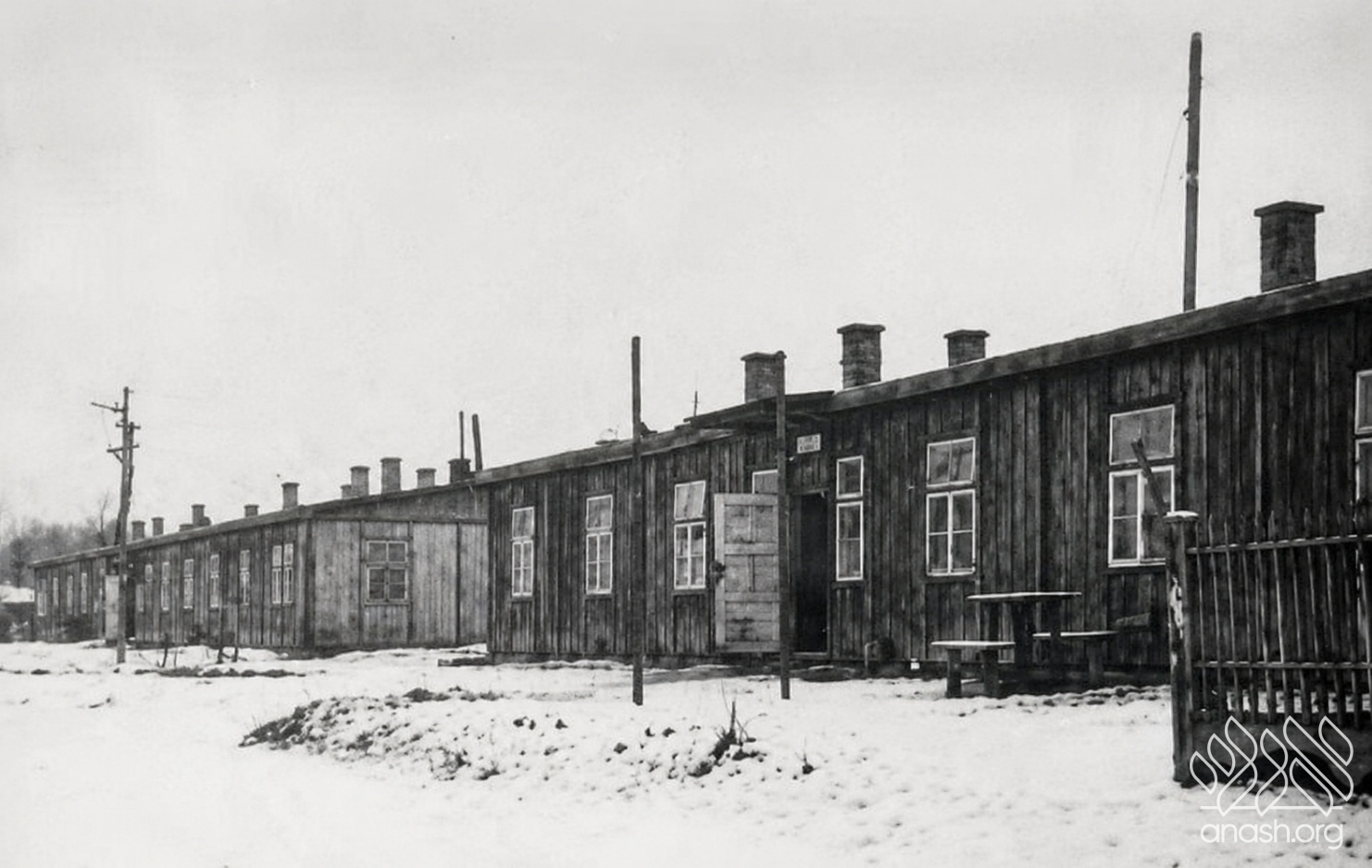
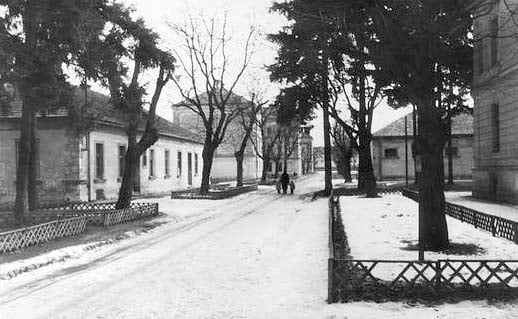
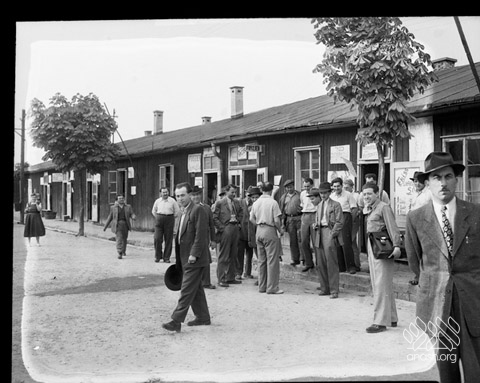
A view of the main street in the Hallein DP camp.
Shabbos afternoon in the camp. It is an ordinary summer Shabbos, and the camp, too, is an ordinary camp, one of the many camps in the American occupation zone in Austria, one of the many marks of shame left by the “civilized nations” of the twentieth century. A camp surrounded by barbed wire, with wooden barracks, and so on.
Yidden are sitting in Reb Ezriel’s room. Reb Ezriel was special, for thanks to his large family, bli ayin hara, he had received living quarters of his own. Today was extra special, for this Shabbos, he was celebrating the bar mitzvah of his son.
The host, as well as most of those gathered, are Chabad chasidim, remnants of that authentic, rich Jewish life that has been lost to us for almost thirty years. They sit, “take mashkeh”, sing chasidishe nigunim, and speak Chasidus. The bar mitzvah bachur recites a maamar, and after him, the elder Chassidim in the camp also say chasidishe maamarim.
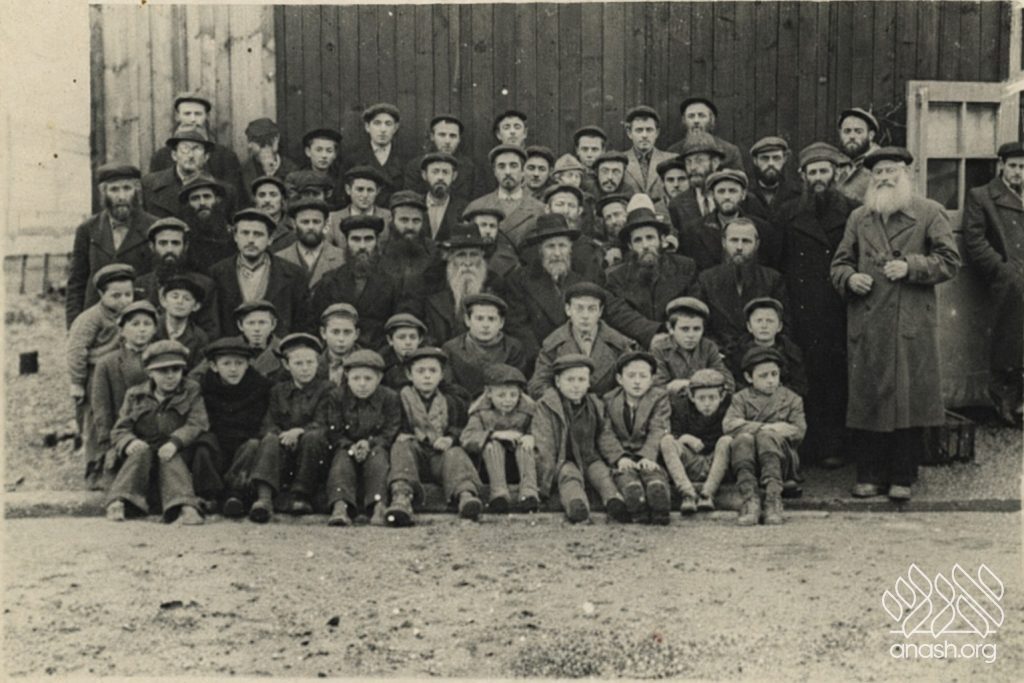
A picture taken during Rashag’s visit to Hallein. Seated in the center is Harav Yisrael Noach Belinitzky. Rashag and R. Binyamin Gorodetzky are seated to the right of R. Yisrael Noach, and R. Leibel Tzeitlin is on the left.
Then, over the meal and with a third and fourth cup of mashkeh, conversation begins to flow. First come memories of the very distant past, of the days of Lubavitch. Then memories of the more recent past, of the days of “paradise,” the prison, the NKVD, and the like. Then they speak of the transient present, of camp life and wandering from one nation to another. And finally, they speak of the future, of Eretz Yisrael: Preparing for Eretz Yisrael, preparing for the very air of Eretz Yisrael, for an aliyah in ruchniyus, for preparing the mind to receive the light of Yerushalayim. . . .
In our barrack, the elderly chasid Reb Moshe Noach was chazering a deep maamar Chasidus. Not a sound could be heard, only Reb Moshe Noach’s thin voice.
Harav Yisrael Noach Belinitzky (5644-5743), pictured shortly after leaving Russia. Library of Agudas Chassidei Chabad.
Who are R. Ezriel and R. Moshe Noach? There were no chasidim with these names of the relevant ages in the DP camps. A little research shows that Tzimmer got the names slightly wrong, and they must be R. Uziel Chazanov and R. Yisrael Noach Belinitzky, both residents of the Hallein DP camp.
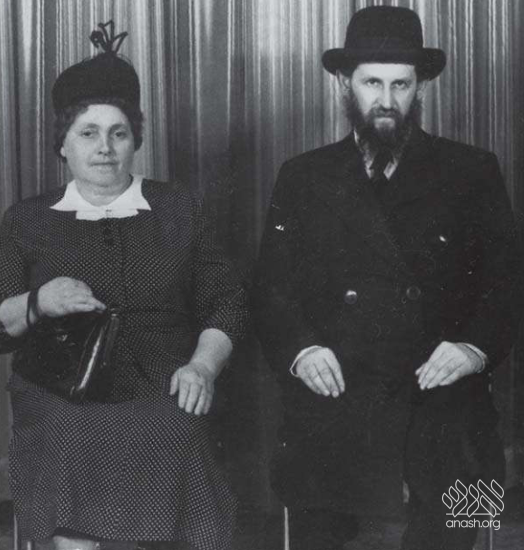
The Bar Mitzvah described is that of R. Meir Simchah Chazanov, today one of the ziknei Anash in Crown Heights. R. Meir’s own memories of his bar mitzvah are related in Peilut Chotzah Gevulot, pp. 208-210. Notably, he also mentions the presence of Agudas Yisrael guests at the simchah and describes a fight that broke out with some non-frum camp residents over chilul Shabbos. R. Uriel Tzimmer’s version of these events is related in a section of the article that we omitted. This identification enables us to date the events of the article, as R. Meir Chazanov’s bar mitzvah was on 6 Iyar 5707.
R. Uziel and Hinda Chazanov with their children Meir and Rochel Leah, Paris, 5709.
Another report, worthy of inclusion here, appeared in the New York-based Der Tog newspaper on 11 Av 5707 (July 28, 1947). This article relays the positive impressions of Harav Yehoshua Aronson, Chief Rabbi of the American Zone in Austria, regarding the chasidim in Hallein.
Chief Rabbi of the American Zone in Austria Praises the Lubavitcher Yeshivah
In a letter from Harav Yehoshua Aronson, Chief Rabbi of the American Zone in Austria, written to Harav Shmaryahu Gurary, chairman of the executive committee of the United Lubavitcher Yeshivos, he sends a heartening report about the spiritual condition of the Lubavitcher yeshivah in Hallein, where close to two hundred students are learning.
Harav Aronson, who is currently in Bad Gastein and formerly served as rov of Sanik, Poland, met Rabbi Gurary during the latter’s recent visit to Europe. Since then, he has taken a deep interest in the Lubavitcher yeshivah in Hallein, as well as in the second Lubavitcher yeshivah, located in Steyr.
Harav Yehoshua Moshe Aronson (5670-5754). Harav Aronson later served as a rov in Petach Tikvah.
The students, Harav Aronson writes, are learning with great hasmadah. If only their material situation were better. The distinguished rabbi writes that the yeshivah serves as a center for all the refugees in the surrounding camps, and that everyone relates to this exemplary Torah institution with great respect.
The yeshivah in Hallein is one of the four American yeshivos located in the camps in the American zones of Germany and Austria. The other yeshivos are located in Pocking, Schwäbisch Hall, and Steyr.
In addition, a Lubavitcher community has also formed in Paris. A significant number of Lubavitcher students are now located there, having already been taken out of the camps thanks to the rescue work of the United Lubavitcher Yeshivos.
As mentioned earlier, the chasidim in the Austrian DP camps relocated to Paris over the course of Iyar-Elul 5707. Over the coming months, they were joined by the chasidim from Pocking. A future article in this series will present reports about the Paris period.
To view all installments of From the Margins of Chabad History, click here.
For additional exclusive content, follow the column on X: x.com/ChabadMargins
COMMENTS
We appreciate your feedback. If you have any additional information to contribute to this article, it will be added below.
Thanks for the research. The attention the Chabad groups received, despite the thousands of emaciated survivors inhabiting the same dp camps can be understood by the underlying theme of all the articles, namely the surprise that these Chassidim managed to remain frum in Soviet Russia.








 COMMENTS


להחזיר עטרה ליושנה
Many Yidden – not just Lubavitchers – wore such Tefillin in Europe. As far as the Tallis, it’s hard to see from this angle.
Thanks for the research. The attention the Chabad groups received, despite the thousands of emaciated survivors inhabiting the same dp camps can be understood by the underlying theme of all the articles, namely the surprise that these Chassidim managed to remain frum in Soviet Russia.