




כ׳ תמוז ה׳תשפ״ו | July 5, 2026
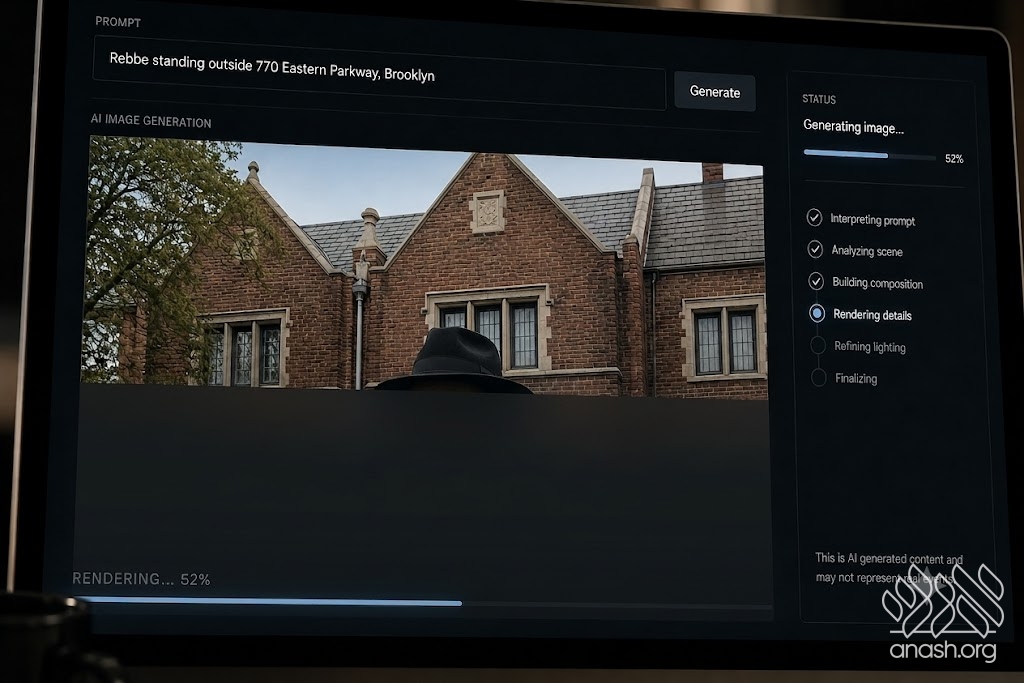
There’s a New Trend, and It Should Worry Us
“It started innocently enough. People began using AI to restore old photographs, then came colorization. But today, AI is being used to create images and moments of the Rebbe that never actually existed at all.”
By Eliyahu Klein
There’s a new trend spreading through the Chabad world, and it’s worth talking about: AI-generated pictures of the Rebbe.
It started off quite innocently. People began using AI to restore old photographs by removing scratches, cleaning up blurry areas, or taking out objects that didn’t belong in the background. Few people saw a problem with that. It’s simply a more advanced form of photo restoration, something editors have been doing for decades, only now it’s faster and more powerful.
Then came colorization. Old black-and-white photographs of the Rebbe and previous Rebbeim began appearing in color. That was already a step further, since the AI is guessing at skin tones, clothing colors, and countless other details that were never actually recorded. Still, many viewed it as an extension of restoration, adding color to an authentic photograph.
But it didn’t stop there.
Today, AI is being used to create pictures and moments that never existed at all.
A shliach wants a picture of the Rebbe smiling for a Simchas Torah flyer. A mosad wants the Rebbe with a more serious expression for an article about a difficult topic. AI generates exactly what is requested, even though it was created entirely from a text prompt.
This is becoming more and more common. You’ll find these images on local flyers. You’ll see them in well-known Chabad magazines. And almost nobody stops to ask whether it’s acceptable.
It isn’t.
Generating an image and presenting it as a picture of the Rebbe is a serious problem and disrespectful of the Rebbeim. It doesn’t matter how realistic the technology becomes. If the image was never taken, then it is not a picture of the Rebbe. It is simply an algorithm’s best guess of what the Rebbe might have looked like in an imaginary moment.
During the winter of 5744, someone submitted drawings they had made of the Mitteler Rebbe, imagined based on his resemblance to the Alter Rebbe, along with a drawing of the Rebbe Maharash based on a resemblance to the Frierdiker Rebbe. Since no photographs exist of those Rebbeim, the artist’s goal was understandable. They wanted to help people picture them.
The Rebbe’s response was unusually sharp.
“Chas v’shalom, chas v’shalom to draw pictures based on imagination and attribute them to our Rebbeim.”
Attributing an imagined image to a Rebbe is a serious affront to the honor of the Rebbeim. No matter how well-intended or how convincing it appears.
On numerous occasions, the Rebbe emphasized the importance of tziur pnei harav – picturing the holy face of the Rebbe.
At the farbrengen of Shabbos Parshas Re’ei 5746, the Rebbe spoke with remarkable intensity about the strength a shliach draws by picturing the Frierdiker Rebbe before going out on shlichus. The Rebbe added:
“Those who merited to see my revered father-in-law, the Rebbe, can picture his appearance ‘as though he is standing before them.’ Even those who did not have the merit of seeing him can form that picture by looking at an accurate photograph.”
Accurate.
The unique effect that comes from looking at a photograph depends on the fact that it is an authentic image.
As this technology keeps getting easier to use and harder to spot, this question is only going to come up more. Whether you’re putting together a flyer, magazine spread, or any other publication, think before they hit print.
 COMMENTS


Thank you for speaking out about this, and especially with the marei mekomos.
It’s terrible what’s going on out there with this…
The underlying issue is a lack of sensitivity. No chossid who was by the Rebbe would do this. But today the Rebbe has become a poster on the wall, an icon. And an icon can be tweaked to meet the needs.
We need to cultivate in our youth a sensitivity, a natural and genuine feeling, to the Rebbe as a tzaddik and real person. They should feel that the Rebbe is THEIR Rebbe, not just an idea.
This would solve a lot of other problems too.
Sounds good. HOW will you cultivate that feeling
There’s been paintings of the Rebbeim standing together in front of 770 and the like, which never happened, and in some pictures, the way chassidim and the Rebbe stand, in one line as if that’s acceptable…
We needed to have spoken out then. But never too late. Hopefully this article will be taken to heart
This is nice but the cat is of the bag and this will only get more main stream. AI is here and there are no boundaries. As long as it done with respect I imagine it will get only more perfect as AI and NVIDIA get more perfected.
What does a graphic cards company have to do with anything?
do a google search (or a Kosher search…)
Have you read a word of this article? asking for a friend.
Agree 100 percent. The question is where do you draw a line between a painting and an accurate AI depiction.
People never made a big deal of paintings of the Rebbeim. Almost all the paintings are also somewhat not accurate (some more than others…)
The difference is that a painting is painting a real picture — people didn’t invent a completely new expression from scratch.
It’s a respect to paint a real image you find inspiring.
It’s a disrespect to ask a robot to generate its own version of the Rebbe — because you want that expression.
Just this year at the 12 Tamuz rally they showed an AI video of the Frierdiker Rebbe! They had the FR talking in English. They had the FR climbing up the stairs after being thrown down by the guards. They literally put words into the FR’s mouth!! Hashem y’rachem, if Tzivos Hashem doesn’t have this hergesh…
Tzivos Hashem is very insensitive in this area, like having videos of the Rebbe flying across the screen at the beginning of their rally videos, comics with pictures of the Rabbeim (derher for kids, to their credit, is very careful never to show the Rebbe’s face) etc.
והלואי שיפעלו הדברים בי ובהשומעים
“(comics with pictures of the Rabbeim… is very careful never to show the Rebbe’s face) etc”
Where does it say your not allowed to draw or paint a picture of the Rebbe? There are hundreds of beautiful paintings of the Rebbeim, (some of the artists recieved encouragement from the Rebbe). Its not the idea of paintings per se, its the lack of sensitivity towards the Kedusha, or drawing inacurately, (the two major problems with AI.)
Some people have a hergesh not to draw pictures of the Rebbe because feel a certain sensitivity, or they don’t think it will come out good enough, and don’t want to paint a picture of the Rebbe that won’t look good, or won’t look accurate.. thats a Chassidishe hergesh that comes from a good place, but I think its wrong to say that “its wrong to paint pictures of the Rabbeim – full stop”.
Tzivos Hashem proper (like Moshiach Times) is very responsible in this matter. The problems you mention are from Hachayol, which functions independently and is mostly managed by young bochurim and girls.
Rabbi Pape is very sensitive to these matters. Halevai he had a say….I remember when they hired a marketing firm (albeit Lubavitchers) to start running the “new and improved” tzivos Hashem. Hashem y’rachem.
וואו איז די אחריות!?
The recording (including the Frierdiker Rebbes voice) is from a storyteller -name just slipped my mind- which has been used for years (so I don’t think its so bad). But the video is ‘disgusting’ and should be taken down immediately. They need to be some who look over everything that is published their and if their already is he desperately needs to raise his standards.
Nvidia is the source and king of AI together with Coreweave and Nebius etc. The AI will get better and better until we will be able to actually use the Voice of a Weekday farbrengen and match it with the live AI video of the Rebbe speaking. Its a matter of time
Love it