When Fake News About the Rebbe Maharash Sparked a Public Rebuttal
2 Iyar marks 192 years from the birth of the Rebbe Maharash. From the Margins of Chabad History relates an episode of fake news from the contemporary maskilic press that gives us a glimpse of the respect in which he was held, details about his travels, and the loyalty of his devoted chasidim.
The first Jewish newspaper in the Russian Empire was the Hebrew-language Hameilitz, established by Alexander Zederbaum (Erez). Based in the Russian capital of S. Peterburg, this was a maskilic newspaper which billed itself as a mediator (meilitz) between the Jewish people and the Russian government, and between traditional Yiddishkeit and modern “enlightenment.”
Like all of the maskilim of this era, Hameilitz identified chasidim as the primary enemy of their modernizing cause. Chasidim and their rebbes were frequently mocked in the pages of Hameilitz, although the newspaper still presented itself as a religiously observant publication.
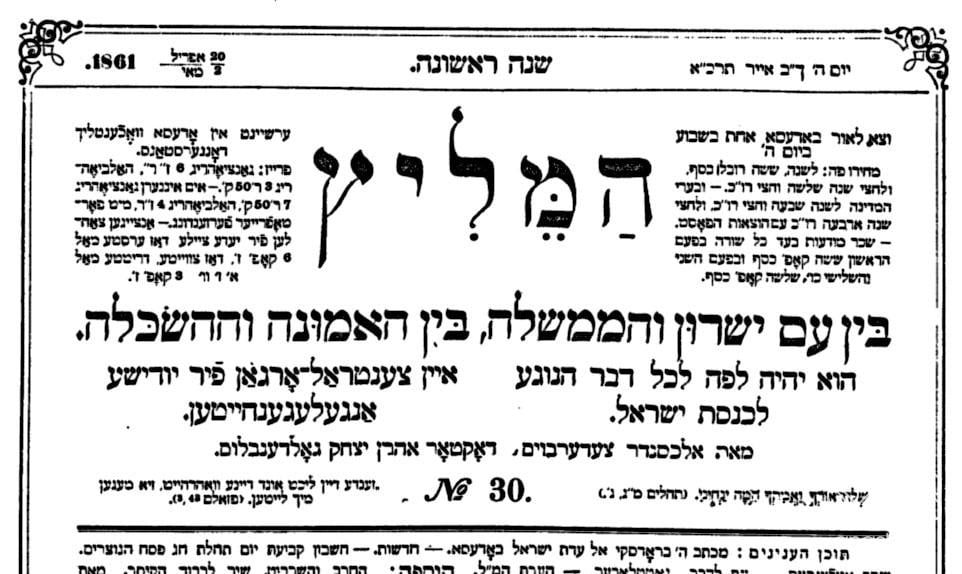
The masthead of Hameilitz newspaper in its first year of publication, 5621. Originally based in Odessa, the newspaper moved to Peterburg in 5631.
On the occasion of Beis Iyar—tiferes shebetiferes—this article presents an episode of fake news about the Rebbe Maharash that was published in Hameilitz in 5641-5642 (1881). The story of this false report and its refutation grants us a glimpse of the tiferes of the Rebbe Maharash among his chasidim, and the tiferes he enjoyed even among his opponents. We also learn new details about his travels during this period.
Fake News
In the Hameilitz newspaper of 26 Elul 5641 (September 20, 1881), a letter signed with the name “MY Yafit” appeared. The writer identified himself as a resident of Dvinsk (also known as Dinaburg), and as a grandson of the late rov of the city, הגאון אש”ז.
(This rov must be Harav Aharon Shaul Zelig Meirov (Guryon), the rov of the non-chasidim in Dvinsk from c. 5625 until his passing in 5639. An entry for Harav Aharon Shaul Zelig appears in R. Mordechai Glazman’s Latvia Verabaneh (p. 61) with the last names “Meirov” and “Guryon” noted, and “Yafit” appears to be yet a third last name he used.)
MY Yafit, clearly a maskil, has a complaint. He writes that the financial situation in the Jewish community of Dvinsk is very difficult at the moment, and claims that the wealthy members of the community who have the ability to help are not contributing to support the poor. Instead, he complains that they are directing their money to causes he considers unworthy.
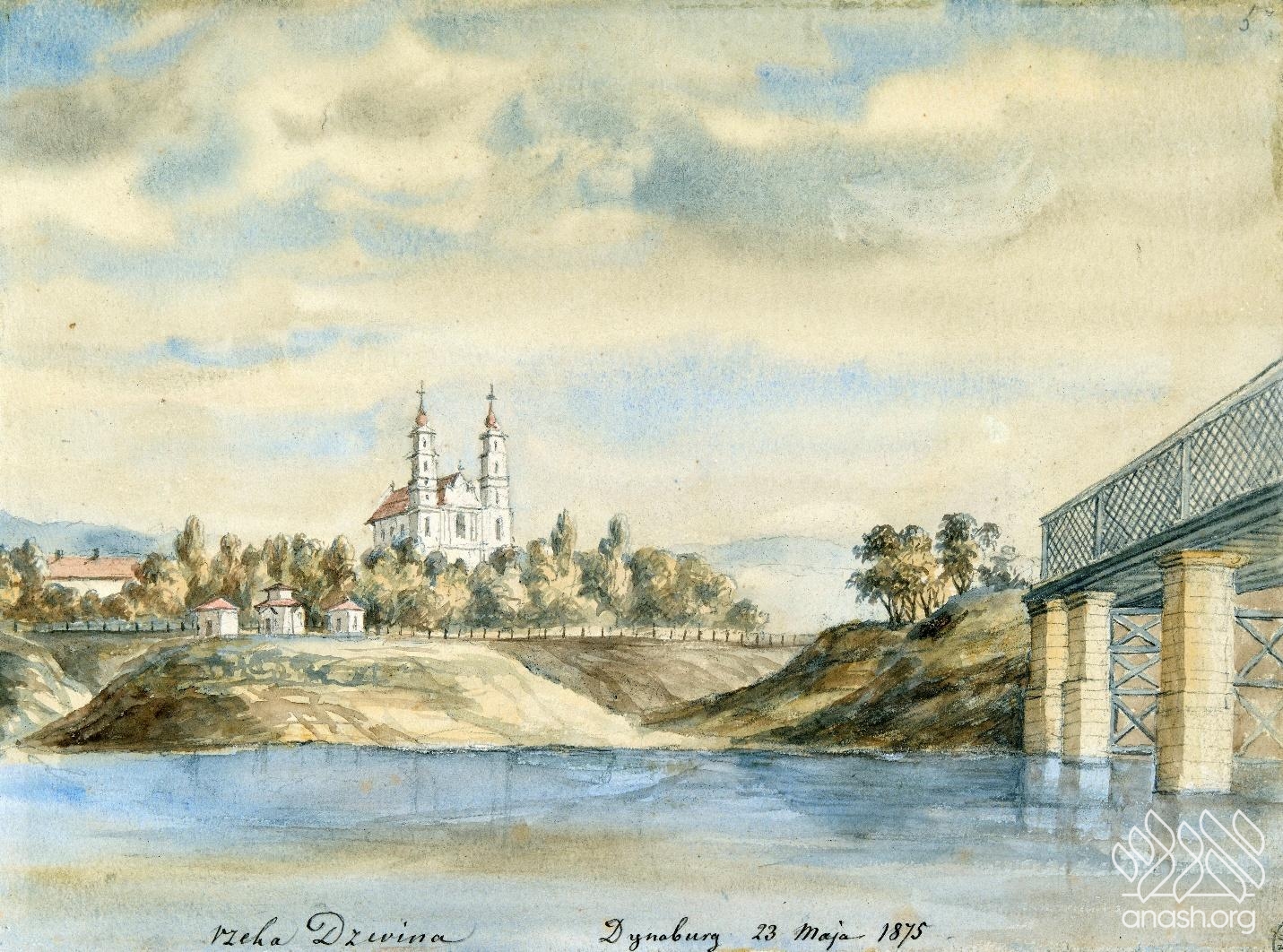
Dvinsk in 5635, by Polish artist Napoleon Orda.
The first cause he doesn’t approve of is “the Rebbe of Lubavitch, who recently made a commotion in our city and emptied the pockets of its residents.” Now, Yafit continues, a visitor from Yerushalayim is in town selling token plots of land in Eretz Yisrael to give residents of chutz laaretz the ability to observe the mitzvos hateluyos baaretz. Yafit doesn’t like this cause either, and claims that the sale documents are invalid anyway.
Attacks on rebbes for accepting contributions from their chasidim, and on chasidim for giving these contributions, were classic tropes in the maskilic press. But this criticism directed at the Lubavitcher Rebbe, the Rebbe Maharash, aroused the ire of some of his loyal chasidim.
R. Monye Moneszon Responds
In Hameilitz of 2 Cheshvan 5642 (October 25 1881), the editor reports on an indignant response the newspaper received:
S. Peterburg. A few days ago, we received a complaint from the local shochet, R. Yisrael Chaikin, and the merchant, Mr. Mones Moneszon, questioning why we published the article from Dinaburg titled “The Tzadik and the Yerushalmi Came to Town.” This article stated, “We are still reeling from the Rebbe of Lubavitch, who recently made a commotion in our city and emptied the pockets of its residents.”
The complainants assert that the writer falsely slandered this rebbe, as he did not visit Dinaburg, neither this year nor last year. We have no valid reason to question the testimony of these refuting witnesses, so we must lament the fact that the writer misled us and the readers of HaMeleitz.
He spoke false slander about a man who is holy in the eyes of his followers and respected even by those who do not believe in his miracles, due to his abundant Torah teachings, his holy lineage, and his wisdom. He should forgive us for our error, having been misled by a fraudulent writer into speaking falsely of him. We had no intention to insult him, chalilah, but to remain loyal to our guiding principles, to show no favor to anyone. We therefore have no problem correcting our mistake.
The editor continues with classic maskilic propaganda against chasidim and their rebbes to justify their basic editorial approach. In the course of their screed, they mention that R. Mones stated repeatedly that Yiddishkeit survives only thanks to the tzadikim.
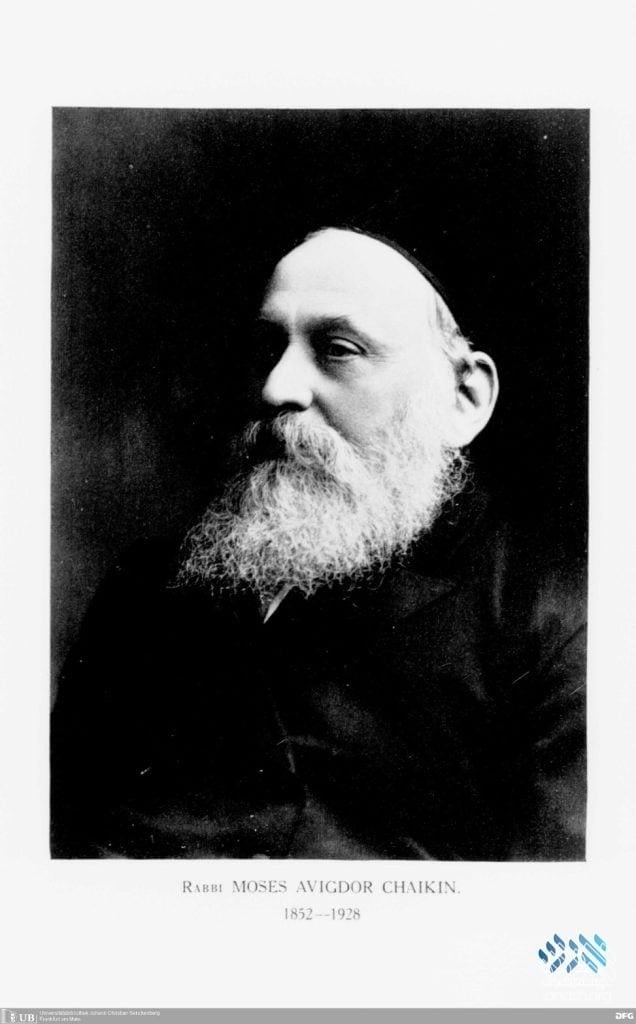
Harav Moshe Avigdor Chaikin (5612-5688), the son of the Peterburg shochet R. Yisrael Shraga.
The first writer of this response, Harav Yisrael Shraga Chaikin, was mentioned in a previous installment of this column devoted to his son Harav Moshe Avigdor Chaikin. A member of a prominent chasidishe family in Shklov, R. Yisrael served as a shochet in Peterburg for almost 50 years, until his passing in 5657.
Peterburg was beyond the Pale of Settlement where Jews were allowed to live in Russia during this period, but Jews who had business there were able to obtain special residency permits. Thanks to his residency in Peterburg and his fluency in Russian, R. Yisrael merited a close relationship with the Tzemach Tzedek and the Rebbe Maharash, serving as a translator and assistant to them when they visited Peterburg for communal affairs (see the sources collected in Doros shel Chasidim, pp. 18–19).
The second writer is the famous chasid R. Menachem Mones (Monye) Moneszon. A descendant of a wealthy chasidishe family, R. Monye married the granddaughter of the Tzemach Tzedek (daughter of Harav Yehudah Leib—Maharil) and had a very close relationship with the Rebbe Maharash and Rebbe Rashab.
R. Monye was a wealthy businessman, supporting the Rebbeim’s activities financially, and working on their behalf in Peterburg on Jewish communal affairs. He was renowned as a genuine chasidishe Yid and a loyal mekushar (see the sources collected in Chasidim Harishonim, vol. 2, pp. 103-112).
Living in the modern city of Peterburg, where Hameilitz was based, these prominent chasidim were alert to slander published about their Rebbe and rushed to refute it. Their categorical denial compelled the editor to retract the claim and clarify that the Rebbe Maharash is greatly respected by all, even those who are not his chasidim.
Travel Information
This wasn’t the end of the saga in the pages of Hameilitz. In the 22 Cheshvan issue (November 15), the editor writes:
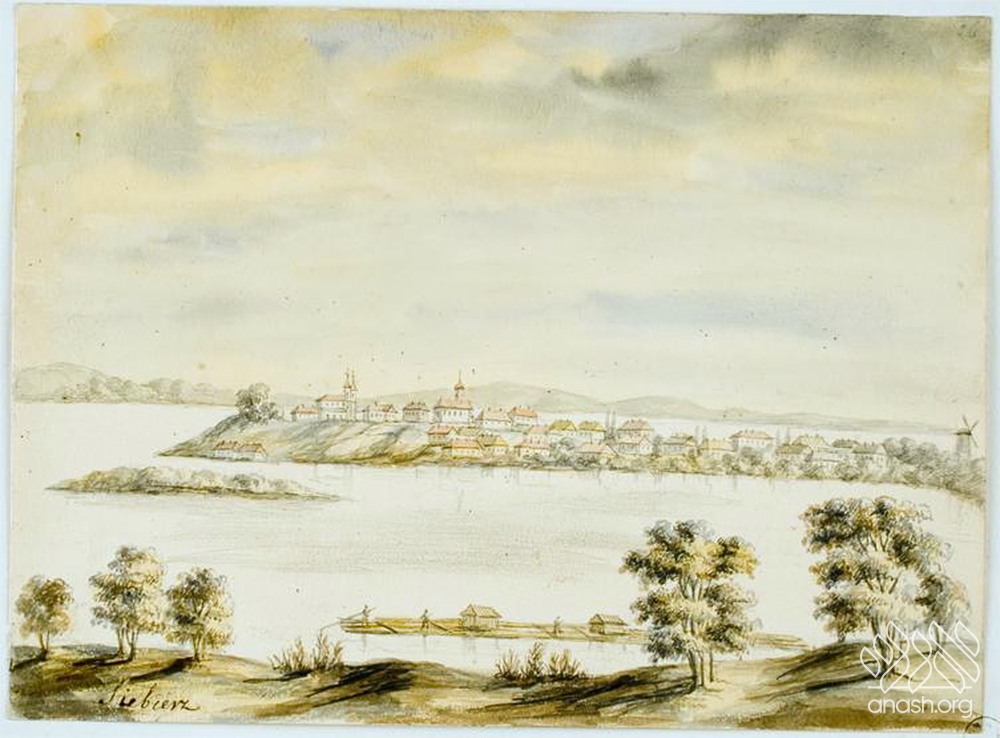
Sebizh in 5635, by Polish artist Napoleon Orda.
We have already cleared the honor of the Rebbe from Lubavitch based on trustworthy testimonies that the writer from Dinaburg spoke falsely, and that the Rebbe was not in Dinaburg this year. Nevertheless, in order to remove any trace of suspicion from our readers’ minds, we are bringing the testimony of a writer who is not a chasid, but, purely out of his love for truth, renders justice to the tzadik.
The editor then quotes a letter signed by Yaakov Meir Lifshitz of Sebizh, a town in the Vitebsk district. This letter provides us with precise information about the Rebbe Maharash’s travels in the summer of 5641.
In Hameilitz issue 35, the son of a rov from Dinaburg published an article titled “The Tzadik and the Yerushalmi Came to Town,” criticizing his fellow townspeople for not rushing to assist their impoverished brethren, even as they gave money to the tzadik and the Yerushalmi. Regarding his reproach, if his words are true (they are indeed true—ed.), that the people of his city did not pay attention to the cries of their unfortunate brethren, his criticism is justified. He is also justified in his criticism of the Yerushalmi, if indeed such a person came to town, because the poor of your own city take precedence.
However, with his complaint against the Rebbe from Lubavitch, he has greatly sinned against the truth. First of all, it is not the practice of this tzadik to travel from city to city to collect from his flock. If he needs to travel somewhere, he doesn’t stop on the way to greet visitors or accept money. His travels are not for the purpose of amassing money at all.
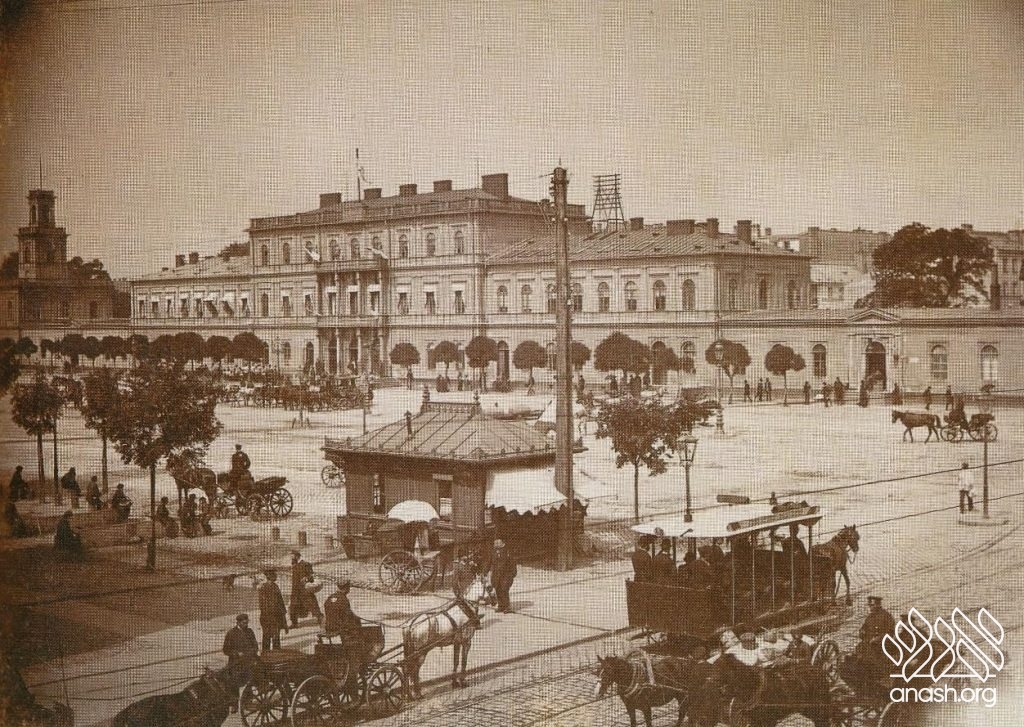
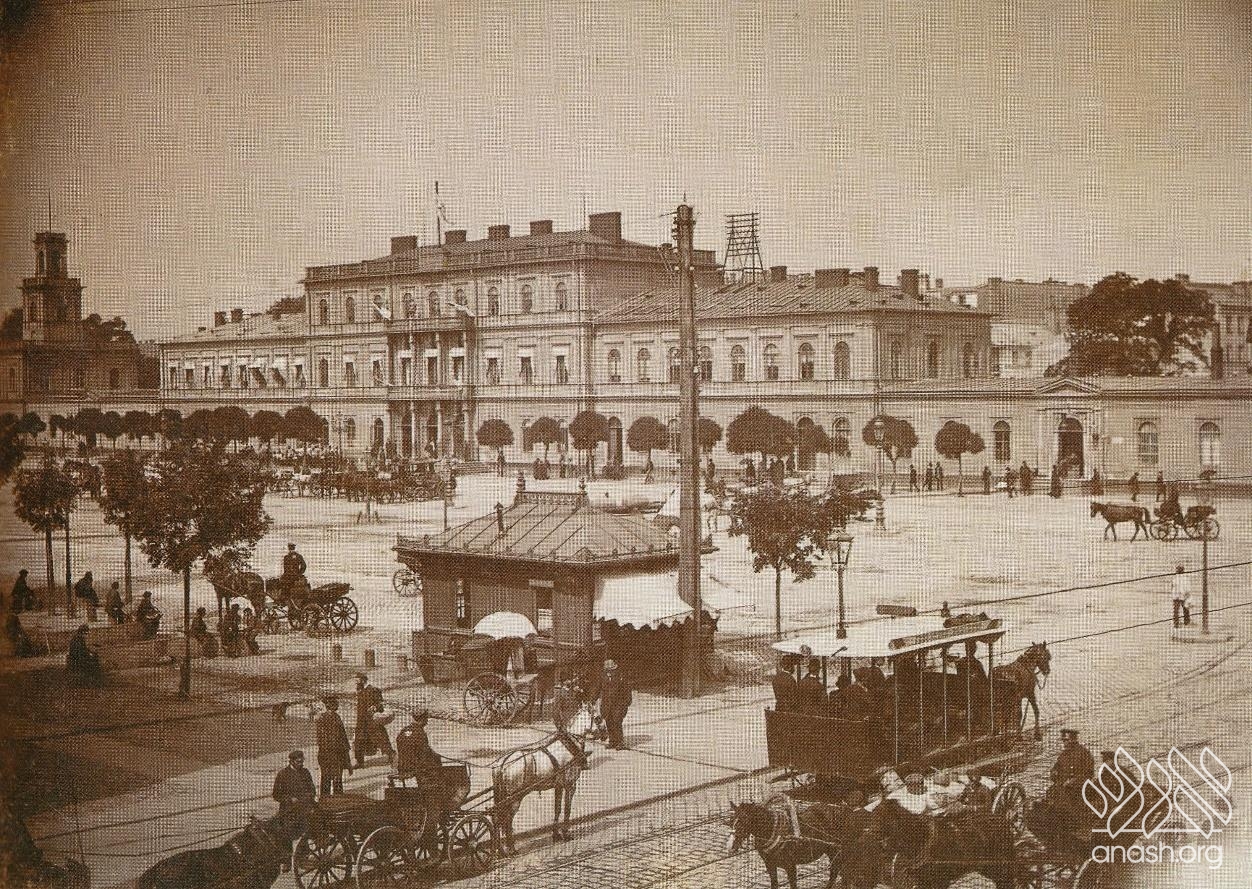
The “Vienna Station” in Warsaw, the starting point of the Warsaw-Vienna Railway.
But besides for this, the writer’s words are categorically wrong. The tzadik was not in Dinaburg at all this summer. In fact, at the beginning of the summer, he traveled to the sanitoriums abroad via the Moscow-Brisk train, and from there he continued to Vienna, via Warsaw. On his return, he traveled on Monday, 25 Elul (September 7) from Warsaw, passing through Brisk to Krasnoya, a few versts away from Lubavitch. He did not pass through Dinaburg at all.
The letter by Mr. Yafit was written on August 26th, and was published in Hameilitz on September 8th, while the Rebbe was still abroad. It is therefore clear that the writer’s words don’t contain even a kernel of truth.
Yaakov Meir Lifshitz.
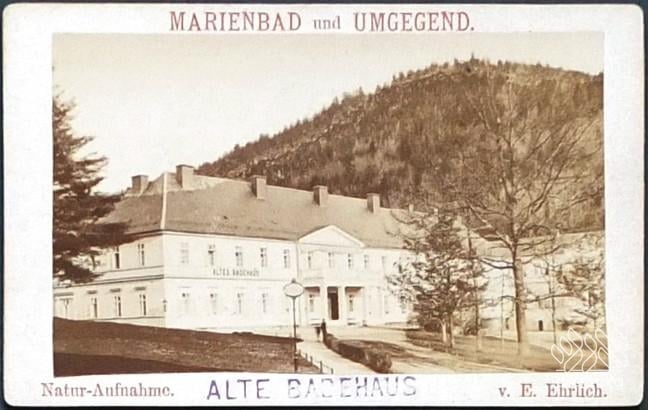
This letter gives us detailed information about the Rebbe Maharash’s journeys in the summer of 5641. We know from letters printed in Igros Kodesh of the Rebbe Maharash (p. 24) that in the summer of this year, the Rebbe Maharash traveled to the health sanatorium of Marienbad, famous for its mineral baths.
The bathhouse in Marienbad, pictured in 5640, shortly before the Rebbe Maharash visited.
These letters record that the Rebbe Maharash arrived in Marienbad on 2 Tammuz, after traveling via Brisk and Warsaw. A letter written by the Rebbe Maharash six weeks later, on 18 Elul, states that he plans to depart Marienbad for home tomorrow and that he is unsure whether he will stay in Vienna for Shabbos. Lifshitz’s report tells us that Rebbe Maharash departed Vienna on Monday, 25 Elul, indicating that he did in fact stop along the way for Shabbos.
After publishing Lifshitz’s letter, the editor apologizes again for the slanderous report and reiterates his words about the sterling reputation the Rebbe Maharash enjoys, well beyond his circle of chasidim.
We trust the words of this writer. Until Mr. Yafit proves that he was wrong only about the name, and that a different tzadik came to Dinaburg last summer, soon before the arrival of the Yerushalmi, and took the people’s money, his sin is recorded before the public and before us. He has misled us into spreading slander against a descendant of kedoshim, a great Torah scholar, who dedicates his life to Torah and avodah. He is also known as a wise man and respected by many, even by those who do not believe that he performs miracles in heaven and on earth. We must honor him as a person of great stature, and it is a criminal offense to hurt him or defame him.
The Clarification
The fake news saga ended with a response from Yafit, the man who sparked it. Hameilitz reported on 29 Cheshvan (November 22) that Yafit wrote to them, claiming that he had mailed them a correction even before readers had called him out for fake news, but the letter was apparently lost in the mail. He now wrote again to set the record straight, asserting that his only mistake was the name of the visiting rebbe: instead of the Rebbe Maharash, it was actually the Rebbe of Kopust. Other than the name, he stands by all the other details in his original report.
The editor adds that he has received independent confirmation that the Kopuster Rebbe did in fact visit Dvinsk in the summer, so Yafit has been vindicated. The editor also notes that he has been told that Lifshitz, the letter-writer from Sebizh who gave the details of the Rebbe Maharash’s travel schedule, is actually a chasid, contrary to his claim.
To view all installments of From the Margins of Chabad History, click here.
For additional exclusive content, follow the column on X: x.com/ChabadMargins
Dvinsk in 5635, by Polish artist Napoleon Orda.
Sebizh in 5635, by Polish artist Napoleon Orda.
The “Vienna Station” in Warsaw, the starting point of the Warsaw-Vienna Railway.
The bathhouse in Marienbad, pictured in 5640, shortly before the Rebbe Maharash visited.
The masthead of Hameilitz newspaper in its first year of publication, 5621. Originally based in Odessa, the newspaper moved to Peterburg in 5631.
Harav Moshe Avigdor Chaikin (5612-5688), the son of the Peterburg shochet R. Yisrael Shraga.
COMMENTS
We appreciate your feedback. If you have any additional information to contribute to this article, it will be added below.
Rabbi Moshe Avigdor Chaikin was born in Sklov in 1852 and moved to Petersburg, where his father was Chief Shochet. He had Semicha from Rabbi Yitzchak Elchanan Spektor of Kovno.
He emigrated to England in 1890 and was appointed Rabbi of Sheffield, and then, on 15th December 1901 was appointed Chief Minister of the Federation of Synagogues until he became a Dayan of the London Beth Din in 1911. He was a fervent Chasid of Chabad and Chief Rabbi Hertz described him as “…a never-failing fountain of Jewish lore; a river flowing on with ever-sustaining vigour… a born Chasid, a Chasid by nature even more than by upbringing…. his was the joyfulness of the true Chasid, the optimism, the clarity in judgement, the obstinate refusal to despair of his fellow mortals and their destiny, which made him the friend to all, beloved by all, loving God and loving all of God’s children.”
He belonged to the Old Castle Street Shtiebl at 42 Old Castle Street, also known as Agudat Achim Kehal Chabad.







 COMMENTS


Rabbi Moshe Avigdor Chaikin was born in Sklov in 1852 and moved to Petersburg, where his father was Chief Shochet. He had Semicha from Rabbi Yitzchak Elchanan Spektor of Kovno.
He emigrated to England in 1890 and was appointed Rabbi of Sheffield, and then, on 15th December 1901 was appointed Chief Minister of the Federation of Synagogues until he became a Dayan of the London Beth Din in 1911. He was a fervent Chasid of Chabad and Chief Rabbi Hertz described him as “…a never-failing fountain of Jewish lore; a river flowing on with ever-sustaining vigour… a born Chasid, a Chasid by nature even more than by upbringing…. his was the joyfulness of the true Chasid, the optimism, the clarity in judgement, the obstinate refusal to despair of his fellow mortals and their destiny, which made him the friend to all, beloved by all, loving God and loving all of God’s children.”
He belonged to the Old Castle Street Shtiebl at 42 Old Castle Street, also known as Agudat Achim Kehal Chabad.