




ל׳ אב ה׳תשפ״ו | August 13, 2026
The Unique Challenge of Our Generation
“Naturally, the first thing we think about when it comes to this topic is the tznius in women’s and girls’ dress. The truth, however, is that it’s also about men and boys. In fact, Reb Hillel Paritcher spoke about the men’s dress!”
By Rabbi Mordechai Lipskier
In the mid-1800s, Tsar Nicholas the rasha made many gezeiros against the Yidden. For example, he decreed that all Yidden must shave their payos. Policemen roamed the streets freely, cutting off the payos of anyone disobeying the law.
The illustrious chossid Reb Hillel Paritcher was adamant about keeping his payos at all costs.
While walking on the street one day, he was caught by a policeman who began wrestling with him to forcibly cut off his payos. Reb Hillel made it clear that the only way they would get to his payos was if they cut off his hands, R”l. A Jewish tailor saw the commotion and managed to convince the police to release the saintly old man. In gratitude, Reb Hillel promised the man “imi bimechitzosi,” that he would be together with him in the World to Come.
Several years later, Reb Hillel Paritcher moved to Cherson, passed away, and was buried there. A few years after that, an old man came to visit his daughter in Cherson and suddenly fell ill and passed away. He was a simple man, so the chevra kadisha buried him in what they thought was an ordinary plot, but when the snow melted several months later, they were shocked to see that he was buried right next to the tzadik Reb Hillel! They asked the local rov what to do and, after some inquiring, discovered that this man was none other than the tailor. Reb Hillel had made good on his promise.¹
Another gezeirah was that all Jews had to wear hats with visors. Here, too, Reb Hillel had mesiras nefesh not to wear this hat. Even in the scorching heat, he always wore his traditional fur hat.²
Also in his teachings, we can see Reb Hillel’s passion for maintaining the Yiddishe levush, the uniquely Jewish way of dress.
“How can it be,” he once asked, “that Yaakov Avinu, the embodiment of middas ha’emes, should mislead his father into thinking that he is Eisav?! For someone like him, it should have been impossible to utter anything but the complete truth!”
The answer, he explained, is that clothing has a very powerful impact on a person; since he was wearing Eisav’s clothing, it had a negative effect on him.
Reb Hillel Paritcher’s passion and mesiras nefesh were so unique that it prompted chassidim to ask him where he got his strength from. He answered: “I have a manuscript written by the tzadik Reb Pinchas of Koritz, and if you would have this in your possession, you would also be as strong as I am!”
What was written in that note?
Today we are fortunate to have it printed in a sefer called Imrei Pinchas:³
After the Yidden left Mitzrayim, they merited to enter the 49 gates of kedushah, but the 50th gate was not attainable for them.
Why not?
While in Mitzrayim, they refined all 49 gates of tumah, and this made them capable of receiving the corresponding gates of kedushah. But the 50th gate of tumah was beyond their ability to refine—had they entered that gate they would have remained stuck there R”l!
And since they didn’t refine the 50th gate of tumah, they didn’t have the ability to enter the 50th gate of kedushah.
What is the nature of the 50th gate of tumah? Reb Pinchas explains that it’s the kelipah that fights against maintaining our Yiddishe name, Yiddishe levush, and Yiddishe language. True, the Yidden in Mitzrayim were able to maintain these things, but they didn’t have the power to really fight for them and overcome the essence of the kelipah.
Then he brings a shocking statement:
In the times before Moshiach, however, Yidden will have the power to elevate even the 50th level of tumah and thus merit the 50th gate of kedushah!
Before Moshiach’s arrival, Reb Pinchas explains, the temptation to change from the Yiddishe levush will be extremely strong and many Yidden won’t be able to withstand the test, R”l. And in the merit of the Yidden who will stay strong in the face of this great test, the 50th gate will be overcome, Moshiach will come and we will merit the 50th gate of kedushah!
This, Reb Hillel told the chassidim, is the challenge of our times, and we have the unique ability to overcome it!
Fast forward to 5786 (2026), and it’s plain to see that the kelipah against the Yiddishe levush is stronger than ever.
*
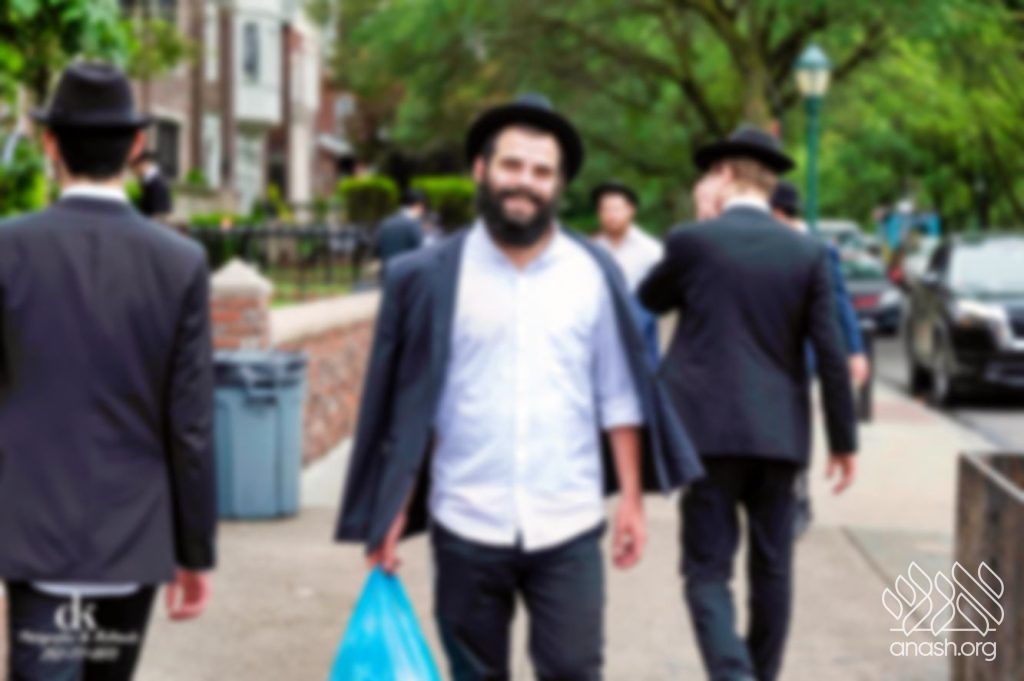
Naturally, the first thing we think about when it comes to this topic is the tznius in women’s and girls’ dress. The truth, however, is that it’s also about men and boys. In fact, Reb Hillel spoke about the men’s dress!
The Rebbe once spoke about the idea that men must keep the halachos of tznius and not walk around in the “country” during the summertime in short pants. “A reduction in clothing indicates a reduction in sechel!” the Rebbe quipped.⁴
Perhaps it can be said that when a man keeps his shirt buttons adequately closed, it’s an eidelkeit that breaks today’s kelipah.
Furthermore, Chabad men always wore hats and jackets, wherever they went, and especially during davening. This is based on halachah and on minhag.
Today, there’s a lot of ignorance, leading to indifference, regarding this age-old practice. Many yungeleit are even under the impression that once they get married and start wearing a tallis, they no longer have to wear a jacket during davening.
While sitting at a Shabbos kiddush in shul recently, I had a geshmake conversation with a yungerman sitting next to me about the fact that he walked from his shul to ours without his kapata. We discussed the importance of dressing appropriately in general, and that the concept of dressing for davening in the clothing you’d wear when going to the Rebbe is actually a halachah!⁵ He was appalled that he had never been told this in yeshivah. He resolved to wear a hat and jacket for davening.
*
One of my most memorable moments in yeshivah was when Rabbi Yossel Rosenfeld, a”h, Executive Director of Oholei Torah, came to the beis medrash on Troy Avenue to give us a talk. One of his simple, straightforward messages was that a bachur should already now prepare for the time that he’ll leave yeshivah.
“If you get a job in Manhattan and you need to ride the subway every morning,” he thundered in his inimitable style, “make sure to dress like a chossid! This will keep you in line and protect you from outside influences. By dressing differently, you’ll be reminded that you are different!”
It’s absolutely imperative that mashpi’im talk and farbreng about these “simple” values. Yiddishe dress is the unique challenge of our generation and therefore the unique strength available to us. And the beautiful fact is: Our generation is not only receptive but also yearning, thirsting to hear all about it—as that yungerman at the kiddush demonstrated!
May all our efforts in this regard bring Moshiach b’karov mamash!
¹ Shemuos V’sipurim Vol. 1 pg. 268.
² See sichah of Simchas Beis Hashoeivah 5714 (1952) and sources cited there.
³ Section entitled Parshas Bo.
⁴ Sichah of Parshas Shelach 5723 (1963).
⁵ See Achronim to Shulchan Aruch, Orach Chaim siman 91.
Republished from the N’shei Chabad Magazine
 COMMENTS


So well written and the point was brought out in a truly educational way!
Thank you for sharing.
Rabbi Yossi Paltiel explains here very eloquently how vital this really is!
A must watch and publicize!
https://anash.org/why-doesnt-chabad-wear-long-jackets-like-other-chassidim/