




ט׳ מרחשון ה׳תשפ״ז | October 20, 2026
The Rebbe Saw East Flatbush’s Potential 64 Years Ago
Three newly published letters reveal the Rebbe’s remarkable assessment of East Flatbush, his personal initiative to secure funding for its mikvah, and his strong insistence that its construction could not wait.
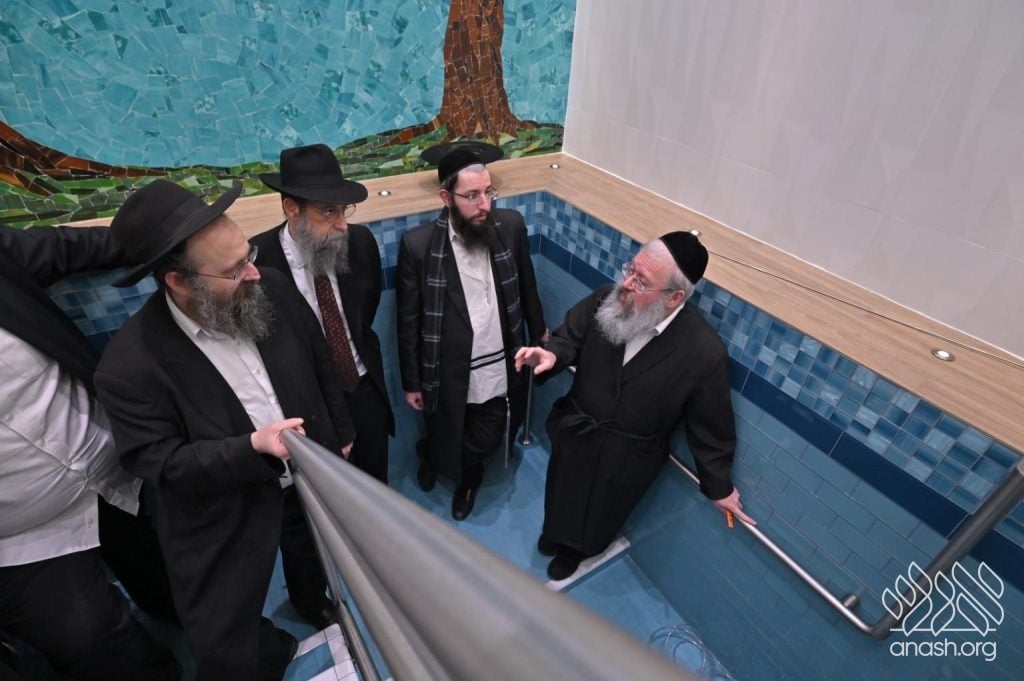
Three newly published letters reveal the Rebbe’s remarkable assessment of East Flatbush, his personal initiative to secure funding for its mikvah, and his strong insistence that its construction could not wait.
More than six decades later, the historic mikvah is being rebuilt to serve a growing Jewish community.
In 5722 (1962), East Flatbush had a sizable Jewish community, with many young couples. Its future, however, was far from certain.
In the decades that followed, the Jewish population dropped sharply. Shuls struggled to stay open, institutions faced financial trouble, and the neighborhood’s mikvah fell into disrepair.
“A whole neighborhood … closer to home, a neighborhood where many young Jewish couples live and attracts new couples, deserves special consideration,” the Rebbe wrote in a fascinating letter now published for the first time.
Today, Lubavitcher families are moving back and rebuilding Jewish life there. Against that backdrop, the words above, written in a letter dated 23 Shevat 5722 (January 28, 1962), could almost have been written about East Flatbush today: young Jewish couples, more couples on the way, and a neighborhood that deserves special consideration.
The letter was addressed to Mr. Elimelech Mordechai (Max) Schreiber, a philanthropist who devoted his life to building mikvaos. But there’s a lot more to the story.
The previous evening, before the Rebbe addressed the letter, representatives of the Rabbinical Board of East Flatbush had come to see the Rebbe about a serious problem.
Work on the neighborhood’s mikvah had begun long before, but the project had run out of money. Only the walls and roof were finished, and a substantial sum was still needed.
The Rebbe took on the project himself.
Schreiber, known as “Mikvah Max,” had helped bring about more than 350 mikvaos, mostly in Eretz Yisroel. The Rebbe knew his work well and regularly encouraged and supported it. Now, the Rebbe was asking Schreiber for something outside his usual focus: a mikvah in Brooklyn.
The Rebbe acknowledged that Schreiber’s main concern was Eretz Yisroel, but asked him to make an exception and contribute generously to the East Flatbush project.
He offered to serve as the go-between with the local rabbonim or to put Schreiber in direct contact with the organization’s treasurer, Rabbi Shalom Zvi Barenholtz.
The Rebbe also wrote that he had urged the delegation to get a kosher mikvah up and running right away, without waiting for the whole project to be completed. The matter was so pressing that he sent the letter by Special Delivery.
A second newly released letter, dated 2 Adar I 5722 (February 6, 1962), shows how personally the Rebbe took the matter.
Schreiber had apparently understood that the East Flatbush delegation had asked the Rebbe to approach him for money, which would pull resources away from his work in Eretz Yisroel.
The Rebbe assured him that the representatives hadn’t even known about Schreiber’s foundation. The Rebbe had decided on his own to approach him. “It was completely my own idea,” the Rebbe wrote.
This wasn’t a request the Rebbe was simply passing along. It was the Rebbe’s own initiative, taken after hearing what the neighborhood needed.
The Rebbe also made clear that helping a mikvah in Brooklyn did not mean neglecting Eretz Yisroel. Someone devoted to one important cause can still help another worthy one, and even when funds are tight, a request for help deserves serious thought.
After the Rebbe’s appeal, Schreiber sent $500, a large sum of money at the time, toward the East Flatbush mikvah.
In a later letter, dated 21 Adar I 5722, the Rebbe confirmed that the money had been passed on to the committee of rabbonim and said he had prospects for another donation.
By Kislev 5723, the mikvah was nearing completion. The mikvah at 340 East 52nd Street went on to serve the community for decades. Among the rabbonim involved in its upkeep were Rabbi Yaakov Yehudah Hecht, Rabbi Chaim Meir Bukiet, and Rabbi Michoel Teitelbaum.
As the Jewish population shrank, keeping it going became harder. By the late 2010s, the aging building faced possible redevelopment. Community activists stepped in, and in 2020, the property was acquired for restoration.
Today, the site is being rebuilt as Chayala’s Mikva, named in memory of Chaya Moussia Levy AH. It is intended to serve as a modern mikvah and communal center for the area’s returning Jewish families. Work continued through 2026, including completion of the rainwater reservoir and major structural work.
The same mikvah the Rebbe pushed to fund more than sixty years ago is now entering a new chapter.
Read the letters here.
*
The full letters appear in this past week’s Rebbe Responsa, along with more correspondence about mikvah construction around the world.
The issue also tells the story of Max Schreiber, whose decades-long relationship with the Rebbe produced a large body of correspondence, including three newly released letters.
Readers can browse more than 5,000 of the Rebbe’s original English letters on the Rebbe Responsa app, available for smartphones. Anyone with English letters from the Rebbe, whether in family collections, personal archives, or wedding teshuros, is encouraged to share them with the project at [email protected].
 COMMENTS


We appreciate your feedback. If you have any additional information to contribute to this article, it will be added below.