




כ״ה תשרי ה׳תשפ״ז | October 6, 2026
‘Rambam Clearly’ Helps One-Perek Learners Understand Every Day
‘Rambam Clearly’ combines the original Hebrew, switchable translation and elucidation, word-by-word help, iyun, Rebbe insights, practical lessons, and progress tracking to help one-perek learners understand what they learn each day.
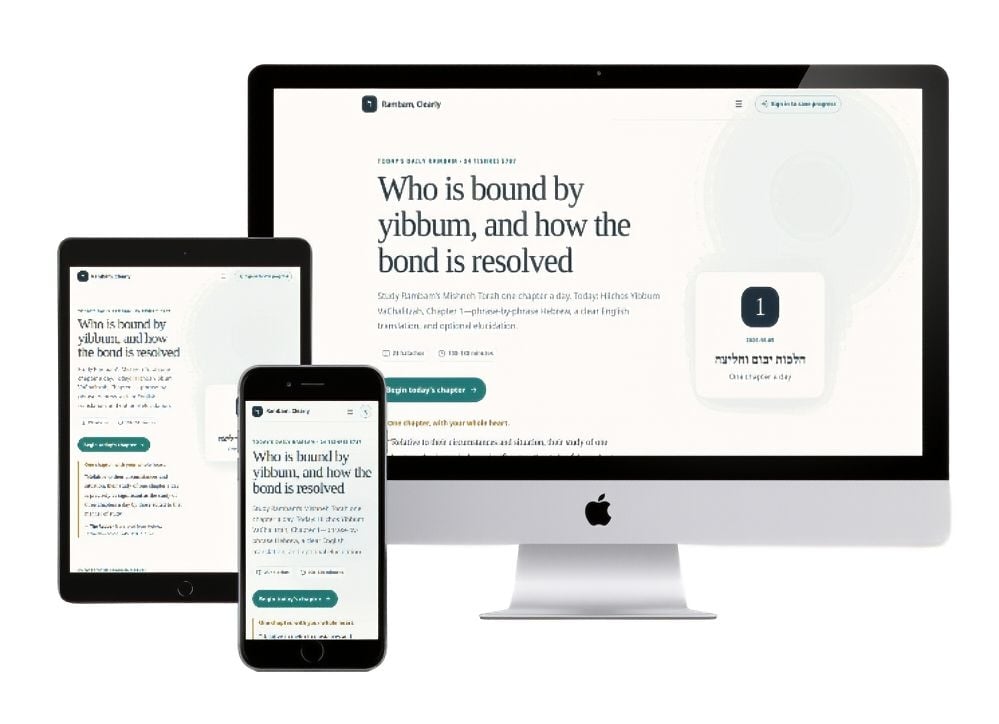
For someone committed to the Rebbe’s takanah of daily Rambam, there is a quiet challenge that can appear even when the learning is going well.
You open the perek. You read the Hebrew and English. You make it through all the halachos. But if someone asked a few minutes later why the Rambam distinguished between two of the cases, or what exactly changed in the middle of a complicated halacha, you might need to open it again.
The difficulty is often not translating the Rambam. It is understanding him.
That is the problem Rambam Clearly was built to address. Rather than offering another place to simply access the daily Rambam, it is designed as a guided way to learn the Rambam himself — phrase by phrase, with as much or as little help as each learner needs.
The project follows the one-perek-a-day cycle and is built around a simple goal: a learner should be able to close the day’s perek feeling not only that he finished it, but that he knows what he learned.
An ArtScroll-style experience built around the Rambam
The feature that most immediately changes the learning experience is the way the text is presented.
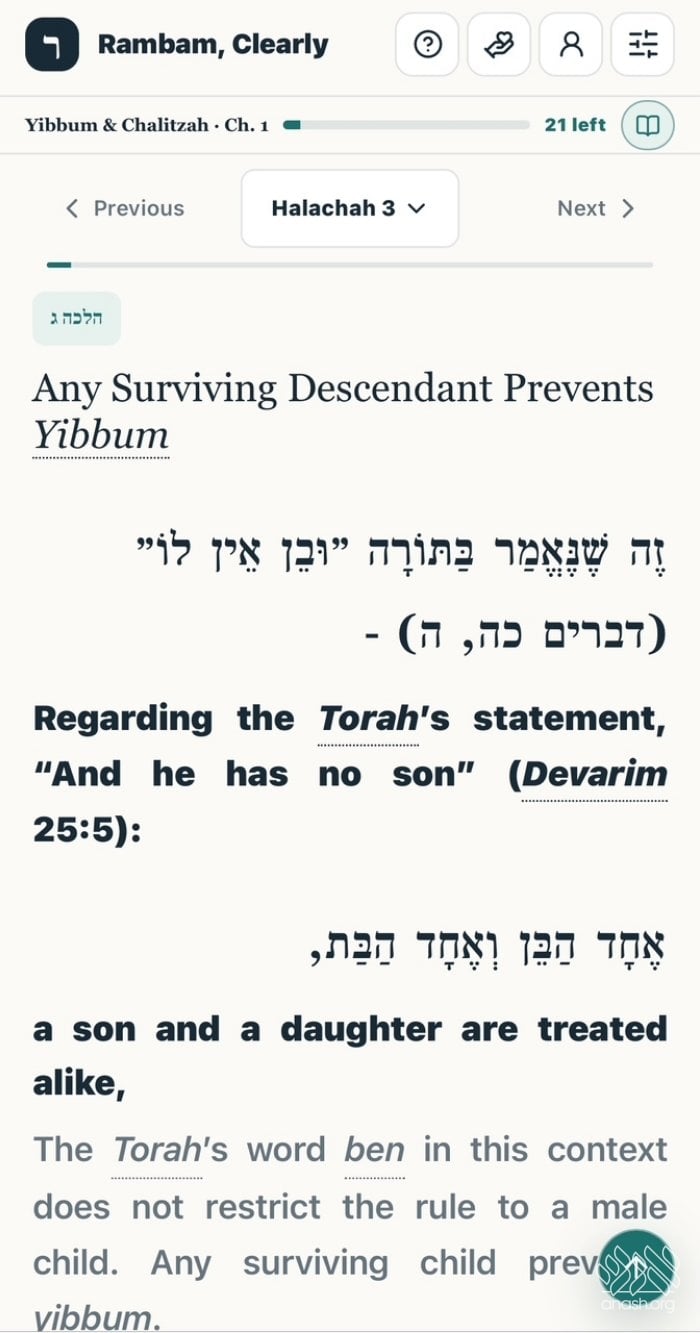
The Rambam’s original Hebrew is broken into short, natural units. Directly beneath each phrase appears a clear English translation. Then, where the translation still leaves something unexplained, a separate elucidation supplies the missing context: what the legal mechanism is, why the next case differs, what creates a doubt, or why a small qualification changes the ruling.
It feels in some ways like the learning experience many people know from an ArtScroll Gemara or Mishnah: original text, translation, and elucidation working together while remaining clearly distinct.
That distinction matters. The translation does not quietly insert commentary into the Rambam. The learner can always see what the Rambam actually said, what the words mean, and what has been added to make the halacha understandable.
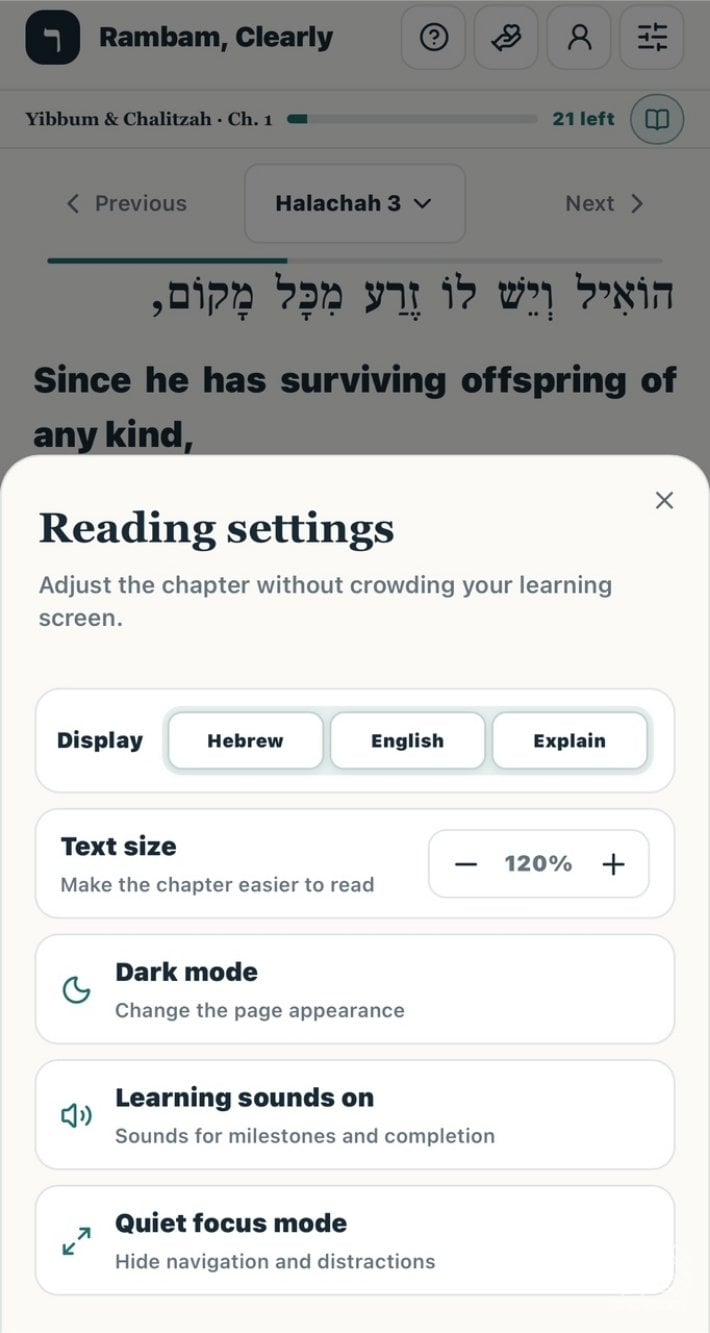
Because the site is digital, the learner can also choose how much help he wants. Hebrew, Translation, and Elucidation can each be turned on or off.
Someone who wants to challenge himself can hide the translation and try the Hebrew first. Someone comfortable with the basic meaning can leave the elucidation hidden unless he needs it. On a first pass through a difficult perek, all three layers can remain visible. On review, the same page can become much more stripped down.
The site therefore adapts to the learner rather than forcing every learner to use the same amount of help.
Where translation alone is not enough
A translation may tell you that if a newborn survives thirty days, the child is considered viable.
The sentence itself is understandable. But the learner may still be wondering: Why thirty days? What exactly is uncertain before then? Why does that uncertainty allow chalitzah but prevent yibbum?
Those are not translation questions. They are comprehension questions.
That is where the site’s Explain layer comes in. It is meant to supply the missing sentence or two that makes the Rambam suddenly make sense, without turning every halacha into a lengthy shiur.
The same need arises constantly throughout Mishneh Torah. A maternal brother may count as a relative for some halachos but not for yibbum. Kiddushin may take effect even though the relationship is prohibited. A minor’s act can have some legal significance without completing the acquisition.
A learner can understand every English word in those sentences and still not yet understand the halacha.
Rambam Clearly is built around noticing that difference.
When additional context is useful but not necessary, it appears in an optional Background panel, keeping the main learning uncluttered.
Helping the learner stay inside the Hebrew
Many people want to learn the Rambam in the original but find that technical vocabulary gradually pushes them toward reading only the translation.
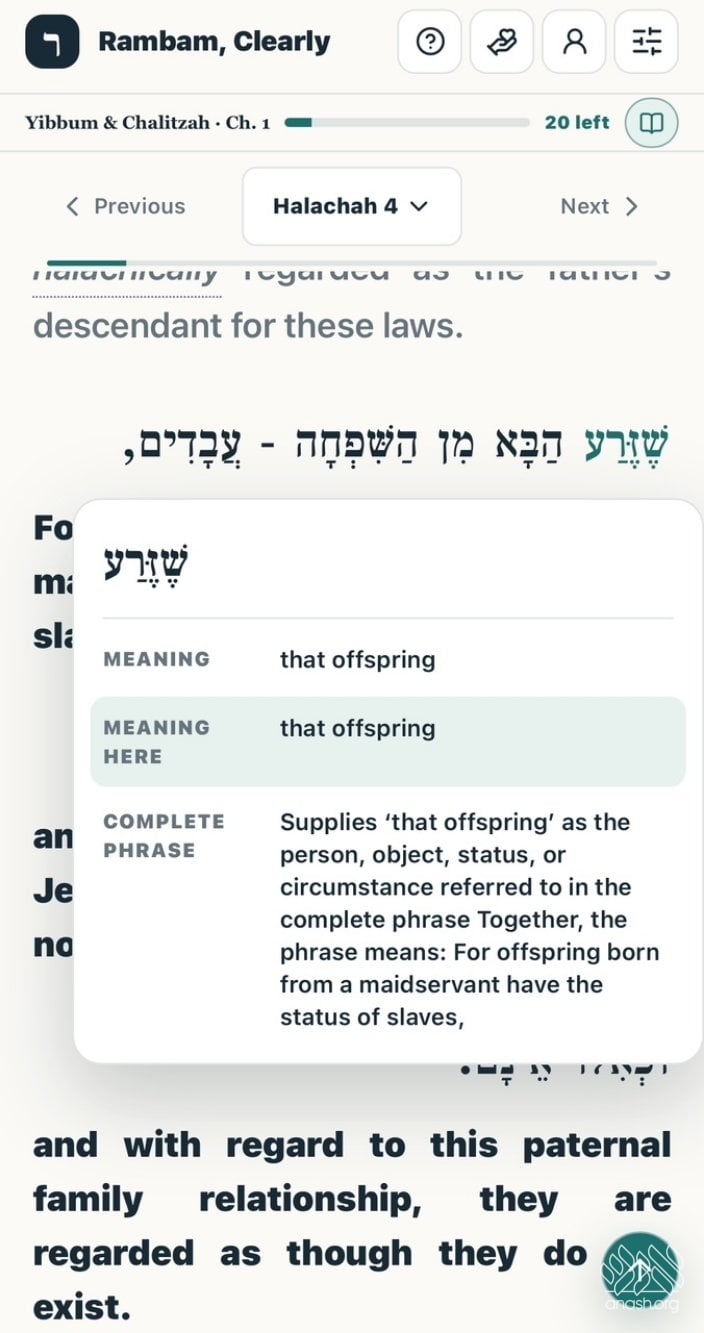
On Rambam Clearly, every Hebrew word can be tapped. A word card gives its basic meaning and, where needed, its meaning in that specific phrase, together with grammatical information where it has been reviewed.
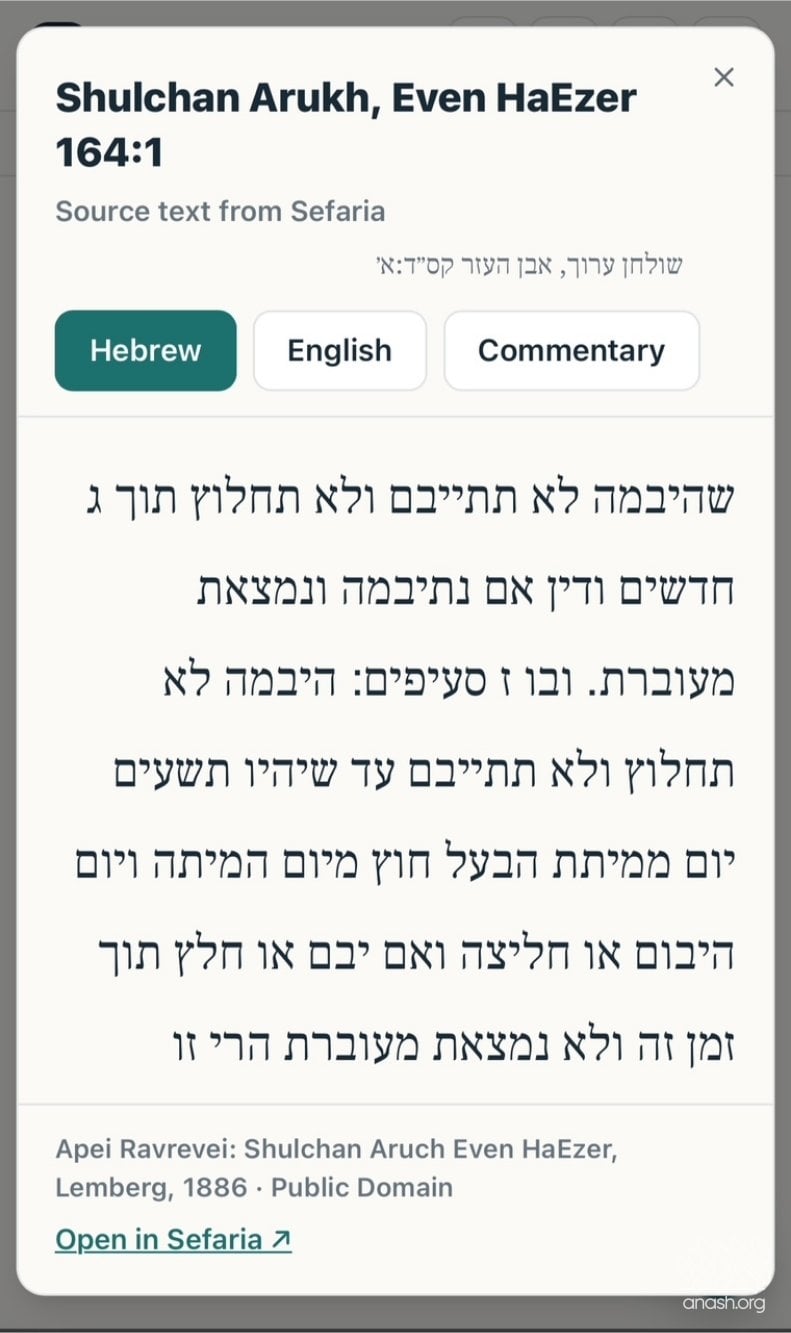
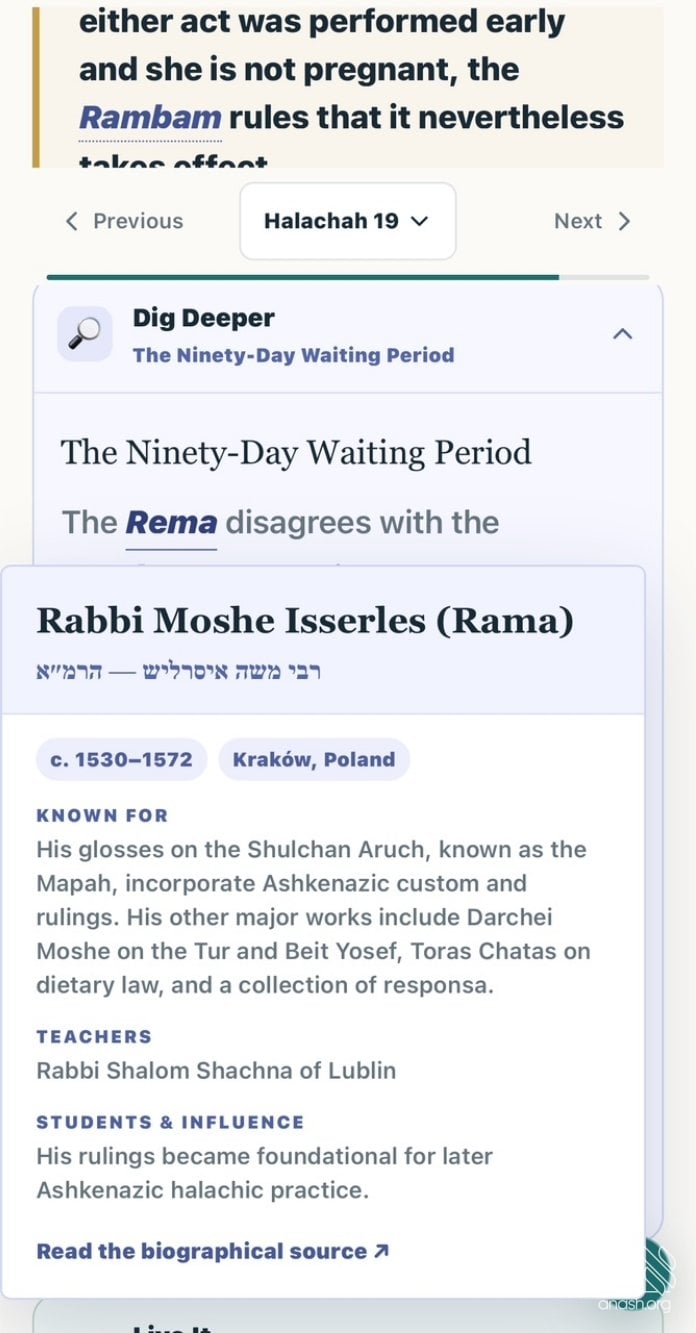
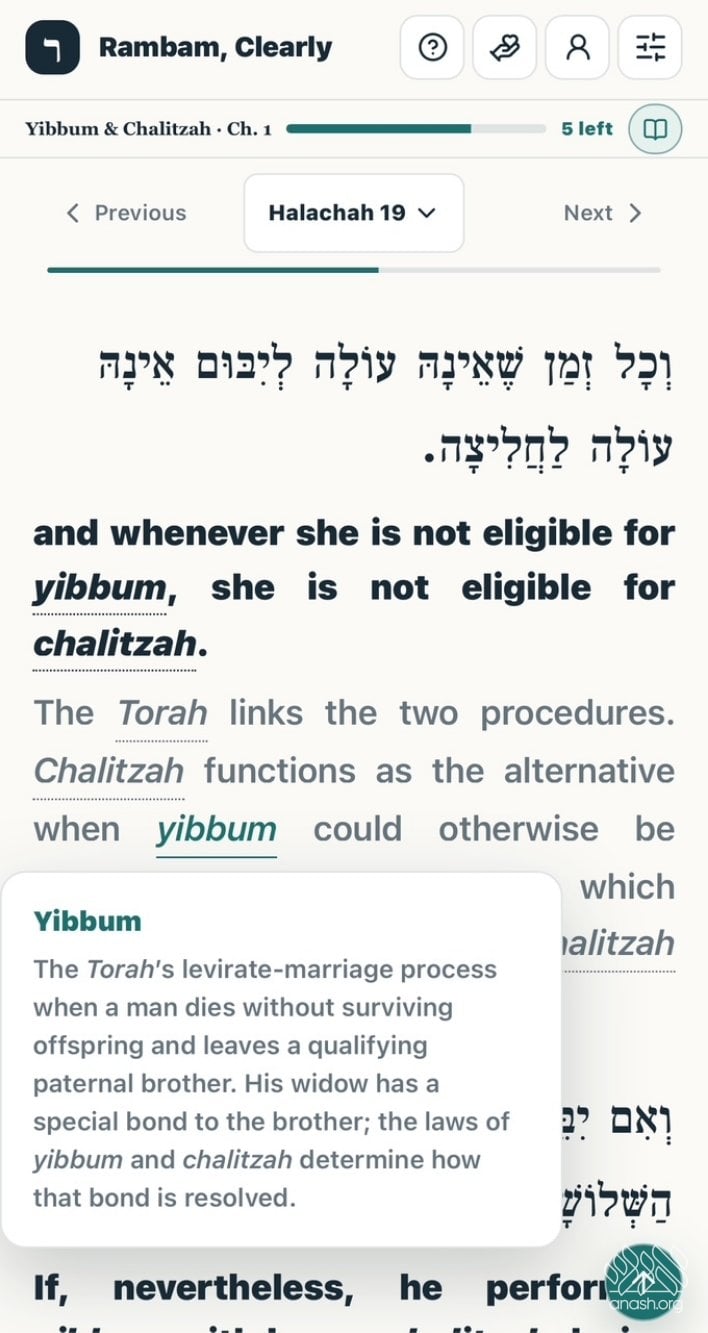
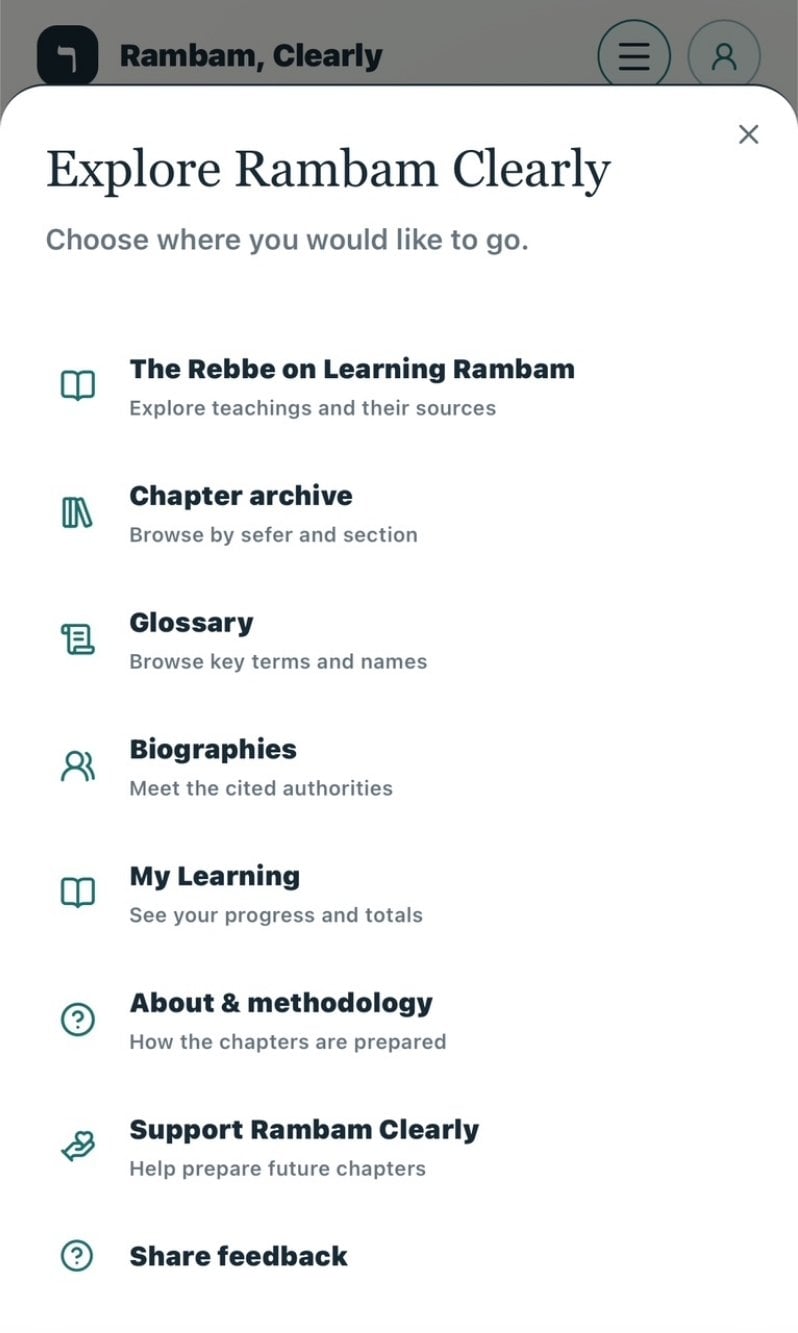
Recurring halachic concepts are connected to a shared glossary, while names of classic mefarshim and poskim can open short biographies. Source references remain available for someone who wants to continue exploring.
The goal is not to make the Hebrew less important. It is to remove the small obstacles that make an average learner give up on it.
Understanding the perek, not just individual halachos
A long Rambam chapter can easily become a collection of disconnected rulings.
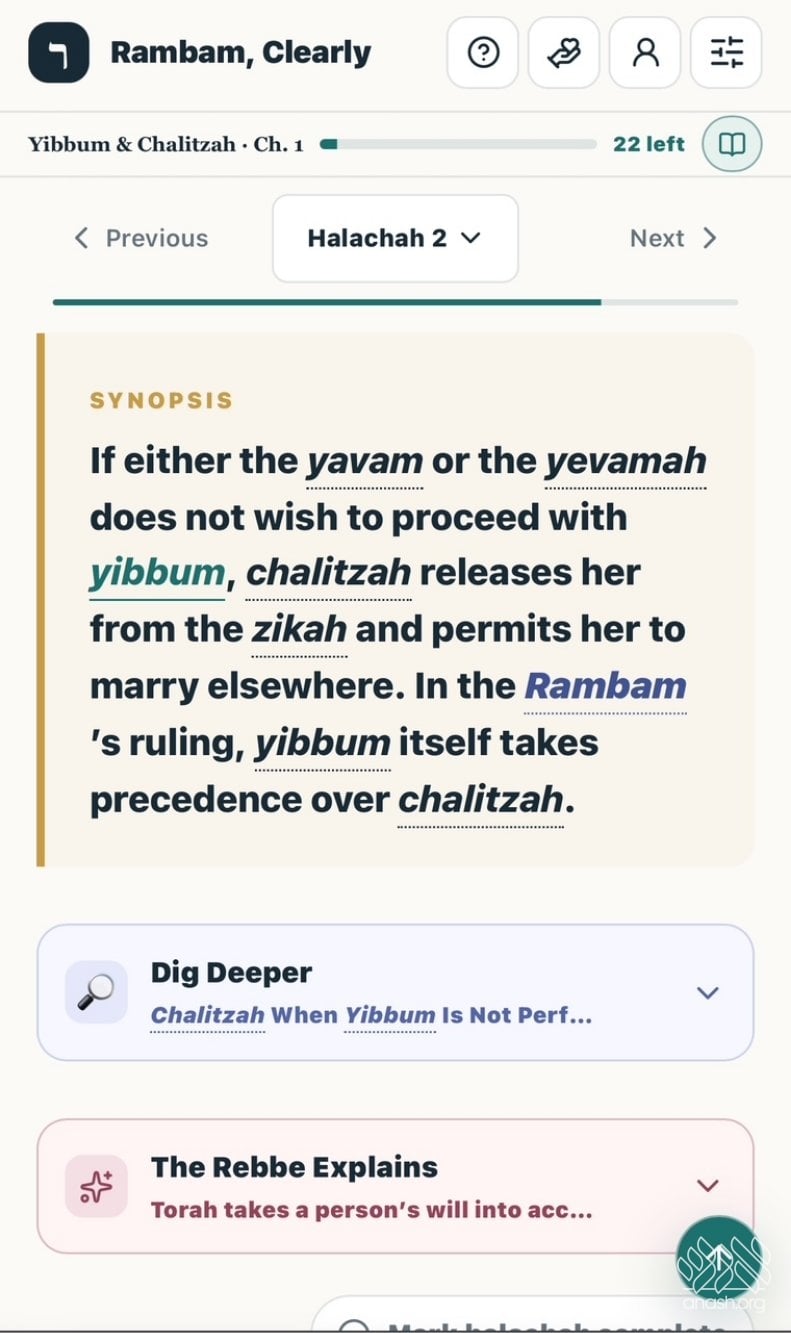
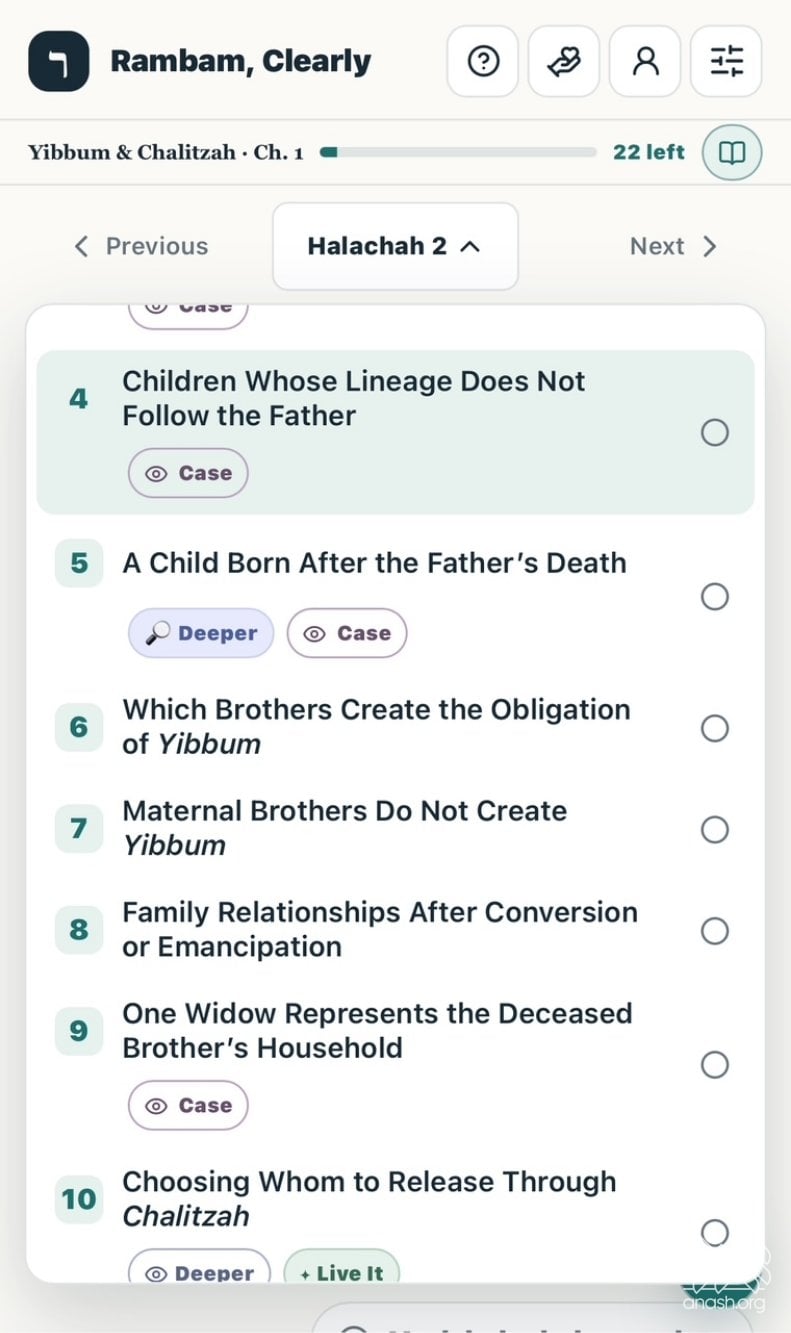
Rambam Clearly gives every halacha a descriptive English title. Instead of only “Halachah 19,” the learner may see “The Ninety-Day Waiting Period.” Instead of “Halachah 7,” he sees “Maternal Brothers Do Not Create Yibbum.”
At the end of each halacha, a concise Synopsis states the central ruling. Those titles also appear in the chapter navigation, turning the menu into an outline of the perek.
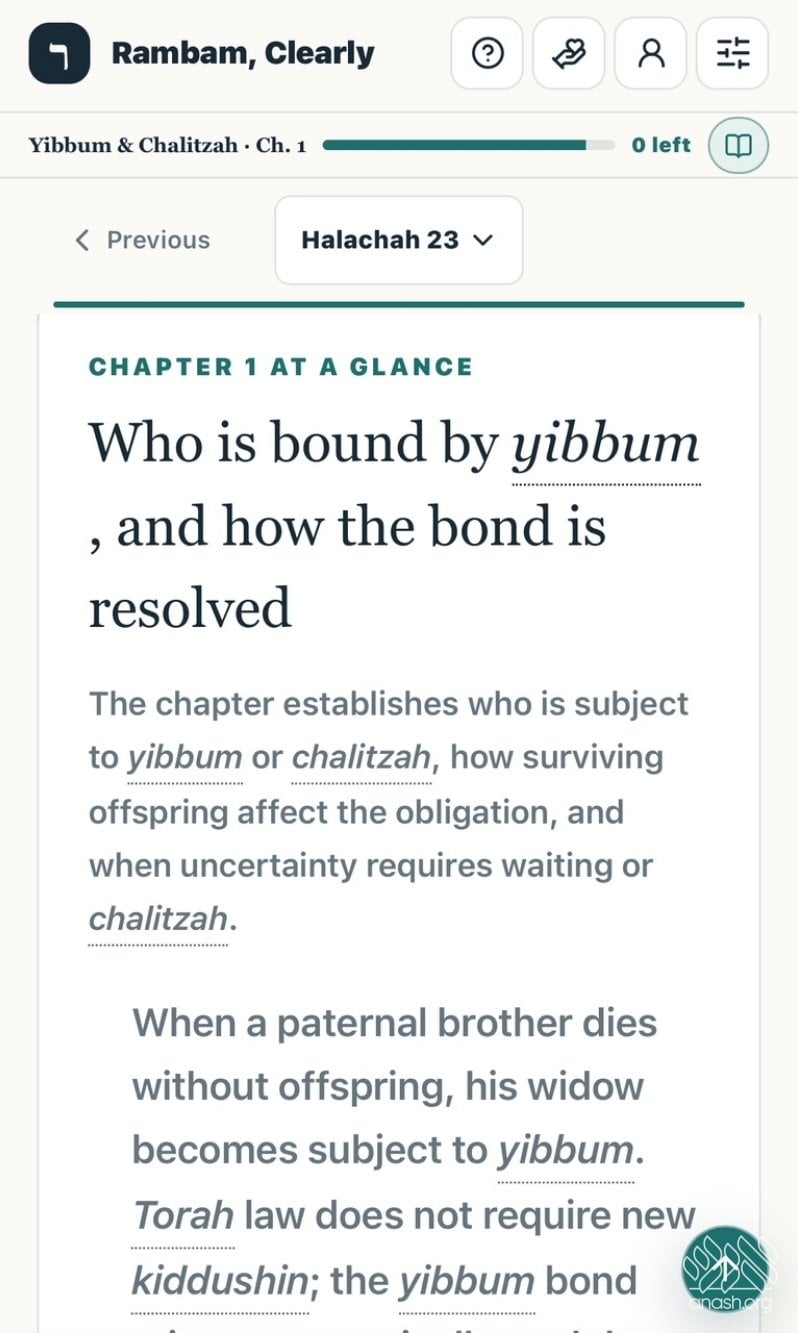
After a chapter is completed, Chapter at a Glance brings the main rulings together so the learner can review the structure of the perek as a whole.
The chapter page also gives an estimated study time and difficulty level, helping a learner know whether today’s perek is likely to fit into one sitting or may need to be divided through the day.
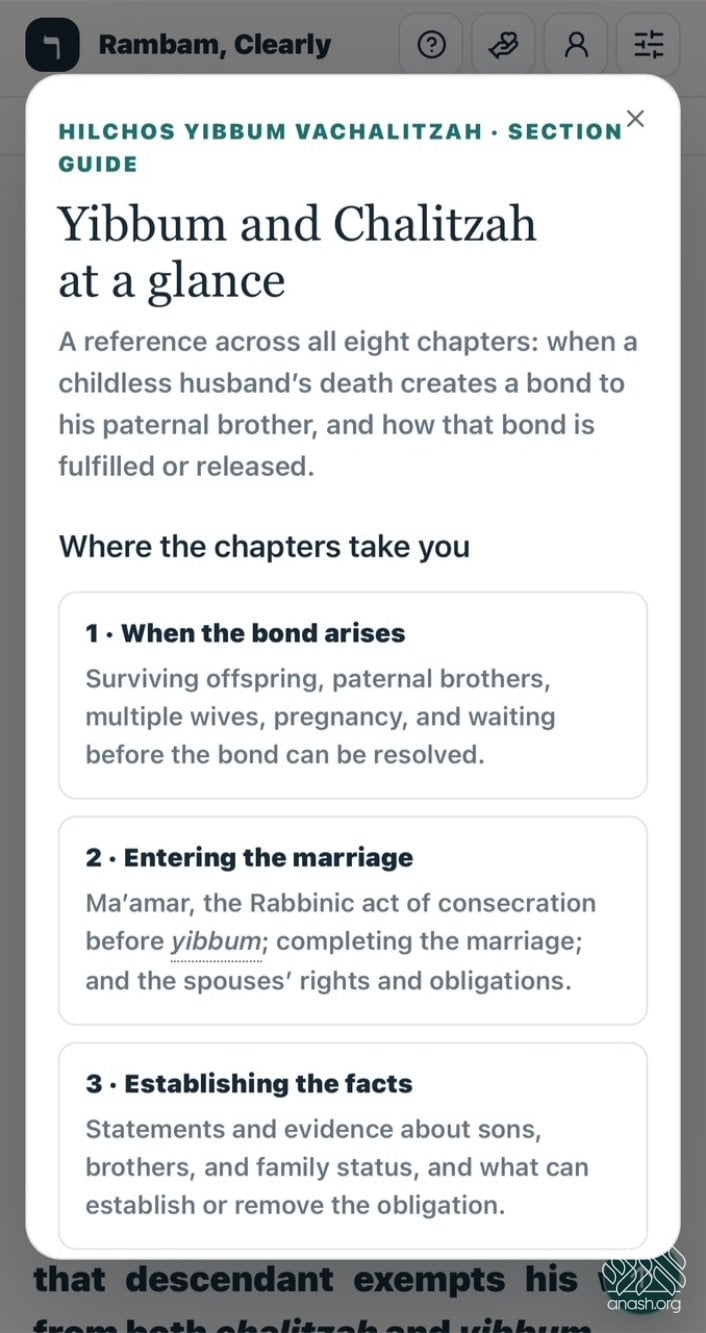
For larger sections of Rambam, the site is also developing section guides. The current Ishus, Gerushin and Yibbum and Chalitzah guides map recurring concepts and show how the chapters relate to one another, with concrete examples such as an actual ketubah or get where helpful.
Sometimes you need to see the case
Certain halachos remain abstract even after the words and reasoning are understood.
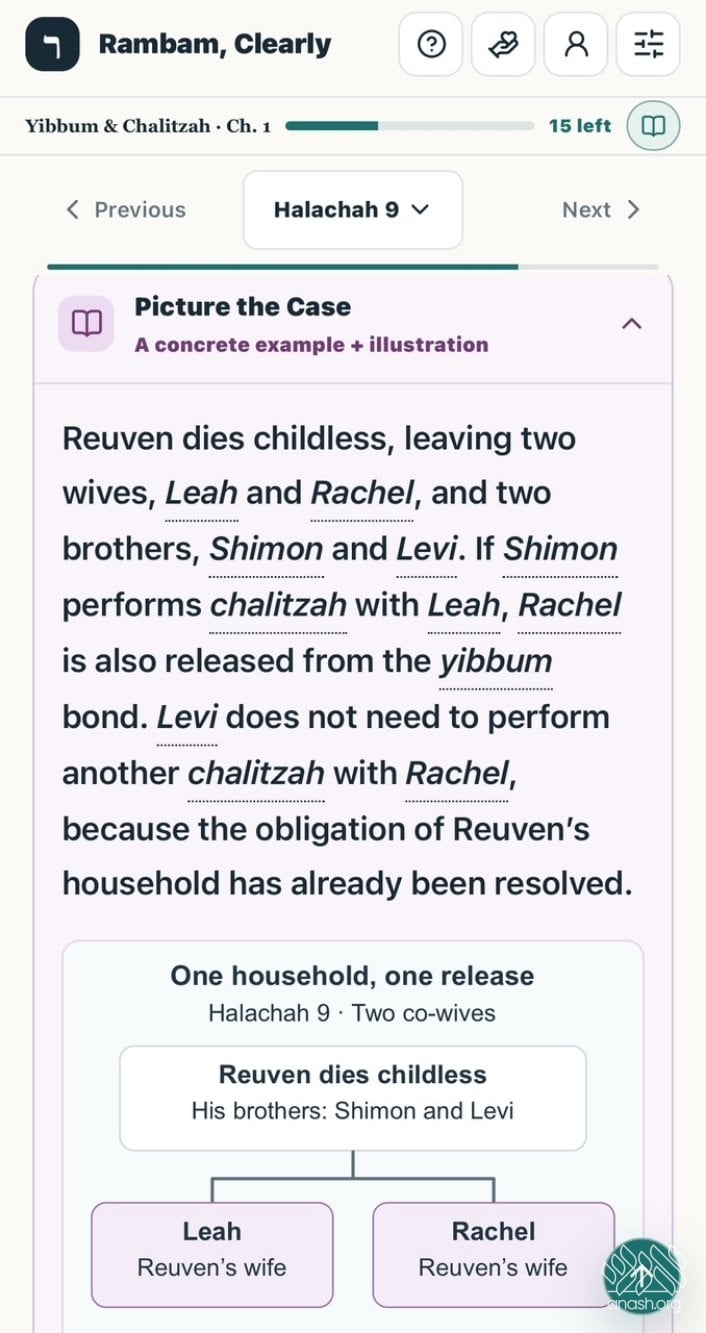
A man dies leaving two wives and several brothers. One brother performs chalitzah with one widow. What happens to the other wife? What obligation remains on the other brother?
For selected halachos, Picture the Case turns the ruling into a simple scenario with ordinary names and circumstances. Some cases also include an image where the physical setting or arrangement is important.
The point is not to illustrate every halacha. It is to use a concrete example precisely where the learner would otherwise have to keep too many moving pieces in his head.
The Rebbe encouraged learning at least one halacha in depth
One of the ideas shaping the site comes directly from the Rebbe’s guidance about daily Rambam.
The Rebbe repeatedly emphasized maintaining the common daily cycle while also encouraging additional depth. In 5749, the Rebbe referred to the earlier suggestion to “study at least one halachah a day in depth.” (Shavuos 5749 · Toras Menachem—Hisvaaduyos, vol. 3, p. 282)
That creates a practical challenge for a one-perek learner. If every halacha becomes an iyun seder, the daily perek may become impossible to finish. But if the goal becomes only covering the quota, the learner can miss the depth the Rebbe encouraged.
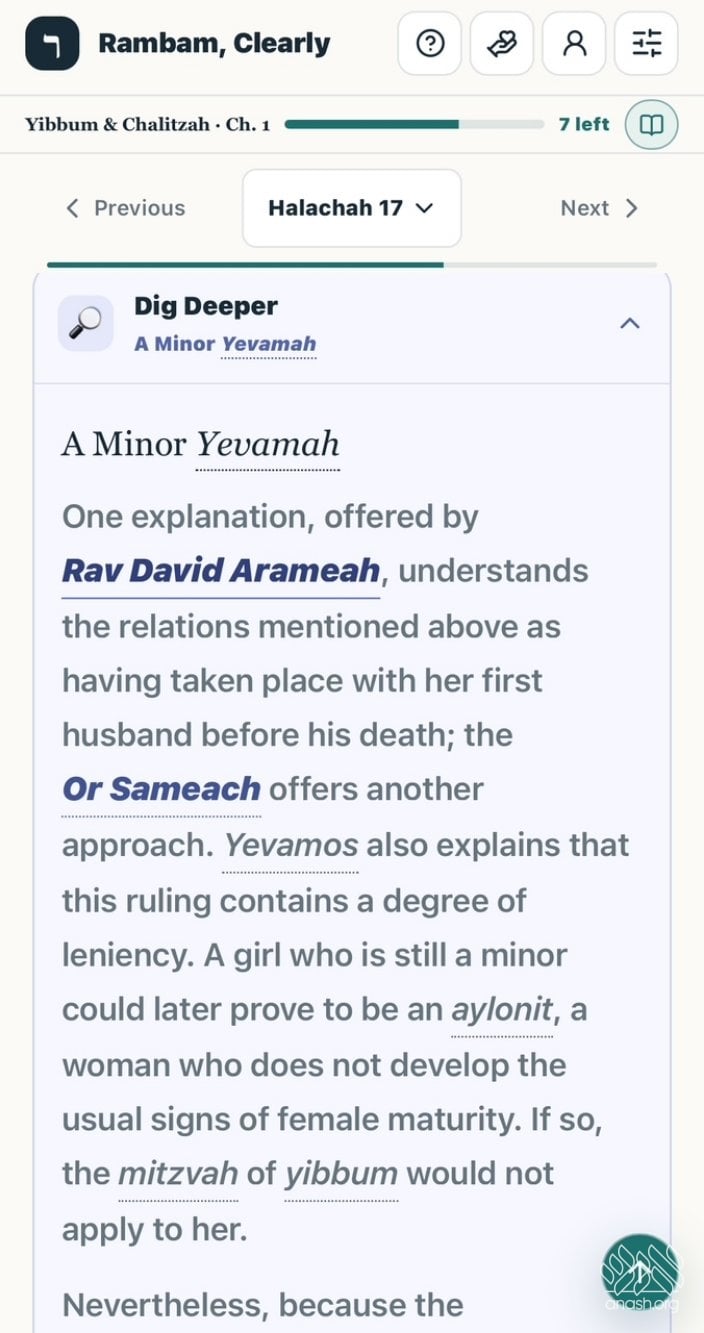
The site’s Dig Deeper panels are intended to make room for both.
Most of the perek can continue at a steady pace. Then, in selected halachos, an optional panel presents a meaningful question, explanation, or qualification from the Maggid Mishneh, Kesef Mishneh, Rema, Beis Shmuel, or another classic source.
The discussion is sourced, and deeper learning is tracked separately from ordinary completion. A learner can therefore finish the entire chapter while also remembering, “Today this was the halacha I stopped and learned more deeply.”
Taking the daily Rambam into the day
The Rebbe also modeled another dimension of Rambam learning: looking for something in the day’s halachos that could become part of the learner’s avodah.
In discussing the daily Rambam, the Rebbe spoke of trying to “derive a practical lesson in living our daily lives.” (Shabbos Parshas Noach 5749, section 19 · Hisvaaduyos, vol. 1, p. 309)
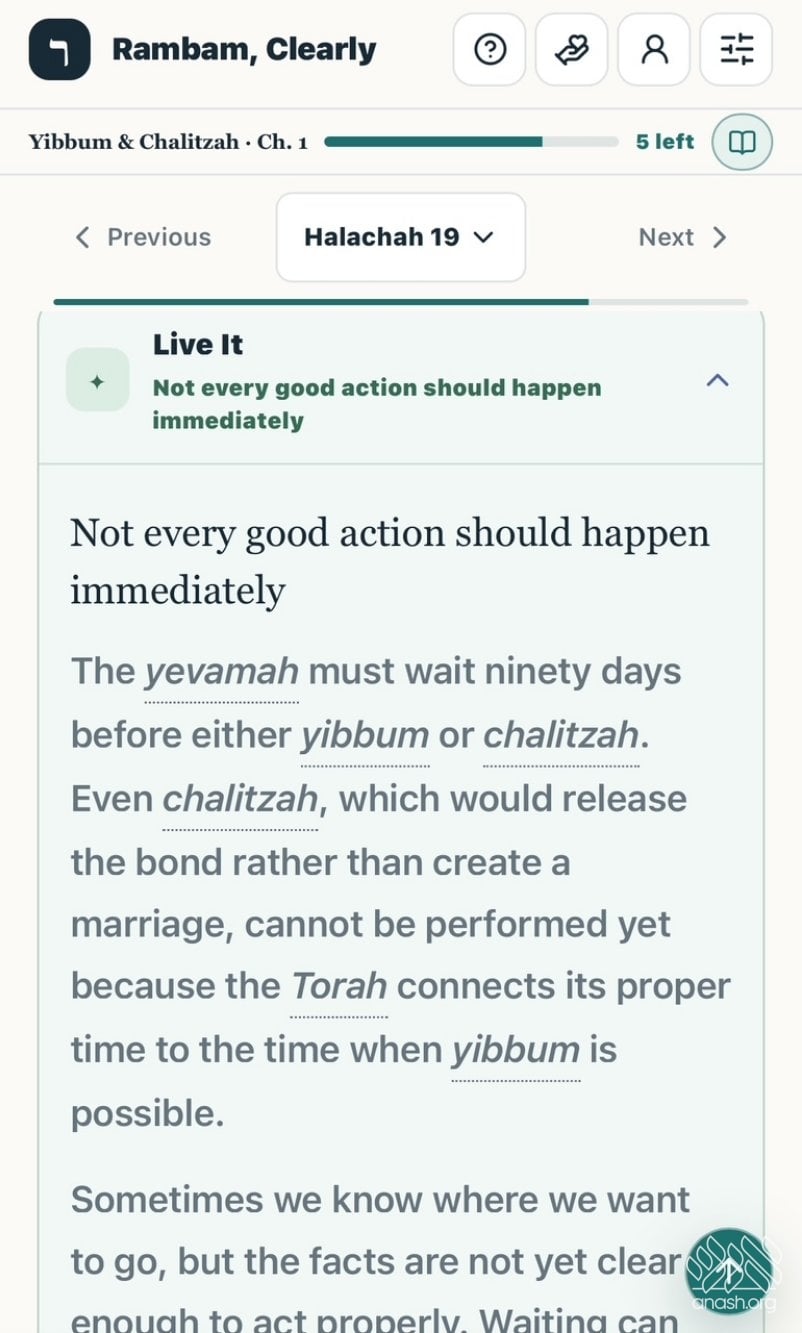
That is the inspiration for Live It.
Selected halachos include a short practical reflection connected specifically to the ruling, followed by one realistic “Try today.” A halacha that shows concern not to unnecessarily damage another person’s future opportunities may lead to a reflection about avoiding needless cost to someone else. A halacha that requires waiting until uncertain facts become clear may prompt the learner to notice where he is treating an assumption as a certainty.
The site is careful about attribution. These applications are clearly labeled as suggested reflections. They are not presented as part of the Rambam’s ruling, and they are not attributed to the Rebbe simply because the Rebbe encouraged finding a practical lesson in daily Rambam.
The approach is based on Torah values and Chassidus, while the sourcing remains precise.
When the Rebbe himself explains a Rambam
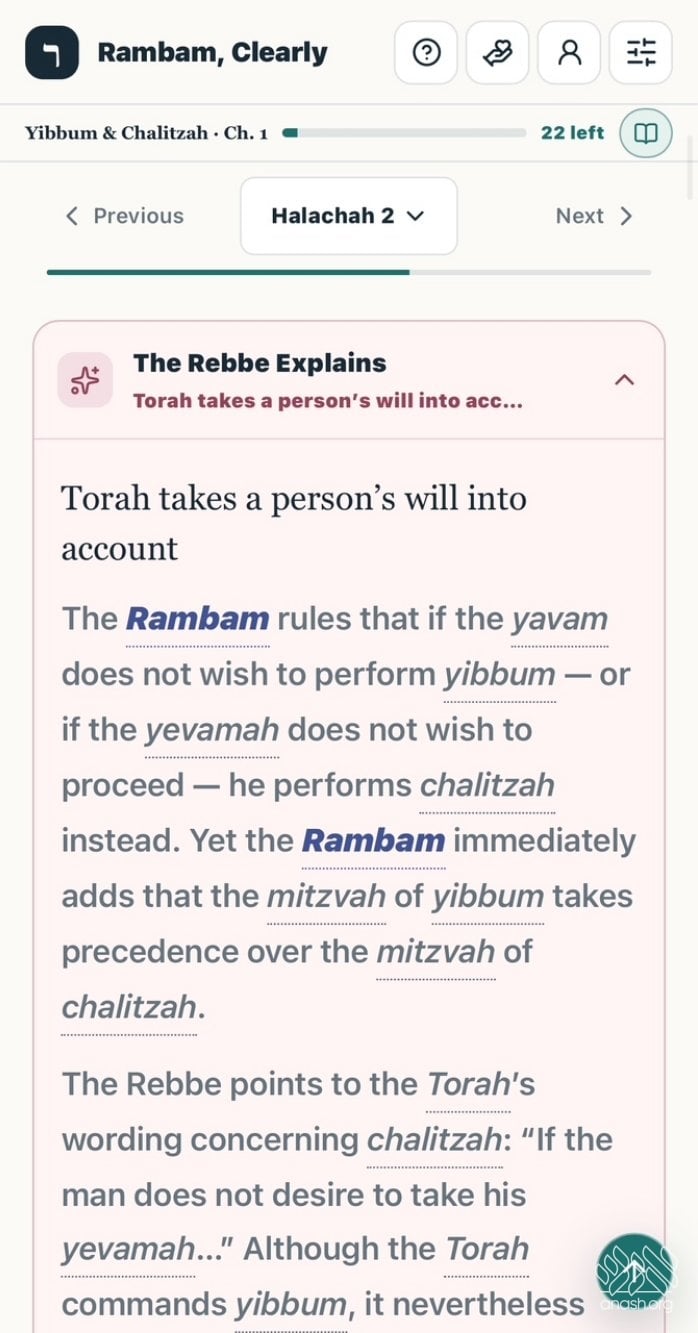
Live It is separate from another feature called The Rebbe Explains.
When an actual sicha gives substantive insight into a specific Rambam — explaining a difficulty, a formulation, or the idea behind a halacha — that teaching appears in its own sourced panel.
The site also contains a growing library called The Rebbe on Learning Rambam, with more than forty sourced teachings about the purpose of the takanah, the unity created through the common cycle, learning the entire Torah, learning Rambam in depth, understanding the Rambam’s words precisely, living with the daily Rambam, preparing for Moshiach, and other aspects of the Rebbe’s approach.
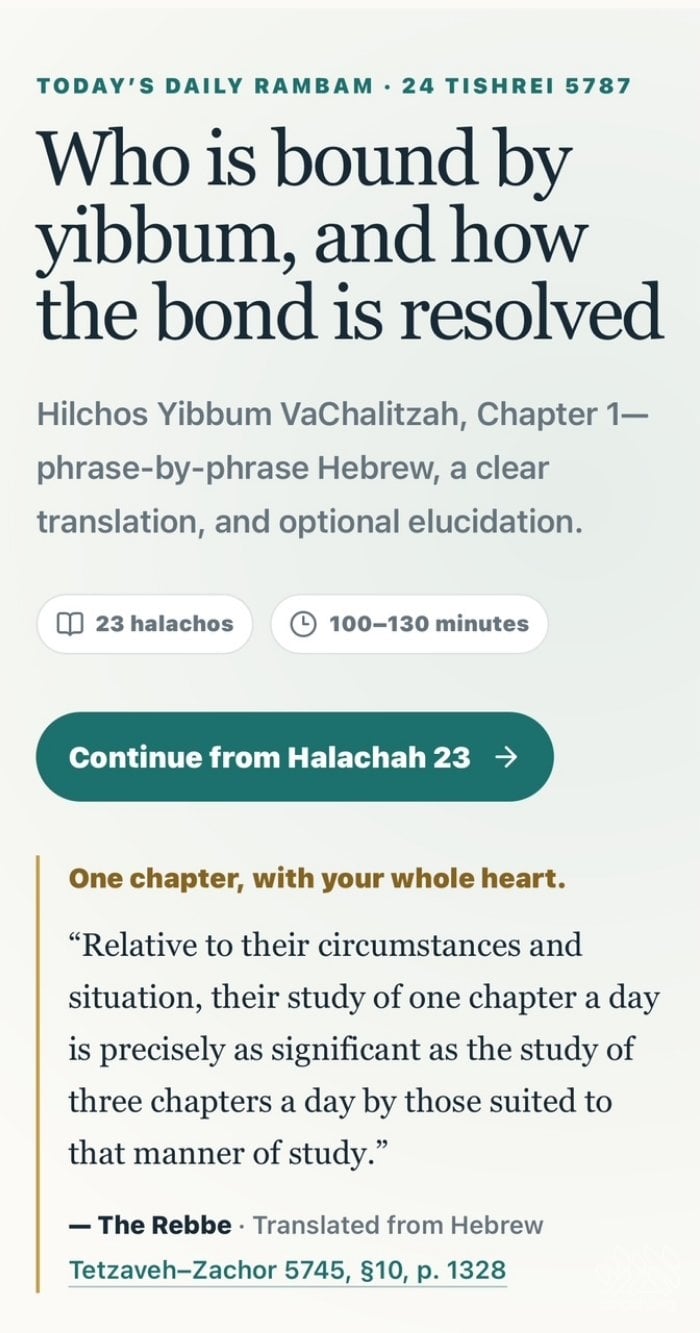
Among the teachings highlighted is the Rebbe’s encouragement to one-perek learners: for someone whose circumstances are suited to one chapter a day, that learning has the same significance relative to his abilities as three chapters have for someone capable of that track. (Shabbos Parshas Tetzaveh–Zachor 5745, section 10 · Hisvaaduyos, vol. 2, pp. 1328–1329)
That idea appears prominently on the homepage under the words “One chapter, with your whole heart.”
For the site’s intended learner, that is not only encouragement. It shapes the project: if one chapter is the Rambam schedule suited to you, that one chapter deserves to be understood well.
It also remembers where you were holding
Daily Rambam does not always happen in one sitting. A few halachos may be learned before Shacharis, several more at lunch, and the rest later in the evening.
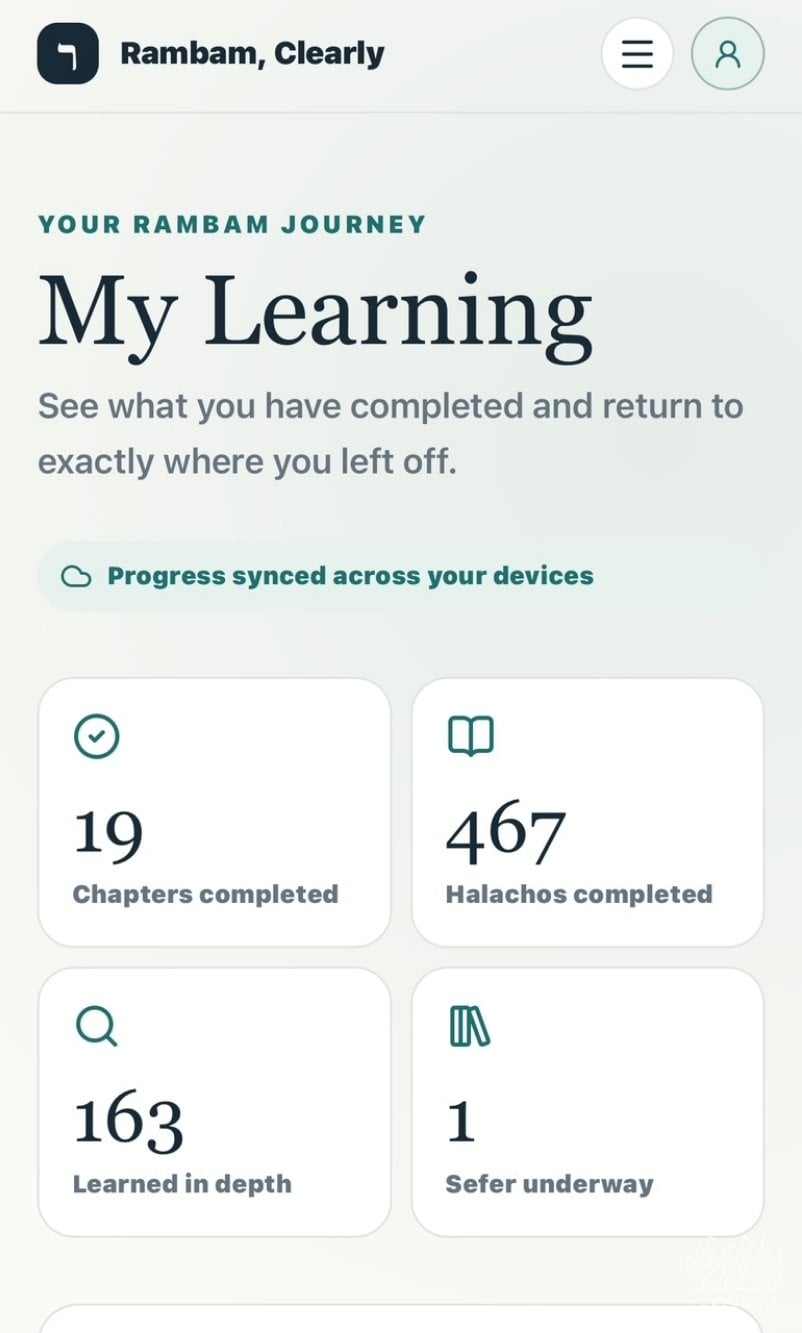
Each halacha can therefore be checked off individually. The site keeps track of reading position. Learning a halacha in depth can be marked separately. A Mark all complete option is available for someone who learned elsewhere but wants the chapter reflected in his progress, and signing in allows progress to sync across devices.
Once the chapter is completed, the site opens its end-of-chapter review experience.
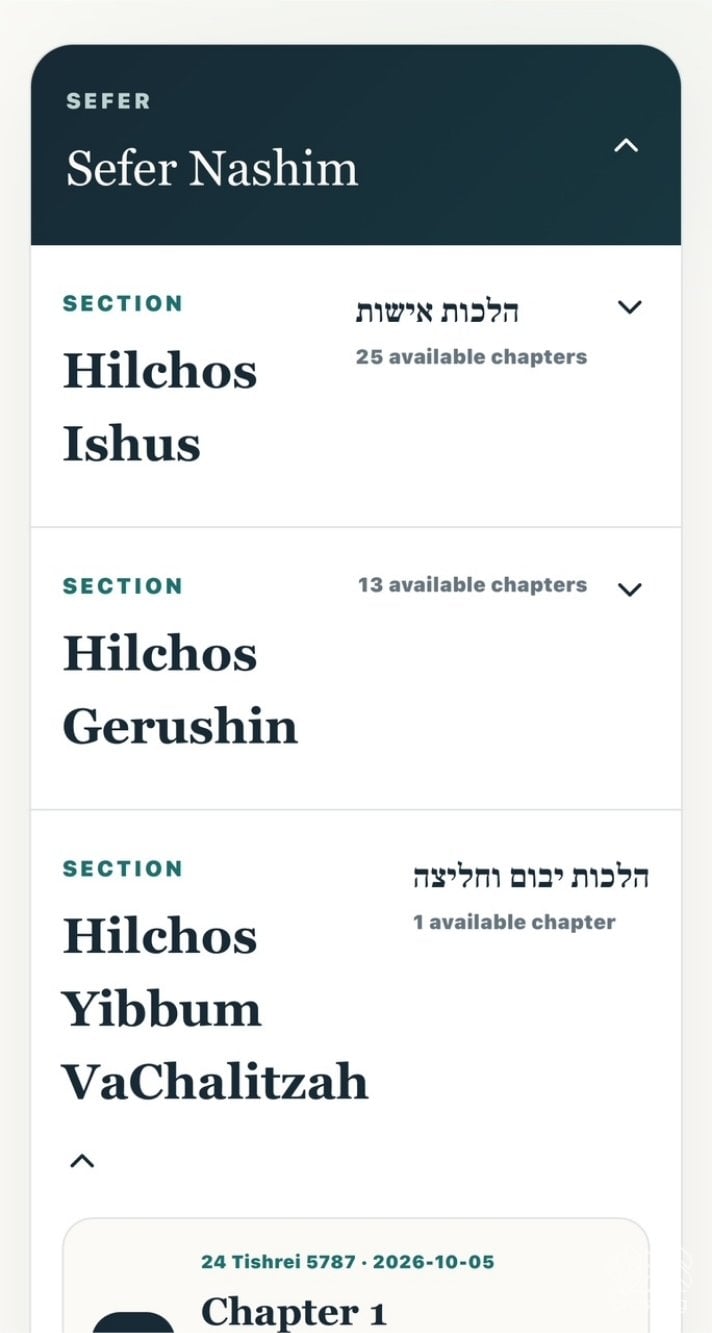
There is also a growing archive organized by Sefer → Hilchos → Chapter, making earlier chapters easy to return to for review.
For someone learning a long perek in several sittings, the usefulness can be very simple: no more opening the chapter late at night and wondering whether you stopped at Halachah 14 or Halachah 17.
Showing the learner what comes from where
One of the less flashy but important parts of the project is its editorial transparency.
At the bottom of a chapter, Sources & Editorial Method explains what text was used, how translation differs from elucidation, how word cards and glossary entries function, what Dig Deeper is based on, how Live It is treated, how measurements are converted, and how the Rebbe’s teachings are sourced.
The site also has a Report something unclear button built into each chapter. The chapter and halacha are attached automatically, allowing a learner to flag a translation, explanation, word meaning, or other point for review.
The site explicitly states that it is a learning resource and not a substitute for asking a rav regarding practical halacha.
Why another Rambam resource?
There are already outstanding resources for daily Rambam, and Rambam Clearly is not trying to replace them.
If a person learns best through a full shiur, excellent shiurim already exist. If someone wants a large interconnected Torah library, that serves a different purpose. Visual Rambam projects are increasingly making difficult cases visible. Printed editions and existing translations remain indispensable.
Rambam Clearly is built for a different moment: you want to learn the perek yourself.
You begin with the Hebrew. If a word blocks you, tap it. If you want to challenge yourself, hide the translation. If the English is enough, keep the elucidation closed. If the sentence is clear but the legal reasoning is not, open Explain. If the case remains abstract, open Picture the Case. If one halacha grabs you, open Dig Deeper. If the Rebbe discusses it, open The Rebbe Explains. If there is a natural lesson to carry into the day, open Live It.
Then close those layers and keep learning the Rambam.
That is what makes the switchable Hebrew, Translation, and Elucidation layers so important. The page can function almost like a good chavrusa who knows when to explain — and when to be quiet.
For a beginner, it can make a difficult perek approachable. For an experienced learner, it can stay mostly out of the way until something deserves a closer look. And for someone reviewing a chapter he already learned, the same page can become a self-test by hiding the help he no longer wants to see.
Built because one learner wanted exactly that
Rambam Clearly was created by Levi Gelb out of his own one-perek-a-day learning.
“I originally made Rambam Clearly for myself,” he explains. “I wanted something that would help me learn the daily Rambam better — to follow the words, understand the concepts, and see how the halachah fits together.”
What began as a personal learning tool kept expanding as new needs appeared: word help, clearer elucidation, summaries, mefarshim, section guides, teachings from the Rebbe, progress tracking, concrete cases, and review.
The project is still an early release and is being built chapter by chapter along with the cycle. It does not yet contain the entire Mishneh Torah. Its aim is not simply to digitize Rambam, but to prepare each available chapter carefully enough that it can genuinely help someone learn that day’s perek.
For an Anash reader already committed to the Rebbe’s takanah, perhaps that is the best way to understand the project.
Rambam Clearly is not primarily trying to convince someone that Rambam is worth learning.
The Rebbe already did that.
It is trying to help the person who opened today’s Rambam fulfill that takanah with more הבנה והשגה — to understand the words, see the structure, learn one point more deeply, and perhaps carry one part of the day’s Rambam with him after the sefer is closed.
Because finishing the perek matters.
And so does knowing what you learned.
 COMMENTS


We appreciate your feedback. If you have any additional information to contribute to this article, it will be added below.