



ט׳ אייר ה׳תשפ״ו | April 26, 2026
How the Rebbe Launched the 12 Pesukim
At the Shabbos farbrengen of Parshas Acharei 5736, after Pesach, the Rebbe surprised everyone by declaring it the “Year of Chinuch” and launching Mivtza Chinuch. For two reasons, the Rebbe’s announcement caught everyone off guard.
By Rabbi Michoel Seligson for Kfar Chabad Magazine
At the beginning of the month of Iyar 5736, the Rebbe requested: “That every Jewish boy and girl should memorize by heart the Twelve Pesukim and maamarei Chazal” (from the biography of the Rebbe printed at the beginning of the Hayom Yom But let’s not get ahead of ourselves.
The Year of Chinuch
At the Shabbos farbrengen of Parshas Acharei 5736, after Pesach, the Rebbe surprised everyone by declaring it the “Year of Chinuch” and launching Mivtza Chinuch, founded on the mitzvah of “V’higadeta l’vincha” – from this point forward, every effort must be made that no Jewish son or daughter should be denied a genuine Jewish education in the true spirit of Yiddishkeit.
The announcement caught everyone off guard for two reasons: the idea itself, and the timing – after Pesach, in the summer months, rather than at the start of the year.
The declaration, the Rebbe added, was being made in a holy place – the shul and beis midrash – drawing its power from the teaching of Chazal that a person’s sustenance is fixed at the beginning of the year (during the Aseres Yemei Teshuva) – but regarding expenses for one’s children’s Torah education, whoever invests more in their children’s chinuch receives more from Above.
“This was the practice of our Rebbeim in connection with certain years that were declared, for example, a “Year of Torah” – in the language of the Kohen Gadol’s tefilah on Yom Kippur as he exited the Kodesh Hakodoshim: “May this year be a year of light, a year of blessing, etc.” – just as we find in various stories of tzaddikim and gedolei Yisroel who took matters of everyday life and redirected them toward the service of Hashem (just as the Gemara uses parables from secular language that became Torah concepts, etc.)”.
The Rebbe called on activists who had already been working in the field of chinuch – “who have acted and succeeded in this until now” – to act and succeed with even greater force.
The Rebbe further called for the establishment of committees, to make noise, and to do everything permissible even on Shabbos itself (“matters of public need may be attended to on Shabbos”), and with even greater energy after Shabbos.
Jewish Education for Every Child
On Tuesday, the 27th of Nissan 5736 (Sefer HaShlichus, Kehos 5747, p. 314), one of the bochurim at 770 received a note from the Rebbe regarding his parents, who were on shlichus in Europe and had asked him to return before the summer. Among other things, the Rebbe wrote: “This teaches us how great the concealments of galus are – that specifically when the Year of Chinuch was declared and the necessity of preparing in time for summer camps was emphasized, this plan arose…”
“Enclosed is my contribution toward the expenses of the Mivtza Chinuch campaign… I will mention the above-mentioned at the ohel. The total amount of the Rebbe’s contribution was the gematria of the names of the recipient’s children: Mordechai = 274 / Dina = 69 / Chana = 63 / Total: $406”
What follows is a compilation of sichos from the month of Iyar (and onward) of 5736, in which the Rebbe issued the call to establish this takana.
Educating Oneself and One’s Surroundings with Torah
At a spontaneous farbrengen on Rosh Chodesh Iyar, the Rebbe opened with this call: “In Mivtza Chinuch, even young boys and girls of Israel can be included – to work on the matter of chinuch, since it is their nature to socialize with children their own age. Beginning with the simple meaning of chinuch — that it should be continuous – for true chinuch encompasses eating, drinking, sleeping, recreation, and so on.
“Beginning with Torah, which is our life and the length of our days – even the youngest Jewish boy or girl can be taught something from Torah shebiksav, something from Torah shebaal peh, up to and including halacha in Shulchan Aruch, and since we are speaking here about Chassidus – a concept in Tanya – each according to their level, there can be understanding and comprehension even for the very young, etc.
“Regarding Torah shebiksav, a question arises about ‘written things that may not be said by heart’ – so we must choose matters that are permitted to be said by heart, and ensure that in every free moment of the day, the child says it or thinks about it and explains it to a friend.
“And here the Rebbe mentioned the pesukim: Shema Yisrael, Kol Yisrael, Ki karov, and V’hinei Hashem, etc.”
The Rebbe continued: “Then one can effect in children – in a way that fits their mindset – the concept of Toraso umnaso: that even while playing with a friend, he suddenly remembers a pasuk from Tanach, a concept from Torah shebaal peh, a concept in Tanya that he understands in his own letters – and within it is hidden the innermost and true meaning of sixty myriads of interpretations.”
Enlisting the Children
“In order to maximize the success of Mivtza Chinuch, it is fitting and necessary to involve Jewish children themselves in these activities – for when a large number of students participate in this work, the success will be multiplied many times over.
“As we see clearly, it is the nature of a child to socialize with other children of the same age, and he also loves to show off to his friends as soon as he learns something new that they don’t yet know.
“This nature must be harnessed for Mivtza Chinuch – to inspire children to themselves become influencers among their peers regarding a Yiddishe chinuch: to speak with their friends about Torah study and mitzvah observance, including influencing them to review Torah matters by heart, and to encourage and influence those among their friends who are not yet learning in yeshiva to register in a yeshiva or Jewish day school (with education on the foundations of holiness), or a kosher summer camp, and similar activities.”
Prizes for Participants
“In addition to distributing coins to those who have not yet reached bar or bas mitzvah age as mentioned above, scholarships and prizes should also be distributed, to further inspire enthusiasm and desire to participate in these activities – and prizes should be given to all boys and girls (including those who have already reached bar or bas mitzvah age) who participate in the above activities.”
Translating the Pesukim in the Local Language
The Rebbe continued at the farbrengen: “As has been discussed many times, action is the main thing. The intention of the above is that since not everyone is capable of translating this into the local language, those who are capable should gather – in this country and in other countries – those who are present at this farbrengen, and write it all down in the local language: the pesukim and maamarei Chazal, or other pesukim and maamarei Chazal, as long as the content is the same and meets these conditions.”
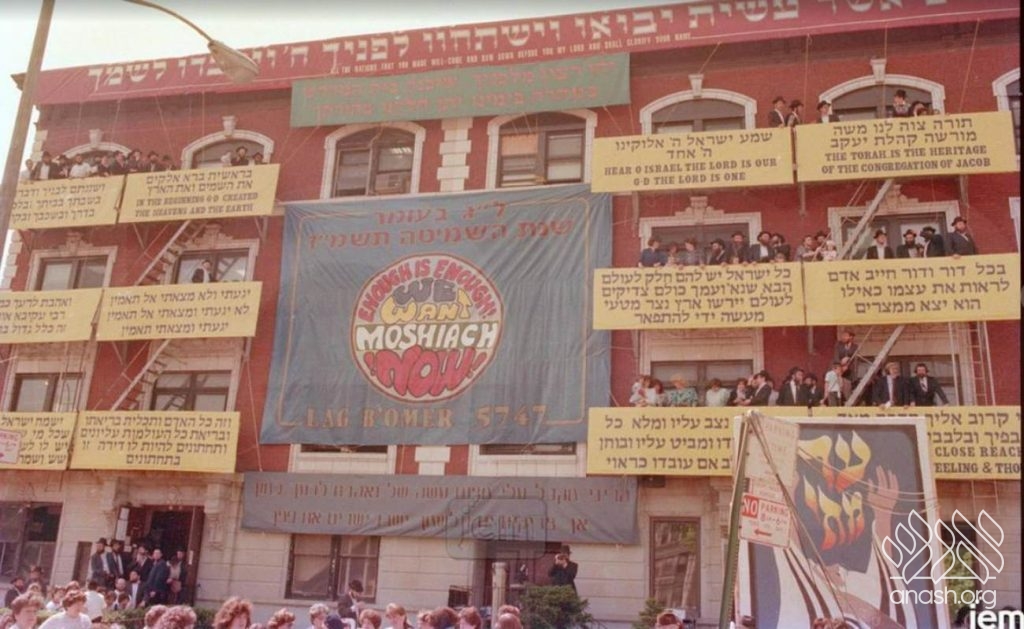
In light of the excitement for the new campaign, Chabad activists decided to organize a Lag B’Omer parade even though that year Lag B’Omer did not fall on a Sunday. In honor of the parade, large signs with the first six pesukim were arranged on the buildings near 770.
On Lag B’Omer 5736, during the parade, the Rebbe added:
“Since we must add something every day – to accomplish yet another mitzvah beginning with educating oneself – it has been proposed and requested of each and every person to memorize Torah matters by heart, so that even when not near a sefer to learn from, one knows from memory what is stated in Torah shebiksav and Torah shebaal peh and can translate this into one’s own conduct and one’s surroundings.
“And as discussed, we must continue to add even more – therefore, in addition to the pesukim and maamarei Chazal mentioned until now, it is proper to memorize two more pesukim, two more maamarei Chazal, and two sayings of the Alter Rebbe from Chapter 33 of Tanya.
“When these are known by heart, they will illuminate daily life, enabling one to fulfill more fully ‘a mitzvah is a candle and Torah is light.’ Therefore, the suggestion is to memorize the pasuk Bereishis, Lo yagati, V’zeh kol ha’adam, Yismach.”
After the parade, the Rebbe instructed that the additional six pesukim also be arranged on the walls of the building of 770 and left there for several days.
Changing the Hearts of Kings and Ministers
Some days later, when the Rebbe spoke before a gathering of women and girls, he continued:
“Since in recent weeks it has been emphasized even more that we need siyata dishmaya – the hearts of kings and ministers are in the hand of Hashem – therefore every Jew must make a special effort to work to change the hearts and minds of those who govern his country, so that it will bring goodness to Eretz Yisroel and to Yiddishkeit.
“This is the meaning of ‘Tzion will be redeemed through justice and her returnees through tzedaka’ – there must be a special hiddur in the matters of Torah and tzedaka.
“And this is what has been emphasized lately – that every Jewish child should be permeated with Torah throughout the entire day. Therefore, the six pesukim and maamarei Chazal have been proposed, and the main point is that every Jewish child – as well as every adult – should be saturated with Torah all day long.
“And for this to succeed on a large scale, there is tzedaka.”
Printing a Booklet in Pocket Format
A month later, the Rebbe continued: “As I requested that all the Twelve Pesukim be printed in a special format (pocket format), and distributed to children and adults, so that it is readily available to review again and again, the booklet should be ready shortly. And as discussed above, this protects the Jewish people from the kelipah in the world.”
It did not take long – within just two months came an event that shook everyone to the core: the kidnapping of Jews as hostages by the enemies, their captivity and transport to Entebbe, and the miraculous rescue. The Rebbe addressed this at length and in detail in several sichos during the farbrengens of that period.
The Young Ones Will Understand
At the farbrengen of Yud Gimmel Tammuz 5736, the Rebbe continued: “As discussed above regarding ‘from the mouths of babes and sucklings You have established strength’ – according to their level – and in a way that the activity will have continuity, so that even when not near a sefer one can review it by heart: matters which from a chinuch perspective are permitted to be learned by heart even when one grows up. Therefore, several appropriate matters were chosen that fit these parameters.
“It is understood and simple that there are many more pesukim and maamarei Chazal – and also in Tanya – but as discussed, this is only a proposal, and whoever memorizes additional matters by heart – it is praiseworthy. And whoever feels that other maamarei Chazal or parts of Tanya are more appropriate for them – let them learn those, as long as they are learning Torah and knowing it by heart.
“And this must be done in a way that the children understand the content, since this is Torah shebaal peh. And there is another primary reason: since they will go on to educate yet more boys and girls, it must therefore be with geshmak and genuine understanding.”
The Rebbe devoted three lengthy sichos to explaining how each and every one of the Twelve Pesukim and maamarei Chazal is capable, in its own right, of providing protection, defense, and salvation for the Jewish people and for every individual Jew.
 COMMENTS


We appreciate your feedback. If you have any additional information to contribute to this article, it will be added below.