




כ״ד אלול ה׳תשפ״ו | September 6, 2026
Animated Film Brings Shofar’s Wake-Up Call to Life
A new animated short film by Sydney-based educator Rabbi Chaim Y. Munitz, takes a simple mashal about a village fire and turns it into a visual lesson about the message of the shofar.
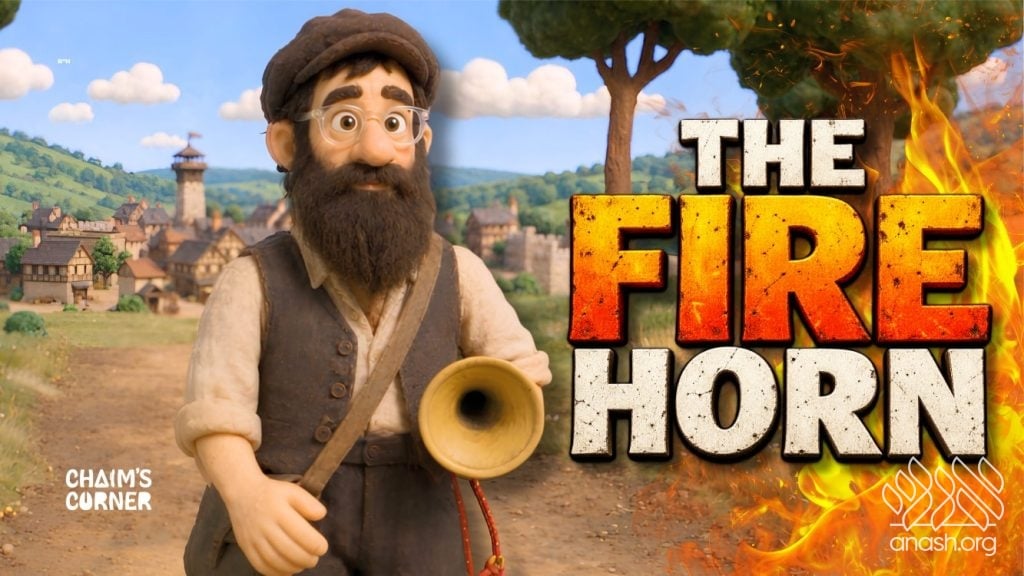
A new animated short film, The Fire Horn, takes a simple mashal about a village fire and turns it into a visual lesson about the message of the shofar.
The film was created by Chaim’s Corner, the educational platform of Sydney-based educator Rabbi Chaim Y. Munitz, who has been creating Jewish educational resources for classrooms for over a decade.
The Fire Horn follows a young man who visits a town and witnesses a fire break out. A horn sounds, the townspeople immediately spring into action, and before long the fire is extinguished.
The visitor, however, comes away with the wrong lesson.
Convinced that the horn itself somehow stopped the fire, he obtains one of his own and returns home. When a fire later breaks out in his village, he confidently begins blowing, but nothing happens. He blows harder, but the fire grows.
While he continues desperately sounding the horn, the villagers eventually form a bucket brigade and fight the flames themselves.
The mashal becomes a simple way of understanding one of the central messages of the shofar: a wake-up call only matters if we respond to it.
For Munitz, the film is also part of a broader experiment in how Jewish history and Torah ideas can be presented to students growing up in a very visual world.
For more than a decade, he has been developing Jewish educational resources through Chaim’s Corner, primarily designed for teachers to take directly into their classrooms. Film, he believes, provides another way to accomplish the same goal.
Rather than beginning with a lecture or explanation, he wanted students to experience the story first.
“If I can put a student inside the story for two or three minutes, let him laugh at the character, watch him make the mistake and understand what went wrong, then the discussion afterwards is completely different,” he said. “You’re no longer explaining an abstract idea. They’ve seen it.”
The film was created in an AI claymation-inspired style, with an old European village, handmade-looking characters and touches of visual humour throughout. There is little reliance on dialogue; the story is designed to be understood largely through what the viewer sees happening on screen. That was deliberate.
“I wanted it to feel like a short film, not an educational video,” Munitz said. “The educational part should come through the story.”
The project also reflects the rapidly changing tools available to educators. Munitz used a combination of AI-assisted filmmaking tools and traditional editing to build the characters, locations and individual shots before assembling them into the finished film.
“A teacher can have an idea for a mashal or a moment in Jewish history and actually build a world around it,” he said. “That opens up possibilities that simply weren’t realistic for an individual teacher a few years ago.”
The Fire Horn concludes by bringing the story back to the shofar itself.
Its final message is deliberately brief: “The shofar is a call to wake up. But hearing the call is not enough. We have to act.”
The film is intended for use in classrooms, Hebrew schools and homes in the lead-up to Rosh Hashanah.
Teachers: Turn the story into a hands-on lesson with The Fire Horn Pop-Up Card Craft. Download the craft: https://tinyurl.com/33347pc4
Rabbi Munitz can be reached at [email protected]
WATCH

 COMMENTS


First good video of AI made I’ve ever seen used properly. Well done, love it
I am frustrated to see that this video can only be e accessed thru YouTube, I do not believe that YouTube should be in a yidish home at all, and I do not have it. Especially in the last few years that yiddin have invested so much to create kosher options like 24six, there is simply no reason why someone would be posting Jewish content on YouTube, and not on a Yiddish platform, denoting access to those that actually care.
It is not too hard to upload a video into the website itself, though often the artist would rather all views go to his channel.Perhaps if, as a matter of policy, the website makes it clear that in order to reach the audience of ANASH you have to agree to have it uploaded directly into the website, it will solve this situation.
Another matter is that it’s quite discouraging for those with a filter to discover that they can’t see basic Chassidish content, simply because of the fact they follow the guidance of their Mashpiim…
I too am unable to view this video. Please provide a link that can be viewed by kosher filtered devices. Thank you
Chaim here, thank you for the feedback. The video is now on 24six https://24six.app/preview/video/content/467914/the-fire-bugle