



ל׳ תשרי ה׳תשפ״ז | October 11, 2026
Aliba D’hilchesa: How Halacha Provides Direction, Clarity, and Geshmak
In an in-depth interview, Rabbi Menachem Aizenman, Rosh Yeshiva of the Poconos Yeshiva, speaks about the unique approach to learning Gemara he institued: learning aliba d’hilchesa. “It’s not plainly Gemara alongside Shulchan Aruch. It’s using the poskim’s guidance to understand the framework of the sugya itself.”
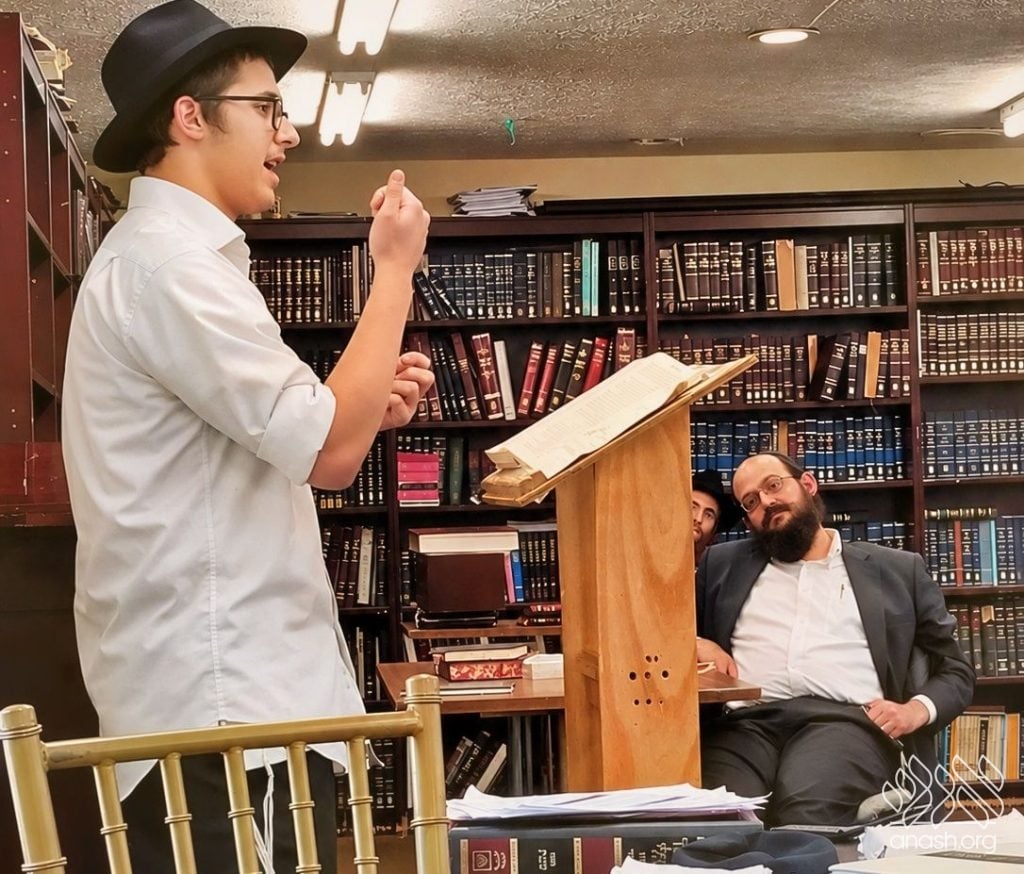
Interviewed by Rabbi Moshe Kessler
Rabbi Menachem Aizenman, Rosh Yeshiva of the Chabad Yeshiva of the Poconos Zal, was not interested in speaking about himself. From the outset, he made clear that the focus should be on the yeshiva — the bachurim, the learning, the challenges, and the responsibility of preparing Chassidishe bachurim for life.
At the center of his approach is a very specific method of learning aliba d’hilchasa. As he explains, this does not mean turning seder iyun into a study of Shulchan Aruch. Rather, it means studying the sugya by following the guidance of the poskim, identifying a central din in the sugya, and routinely setting aside time to focus on the Rambam and the Alter Rebbe’s understanding of the sugya. In his experience, this approach is most effective in allowing a talmid to see what the sugya is truly about.
In his view, this gives talmidim something many are missing: direction. Every sugya contains multiple topics discussed simultaneously; many major and minor questions can be explored in each of these topics, but it is impossible to explore every question that arises. An inquisitive talmid will raise many questions that require further inquiry, and each has the potential to lead him to fascinating learning. However, not all questions will lead the talmid to a clearer understanding of the central din. Often, after investing much time and effort into one of these inquiries, a talmid is left with a feeling of disappointment — or worse, failure.
In this conversation, Rabbi Aizenman discusses the roots of this approach, the place of lomdus, the difference between Mesivta and Zal, and practical ways a yeshiva can help a bachur gain a derech in learning — the skill of entering a sugya with confidence.
The Derech Explained
Tell us about the yeshiva and your role as Rosh Yeshiva.
I have been teaching Gemara for thirteen years, but eight years ago, after observing the challenges bachurim were facing and discussing these issues with my brother, Reb Shneor shlita — who was successful in his teaching in Yeshivas Toras Emes in Yerushalayim — I developed a new derech halimud tailored for our talmidim: we started learning aliba d’hilchasa.
I want to be clear about what I mean by aliba d’hilchasa, because it can mean several entirely different things. It doesn’t mean we turned seder Gemara l’iyuna into seder halacha b’iyun, or some other new limud. On the contrary, I believe this derech restored the lost glory of seder iyun.
The main idea is that the learning is guided by the din derived from the sugya. Although every question we encounter should be noted, we try to distinguish between ikar and tafel — between issues of primary and secondary importance. One may ask: who are we to decide what is ikar? Well, that is where the poskim guide us — are the poskim discussing this particular problem? What they do discuss becomes ikar for us, and we try to go as deep as we can in that discussion. That, I believe, is where the clarity we are looking for can be found.
How would a talmid beginning a sugya know what questions are discussed in the poskim?
That is a great question! I’ll answer it after explaining the idea behind the derech a bit more.
One of the most important foundations of this derech is the Alter Rebbe’s ruling in Hilchos Talmud Torah (1:6) regarding the extent of a father’s obligation to teach his son. The Alter Rebbe explains that one must teach his son the entire Torah She’baal Peh, but adds:
ובזמן הזה שכל התורה שבעל פה היא כתובה לפנינו אין צריך לשכור מלמד לבנו שילמדנו כל התורה שבעל פה, אלא שילמדנו להבין היטב בתלמוד ברוב המקומות, גם בהלכות וסגיות העמקות, עם רב הפוסקים ראשונים ואחרונים, ויעמידנו על עיון ההלכה למעשה, שיוכל לעיין בעצמו, ללמוד ולהבין ולהורות כל הלכה למעשה מתוך עיון בתלמוד ופוסקים ראשונים ואחרונים…
“Nowadays, since the entire Oral Torah is written down before us, one does not need to hire a teacher for his son to teach him the entire Oral Torah. Rather, he should hire a teacher to teach him to thoroughly understand the Talmud in most places — including the deep sugyos — along with most of the Poskim, Rishonim and Acharonim. The teacher must teach him the skill of iyun ha’halacha, so that he will be capable of learning it on his own…”
We see from here that a primary job of yeshivas is to provide every talmid with the skill of iyun. Nothing less.
In reality, however, only a tiny percentage of yungerleit in kollel are learning in a way that resembles the style of learning the Alter Rebbe describes here, and by then time is short. For most bachurim, this kind of limud is completely foreign. So the question is: why should a bachur go through his main yeshiva years without being trained to learn a sugya this way?
The Alter Rebbe’s words are clear, but are bachurim in Zal ready for this level of study?
Yes and no. Obviously, the vast majority are not ready to practice this kind of learning to its fullest degree. But are they capable of being guided in this way? I would say — they are! And far more in this derech than in any other!
That was my main reason for developing this derech in our yeshiva. I saw how bachurim were lacking meaning in their iyun learning. Seder iyun is supposed to be the strongest part of the day — proven by the fact that the time allotted for iyun is the longest and best hours of the day. But for many, it becomes the hardest part of the day, and sometimes the most boring.
Iyun is what makes a yeshiva. Iyun is where a bachur’s learning is transformed — and most importantly, where the bachur himself is transformed. Without properly learning Gemara l’iyuna for multiple years, one is an am ha’aretz, who me’ikar hadin is not counted for a zimun. There are no shortcuts.
Did you just say that you can only be counted in a zimun if you learn Gemara l’iyuna?
Yes, but in practice this is not done. The Alter Rebbe rules (199:3), based on the Gemara in Berachos:
עם הארץ אין מזמנים עליו. ואפלו קרא ושנה, ולא שמש תלמידי חכמים, להקשות ולפרק להבין מתוכם טעמי המשניות על בורים — הרי זה עם הארץ לענין זה. ועכשיו מזמנים אפלו על עם הארץ גמור, כדי שלא יהא כל אחד הולך ובונה במה לעצמו, שאם היו פורשים מהם — גם הם היו פורשים מן הצבור לגמרי.
“One does not include an am ha’aretz in the zimun… Even if he knows all of Tanach and Mishnah, but did not ‘serve Torah scholars’ — to ask questions, resolve difficulties, and clearly understand from them the underlying reasons of the Mishnah — he is considered an am ha’aretz regarding this matter.
The Alter Rebbe continues:
“However, nowadays, we include even a complete am ha’aretz in the Zimun, so that each person will not go and build a platform for himself. For if [the scholars] were to separate from them, they [the unlearned] would also separate from the community entirely.”
Learning Gemara l’iyuna is the shimush talmidei chachomim required to leave the category of am ha’aretz. As long as one did not study Gemara l’iyuna for multiple years in yeshiva, this is what halacha says about him, even if he knows much Torah.
The situation today needs to be addressed, since even a talmid in our yeshivas for multiple years may not be spending them learning Gemara l’iyuna, which is the primary difference between yeshiva learning and non-yeshiva learning.
Why do you say that many bachurim in yeshivas today are not learning b’iyun?
A good talmid can prepare for the shiur, hear the shiur, review mefarshim, know many marei mekomos, and still walk away asking: What did I actually gain?
Advanced talmidim can enjoy the depth of the discussions, but even for them the learning doesn’t always feel grounded. For average talmidim, the problem is more pronounced — they feel that iyun is a non-starter. In a good scenario, they don’t give up; they try, moving from one mefaresh to the next, without feeling confident about what they are discussing.
Then there are the many bachurim who have already given up. I have met capable bachurim who claim — iyun is just not for me.
But isn’t that the reality? Not everyone is cut out for iyun!
I don’t agree. All bachurim enrolled in Zal are able, in one way or another, to learn l’iyuna. And that’s where learning aliba d’hilchasa changes the experience.
Most of the difficulty, in my opinion, stems from attempting to teach more material than the talmid can handle. There isn’t enough time to both prepare the sugya on a simple level and attempt deeper learning. Another issue: the questions addressed in shiur are not always tailored for the talmidim. Many are too complex and require introductions the maggid shiur may not be prepared to provide.
“Halacha Structures the Sugya”
However, when we limit our focus to one din and make an honest attempt to understand how it is derived from the sugya — its roots and branches — the discussion develops intuitively. Everyone can join, and enjoyably.
Not every bachur can delve into every part of the sugya or every Tosafos, but everyone can appreciate gaining clarity in the central din. Those bachurim who lack the skill to study every Tosafos should focus on the parts of the sugya and the Tosafos that directly clarify the central din.
Is this derech tailored specifically for bachurim who struggle with iyun? What about those who thrive learning a Rashba or a P’nei Yehoshua?
The bachurim who excel in iyun are the first to gain from this derech. I’ll make three points:
a) Bachurim want to learn the skill. The Alter Rebbe says the teacher’s job is to give them that skill. They need a derech they can trust and acquire for lifelong learning. A maggid shiur can point out a fascinating Rashba here, a P’nei Yehoshua there, but when a bachur leaves yeshiva, he will not be inclined to learn the Rashba. However, if he consistently learns a sugya with the Rosh, Ran, or even the Rambam, he will be inclined to learn that way for life.
b) Many bachurim who thrive in iyun feel it is an enjoyable luxury. They are not sure why it is critical. That is terribly wrong. Look in Likkutei Sichos vol. 2, p. 566 — “everyone must have a set time for learning Gemara b’iyun!” — and it is not referring to bachurim.
If a talmid doesn’t understand why the mefaresh he’s learning is critical to the sugya, why is he learning it? To learn “another opinion”?
The focus on the din presents the Gemara, Rashi, Tosafos, and mefarshim in a way that they are all connected. Many comments of the Rishonim and Acharonim no longer seem like chidushim, but like obvious possibilities. Once a bachur sees that, now he’s learning — and if he learns this way for a few years, he will be transformed.
c) There is another reason for why even the best talmidim connect specifically to this kind of learning: bachurim in Lubavitcher yeshivas have a special yiras Shamayim. When they hear “halacha” or “Shulchan Aruch,” their interest spikes. They feel relevance to real life. When they hear that this sugya is the source of a din in Shulchan Aruch, it connects them. Similarly, when a bachur is presented with a Rambam on the sugya, he feels a deep connection — it’s the Rebbe’s Rambam; it’s the Rebbe’s takana.
So when we set aside time to learn the Rambam related to our sugya and try to see how he understood the Gemara, it is engaging and makes the whole sugya feel more relevant. We go back and forth between Rambam, Rashi, Tosafos, and others — seeing how each read the sugya in context of the Rambam, identifying advantages to each shita, and finding the nafka mina.
Comparison to the Maharal’s Derech
This sounds similar to the derech of the Maharal, who emphasized learning Gemara with the Rosh because it brings the sugya toward halacha.
That is true — the Maharal wrote against teaching Tosafos to young talmidim, suggesting it would have been better to print the Rosh on the side of the Gemara rather than Tosafos (Nesivos Olam, Nesiv HaTorah ch. 5). But the fact is that by hashgacha protis, Tosafos were printed on the side, and the minhag is to teach Tosafos to young talmidim.
The same applies to what the Maharal wrote (Gur Arye Ve’eschanan, Tiferes Yisroel ch. 56) about teaching according to the order in Pirkei Avos: ben chamesh l’mikra, ben eser l’mishnah, ben chamesh esrei l’Gemara. That first talmidim must acquire the entire Tanach, then the entire Mishnah, and only afterward Gemara, so that a person builds the foundations of Torah knowledge before entering Talmud.
But the minhag does not follow the Maharal, and the Alter Rebbe defends the minhag at length (Hilchos Talmud Torah 1:6). This order depended on the reality of those times, when Tanach wasn’t printed with nekudos and ta’amim the way we have it today, and Mishnayos had to be learned by heart. Today, with printed seforim readily available, that order of the Mishna in Avos doesn’t apply. Rather the minhag that the Alter Rebbe mentions is that a child is taught Chumash (and not Nach) with special emphasis on the pesukim that discuss the 613 mitzvos. It seems from the Alter Rebbe that the obligation of teaching one’s son is to teach him Chumashand the skill of Gemara l’iyuna, that’s it.
My shver, Rabbi Chaim Sholom Deitch shlita, told me that as a child in Etz Chaim Yeshiva in Yerushalayim — which followed the precise seder instituted by Rabbi Shmuel Salant almost 200 years ago — they went directly from Chumash to Gemara, with no separate seder of Mishnayos.
I understand that there is a derech today that attempts to follow the Maharal. A talmid who goes through that system can come out with tremendous yedios, but the question isn’t only how much a bachur knows — it is whether he understands. Does he understand the way Chazal speak? Knowing how to learn means to understand that Torah She’baal Peh cannot be understood at first glance. He will be missing the libun hilchasa that takes a person out of the category of am ha’aretz according to Shulchan Aruch siman 199, as mentioned before.
So actually, the traditional derech for the past few hundred years has been what the Alter Rebbe describes and defends, not exactly what the Maharal suggests. What we do in yeshiva is in line with the traditional derech: we are not substituting Tosafos with the Rosh; rather, we are teaching Tosafos in context so we do not drift away from the main point.
But you are still making a valid point that this derech attempts to address some of the issues that the Maharal raises (although it should be noted, that the reality nowadays is only remotely related to the kind of study that the Maharal was bemoaning).
Kovetz Meforshim vs. Lomdus
How can you say your derech is traditional? Yours is very different from the derech of lomdus known in yeshivos. Take for example Reb Yudel Eber’s shiurim – there is an emphasis on deep lomdus and amkus over halacha l’maaseh. Doesn’t moving toward halacha risk losing some of that passion and depth?
This derech isn’t a move away from lomdus — I believe it is closer to the true derech of the great Roshei Yeshivah. What made them great teachers was the way they pointed out the ikar of a sugya. They didn’t chase every possible question until the sugya became scattered; they emphasized one or two points, and through that they could take a complicated sugya and show exactly what it depends on.
According to my understanding, before the war, the common style of learning was simpler in terms of how many mefarshim were used — it was similar to what I’m describing. It centered on Gemara, Rashi, Tosafos, the Rosh, the Ran, and the advanced learners attempted to learn the Rambam as well. The kovetz mefarshim did not exist, and most talmidim didn’t have access to a Rashba. They learned what was printed in the Vilna Shas.
So learning a sugya aliba d’hilchasa doesn’t mean giving up lomdus — it means the lomdus is guided. The halachic structure helps identify the sugya’s central issues: what the Gemara is dealing with, what the Rishonim are arguing about, and what practical difference it makes. That itself produces deep lomdus.
The Rebbe writes in a letter to Reb Shmuel Plotkin praising his father, Reb Avrohom Elya’s, chidushim, dated 24 Teves 5723:
“May it be His will that these chidushim—both in their substance and in their style—strengthen the recognition among all students of our Torah, the Torah of Truth, regarding the manner of study: that the truly desirable and genuinely good approach is learning with yashrus (honest straightforwardness) and shakla vetarya lasukei shmaatsa aliba d’hilchsa, halacha lema’aseh, and in the language of Chazal, when explaining a difference of opinion among our Rabbis, “mai beinaihu?” and “lemai nafka mina?”.
The Rebbe continues:
“My intention is: not like the two other approaches—the empty, futile pilpul, about which the earlier Rabbis already cried out and rejected; nor to suffice with exceedingly subtle, hair-splitting conceptualizations that yield no nafka mina and no halachic conclusion. For in such methods, the true determination needed to identify the correct reasoning is lacking. Rather, they must choose the straight and proper path described above—as is, of course, evident from the introduction of the sons of the Alter Rebbe, to his Shulchan Aruch, and as explained at length in Kuntres Etz HaChaim by the Rebbe Rashab, of blessed memory, from chapter 28 onward.”
Mesivta vs. Zal
Why do you think many yeshivas today don’t learn this way?
I’m not entirely sure what the derech of learning is in yeshivas today. I have met some very promising young maggidei shiur, and I believe their success is partly due to their study of halacha in kollel.
I can only speak from my own experience. When I was a young talmid in yeshiva, I rarely encountered this kind of limud. I think that our yeshivas in recent decades have emphasized a Mesivta-style approach.
What I mean is that there is a significant difference in how a person thinks at age fourteen or fifteen versus eighteen or nineteen.
In Mesivta, the goal is building fluency — reading a Gemara correctly, familiarizing the talmid with the Gemara’s way of thinking. The maggid shiur should teach with a pace: every Rashi, every Tosafos, thorough but without delving too deep. He should point out all the obvious questions, but answer only a few, leaving the talmid with an appetite for more.
But Zal is different. By Zal, even if a talmid is lacking skills, his mind has matured. He finds less meaning in sharp points and more meaning in seeing the sugya as a whole — identifying the ikar, understanding how the Rishonim read the Gemara, and how those readings lead to different conclusions. An average bachur who continues in Zal with the same derech he learned in Mesivta — many details, many calculations, without training to see the sugya’s central structure — will not feel as connected to his learning as he did in Mesivta.
This is a well-known problem: many bachurim lose enthusiasm for iyun when rising to Zal. I believe this is at least part of the reason.
Where It All Began
What originally got you interested in learning Gemara l’iyun aliba d’hilchasa?
When I was learning in Toras Emes, we learnt the first perek of Pesachim with Rabbi Chaim Sholom Deitch. We would learn the Gemara and Rishonim and then try to see how the Alter Rebbe learned the sugya and resolved the problems.
That year opened my eyes. When you learn the Alter Rebbe carefully, you see he isn’t just giving a psak — he’s illuminating the sugya. After we finished the first perek, Rabbi Deitch took us to the third perek, Eilu Ovrin, which contains major sugyos in hilchos taarovos, so we could continue seeing the Alter Rebbe’s chidushim in that area. A few years later, when I was learning issur ve’heter for semicha, I found it very helpful to have had many yesodos from Pesachim.
I had good maggidei shiur, and they taught well, but this was different. They say in the name of the Avnei Nezer that studying the Alter Rebbe’s Shulchan Aruch and Kuntres Acharon gives one a derech in learning, and one who has open eyes can see how the Alter Rebbe answers many of the questions Reb Akiva Eiger raises — through his precise wording and order, and the way he brings the halacha hints to a deeper understanding of the sugya itself. That’s the kind of shiurim we heard in Pesachim that year.
That’s the ultimate, in my opinion.
Practically speaking, how do you guide the bachurim through a sugya? How does it actually work?
Truthfully, it would be difficult to fully describe the learning program in our yeshiva, but I’ll give a general outline.
First of all, I provide the initial guidance. Before we learn a piece of Gemara, I look at the general outline and try to find a beginning and end point for that week’s learning. Sometimes the sugya cannot be covered in one week, so I allot two weeks in advance. I look into the Rosh, the Ein Mishpat, and the Rambam and Tur referenced there, which all help me choose one central din to focus on. I then give a title for the upcoming week’s learning. I believe the title helps the talmidim not lose sight of the din we are trying to clarify.
I suggest to older talmidim, who are learning on their own, to do the same — plan their weekly learning quotas and topics in advance. Some of it is guesswork, so modifying the quota and topic is sometimes necessary as the learning proceeds, but nevertheless I find it to be a very helpful tool.
Additionally, there is the proper order of learning. The Gemara (Shabbos 63a) says ligmar ve’hadar lisbar, which plainly means that first you learn, then you understand. Or in other words: first learn what is explicit, and only afterward what is the underlying reasoning between the lines. The Alter Rebbe brings this principle l’halacha in Hilchos Talmud Torah.
After a talmid has a basic knowledge of the sugya, he is encouraged to open one or more of the poskim — let’s say the Rosh (which I think is beneficial for most talmidim) — and learn it on a basic level. After gaining clarity in the din found in that segment of the Rosh, he should go back to the segments of Gemara, Rashi, and Tosafos most relevant to the Rosh’s discussion. Then the lisbar — the deeper understanding — begins. Automatically, he pays more attention to details, often finding a hidden nafka mina regarding that din found in the Rosh.
At this stage, the focus of the sugya becomes clearer to the talmid, and it becomes easier for him to distinguish between primary and secondary concepts.
How do the talmidim cover so much material — Gemara, Rashi, Tosafos, and poskim? Isn’t that too much?
You’re right. There are weeks when most talmidim will only learn the poskim in shiur, while on their own they focus on Gemara, Rashi, and Tosafos.
Still, I try to design the weekly learning quotas so that an advanced talmid who utilizes his time can go through the entire week’s quota — Gemara, Rashi, and Tosafos — with a basic understanding, meaning without avoiding apparent difficulties but not yet dwelling on them, all within the first two days of the week. We call this learning GaPaT — an acronym for Gemara, Pirush Rashi, Tosafos. After that, I advise learning the quota again and again, each time a bit deeper, for example opening all the citations in a Tosafos.
Whenever Rashi or Tosafos references another Gemara, I show the bachurim exactly where to look — it shouldn’t remain a vague citation. Many times, those background Gemaras open up the entire sugya.
Interestingly, opening the Gemaras that Tosafos quotes is not only beneficial for understanding Tosafos — it is sometimes the key to understanding the Rambam. A halacha in the Rambam may seem awkward until you look at the Gemaras Tosafos brings and realize that the Rambam is also reconciling the two Gemaras Tosafos is dealing with — but not in the way Tosafos does.
Then, I advise looking into Tosafos HaRosh and Tosafos Rabbeinu Peretz. Some talmidim are shayach to learning a Maharsha or Maharam Shif, and I point that out. All of this is outlined in a small paper all the talmidim receive at the beginning of the week.
We also have different tracks for different levels — not every bachur can learn the same amount of material. So we created a system: one quota for Gemara and Rashi for everyone, but different levels for which Tosafos to learn. The most important Tosafos relating to the central din is required for all.
What would you like to say in conclusion?
I would like to quote a letter of the Rebbe dated 22 Kislev 5712 (Igeres 1302):
“…It is well known what is written: ‘Hashem made man upright, but they sought out many calculations.’ For many, many generations, people learned Torah without entering into numerous ‘calculations’ about what manner of study should be arranged to be most successful and most in line with the principles of chochmas hachinuch, the study of education, and so on. Yet in recent times, newcomers have arisen who delve deeply into various systems and strategies — and the results of these methods are the very opposite of what one would reasonably hope for. For in earlier generations there was a great desire to learn Torah without excessive cleverness, and the knowledge of Torah grew — both in quantity and in quality. Whereas with the style of learning that follows all those rules, the number of learners has diminished, and their desire has diminished as well, and so forth.”
The Rebbe says here that the main thing is not so much the derech of learning. The main thing is to arouse a true desire to learn Torah. That itself can lead a talmid to true knowledge of Torah.
Reprinted with permission from the Tishrei 5786 edition of “Hatomim.” Download the full issue here.
 COMMENTS


We appreciate your feedback. If you have any additional information to contribute to this article, it will be added below.