




ל׳ סיון ה׳תשפ״ו | June 15, 2026
Third-Party Investigation Confirms Kashrus Issues with Tefillin
A new independent investigation into tefillin sold by Judaica and STaM retailers in Brooklyn has uncovered troubling findings that raise serious questions about quality-control practices within portions of the industry.

A new independent investigation into tefillin sold by Judaica and STaM retailers in Brooklyn has uncovered troubling findings that raise serious questions about quality-control practices within portions of the industry.
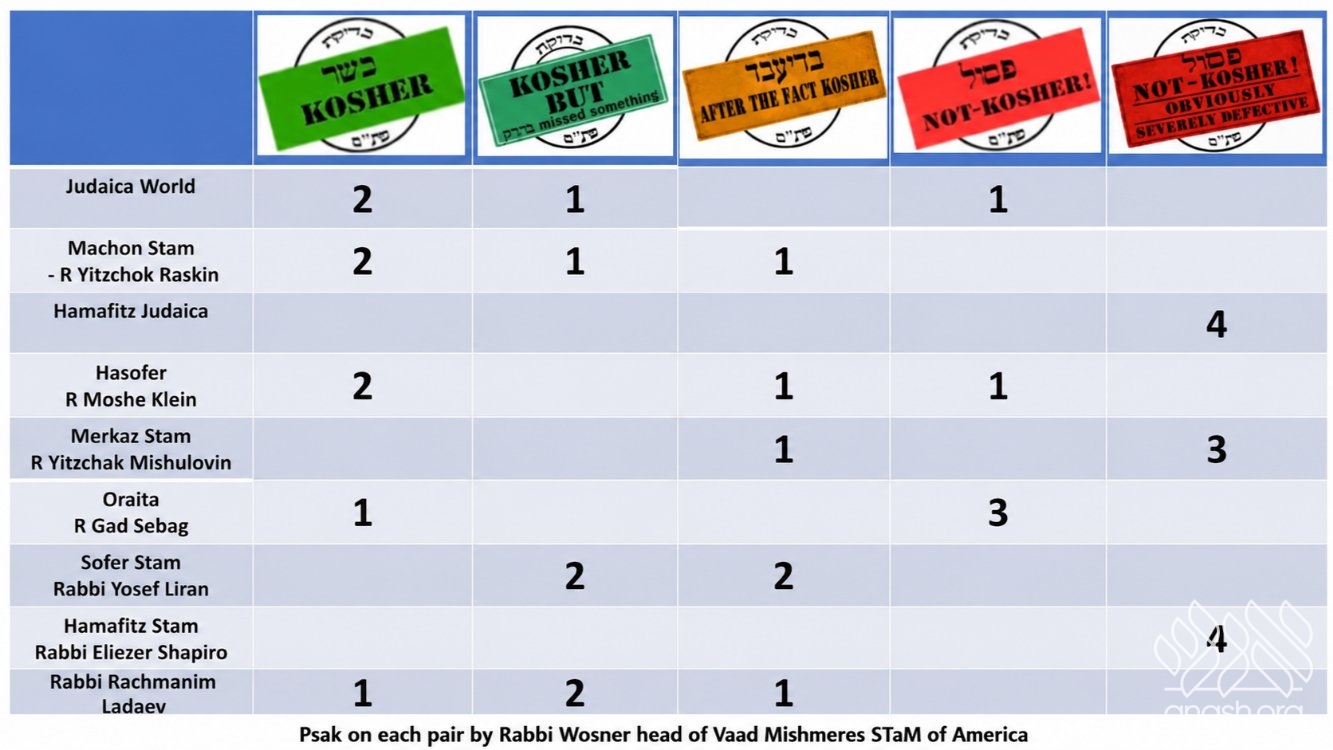
The private investigation, conducted by Rabbi Moshe Yisroel Dovid Wolf, involved the purchase of the least expensive pairs of tefillin sold by nine different Brooklyn-area retailers. The tefillin were purchased anonymously, documented on video, and submitted for a blind examination by an experienced sofer who was not told which store supplied any particular pair.
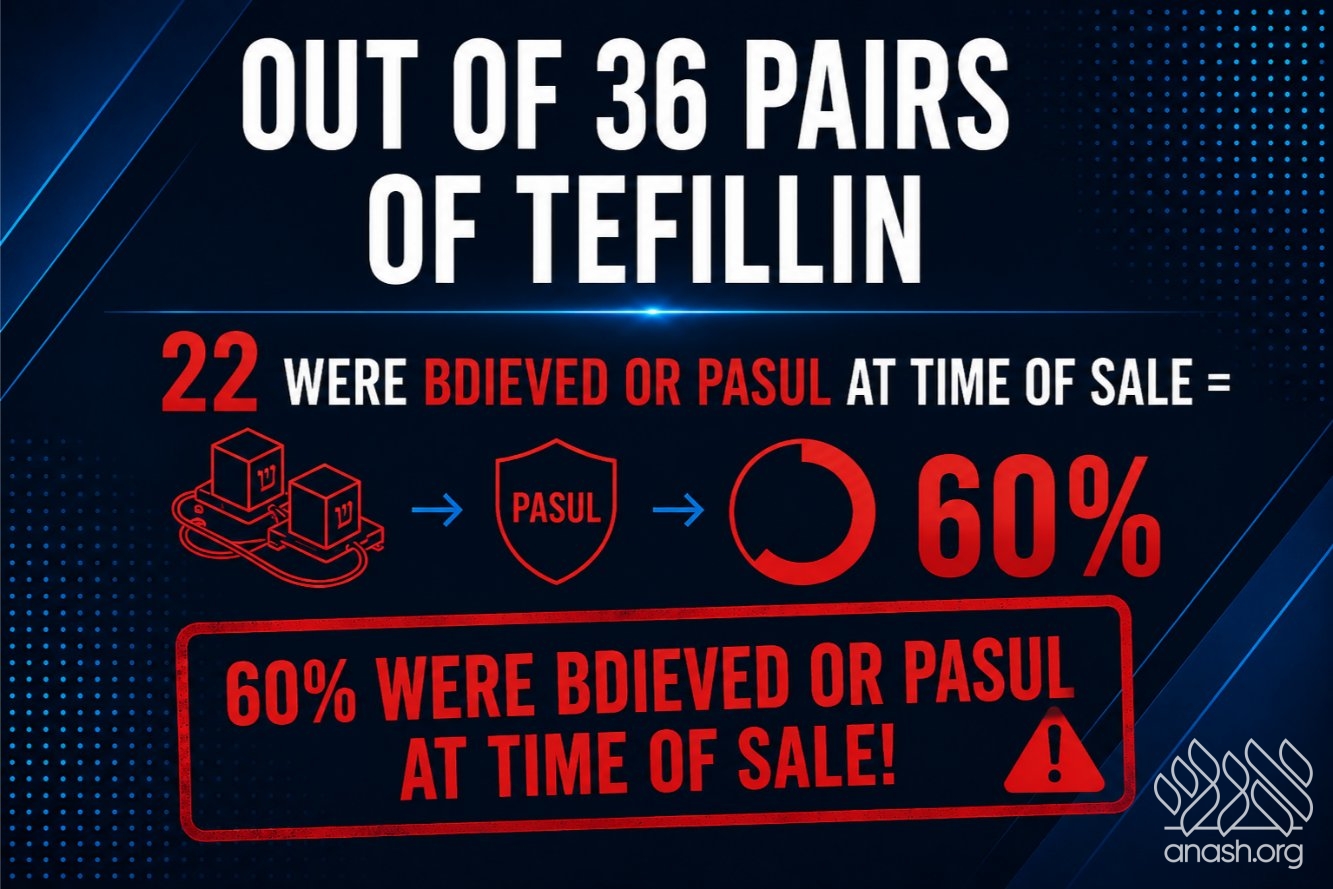
According to the investigation, more than 60% of the tefillin examined were determined to be either pasul (halachically invalid) or b’dieved (a level that may fulfill the mitzvah after the fact, are not allowed to be worn again after the findings are revealed, and definitely should not be sold to consumers in their present condition).
The findings were subsequently reviewed by the renowned Posek Rabbi Avraham Tzvi Wosner of Monsey, New York, who issued the final halachic ruling on each pair. Rabbi Wosner heads the rabbinic oversight of Vaad Mishmeres STaM (VMS), widely regarded as the world’s leading organization dedicated to ensuring the halachic integrity of Sifrei Torah, Tefillin, and Mezuzos.
After reviewing the findings, Rabbi Wosner expressed deep pain over what had been discovered. Rabbi Wosner remarked in Yiddish: “עס טוט אזוי וויי אז זיי פארקויפן די תפילין” (“It hurts so much that they are selling these tefillin.”)
Rabbi Wolf stated that Rabbi Wosner’s reaction reflected concern not only for the specific deficiencies found in individual pairs but also for the broader responsibility of those who sell STaM products to ensure that every pair of tefillin reaching a customer has been properly checked and verified.
“This investigation was never about attacking any particular store,” said Rabbi Wolf. “It is about protecting consumers and raising awareness. Most people assume that if tefillin are being sold in a reputable Judaica store, they have already been thoroughly checked and verified. Unfortunately, the evidence suggests that assumption is not always justified.”
“Tefillin are handwritten by human beings, and mistakes can occur at every price point,” Rabbi Wolf explained. “The issue is not whether mistakes can happen. The issue is whether those mistakes are being identified and corrected before the product is sold to the public.”
The investigation also revisits a longstanding ruling regarding STaM in 1987 issued by the Crown Heights Beis Din, which stated that local sellers of STaM must verify the kashrus of the products they sell and may not rely solely on quick wholesale inspections performed in Israel prior to being sold.
The complete investigation documents the purchase of the tefillin, the opening of the batim, the examination of the parshiyos, the findings of the sofer, and the final rulings issued by Rabbi Wosner.
Rabbi Wolf hopes the project will increase consumer awareness and encourage higher standards throughout the STaM industry.
“The goal is simple,” Rabbi Wolf said. “We should all be able to take for granted that the Tefillin that are being sold in religious stores are Kosher. Our sages tell us that the Mitzvah of Tefillin brings blessings to the individual who puts them on, adds protection to the entire Jewish community, and hastens the Geulah. When a Jew spends hard-earned money to buy tefillin, he deserves confidence that what he is receiving has been properly checked, meets the standards that were promised, and that he will fulfill the Mitzvah while putting them on.”
The full investigation is now available for public viewing at: STAMUNCOVERED.COM
WATCH



 COMMENTS


What is the price point on these tefillin?
Big piece of information
No matter what price teffilin or mezuzos you buy they need to be checked very well prior to being sold. If they are not checked well issues will be found. Yes, granted in more expensive teffilin the issues will be less common becuase they have better penmanship in the first place. Many of these pairs were not checked well. That’s besides the 11 pairs that were so bad that im wondering who wrote them?? Keep up the good work Rabbi Wolf
The Mezuzah video that was sent around a number of years ago showed a concern. I am not discrediting the fact that it is very probable that this is an issue, but at the same time, it should be noted that it is coming from the same source that there were some reports that he may or may not be biased. I personally am not comfortable with the source that it is coming from. If there is an issue, go to Rabbi Braun and tell him that there is this issue, and let him decide what to do. But this, in my strong belief, is wrong.
I’m honestly confused by this argument.
If a grocery store was selling food and 60% of it wasn’t kosher, would anyone say, “Don’t talk about it”?
If a doctor was giving the wrong medication to 60% of his patients, would anyone say, “Stop criticizing”? or go to a rov first?
He is doing the job that many rabbonim don’t want to do
When we’re dealing with תפילין, People put them on every morning believing they are fulfilling a מצוה דאורייתא.
AND BRACHA LVATULU EVERY DAY
I know for a fact:
Rabbi Brown was approached and informed long before this was published to the public….
Take your own note on that.
Before sowing doubt on a person’s reputation, bring facts. I know rabbi wolf, and has no bias.
And don’t tell me that rabbi wolf is also smearing. He’s actually doing the opposite of what your doung: showing evidence. And not hiding his name.
In what way is Rabbi Wolf biased?
I personally think making a video like this is the wrong approach. The way the Rebbe taught us is to add in light, and that is exactly what Rabbi Menachem Kahn is doing. I attend his weekly shiurim and got certified through him, it’s a game changer to have a Rov who answers Shailos, that is raising the standard from the ground up. That’s how you change an industry, not by making videos.
Trying to stay “pareve” and good with everyone is spineless. If you knew that a CH store was selling treif, should you also be good and not say anything so not to be on their bad side?
And until you “raise the standards from the ground up” shluchim and others will be giving out possul tefillin to 60% of the bar mitzvah boys or community members in their city? thank you very much for the advice
Don’t shoot the messenger. It’s painful to watch these arguments. Every time someone points out a wrongdoing, do‑gooders decry “negativity” and object to the method of publicizing it claiming “this is not our way.” People naively rely on sellers’ Yiras Shamayim, while unfortunately some simply do not care or take responsibility. Sadly, I’ve had my share of unquestionably pasul STaM. If you can fix the problems, please do. Otherwise, at least let the community know what is happening so they can make informed decisions — and maybe one day we’ll merit a real kosher market.
To the so called “local sofer” – Changing the industry will only come when it hurts the pocket. When consumers will ask questions.
The reality is that money blinds people.
And to this ” sofer” please tell me how you would react if the Simchas you made had trief meat? And the community is sold trief meat ? Would you add in light? Maybe light candles ? Dance hakafos?
And tell me what you would do when a person Is about to drown? Also add in light? By the time you light the candle – the person will be dead …
Adding in light is saving a life
Adding in light is making sure people put on kosher tefilin
Adding light is making sure people eat kosher
Rabbi Wolf should be congratulated for his efforts. He gains nothing from this. Anyone who knows him – knows that he deeply cares for Mivzta mezuzah and tefillin – and yes he adds in light – like real light – not the fake excuse of add light by doing nothing!!
The chassidim in Russia stood up to communism – today we need to stand up to the idol of America – money!!
Who is standing up?
How can they sell this???
This is a disgrace!!
It’s is a mitzvah d’oraissa to put on tefilin every day.
The Rebbe encouraged tremendously mivtza tefilin.
When a person puts on tefilin that are not kosher, is he performing the mitzvah?????
Shouldn’t we help each person to actually perform the mitzvah by putting on KOSHER tefilin!!!!!!
I know Miyad from Yeshiva and he cares a lot about Yidden having Kosher Mezuzos and Teffilin like no one else I know of…
I know that he saved up his own money for the past few years to make this expensive project for one reason:
Every YID SHOULD HAVE KOSHER TEFFILIN!
BTW, I heard from the son of one of these stores say: “Mivtzoim Teffilin means that it’s not so good. And everyone should expect that”. We wouldn’t sell this to our own.
Crown heights Farmers!
Shame on you!
That a YID doesn’t need kosher TEFFILIN!!!
Stop being money hungry!!!
The results shown in this video are shocking. After all the effort to encourage people to put on Tefillin and pay for them, or raise funds for them, they likely turn out to be posul??!!
Will we finally wake up and push for change???
I think that he is correct for saying there is an issue. But I think he took the wrong approach. It is wrong to list every single store and rank them. I think the proper approach is to talk to the stores privately, and have them deal with the issue. It is GROSS to say that there is an emphasis on the store, when the issue is more to do with the LEAST EXPENSIVE aspect to it. Let us say it flat out. Don’t buy the cheapest Tefillin. Ever.
Also, when u get Tefillin, get it checked before use. It is not that expensive.
What’s your issue???
So, if 60% of the LEAST EXPENSIVE meat sold in Crown Heights was TREIFE …
we should not publicize which stores sell treife ??!
No way! That would be GROSS!!!
We should just say, dont buy the least expensive meat…
and continue ALLOWING TREIFE meat to be sold in kosher stores on Kingston Ave ???!!!!
Are you nuts?
How many Yidden are innocently eating treife?
What have YOU done to stop Yidden from eateing treife on Kingston?!!!!
The stores were spoken to privately,
(see stamuncovered.com)
and the way they “deal with the issue” is here for all to see….
You are amazing Rabbi Wolf!!!
Opening the eyes of shluchim worldwide who are trying to do the Rebbe’s call of mivtza tefillin… and believe they are…
How painful is it when a yid learns about yiddishkeit, and commits to putting on tefillin, only to find out much later that he was cheated…!
There is NO EXCUSE to sell posul tefillin!
to ANYONE!!!!
This is NOT what the Rebbe intended with mivtza tefillin- to cheat people into thinking that they are putting on tefillin!
Sofrim/ Stores,
What will you answer to the eibeshter?!!!
Can you really sleep at night knowing that you fed treife to yidden?!!!
Wake up!
Take responsibility!
It is GROSS to sell a Pasul pair. Or to sell a pair that wasnt checked.
The seller has an achrayus.
We should all be asking the sellers why are they machshil the rabim??
It has nothing to do with the inexpensive pair. And everything to do with the owner taking advantage of the uneducated consumer…
If this was inexpensive meat that was trief – the seller would.be embarrassed to walk in shul…
What is going on here?
I’m just curious why this topic took years after the mezuzah story to come to light. You would think either the sellers would have learned their lesson or at least be afraid for this new story to be published…
kol hakavod to Rabbi Wolf for finally exposing to the public the truth. we should all know the truth of what we are buying. i want 100% kosher tefillin. i will buy wisely from now on…
Not kosher
I personally purchased these holy parchments, wanting to do a real Mitsvah .
I heard so much about this important mitzvah!
I was very very disappointed and upset when I found out that they were not kosher. I felt cheated ! Cheated when buying holy parchments!!!!
How can religious people sell not kosher stuff !!!
How is that possible?
This really troubles me and I’m sure that it troubles many others .
I hope that they will be careful from now on to sell only the kosher ones!!!!
Most likely, this is not the first case where there is a lot of mistakes, but on the other hand, this business is becoming more or less dangerous for me in general, and buying tefillin or mizuzah in stores is dangerous.They may be of unknown origin. I bought some about 30 years ago and the quality was zero. We live in terrible times.
It is dangerous to buy sacred objects and things in stores, as they do not inspire confidence.
Who wrote the “comments” featured next to each of the images of the parshios? Did he also not know who he was writing about or could he have been, even unknowingly, more favorable to those he fell close too and possibly more critical of others?
Empty words.
Maybe you are biased- more favorable to those who you feel close to
There seem to be 2 standard comments, one for the pasul, and one for the “pasul obviously severely defective”. These 2 categories were given by Rabbi Wosner- as clearly stated in the video.
Amalek macht kalt
Honestly, Does it not bother you that many yidden are being sold pasul tefillin? and are not fulfilling the mitzva doraissa?
Why are you looking to point fingers in the wrong direction?
Instead of looking at the main point, you are focusing on side details.
Main point is that many yidden are misled and are NOT fulfilling a mitzvah d’oraissa and that is a BIG problem!
As a chossid of the Rebbe, you should be very concerned about it. Many yidden are not putting on KOSHER tefilin, and are not fulfilling the mitzvah! What a terrible thing!!!
We run around doing mivtza tefilin, helping yidden to put on tefilin one more time and one more time, and here in our own crown heights, lubavitch stores are selling possul tefilin!
This is Absolutely a crime!!!
Everyone should demand that there should be some kind of supervision to make sure that tefilin sold in crown heights should be kosher !
Where are the Rabbonim???
Why aren’t they coming out clearly against that which stores are selling Possul tefillin?
Why aren’t they overseeing the checking of the tefillin before they are sold?