




ו׳ אלול ה׳תשפ״ו | August 19, 2026
The Smartphone Question We Can’t Afford to Ignore
“They try to guide people to avoid using a smartphone, but their words don’t carry the same weight, because they themselves have one. If there were a physical danger to our children, wouldn’t we demand of the school administration, first and foremost, to see to our children’s wellbeing? Physically, we don’t let anyone harm our children – spiritually?”
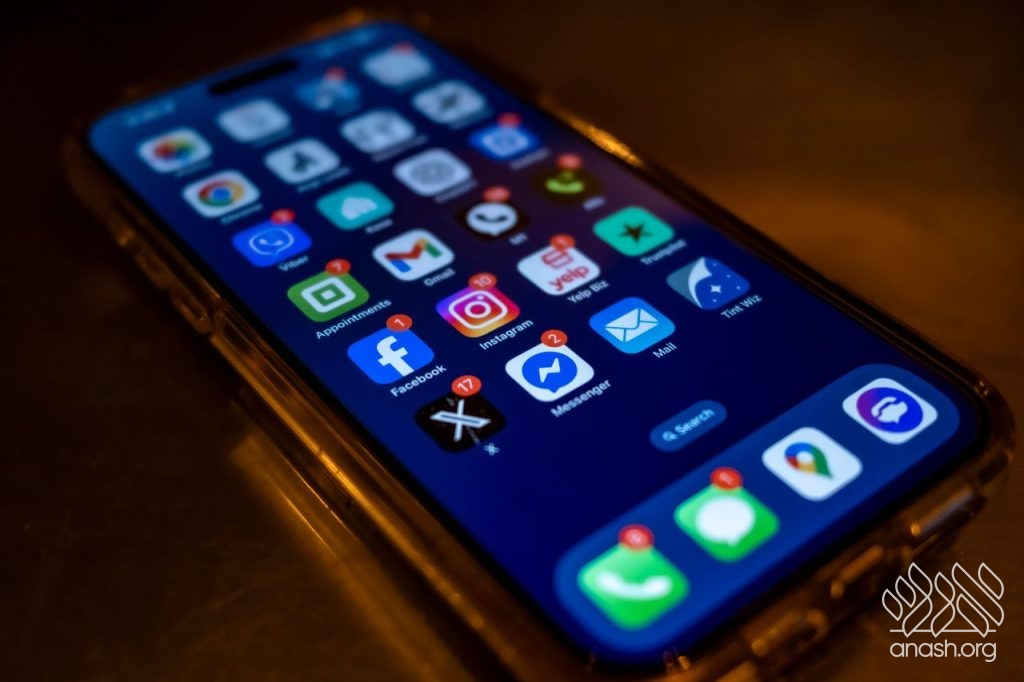
By Rabbi Moshe Blumberger – Kfar Chabad
Neither my wife nor I have a smartphone. I see people of stature for whom the smartphone serves as a powerful tool in their shlichus and their parnassah. Usually, these are very focused people, with inner strength and fire. But there are others for whom it pulls them out of focus and distracts them from what really matters.
Given this reality, it’s clear to me that a smartphone isn’t right for everyone. Technology is a gift from Hashem, created to help us, but that doesn’t mean a smartphone has to be in everyone’s pocket.
I want to share here part of my own internal dialogue on the question of “smartphone or no smartphone.”
Beyond the personal question each of us should ask ourselves, how should I be using technology? I think we also need to ask ourselves how our choice affects those around us, especially those we’re responsible for.
For example, if I’m a father of eight children, and I estimate that one of them won’t use technology properly, how do I, as a father, help him make the right choice and manage without a smartphone? Do I tell myself that since the other siblings can handle it and allow it, even though this one child won’t be able to withstand it? Or do I take responsibility and do all in my power so that he and his siblings are not put to that test to begin with?
There’s a real problem in the current situation. Many leaders, rabbonim, shluchim, and askanim use a smartphone properly. So for themselves, there’s no felt need for change: “I’m perfectly fine.” But what about their communities? They cannot serve as an example for people for whom a smartphone, even a filtered one, is a bad choice.
Even if they try to guide and direct those people to avoid using a smartphone, their words won’t carry the same weight, because they themselves have one. It’s very hard to influence in this area when you yourself carry a smartphone. And so, for the most part, they settle for recommending or requiring filtering alone.
Wouldn’t it be impactful if a mashpia or a mechaneches would sit with talmidim or talmidos who are struggling and tell them, “I’m with you in this struggle too. I also want a smartphone very much. But the two of us, together, will overcome this desire, no matter how important it feels”?
Most of the arguments in favor of keeping a smartphone are about shlichus and parnassah needs. It follows, then, that until someone actually goes out on shlichus or to work, by every account, a smartphone doesn’t benefit their learning.
It’s sad and almost absurd that chassidishe bochurim, after Zal, go on shlichus and get a smartphone. Why? “To stay in touch with family on WhatsApp.” Does that justify the price?
The reason there’s no outcry, no protest, is that a considerable portion of the rabbonim in yeshiva have smartphones themselves. So the talmid absorbs not the legitimate reasons of shlichus or work, but rather: “For children it’s a problem, but for adults it’s fine.” And so, “I’m already grown up.”
The saddest part is that there’s no attempt to change the situation. It’s simply accepted as a given, something that can’t be changed.
Does anyone doubt that a smartphone doesn’t benefit the yiras shamayim of high school and seminary girls? The responsibility of the menahalos of these schools and seminaries is, above all, for the yiras shamayim of their talmidos. If they see that it isn’t good for the talmidos to have a smartphone at all, they need to do everything possible so the talmidos receive the proper chinuch without needing one.
The reason this battle is seen by many as a “lost war” is that the chinuch staff themselves have smartphones. That’s why they don’t see a real chance to enforce it and go out to fight this battle for the benefit of the talmidos.
I want to look at this from another angle:
We see many people among us who wouldn’t want to carry a smartphone, and do so only “for the sake of their shlichus.” Therefore, anyone whose shlichus is educating talmidim toward yiras shamayim – such as menahalim, teachers, mashpi’im, and so on – needs, for the sake of that very shlichus, to go without a smartphone.
Only that way can they take an active part in influencing those they’re educating on how to use technology properly.
Some argue that since the talmidim will likely end up with a smartphone anyway once they grow up, our job should instead be to teach them to use technology correctly, to set boundaries for them while using it, and so on.
I personally don’t agree with this approach. Chabad, as is known, holds by the approach that the proper preparation for influencing others is first strengthening your own essence, and only once a person has that maturity and inner strength will he be able to influence rather than blend in and lose his own identity in the process of trying to influence others.
In our case, if until the age of 24 or 25 the talmidim and talmidos are immersed in an atmosphere of kedusha, they have a chance to use technology correctly and properly when the time comes. But if they’re exposed to technology at a young age, then later on too, they won’t be in a position of influence.
If there were a physical danger to our children, say, someone on a school’s staff was repeatedly hitting the students, wouldn’t we, as parents, fight to have him removed? Wouldn’t we demand of the school administration, first and foremost, to see to our children’s wellbeing, before any other consideration of “it’s not comfortable”? Physically, we don’t let anyone harm our children. Spiritually?
COVID came along, and our mosdos push screens on us, arguing that distance learning is important and necessary. Excuse me, where are the values of Chassidus here? What’s actually important?
A friend admitted to me that he’s very careful with technology, and for 14 years never brought internet into his home. Until, during COVID, the principal herself called to make sure they’d get it, to ensure each of the children had access to online learning. COVID ended long ago, but the three computers he bought for his children never left.
There are online school assignments, which can make girls feel that only with online access can they succeed in school. Why not the opposite? Why not encourage and initiate as little contact with the internet as possible?
We need to ask the principals of our daughters’ schools: What’s more important, chinuch for yiras shamayim or academic success? What matters more to them, test scores or tznius?
True, we all have yiras shamayim. The question is whether there are other values considered more important that force yiras shamayim to wait its turn.
So, dear principals:
If a CEO sees that for years running his business has been losing money, he understands the failure isn’t a small part of his job. He’s paid to make the business profitable. And if he can’t, he must resign and recommend finding a replacement who can lead the business to profitability.
When a principal notices spiritual decline in his institution – not on the margins, but among the mainstream – shouldn’t that shake him to his core? Before you move on as if nothing happened, go find someone who will actually try to help. Or try to change the situation yourself.
As parents, we need to be brave and change the rules of the game. If we don’t wake up now, the claim of “I’m fine, I only use my smartphone for holy endeavors” will end up harming and damaging the best of our sons and daughters.
Adapted from the Lubavitch monthly.
 COMMENTS


The reason they feel they need it, is because the moisdos they end up under as a bochur and older, make it the normal, and anyone who doesn’t have a smartphone or WhatsApp ends up missing out.
Take camp for example. These days, it’s all run with group chats and pdf’s and files and more.
Any bochur that doesn’t have a phone, is going to actually end up left out from knowing what’s going on, and when they do find out, it’s usually too late. (You didn’t hear the schedule change?it was on the group!).
It only gets worse once the pressure join in from the sides when your friends end up leaving you out of things because you don’t have a phone or WhatsApp.
People will by default choose the path of least resistance. If they have a choice of a bochur with a phone and one without, most times (unless the moisad is looking specifically otherwise), they will choose the bochur who has a phone and can be easily reached and be able to take care of themselves. They don’t want someone that doesn’t have Google maps, or Spotify, or WhatsApp etc, the reality is this.
The pressure will be relieved when bochurim feel they can function and be included without one. Until then, the trend will only grow.
It’s because it’s the norm look at the polisher chassidim the majority outside of the house is flip phone even by the women and girls, today 99% of Chabad has a smartphone what you expect? We don’t need technology in every aspect in our life I only have a flip phone and a filtered tablet that’s only in thr house, yet I manage if I can do it anyone can.
good for you
This was exactly my experience on Shlichus. The camaraderie that used to happen among friends now happens on a WhatsApp chat and it’s extremely socially isolating. How crazy of an idea would it be, if Talmidei Hashluchim are meant to be proper Talmidim of the Yeshiva and are under the jurisdiction of the Hanhalah, there should be rules about phones for the Shluchim as much as there are for the other Bachurim. It only takes away from the Shlichus anyway
Moishe himself is a living example, he has a camp each summer for 150 bacherim with day long trips, learning and programs, a yeshiva year round, fundraises money for all his peulas and running everything without a SMARTPHONE!!! he is a living example and shows that you can be successful and he practices what he preaches
A lot of people walk around with the phone that we think is a smart phone when in reality all it is, is a simple dumb phone with no Internet ability. It just has a touch, etc..
Someone told me about one of our rabbonim that for years has resisted the temptation to have a smart phone and recently he also fell through and he’s also using a smart phone “like everyone else”. . I went to find out and I discovered it’s actually not even true. The regular dumb phones are almost impossible to work anymore in certain places and he therefore decided to change to a better phone which looks and feels like a smart phone, but with no Internet capabilities.
When we talk about our staff having a smartphone, we need to know what we’re talking about is it a gab? Or a real phone with internet access.
It’s a good sign that we’re still talking about it, it means the fight isn’t over
why would you think it would be over? its like saying after the holocaust that jewery is over
the eibeshter is emes, and emes can’t lose
It’s about the Chinuch, and no one knows what’s actually on your settings. The difference is that a smart phone by default is unfiltered and it’s impossible to know how much someone is filtering it, a dumb phone is by default filtered so it’s really about the values that you’re teaching to the kids.
I’ve seen time and time again my work of education, that when parents spend time with their kids and allow them to share their feelings with them and they connect them in a real way – this allows the children to not need to connect deeply with their smartphone and internet.
In Zal, a close friend of mine had a dumb phone that was not filtered, and he lamented to me that he got caught up seeing very inappropriate things online. The sky was the limit with what he was watching at night.
A filtered smartphone (or a filtered iPhone) is a million percent better than an unfiltered dumb phone.
it’s better? it’s the only way!
I think the article was about a obviously “filtered” smartphone vs a flip phone, I wouldn’t dream of anyone getting unfiltered
it’s pashut these days for everyone
100% right. It’s a disaster.
Especially this:
In our case, if until the age of 24 or 25 the talmidim and talmidos are immersed in an atmosphere of kedusha, they have a chance to use technology correctly and properly when the time comes. But if they’re exposed to technology at a young age, then later on too, they won’t be in a position of influence.
That’s the problem… the leaders who have smartphone don’t understand the damage being caused to the younger generation who think it’s ok because even the Mashpia has…
It is imperative to educate your children that certain individuals require specific accommodations and have sought guidance from religious authorities on how to navigate these needs in a manner consistent with their beliefs. These individuals are no less observant than those who do not possess a smartphone. As they mature, should they require such a device, they are fully entitled to seek rabbinical counsel on its appropriate use.
It is deeply inappropriate and disrespectful that some members of our community exhibit a condescending attitude, believing themselves superior due to their lack of a smartphone. This sends a detrimental message. Our objective should be to encourage responsible usage, and this message ought to be conveyed appropriately.
While you cannot control your children’s choices, you can empower them to make sound decisions. For some, a religious authority may advise the use of a smartphone, while for others, it may not be recommended. It is understood that responsible use is paramount if one possesses a smartphone, and religious principles must not be disregarded in the pursuit of technological convenience. This is a distinct conversation.
It appears you are concerned that your child may desire a smartphone, and you perceive it as your duty to prevent this. I do not believe this is an accurate assessment. We must acknowledge the pervasive presence of smartphones and seek rabbinical guidance in navigating their use. It seems you may lack rabbinical leadership in your life; I recommend seeking such guidance. Allow your children to witness the process of consulting a rabbi, demonstrating that this option is available to them if needed. Restrictive approaches have historically proven ineffective, as evidenced by outcomes in areas such as Crown Heights.
I lost you here: “Excuse me, where are the values of Chassidus here? What’s actually important?”
If so, tell us the values of chassidus, please. Don’t excuse yourself.
And then, “he must resign and recommend finding a replacement who can lead the business to profitability.” Do not go saying our mechanchim must leave. Even saying that indirectly. Cheap to say.
How good it would be not to have a smartphone.
I am trapped. And no one knows.
It is so painful. They all see a good chassidishe person. All those people who said they can tell well no they can’t. They can’t tell yiras shomayim they can’t see it on my face as they told us when we were younger.
I can say maybe my parents didn’t know and didn’t do enough and didn’t raise us with proper filters but it’s all me now. All me.
And half the adults I know don’t have a filter and can’t recommend one.
And I guess now I am going to be an adult to. And I guess I have joined them. Only they got to it later and I got to it when I was young and impressionable and addicted to goyishkeit on a phone I probably should never have gotten.
And yes COVID helps as well but there are families around the world who had computers and also there’s like online school etc.
Gentec is the best filter (and no, I don’t work for them : )
I learned in Zal in Nyack, where none of the Rabbonim have smartphones. They are the furthest thing from batlonim. Aside from the yeshiva itself—which requires a lot of communication—a few of them are involved in other endeavors as well, yet they still don’t have smartphones.
I came in from Mesivta thinking a smartphone was a necessity, but after the third year – Shiur Daled – in Nyack , I realized it isn’t. I am now going on shlichus without one and will, B’EZ”H, stay without it.
I was involved in a few projects In the past years, some involving advertising
through Media, and managed reaching the exposure of thousands without having a device myself.
Over the summer, I made it clear to camp that if I was joining the staff, it was a package deal: I don’t have WhatsApp. It worked out fine. I got a few updates slightly later, but as long as you aren’t a batlan and keep your ears open (the way staff should be, rather than being busy on status), you stay in the loop on everything important.
It’s completely possible, and at the end of the day, people appreciate you even more for it. Try it out!
עד מתי יהי׳ זה לנו למוקש ולא די לנו לכל הצרות שעברו עלינו ר״ל
do you not see the destruction that the smartphone has had on us ourselfs and more so the children that don’t know better when they see their parent looking all the time on it, most of it is total emptiness, 99.9% of what is shared on whatsapp is not important at all, and we share it around on all the groups and make total batlonus and stupidity important, and the kids see this and all the little “kosher” stupid pictures and clips of shpintza’s new shoes and the like, really, this is what we are on this world for, is this how we are mechanech the next genaration, leave aside the shmutz problem, lets say your device is filtered, how do you expect a child who is brought up on total emptiness to be able to open a gemara, you are destroying your children’s branes, i see these children they are walking zombies, as kosher as the parents device is, wake up already and think twice about the “need” for that device in your pocket.
maybe this elul instead of putting a check mark on יפשפש במעשיו by getting your tefillin and mezuzos checked, check the “mezuza” on the door to the open world that is sitting in your pocket, i.e. getting it properly filtered if it is a absolute need and discuss it with a proper rav (a rav that has not fallen in the trap who will say for sure it is mutar) and for most of us who don’t really need it, throw it out now, think about what we came down on this world to do, not to send silly “kosher” jokes, and if that is what you think is the only way to connect with your family, think again, maybe try to find more meaningful ways of connecting with your family, maybe weekly zoom meetings and the like, think hard and deeply about the affect that you are having now having it in your pocket and the affect on at least yourself and hopefully your children by getting rid of it altogether, it may be that you will lose many conveniences but please consider the big picture.
בברכת כתיבה וחתימה טובה לשנה טובה ומתוקה
Please post email addresses of all the shadchanim who do not use whatsapp or would work with a single who does not use whatsapp. I need someone who replies to emails.
I can immediately say that there is harm: a person wakes up with a smartphone and falls asleep with a smartphone instead of sorting out Hasidut; he is distracted by the news and is in another world, and all his thoughts are on the news.And this is what he lives for.
For some reason, the second they can, Bochrim and girls jump to get one. It is almost like a way to prove you are an adult is by getting a smartphone and being added to all the family WhatsApp chats. Girls started going to school because otherwise they would go to the movies, but now that they are going to high school, we bring the movies to them. I don’t think the Rebbe would be happy with how people handle their phones at all. Klipas Noga isn’t Kedusha; it is Klipa whose goal is to cover over Elokus. Klipas Noga is a Memutzeh between Kedusha and the Three Klipos. If used the wrong way, you’ll end up in pure Klipa. The Kuntz is that we use it for Kedusha, but if that isn’t why 90 percent of us have it, what is the point?