




י׳ תמוז ה׳תשפ״ו | June 25, 2026
The Rebbe Grabbed Me by the Collar and Pulled Me In
As a student in YU, Rabbi Alter Metzger had visited 770 for the Rebbe’s first official farbrengen and a Q&A yechidus for students. But when he stood on the side during dancing, the Rebbe made sure to pull him in.
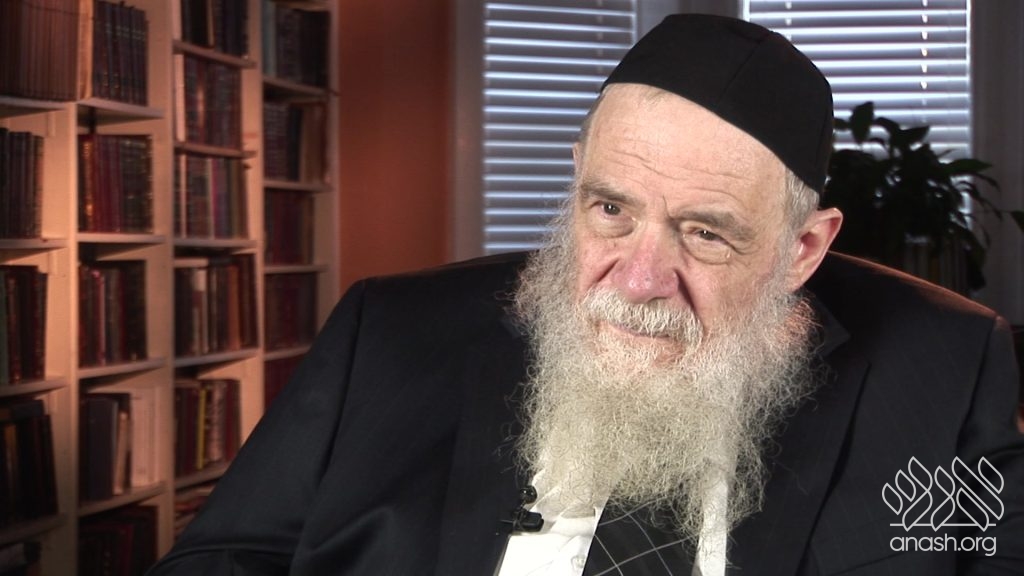
Rabbi Alter Metzger was a longtime Jewish studies professor at YU’s Stern College, and the author of a number of works on the history and philosophy of Chabad. He was interviewed in July 2010. He passed away earlier this year.
I grew up on the Lower East Side, before going uptown to study at Yeshivas Rabbeinu Yitzchok Elchonon, which is a part of Yeshiva University (YU). I would stay there for seven years, studying for my rabbinic ordination, as well as for a major in psychology.
In the winter of 1951, together with a group of YU students, I took the train into Crown Heights, Brooklyn, and was present at the very first farbrengen with the new Lubavitcher Rebbe. Not long afterwards, a group of Lubavitch yeshivah students began coming to YU on Thursday evening to teach Tanya and other works of Chabad thought, often staying until 11:00 or 12:00 at night. They would also inform us about different events taking place in 770, and encourage us to participate in them. As a result, I began coming to Lubavitch regularly.
One Rosh Hashanah, I walked all the way to Crown Heights, taking the pedestrian side across the Manhattan Bridge, and I was there to hear the Rebbe blow the shofar.
After the services, I didn’t know where I would eat the holiday meal, but a yeshivah student named Shlomo Carlebach noticed and took me along to where he was eating.
As a result, I became friendly with this Shlomo Carlebach. His father served as a rabbi in a synagogue on the Upper West Side of Manhattan, and Shlomo would teach a weekly Torah class and host gatherings there.
Meanwhile, a Columbia University student named Marilyn Hittner was a regular at his classes and also became very active in his outreach efforts among college students. Ms. Hittner – later Schwadron, her married name – also went on to develop a connection with the Rebbe, and came to 770 many times over the years.
On one occasion, she later related, while she was still a graduate student at Columbia, she asked the Rebbe to explain the relationship between the Baal Shem Tov, the founder of the chasidic movement, and the work of the early-19th-century English poet Lord Byron, for a paper she was writing.
The Rebbe answered that while we don’t know of any direct relationship between the two figures, one can develop this concept in a negative sense: The Baal Shem Tov inspired the Jewish people to serve G-d joyfully, even though they were economically impoverished at the time. Meanwhile, although Byron was a nobleman and a creative poet who was very much admired by English society, he was characterized by melancholy and depression. So they were opposites, with optimism on one side and sadness on the other. It was an unusual response, and astonishing that the Rebbe was even aware of this figure.
As an offshoot of these outreach efforts by Shlomo Carlebach and Marilyn Schwadron, in 1952, an audience with the Rebbe was arranged for a group of students, including myself, as well as some adults. It was a diverse group, and there must have been forty people there in all. To ensure that we could all fit, the audience was held in the study hall, which was set up informally. Over the course of an hour or so, the group asked the Rebbe various questions, about the existence of G-d, the soul, evolution, dinosaur fossils, the concept of a tzaddik, and so on.
I recall the Rebbe spoke about the Conservation of Energy, a foundational principle in physics which holds that energy cannot be destroyed – only transformed from one form into another. The fact that a person can speak and walk, but loses these qualities when he is no longer alive, indicates that he had some kind of animating force – an entity like the soul. One might think that this individual has met his end, but he must continue to exist in some other form.
One student asked about the significance of a bracha, a blessing received from a Rebbe. The Rebbe quoted his father-in-law, the Previous Rebbe: When a farmer wants to grow something in his field, he must first plow and spread fertilizer, and only then can he sow some seeds. In the same way, a blessing from a Rebbe is not just a magnanimous bestowal from above; if a person prepares themselves spiritually, then the Rebbe’s blessing will facilitate that he will be successful in his efforts.
For me, this audience was a kind of gateway into the many things the Rebbe would do later on, in providing personal and intellectual leadership – for Jews in America, as well as the rest of the world.
That same year, on another one of these visits to Crown Heights, something unusual happened. It was the last day of Passover, and after the farbrengen that the Rebbe always held at the conclusion of the holiday, he went into his private study. This farbrengen had been a particularly lively one, so the chasidim continued singing and dancing outside his office, in the lobby of 770, until the Rebbe came back out.
Standing there, the Rebbe gave another talk. Someone there was a shochet – a kosher slaughterer – and so he spoke about the spiritual aspect of this work: The Hebrew word shechita means “drawing,” because in making it fit for kosher consumption, the shochet elevates the animal, and draws it into the realm of holiness.
The Rebbe also spoke about the power of dancing, and said that when a person goes out of their limitations by dancing late into the evening – as we were doing – without paying attention to the time, then G-d responds by giving without limit.
Quoting the prophet, “And I will pour down for you blessing until there will be no room to suffice for it,” the Rebbe encouraged us to sing those words and dance along to them. He added that there is a reliable tradition within Lubavitch that the melody set to these words was composed by the first Rebbe of Chabad, the Alter Rebbe.
The chasidim followed his lead, forming a circle, and enthusiastically singing along – except for two outsiders, who were standing on the periphery, passively watching all the excitement. Suddenly, the Rebbe stretched out his arm, and grabbed these two young men by the scruff of their collar, pulling them into the dance.
I was one of those two young men, and that scene is something I still vividly remember.
 COMMENTS


We appreciate your feedback. If you have any additional information to contribute to this article, it will be added below.