




כ״ז תשרי ה׳תשפ״ז | October 8, 2026
The Big Tent of Lubavitch
“Politicians love the phrase big tent. A party roomy enough for people who disagree, who come from different places, who would never otherwise share a table. Usually it’s a slogan. This Tishrei, in Crown Heights, I watched one actually stand.”
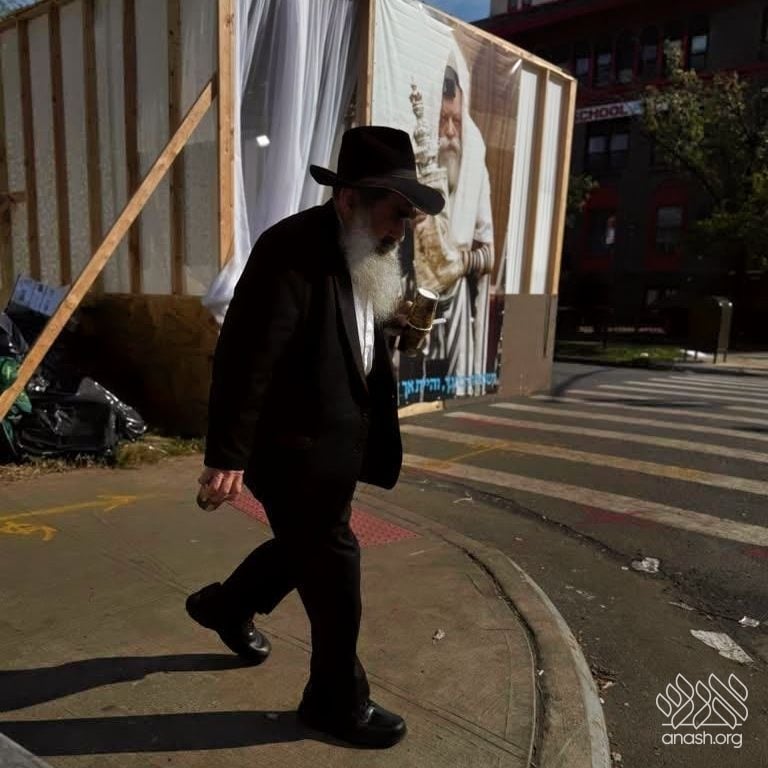
By Shimon Rosenberg
Politicians love the phrase big tent. A party roomy enough for people who disagree, who come from different places, who would never otherwise share a table. Usually it’s a slogan. This Tishrei, in Crown Heights, I watched one actually stand.
I spent this past year learning the Rebbe’s maamarim straight off the page. No summaries. No stories about them. Somewhere in there the words stopped being something I read and became something I could see. Then Tishrei came and I lived it. Not as an observer of Chassidus. Inside it, with my body, from Elul to Simchas Torah.
What I saw was the widest net any Jewish leader has ever cast. Still holding. This is about that net: who it caught, how it was woven, why it hasn’t torn.
*
In 5723 the Rebbe said four maamarim across Tishrei: יבחר לנו את נחלתנו, וכל אדם לא יהיה באהל מועד, בסוכות תשבו, and תורה צוה. We built an edition of them. Read as a set, they do something no single one can. They are not four talks. They are one argument in four movements.
The thread runs from Elul’s preparation, through the coronation of Rosh Hashanah and the return of Shabbos Shuvah, into the essence-level encounter of Yom Kippur, out into the sukkah where the whole body lives inside a mitzvah, and on to Shemini Atzeres and Simchas Torah, where everything gathered is held, and danced. Each day draws down what the one before it opened. Nothing in the month stands alone.
Once you see the thread on the page, you can’t unsee it on the street.
*
Chassidus was never meant to stay in the head. The deepest ideas in those maamarim end in a sukkah you sit in, a lulav you hold, a Torah you carry in circles until your arms ache.
The intensity this year didn’t come from understanding more. It came from the understanding finally having somewhere to land. Idea met act. That’s the whole point, and it’s easy to lose once Chassidus becomes something we quote instead of something we do.
And the joy. Joy’s too small a word, and too loud. It got to my legs before my head had a vote. The old Chassidim called it simcha poretz geder, the joy that goes through fences. It went through mine so quietly I only noticed after, by the gap.
If that sounds romantic, look at the old faces. Feter Hendel Lieberman painting the Chassidim of the Russia he grew up in. Zalman Kleinman’s farbrengens, his wagon of Chassidim from Chaslavitch flying through the air to Lubavitch. When the Rebbe asked Kleinman to draw Kfar Chabad, he asked for it without embellishment, in its simplicity, as it actually is. Look at those faces and you know. That’s what it was.
If we struggle to see how wide Lubavitch is, I suspect the limit is in us, in how open we’re willing to be. It was never in the Rebbe.
*
The Rebbe’s nesius began in 1951 with people who had lost almost everything and arrived with less. New countries, new languages, a world that hadn’t waited for them. That was the raw material.
My wife’s grandmother raised four daughters alone. The steppe, the camps, a château outside Paris. Wherever they were, they kept their airs. That, too, is a face of Lubavitch.
My family came from the other end of the net. A Newark boy with an anthropology degree, meditating on a mountain in Colorado. An Upper Manhattan debutante who chose her college for its riding stables. One Shabbos in Crown Heights, and that was that. Lubavitch takes its name from the Russian word for love. They found out why.
Two families. One came through the fire with nothing. The other walked away from everything it had. The same man reached both.
These stories rarely get told whole. Every generation has had its turnover. What stands out is how much less of it there was under the Rebbe: a measure of how far he could reach, and how gently he held what he reached.
*
Look at how the net was actually cast. Not in a line. In rings. The survivors first. Then the ones who came in through a lab or a lecture hall: Herman Branover out of the Soviet underground, Velvl Greene looking for life on Mars, Yitzchok Block with his Aristotle, Yaakov Hanoka sent back to Penn State to finish his degree. Then my father-in-law, Faivish Vogel, whose Tanya ended up in the hands of a teenage Jonathan Sacks, who carried it into the House of Lords and onto the BBC. Chutza, squared. Then the hippies, my parents among them, who had already seen something on a mountain and needed a vessel strong enough to hold it. Then us.
The tidy histories pluck a few names and skip the rest: the gray middle, the cousin who married out, the great-uncle who left for the Party. They were never the footnotes. They were who the Rebbe was reaching for.
*
The generosity was real. So was the firmness. The Rebbe held an exact vision, an absolute commitment to halacha, an unbroken line to the sources. Read any maamar and you see the pedigree: it opens from a verse, from a teaching of the Rebbeim before him, a line running back through the generations. He isn’t speaking for himself. He’s expounding and applying what he received.
That combination is the hard part. Openness without the anchor dissolves. The anchor without the openness shrinks. The Rebbe refused to choose, and the tent stands because he refused.
*
Look at the arc of the campaigns. Every new mivtza answered something: a threat, a tragedy, a wound the world needed healed. Tefillin on the eve of war. Mezuzos after terror struck a school. Shabbos candles in the hands of girls and women everywhere.
Physical acts, and in their time they looked radical, even strange. Today we take them for granted, which is its own kind of proof. The Rebbe’s answer to pain was never only a statement. It was something a person could do with their hands, today, for someone else.
*
Gimmel Tammuz was a tragedy for most of us, personally and as a movement. Few understood then where the Rebbe’s vision would take us next.
But look at who was there this Tishrei. The French, with a quiet elegance. The Moroccans, with their own melodies and a warmth that pulls you in. The Israelis, who come with one change of clothes, if that. Hilltop youth with wild peyos and knit kippot the size of plates. Crown Heights kids testing every limit and boundary, as a rite of passage. The hippie Lubavitch kid in Blundstones, hair just long enough to make the mullet shine, who loves every bit of it and still needs to wander. Yemen, Russia, South America, every corner of the map.
What was once in back alleys is now out in the open. It was always there. Now you can see it.
Many of them arrived carrying stories of their own. Look without narrowing your eyes and you see a community made of exactly the people the Rebbe began with in 1951: uprooted, and finding their way by reaching out to someone else.
*
A while back I helped run a public seder on a college campus. One of the students from that night showed up in Crown Heights this Tishrei.
So I went to hakafos at 770 with someone who had never seen it. The crush, the heat, the singing, a whole building turning in one circle. For the first time in recent memory I stood in that room and didn’t feel what was missing. I didn’t have to. I only had to see it the way they see it, the ones who never knew the loss: fresh, childlike, nothing to compare it to.
Through those eyes it wasn’t a memory. It was wonder, in the middle of the chaos, happening now.
At some point I wasn’t watching anymore. An arm across my shoulders, another under mine. Old men, bochurim, kids carried above the crowd. The whole room turning on itself like water, slow at the edges, fast in the middle. The light in it was more than the room was built to hold. It went out the doors, down the steps, onto the Parkway. Chutza. It was still moving when I left.
You don’t learn chibur from a page. You learn it with your arms locked around people you’ll never see again, everyone turning around the same Torah, everyone held. It’s only later, walking home, that you get it: the holding was the lesson.
And there’s an inconvenient truth about the early nunz that nobody likes to say out loud. Some of us still ache for it. The fervor, the faith, the connectedness, the joy of the ones with the yellow pins. The slightly wild Chassid, unsettled, rough at the edges, offending all the right sensibilities, alive in his whole body. Maybe not a mistake. Maybe a sketch of where it was all going.
Everything’s on TikTok now, the whole muddle and more, in our pocket, eating our attention alive. Turn back to the books anyway. You’ll catch the faintest glimmer of a spark, just enough to want to connect. And when you look up, the street is yellow.
*
I spent as much of Sukkos as I could in Rubashkin’s sukkah. Plates going out, people coming in, all day, deep into the night. Many of the people at those tables had traveled here with almost nothing. They were fed and cared for by the generosity of people they had never met.
I didn’t visit them. I lived with them, and through them. That’s where you understand how alive this movement is. Not on a stage. At a long table under schach, where someone who arrived with nothing is handed a full plate by someone who asks nothing back.
And the long tables. Plates and l’chaims moving hand to hand. People who came with nothing giving each other the one thing they had, which was each other. Now and then a niggun would start somewhere no one could point to, run the length of the sukkah, and slip out under the schach into the street. Nobody started it. Nobody could have stopped it.
The energy was everywhere. You felt it like bass through a floor.
*
The Rebbe’s vision was that every single person is a shliach. Not only the couple who moved to a city with no other Jews. Every one of us. And once we live that way, it’s in reach for anyone: step a little past your comfort zone, find one person, connect.
That’s how people who had lost everything became the ones who give. By helping someone else, they were helped. That was the design.
I saw it this year in Crown Heights, in every facet. Lubavitch today is fascinating, alive, and well.
Words and photographs by Shimon Rosenberg. Crown Heights, Tishrei 5787.
Originally published at https://reshimu.ai/blog/big-tent-of-lubavitch
 COMMENTS


We appreciate your feedback. If you have any additional information to contribute to this article, it will be added below.