




י׳ תמוז ה׳תשפ״ו | June 25, 2026
Stop Making Two Years in Kollel Sound Like Too Much
“We have turned the Rebbe’s vision on its head. Today, a yungerman who stays for three years is looked at like something went wrong. We have convinced ourselves this is the authentic Lubavitch position. It is not. And the Rebbe’s own words make that unmistakably clear.”

By Rabbi Levi Yarshevsky
Every Lubavitcher yungerman getting married today has one thing on his mind: shlichus. Where he will go, what he will build, how he will make it happen. That urgency is real and it is right. But somewhere along the way, that urgency started bleeding into something else entirely.
Picture this. A Shabbos farbrengen, a table full of yungerleit. One mentions he is in his second year of kollel. Immediately, the questions start. “Nu, what are you looking at? Any options? Anything developing?” The subtext is unmistakable: the clock is already ticking and he is running behind.
Then someone mentions he is in his third year. The table goes quiet for just a moment. The look that crosses someone’s face says it all without a single word being spoken: nebach. He still hasn’t found something. And if a yungerman is sitting and learning in his fourth or fifth year? There will always be someone nearby ready to shake his head and say it plainly: “That’s not Lubavitch. In Lubavitch, we go on shlichus.”
And underneath that pressure is a real feeling. There are Yidden out there with no Chabad House, no shliach, no one knocking on their door. There is a fire burning and you could be there helping put it out. Instead, you are sitting in kollel. That is the accusation hanging in the air, spoken or not.
Here is what nobody stops to ask: Why does nobody say that to an eighteen-year-old in his second year of Zal? Why does no one walk over to a bochur and demand to know why he hasn’t opened a Chabad House yet? Because we all understand, without needing to explain it, that those years of building yourself are not time stolen from the mission. They are the mission.
Yet, the moment a yungerman gets married, that logic vanishes completely. Kollel becomes a waiting room. A placeholder. Something you do until the real thing begins.
We have convinced ourselves this is the authentic Lubavitch position. It is not. And the Rebbe’s own words make that unmistakably clear.
Before 5722, there was no broad kollel system in Chabad. The Rebbe’s letters from those years were pointed and urgent about the desperate need for rabbanim, mechanchim, and leaders in communities starved of Torah life. In Igros Kodesh (Vol. 14, pp. 30-31), the Rebbe openly questioned how talented yungerleit could sit and learn while communities were facing a spiritual hatzalas nefashos. The question back then was not how many years to spend in kollel. The question was whether there should be a kollel at all.
Then came Yud Alef Nissan 5722, and everything shifted. The Rebbe publicly invoked the Alter Rebbe’s ruling in Hilchos Talmud Torah: A man should dedicate two to three years to serious Torah study after marriage before taking on worldly responsibilities. That same year, the first Lubavitcher kollel opened. The framework was established. Two to three years. That was the baseline.
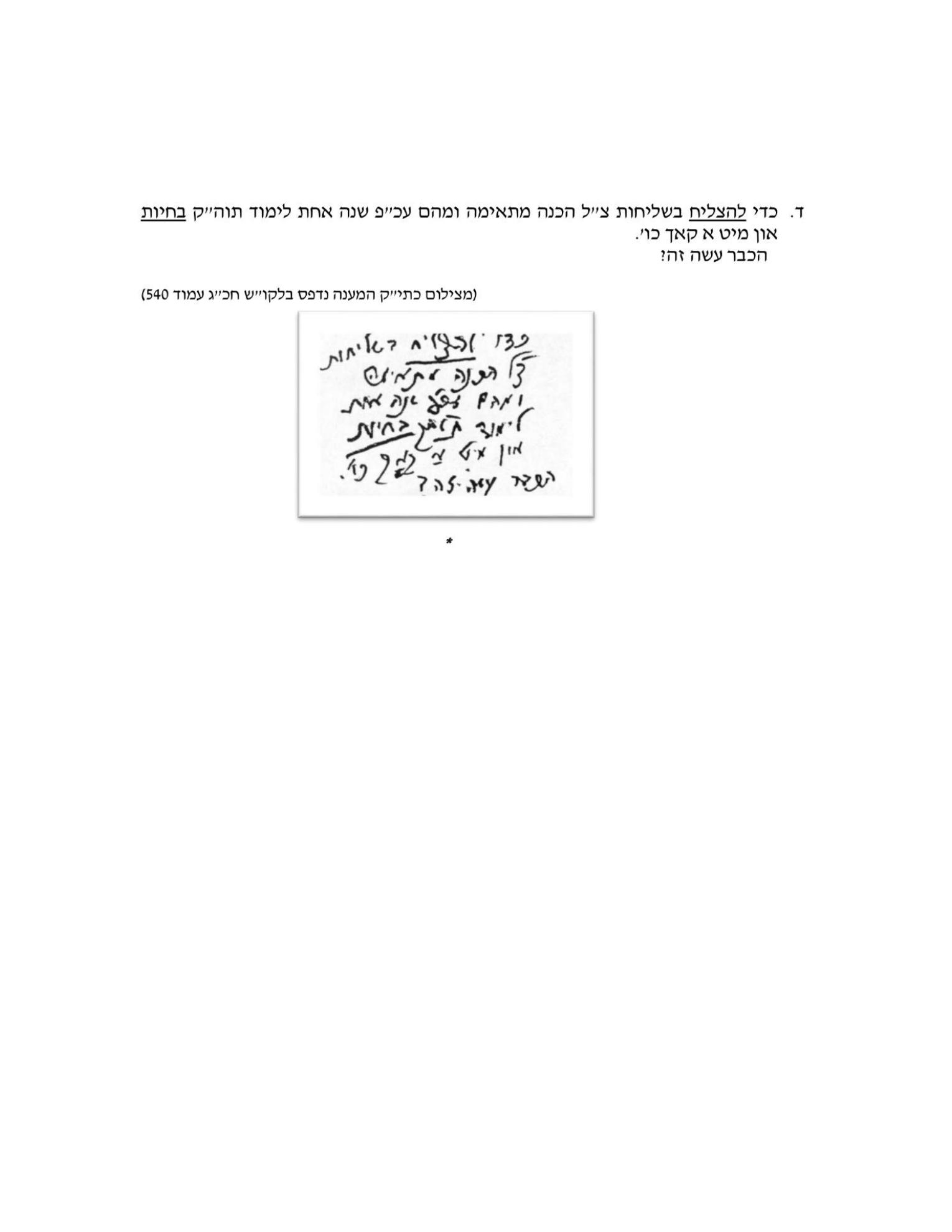
From that point on, the Rebbe’s position was stated again and again consistently. In the sichah of Rosh Chodesh Nissan 5740, the Rebbe quoted the Alter Rebbe’s ruling directly and called on yungerleit to live by it. In private letters and yechidus’n across decades, the Rebbe directed yungerleit to learn for two or three years, or more. In one handwritten response, the Rebbe specified “לערך שנתיים,” approximately two years.
In another letter, the Rebbe wrote that the longer one remains in kollel, the better, and that at a minimum one should be there for two or three years. The standard the Rebbe set was two years at the floor, three years for a yungerman who is genuinely growing, and longer still for someone truly thriving.
There is one well-known letter where the Rebbe tells a yungerman to stay for one year. This is the letter that gets pulled out constantly to justify the modern one-year norm. But the context of that letter tells a completely different story. It was written to a specific individual who had no plans to go to kollel at all. The Rebbe was not establishing a standard.
The Rebbe was coaxing a reluctant yungerman into the kollel with the lowest possible bar to clear. Taking that letter and turning it into the blanket ruling for all of Lubavitch is not learning from the Rebbe. It is cherry-picking to confirm what we already decided we wanted to do.
Now, to be fair, the Rebbe was never rigid about this. Not every yungerman is cut from the same cloth. Someone who is genuinely struggling in his learning, who is not growing and not finding his footing, should not be pressured to stay. The Rebbe himself would direct such a person to move forward.
But they are individual exceptions, not the definition of the standard. They do not change what the Rebbe expected from the average capable yungerman who is succeeding in his learning.
The institutions the Rebbe built tell the same story. The kollelim in Eretz Yisroel and the kollel in Australia were built around a two-year framework, with the possibility of extending for those who were excelling.
Kollel Menachem She’al Yad Hamazkirus had no fixed time limit at all. That was not an accident. The Rebbe did not set a cutoff there precisely because growth cannot always be measured on a calendar. The open-ended structure was itself a statement: stay as long as you are genuinely building yourself.
As recorded in Yemei Temimim, the baseline across the board was two years. The Rebbe allowed only for successful learners that they should extend into a third year or beyond. Nobody was debating whether to stay past year one. That was taken for granted. Today, we have somehow flipped the entire conversation. We debate whether a second year is even justified. In the Rebbe’s world, the second year was never in question.
There is also a practical reality that rarely gets acknowledged. When a yungerman enters kollel already planning to leave after twelve months, he does not actually get twelve months of learning. By the time winter hits, he is on the phone with communities, interviewing with head shluchim, looking at cities, drawing up budgets, and starting to raise money. Strip all of that out, and a one-year kollel often amounts to a few months of real, focused learning. That is not what the Rebbe built kollel for.
The entire point of kollel was never kollel for its own sake. It was to send out shluchim who were genuinely equipped. Men who could pasken a shailah, teach with real depth, counsel a Yid through a crisis, and carry a community on their shoulders. You cannot give what you do not have. And you cannot build that depth in a few rushed months while half your mind is already on the move.
Based on everything above, the conclusion is straightforward. The average yungerman should be spending two to three years in kollel. Two years is the minimum, not the goal. Three years is not excessive for someone who is genuinely succeeding. And for the yungerman who is truly thriving, still growing, still building real keilim, the Rebbe’s message was consistent: stay longer. The question worth asking is not whether to leave after one year. It is how much more a yungerman can invest in himself before he goes out to give to others.
We have turned the Rebbe’s vision on its head. Today, a yungerman who stays for three years is looked at like something went wrong. But read the sichos. Read the letters. Look at what the Rebbe actually built. The real surprise should be the one who rushes out the door after twelve months. The real “nebach” is not the yungerman sitting and learning. It is the culture that forgot why he was supposed to be there in the first place.



 COMMENTS


Look in the back of Kovetz Divrei Torah Chelek Chof Gimmel which has a Likut about Kolel and you will find many sources where the Rebbe writes not stay in Kolel more then 2 years or not for so long in general, many of the letters and Manos brought here were to specific people, and many only say 2 years but not more then 2.
Also especially now that Kolel is only accepting a limited amount of people it’s not fair to all the new Chassanim who would like to join Kolel but there is no space when some spots are being taken by people who have been there for a few years already.
there are zero sources in the back of Kovetz Divrei Torah Chelek Chof Gimmel that say to not learn more than 2 years, rather they say to not learn forever in kollel, and that learning more than 2 years is only for people excelling in learning, which is exactly the point of the article.
point 2 is ridiculous and doesn’t need to be addressed.
Sources quoted indicate the opposite of the entire article. Never mind there are multiple other sources that do not align with this article. The key idea is that it should not be more than two years with exceptions only for unique people. The entire article is to promote the idea of two or more years. In fwct, this is not oisgehalten: One year is normal, two years – within the range of normal, more than two is not acceptable only an exceptional cases.
the point of the article is to learn a full 2 years which means in between 2 and 3 years (which is why the rebbe said always at least 2 years or 2 to 3 years but some places it says 2 years because the point is to learn for 2 full years which ends up being in between 2 years) and that’s the normal and that’s what the rebbe always said, an additional point in this article is that the rebbe was pro specific individual to learn longer more for people that will go into rabanus etc. and this is what all the sources say, and your “One year is normal, two years – within the range of normal, more than two is not acceptable only an exceptional cases” is completely fabricated and doesn’t fit the sources.
In the additional sources you brought Maana Lamed Vov to R’ Avrohom Hersh Cohen shows the opposite point of what you are trying to make, the Rebbe says there since our Avoda is to spread Torah, if you stay longer then a year or 2 it’s a question if your first years there were ok.
incorrect, clearly you didn’t get the point of the article, the article says to learn 2 years and that’s what the yechidus says, the rebbe said in yechidus that the standard is 2 years, because the point is that they shouldn’t stay in kollel forever, however for special individuals the rebbe encouraged more than 2 years but again the same point that its not forever and this that you write “if you stay longer then a year or 2” is not in the source at all and the source is 2 years not one or two.
I was told by Rabbi Binyamin Klein, who was in charge of the Kollel, that the Rebbe set up Kollel only for Bochurim from 770 who got married and continue learning.
Anyone who wasn’t in 770, isn’t meant to go to the Kollel.
I saw a number of sources in the sefer “Magal Hachaim” where the Rebbe says that Kolel is only for מי שחשקה” נפשו בתורה”.
Personal directives, especially regarding kolel, are varied. Kolel, the Rebbe said, was for those who “nafsham chashka baTorah,” and that’s why some people were encouraged to stay longer, while others were told to move on.
For any serious yungerman – two years should be normal.
I think this article misses an important distinction.
The Rebbe’s insistence that most yungerlait should not remain in kollel indefinitely was directed at the broader ציבור—those who were not planning to become rabbanim, morei hora’ah, roshei yeshivah, or maggidei shiurim. However, it is impossible to produce serious talmidei chachamim and spiritual leaders without providing a framework for years of dedicated learning.
One of the major challenges facing Chabad today is the shortage of qualified rabbanim, morei hora’ah, and mature Torah leadership. That shortage should not surprise us when, unlike many other communities, we have no frameworks that allow talented and motivated yungerlait to continue learning at a high level for an extended period.
The question is not whether every yungerman should remain in kollel long-term. The question is whether a movement that aspires to produce Torah leadership can do so without supporting those individuals who are capable of becoming the next generation of rabbanim and teachers. History suggests that it cannot.
Proud to be the wife of someone who has stayed in Kollel for four years before we moved on shlichus!!!
We did get funny looks about it. But I said it with pride and it was the best foundation for our family.
And the best most peaceful four years! Having a husband focused on his learning and having no other stresses are truly beautiful for the marriage and the children.
We did BH have three children at the time and Hashem always worked it out with Parnassah!
For anyone who is considering another year of Kollel. Do it!
People debating the argument, if the sources are endorsing a year, two or more.
But none mentions a basic situation, that makes everything to run as it is today.
Every Menahel moisad that is looking to bring shluchim, can’t wait to offer to the good Avreichim after a year, someone else will anticipate him. That’s why a lot of avreichim get Shlichus offers even before the wedding….
When my father was in Kolel in the early 1980s, the monthly Kolel check covered the rent. Today, that’s not the case. Living without money is not practical and place is great strain on a marriage.