




ח׳ ניסן ה׳תשפ״ו | March 26, 2026
Social Media Erupts Over Misleading Matzah Lookalike
With Pesach around the corner, Jewish social media is buzzing over a mix-up involving year-round Manischewitz crackers that look nearly identical to kosher-for-Pesach matza and are often shelved right alongside it. After several Chabad personalities raised the alarm, Manischewitz says it’s reviewing its packaging.
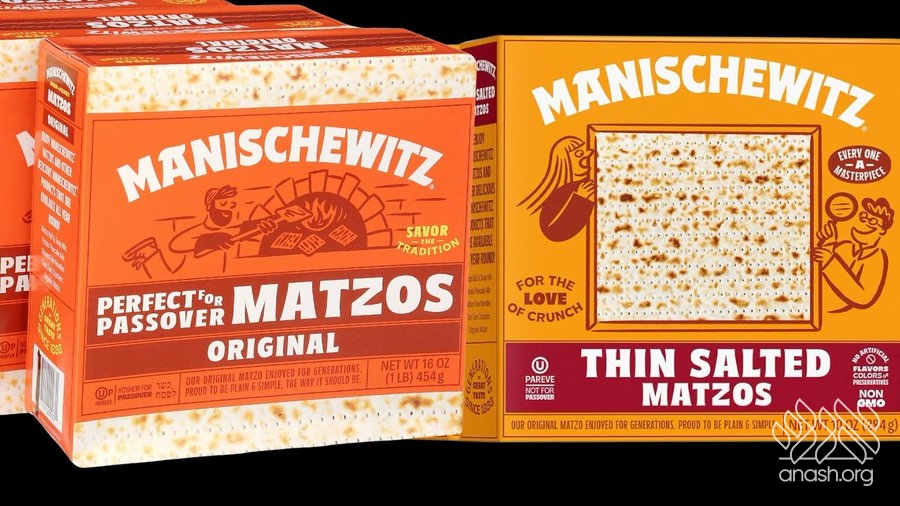
With Pesach days away, a quiet but costly mix-up is making the rounds on Jewish social media. Year-round Manischewitz crackers, bearing an OU certification but not kosher for Pesach, look almost identical to the real thing and are showing up on grocery shelves right next to it.
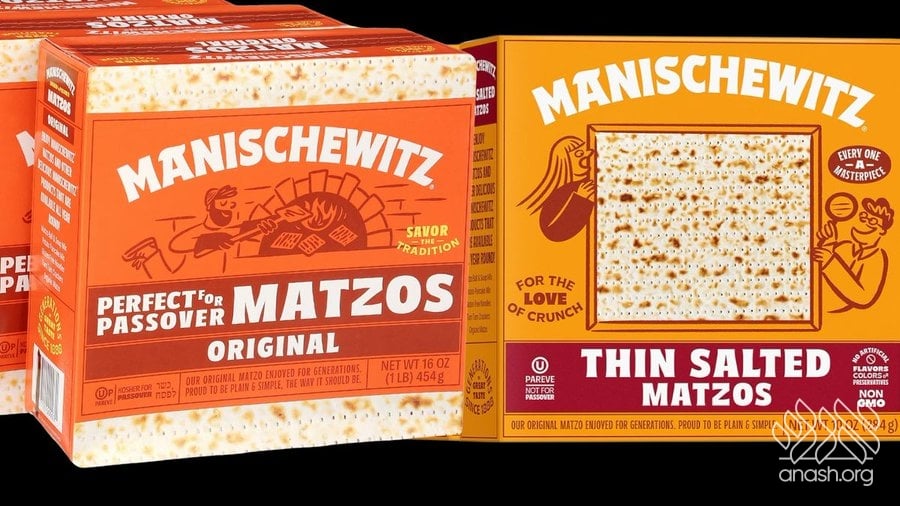
The Pesach box says “Perfect for Passover Matzos, Original” and is marked OU pareve and kosher for Passover. The year-round box says “Thin Salted Matzos” and is marked OU pareve, “not for Passover”. With the same familiar orange Manischewitz packaging and matzah image on the front, many say the difference is easy to miss.
The issue was first raised by the pseudonymous X user @CraftsmanBob, who posted a photo and wrote: “Feel like it’s pretty bad that they call this matzah and it’s actually chametz, stocked by all the national retailers for Pesach. @OrthodoxUnion feels like it’s a big deal.”
Several Chabad personalities were among the first to sound the alarm.
Popular speaker Rabbi Shais Taub shared a photo of two near-identical boxes side by side. “It’s heartbreaking when someone thinks they are keeping Passover and is unknowingly eating chametz,” he wrote. “It happens way more often than you might think. Look at these two products and tell me nobody would confuse them.”
Shliach Rabbi Mordechai Lightstone, founder of Brooklyn’s Tech Tribe, warned users: “Look before you buy, or you too might end up purchasing OU-certified Manischewitz brand bread. Manischewitz sells a cracker that looks like matzah and says matzah, but it isn’t kosher for Passover.”
Rabbi Mendel Super, shliach in Lake Havasu City, AZ, also pushed back strongly. “Hey @OUKosher this shouldn’t be called matzah,” he wrote. “Jews trying to have matzah on Pesach buy it. Even if it says not KFP, because ‘matzah is matzah.’ Especially when the grocery stores put it in their Passover display.”
Super later sharpened the point in a follow-up response. “It’s wrong to call chametz ‘matzos.’ Many Jews aren’t looking for a hechsher. They’re just looking for matzah and buy this. In many supermarkets, the only ‘matzah’ being sold is this chametz.”
In comments given after JNS reached out to Manischewitz about the issue, the company acknowledged the concern. “We’re aware of the conversation and appreciate the community bringing this to our attention, especially at a time as important and detail-oriented as Passover,” said Mirit Shalvi, the company’s senior vice president of marketing and strategic partnerships.
“At Manischewitz, we take our role in helping families prepare for the holiday very seriously. We understand that kashrut during this time is deeply meaningful,” she added. “That said, we also recognize that in a busy retail environment, particularly during the high-volume Passover season, similar packaging across product lines can sometimes create confusion.”
The company said it will be “evaluating packaging differentiation and working with our retail partners to ensure clearer in-store separation and signage where needed.”
OU Kosher’s chief operating officer, Rabbi Moshe Elefant, noted that the distinction between year-round and Pesach matzah has existed for decades and that non-Passover products are clearly labeled as such. “Those who keep kosher must remain vigilant when shopping and always check the product labels, especially as Passover approaches,” he said.
Some online resonated with that point. “But it is matzah. What else would you call it?” wrote Dani Klein of YeahThatsKosher. “Agree that the ‘NOT FOR PASSOVER’ label should be bigger.” Another user argued that “at least now they write it in a prominent way limiting the damage as much as possible.”
But others said the problem is not just the label in theory, but what happens in practice when similar-looking boxes are placed together in Pesach displays. “Mom sent me to the store a few years ago for matzo…I came back with that. it did not go well,” one user wrote. Another added, “Streits does this too. I showed up to a seder with it once, not realizing [it was Chametz].”
A related point was highlighted in a 1944 letter published by Rebbe Responsa. Writing to Manischewitz at a time when the company had a radio program, the Rebbe urged it to use its platform to educate the public about Pesach because of “the great ignorance which exists in many circles regarding the laws of Pesach” and “the great precautions which are necessary in regard to such laws.” He asked that part of the program be devoted to impressing on listeners “the gravity of the laws appertaining to Chometz during Pesach.”
 COMMENTS


But it clearly says on the box, “not for Passover”! I saw these both yesterday while shopping and there was no confusion!
For you it wasn’t confusing because you read the label which is a good thing, but unfortunately many don’t.
its funny to see CH just learn about this. As long as I can remember there has been Matzah with “no kosher for Pesach” for sale at Publix and other groceries even near pesach time.
Rakusens matza in England – the red box and blue box… Same thing and even look more similar probably….
It’s been going on for ages