




ה׳ אייר ה׳תשפ״ו | April 22, 2026
Shazar’s Impossible Dilemma on ‘The State of Israel’
In the summer of 1969, Zalman Shazar – President of the State of Israel and a follower of the Rebbe – found himself caught in a major moral dilemma, even deliberating whether to use his presidential stationery, after a letter from the Rebbe against using the term “State of Israel” made its way to him.

In the summer of 1969, Zalman Shazar – President of the State of Israel and a follower of the Rebbe – found himself caught in a major moral dilemma, even deliberating whether to use his presidential stationery after a letter from the Rebbe about using the term “State of Israel” made its way to him.
MK Geula Cohen, former Irgun and Lechi fighter, had been running a campaign against abortion with the Rebbe’s quiet encouragement. Her opponents tried to undermine her by claiming the Rebbe was hostile to the State of Israel – pointing to the fact that the Rebbe never used the phrase “Medinat Yisrael.” Cohen wrote to the Rebbe directly to ask if this was true.
The Rebbe confirmed it in a letter dated 19 Sivan 5729, explaining that “Eretz Yisrael” had been established by the Torah for thousands of years and was not subject to replacement by majority vote. Furthermore, the name “State of Israel,” the Rebbe said, damaged the Jewish claim to the land, presenting it as something only born in 1948 with UN approval rather than an ancient inheritance from Hashem, as explained in the first Rashi in Torah.
The Rebbe knew the letter would reach Shazar eventually – likely in distorted form. Rather than wait, the Rebbe sent Rabbi Shlomo Maidanchik with a copy, adding two handwritten lines:
“I am not sure how Mr. Shazar will react to what follows, but I decided it is better he receive a copy of my letter directly from me, rather than have it reach him indirectly – and perhaps distorted.”
When Shazar read it, he was shaken. He had long made peace with the Rebbe’s reluctance to use the title “President” – the Rebbe had explained that “Nasi” was reserved in his mind for the Melech HaMashiach, and Shazar had accepted that.
But here the objection wasn’t to a ceremonial title; it was to the institution Shazar had twice sworn allegiance before the nation to uphold. Furthermore, he was unhappy that he had never been told about it by the Rebbe – “not in our many conversations, which I remember word for word, nor in your letters” – but in a letter to a “journalist”.
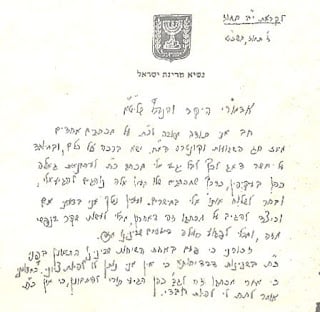
Shazar, deeply troubled by the tension, wrote a long heartfelt letter expressing his bare emotions: “My dear and revered Rebbe, shlita… I am still deliberating whether and how to respond to this latest letter, without being dishonest with myself, and without, heaven forbid, damaging our relationship.”
“I recall the late Rebbe’s saying that Chabad conversation is open-hearted… so please forgive the slight emotion in these lines,” he writes.
“I recall that once, your honor jokingly complained to me that I don’t let him be a Zionist. I think that after this letter to Mrs. Cohen, it is my turn to complain that your honor seems unwilling to let me be a Chabad chossid.”
He continued to write that he could not accept the idea that naming the state “Medinat Yisrael” in 1948 was an ideological attack on the land – what else could they have called it? The borders were what they were. And the suggestion that the word “medina” implied reliance on human strength rather than Hashem struck him as a stretch.
He even raised the question of whether to stop writing on his official stationery – with the word “State” printed on it – “so as not to cause your honor distress.” But then added: “I decided to ask your advice on how to conduct myself, and I will do as your honor instructs.”
The Rebbe replied with a lengthy and detailed letter dated 12–13 Tammuz 5729, beginning with unusual directness: “I read your letter with the greatest astonishment, mixed with deep sorrow. And beyond the content itself — these are essentially the same arguments as those of Satmar against me: ‘Why do you meddle with Eretz Yisroel, Eretz Hakodesh and the bris bein habesorim, and bring Hashem into it.’”
“My simple answer,” the Rebbe writes, “is: absolutely not.” What happened in 1948, the Rebbe explained, was not the founding of something new – it was the liberation of part of the ancient Land of Israel. Saying otherwise left Jews without a real answer to the accusations of colonialism.
“I have no illusion that justice arguments will win at the UN or Vatican”, the Rebbe continued – but Jewish morale depended on knowing they stood on eternal ground, not a post-war political arrangement.
The Rebbe continued to address each of Shazar’s different arguments directly. There is no inherent objection to the word “medina.” The objection was specifically to “Medinat Yisrael” as a replacement for “Eretz Yisrael,” which had real consequences: “This approach has destroyed and continues to destroy, harmed and continues to harm the vital interests of even the State of Israel itself.”
The Rebbe also pointed to Israel’s own UN representative, who twice said publicly what needed to be said – and was reprimanded by the government within 24 hours and forced to retract. A state that defines itself as a political entity born from UN consensus, the Rebbe explained, is trapped by its own limitations.
On the personal side, the Rebbe addressed Shazar’s complaint about not being allowed to be a Chabad chossid: “You were a Chabad chossid before I was born. And so may it remain, be’ezras Hashem, for long and good years.” On the oath of allegiance, the Rebbe said he always knew that when Shazar swore “allegiance to the State of Israel,” he meant in his heart Eretz Yisrael, and more than that, Eretz HaKodesh.
Finally, regarding the stationery, the Rebbe responded: He will certainly continue to write on the sheet as he has done until now, and he should not withhold this good from me, nor the satisfaction I derive when I once again see “black on white” that he is the one fulfilling this role.
“At the very same time”, the Rebbe added, “he is deeply pained no less than I am over the choice of the name (and the general outlook expressed in it), and he awaits the day when even the Jewish people (for the nations of the world never entertained any other thought) will write and establish the word “land” in place of the word “state.””


 COMMENTS


Possible to please see the Rebbes original letter?