



כ״א תשרי ה׳תשפ״ז | October 2, 2026
‘Ribbono Shel Olam, Thank You!’
How would the Rebbe want us to dance this Simchas Torah? In light of the miraculous rescue in the skies that brought 174 Jews from certain death to life, a newly published sicha illuminates the way.
There are moments when a Jew simply needs to stop.
To pause, for a moment, from all the daily pursuits and calculations, look at what happened, and simply say: “Ribbono Shel Olam, thank You.”
On Wednesday morning, in the middle of Chol HaMoed Sukkos, a Flydubai flight departed from Dubai, United Arab Emirates, on its way to Eretz Yisroel. In the midst of the flight, a most serious emergency developed. The aircraft rapidly lost altitude, and the lives of everyone aboard were in real danger.
It became clear that one of the pilots was an extremist Muslim terrorist who had decided to kill the pilot beside him and crash the aircraft with everyone aboard.
In a remarkable chain of miracles and Hashgachah Pratis, the civilians aboard the flight managed to overpower the terrorist, bring the aircraft back under control, land safely in Saudi Arabia, and, after several tense hours, board an alternate flight to Eretz HaKodesh.
Everyone remained alive. Everyone emerged unharmed.
How would the Rebbe look at an event like this?
What message should we take with us into every shul this Yom Tov?
What message should we carry with us to the millions of Jews waiting for us in shuls everywhere—or even on the street?
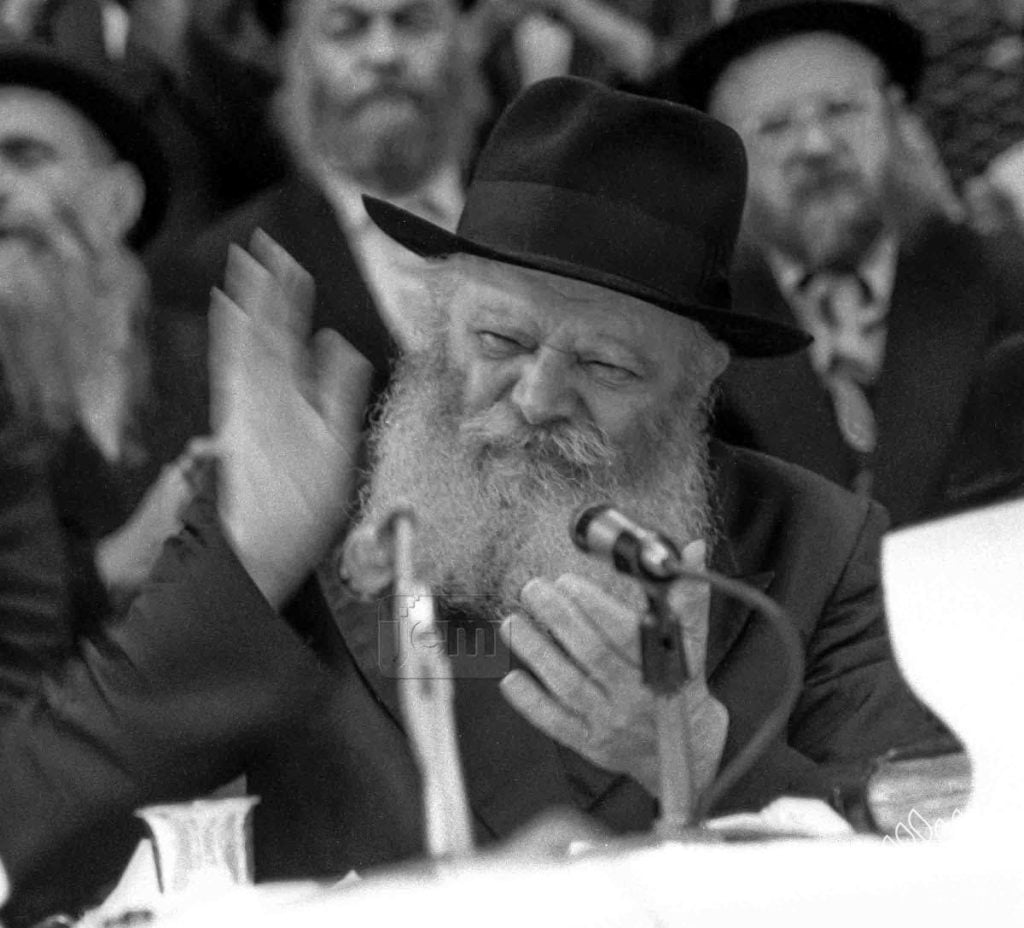
In an extraordinary and almost chilling display of Hashgachah Pratis, a booklet has just been published containing a new sichah of the Rebbe from the farbrengen of Simchas Torah 5737—exactly fifty years ago.
It came after a long summer during which the Rebbe spoke extensively about the miracles that occurred in the rescue of the Jewish hostages at Entebbe. But at this farbrengen, the Rebbe chose to focus on the obligation of gratitude, song, and joy as an authentic Jewish response to such an open miracle from Hakadosh Baruch Hu.
For the Rebbe, recognizing a miracle does not end with, “There was a miracle, Baruch Hashem.”
A miracle places upon a person the responsibility to give thanks, to become inspired, and to add in his life.
Following Operation Entebbe in the summer of 5736, the Rebbe spoke explicitly about the fact that what had occurred was a “nes nigleh,” an open miracle, and about the need to thank Hashem. At the same time, he emphasized that we must also contemplate what Hakadosh Baruch Hu wants to tell us through the event.
One of the unique aspects of the Rebbe’s words was that he did not separate gratitude to Hashem from recognizing the people who acted to save lives. The Rebbe said that a “Yasher koach” should be given to the soldiers who risked their lives to save Jews—and at the same time, we must see the Divine hand that brought about the salvation.
In other words, there are two expressions of gratitude that do not contradict one another:
“Hashem gomel chassadim tovim”—Hashem bestows good and kindness; everything comes from Him.
And at the same time, we must give a special Yasher koach to the people who served as Hashem’s messengers and acted with mesirus nefesh.
But there is an even deeper point: joy.
One of the things the Rebbe explained at that farbrengen was the story of King Chizkiyahu. Hakadosh Baruch Hu wanted to make Chizkiyahu Moshiach, but Chizkiyahu did not sing shirah over the miracle that had been done for him—and therefore he did not merit it.
From this comes an immense lesson:
When a Jew sees a miracle, he must sing to Hashem.
It is not enough to know that a miracle occurred.
It is not enough to feel relief.
It is not enough to say, “Baruch Hashem, everything worked out.”
One must sing to Hashem over the miracle.
This is precisely the lesson the Rebbe wanted us to learn from Entebbe.
This is precisely the kind of moment when a Jew needs to stop and say:
“Ribbono Shel Olam, thank You.”
Not merely, “What luck.”
Not merely, “What courageous people.”
But:
“Modim anachnu Lach… al nisecha shebechol yom imanu.”
“We thank You… for Your miracles that are with us every day.”
Fifty years ago, the Rebbe spoke about the miracle of Entebbe and taught us how a Jew should respond to a miracle.
And now, at a time when the entire world is speaking about the miraculous rescue of Jews from a flight that found itself in mortal danger, that very section of the Simchas Torah 5737 farbrengen is being published for the first time by Vaad Hanochos BeLahak—a transcript from Toras Menachem—Hisvaaduyos, Volume 86, which is scheduled to appear in time for the Kinus HaShluchim HaOlami.
The Rebbe already taught us what to do when Hakadosh Baruch Hu shows us a great miracle such as this.
Stop.
Give thanks.
Sing.
Dance and rejoice.
Let us make use of the 24 or 48 hours of Shemini Atzeres and Simchas Torah ourselves—for joy and gratitude to Hashem, for song over the miracle, and to thank and praise His great Name for His miracles, His wonders, and His salvations.
The booklet is available for online reading:
https://www.lahak.org/
The booklet is available for download in print format:
https://www.lahak.org/media/pdf/1385/cCdm13853689.pdf
 COMMENTS


We appreciate your feedback. If you have any additional information to contribute to this article, it will be added below.