




י״א מרחשון ה׳תשפ״ז | October 22, 2026
I Sent My Son to Crown Heights for Shiur Daled
An out-of-town Lubavitcher parent describes his dismay at the spiritual atmosphere his son encountered in Crown Heights during Shiur Daled and calls on the community to take responsibility for restoring the kedushah of the Rebbe’s shechunah.
By an out-of-town parent
I sent my son to Crown Heights last year for Shiur Daled.
For an out-of-town Lubavitcher parent, those words carry considerable meaning. Our children may grow up far from Crown Heights, but never far from 770. From childhood, they hear about the Rebbe’s shechunah, know its streets and landmarks, and look forward to the privilege of one day learning in the Rebbe’s daled amos.
My son did not grow up sheltered from the world. But he did grow up in a Chassidishe home, shaped by certain assumptions: that yiras Shamayim matters, that eidelkeit is precious, and that kedushah requires boundaries.
He arrived with genuine excitement. Shiur Daled was to be a year of personal and spiritual growth, immersed in learning and Chassidus in the atmosphere of Beis Rabbeinu Sheb’Bavel, a year in which proximity to the Rebbe would deepen his hiskashrus and prepare him for the Shlichus he has long anticipated.
I expected the ordinary challenges of a nineteen-year-old living away from home.
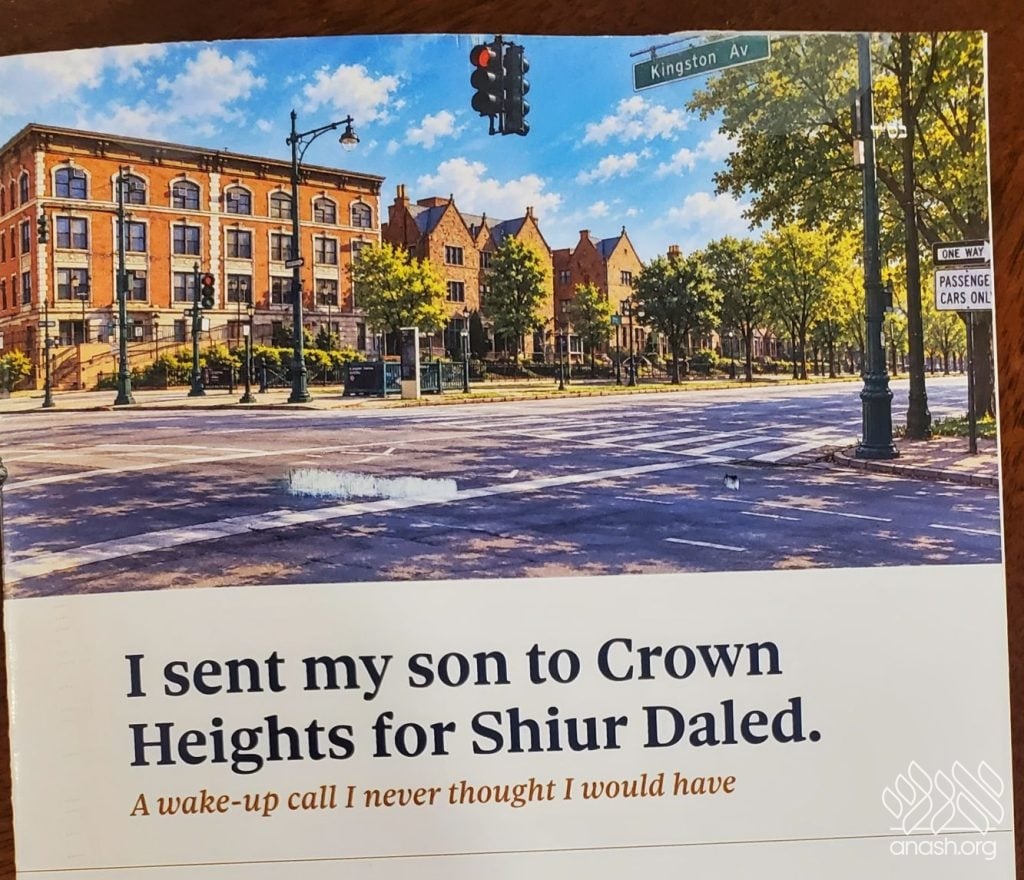
I was not prepared for Kingston Avenue.
*
Anyone who regularly walks these streets understands what I mean. There is no purpose in describing individuals or cataloging clothing. The issue is not one person or one encounter. It is the cumulative environment: the exposure to immodesty, the erosion of standards of tznius long associated with a Chassidishe shechunah, and the ease with which a bochur can encounter, simply walking between yeshiva, 770, his apartment and a store, an atmosphere fundamentally at odds with the one his parents believed they were sending him here to absorb.
Exposure matters.
What is jarring the first time becomes less jarring the tenth. What once instinctively caused a person to avert his eyes gradually becomes part of the scenery. Hergel naaseh teva. When the unusual becomes ordinary, something within us inevitably becomes less sensitive to it.
For a parent who sent his son to Crown Heights precisely to become more spiritually sensitive, that is frightening. Not because our children cannot encounter the world. We are raising them to become Chassidim and Shluchim, to enter the world and illuminate it.
But there is a profound difference between confronting the world as a Chossid and having the world follow you home.
Crown Heights is supposed to be home.
Our bochurim face enough challenges growing up in Dor HaShvi’i. The Rebbe’s shechunah should not become another environment they must guard themselves against. It should be the place that strengthens them for everything they will encounter beyond it.
When did yiyush become a Lubavitcher strategy?
Perhaps more disturbing than what has happened to our streets is our apparent resignation to it.
We explain that Crown Heights has changed. That the neighborhood is larger and more diverse. That nobody can tell anybody how to live. That public streets are public streets. That the subject is delicate, the politics complicated, and meaningful intervention nearly impossible.
All of which may be true.
But when did complexity relieve a Chossid of achrayus? When did yiyush, giving up, become a Lubavitcher strategy?
The history of Lubavitch is, in no small measure, the history of refusing to accept spiritual reality as immutable. Where others saw assimilation, the Rebbe sent a Shliach. Where others saw indifference, the Rebbe saw a neshama. Where others saw an irreversible trend, the Rebbe demanded another school, another mikvah, another mitzvah.
We have spent generations rejecting the proposition that an environment cannot be changed.
Surely Kingston Avenue cannot be the exception.
This is not primarily about enforcement. It is about whether we still believe that a Chassidishe community bears responsibility for the spiritual character of its own public space.
Our Rabbonim and Beis Din carry that responsibility. Our yeshivos and schools carry it. Our shuls, communal institutions and businesses carry it.
And ultimately, every one of us carries it.
We know how to take achrayus
There is something beautiful about Crown Heights that deserves more recognition. When this community decides that something matters, people step forward.
Thousands of bochurim arrive for Tishrei and need beds, meals and a proper ruchniyusdike framework. People organize. Thousands need a place to daven, and a gigantic tent goes up. Simchas Beis Hashoeivah fills our streets; the Lag B’Omer parade fills Eastern Parkway. Our mikvaos, schools, kashrus and communal institutions depend upon people willing to assume responsibility. N’shei Chabad has organized around chinuch, kashrus and mivtzoim.
We have even organized to keep Kingston Avenue physically clean.
And it goes much deeper.
Hatzalah runs when a Yid’s life is in danger. Shmira and Shomrim protect our streets. The Vaad Hakohol and Community Council shoulder communal needs. Committees mobilize around RCCS and Bonei Olam to drive critical help where it is needed. Shifra and Puah mobilize around new mothers. Neshamas has stepped into struggles once met largely with silence. And countless community members step forward to save our schools and build new shuls.
This is one of the noblest qualities of Crown Heights.
Again and again, someone encounters a need and refuses to walk past it.
Behind these efforts are people who rarely receive the recognition they deserve. They give time, money, meetings, phone calls and endless patience because they saw something that needed doing and said: This is my achrayus.
They are among the quiet builders of this community. Perhaps their example suggests something.
Every one of our mosdos has people thinking about what happens inside its walls. Who is thinking about the ruchniyusdike character of the space between them?
Who is thinking about the bochur walking from yeshiva to 770? The girl walking home from school? The young family walking down Kingston? The thousands who travel across the world expecting to encounter not merely the headquarters of Lubavitch, but its heart?
Perhaps there should be a Vaad L’Kedushas HaShechunah.
Perhaps our community leaders, and the leaders of our yeshivos, schools and shuls, need to mobilize. Or perhaps it begins with five people around a table who decide: This is ours to care about.
Not to police. Not to shame. Not to manufacture another machlokes. To take achrayus!
To bring together Rabbonim, menachchim and menachchos, parents, store owners, young people and askanim. To listen, educate and inspire. To engage our institutions and businesses. To cultivate Chassidishe pride and eidelkeit. To think seriously and creatively about the environment our children encounter every day.
We have changed spiritual environments thousands of miles from 770. Surely we have not concluded that the one environment beyond our ability to influence is the one surrounding 770 itself.
V’Yaakov halach l’darko
And perhaps there is no more appropriate moment to begin.
We have just lived Tishrei in the Rebbe’s shechunah. The tekios pierced our hearts and Yom Kippur stirred our souls. The sukkah enveloped us in simcha and achdus, while the Arba Minim bound us together. Our streets were strewn with laces shredded from nights of dancing; the soles of our shoes were worn thin from days of Mivtzoim and record-breaking Tahalucha crowds. Sisu v’simchu b’Simchas Torah permeated our collective consciousness. For one extraordinary month, kedushah, simcha, achdus and hiskashrus reigned supreme in Crown Heights.
Then comes V’Yaakov halach l’darko.
Everything accumulated during Tishrei must now travel l’darko: into our homes, our workplaces and onto our streets.
In Crown Heights, that derech has a name: Kingston Avenue.
Lubavitch lebt cannot only be something one feels at a farbrengen. It must be perceptible in the shechunah itself: in our stores and institutions, in our public spaces, in the dignity with which we carry ourselves, and in the atmosphere our children breathe.
And perhaps there is one place where we can begin immediately.
Our schools and mosdos cannot determine what happens everywhere on Kingston Avenue. But they can take responsibility for the standards they represent and the communities they shape. Every Chassidishe school and institution in Crown Heights should clearly articulate standards of dress and eidelkeit rooted not in personal preference or shifting communal norms, but in Halacha and the standards the Rebbe set forth for a Chassidishe community.
Those standards must be upheld unequivocally, not only on school premises and at school functions, but as an integral part of the Chassidishe life expected of every family that chooses such a chinuch for its children. A Chassidishe school cannot be expected to instill values that are disregarded once the school day ends. Families who seek this chinuch must be prepared to embrace and uphold its standards both inside and outside the classroom. Where that commitment is absent, the school must be prepared to recognize that its chinuch may not be the appropriate fit for that family.
This need not be harsh or intrusive. It should be communicated with sensitivity, dignity and respect. But it should also be clear. We cannot teach our children kedushah and eidelkeit inside the classroom while being hesitant to stand for those same values in the community surrounding them.
Lubavitch lebt cannot only be something one feels at a farbrengen.
That is not policing the shechunah. It is each mosad accepting responsibility for its own community and saying, with clarity and without apology: these are our values, and they matter.
If every school, shul and institution begins by strengthening its own daled amos, perhaps the cumulative effect will begin to strengthen the character of the shechunah itself.
If our Tishrei was real, and it was, we cannot be afraid to aspire. We cannot make peace with decline.
We are not asking for a shtetl sealed off from the world. We are asking for a shechunah whose kedushah is strong enough to illuminate the world around it.
My son came to Crown Heights because he wanted to become closer to the Rebbe. We owe him, and every child who comes here with that same aspiration, a shechunah that helps him do so.
And we owe it to the Rebbe.
This is not a call born of despair.
It is a refusal to despair.
V’Yaakov halach l’darko.
 COMMENTS


We appreciate your feedback. If you have any additional information to contribute to this article, it will be added below.