




ה׳ תשרי ה׳תשפ״ז | September 16, 2026
Maryland Shliach Turns Everyday Life Into 500-Word Lessons
After nearly 50 years of speaking to people, both in person and on the air, Rabbi Shmuel Kaplan, longtime shliach to the state of Maryland, has released the second volume of Eclectic Thoughts of Meaning, a collection of short essays drawn from weekly emails he has been sending to a wide readership for years.
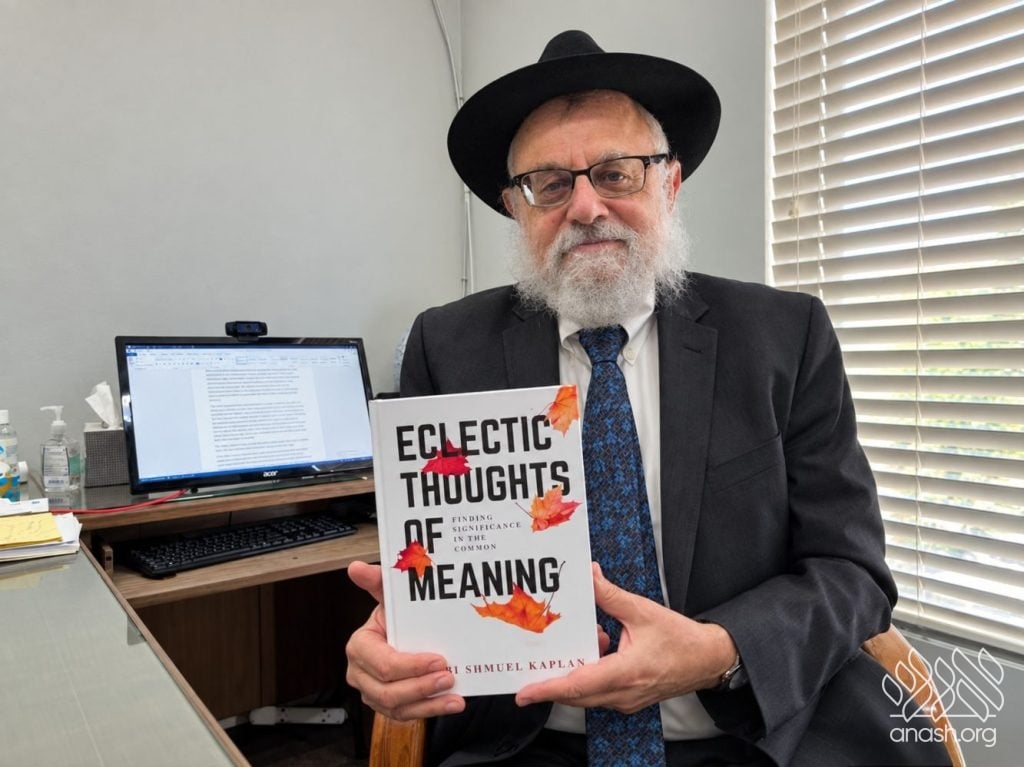
Rabbi Shmuel Kaplan, longtime shliach to the state of Maryland, has released the second volume of his book Eclectic Thoughts of Meaning. Like the first volume, the book is a collection of short essays drawn from weekly emails Rabbi Kaplan has been sending to a wide group of readers for years.
Rabbi Kaplan has served as the Rebbe’s shliach to Maryland since 5734 (1974) and was responsible for opening 33 Chabad centers there, along with a day school and yeshivah. He is also the rabbi of the shul at the Lubavitch Center in Baltimore, and for decades hosted a popular radio show and television program in the Washington, D.C., area.
Each essay runs around 500 words, meant to be read in a few minutes and then thought about before moving on to the next.
“The essays are all around 500 words since I know people will not read much more. Anyone can read 500 words. It literally takes a minute or two,” Rabbi Kaplan said.
The style is meant to feel more like a conversation than a lecture.
“I’ve been speaking to people, in person and on-air, for nearly 50 years, and this continues in that vein. I also tried to incorporate a little humor, just to keep things light and friendly.”
The essays are organized into sections, though each one is designed to stand on its own as a timeless idea that can be applied by any reader at any time.
Across the two volumes, Rabbi Kaplan applies a Torah perspective to an unusually broad range of subjects. Essays such as “Facebook and Sinai,” “Tefillin and Heart Health,” “Impeachment and the Talmud,” “What Oppenheimer Missed,” and “Will AI Surpass Humans?” draw connections between Torah and technology, science, politics, and contemporary culture.
Other essays address current events through titles such as “Impeachment and the Talmud,” “Innovative Solution to Inflation,” “Foresight and the Bed Bath Bankruptcy,” “The Anti-Jewish Bias,” “Rules of War,” “Divisiveness in Israel,” and “The Hostages’ Faith in G-d.”
The book also features a foreword by Nathan Lewin, a prominent constitutional attorney who has argued 28 cases before the U.S. Supreme Court and represented Chabad in landmark religious-liberty cases.
Rabbi Kaplan said the goal is not simply to inform, but to shift the way a reader looks at the world.
“I want them to see a Torah view on everyday life and how everything leads to a purpose, a meaning and a lesson,” he said. “If someone learns to view the world this way as well, looking to Torah for perspective on whatever they are seeing or experiencing, I will have accomplished my goal.”
The essays have already found a readership far beyond the Baltimore community, reaching people from a wide range of backgrounds. One notable example is a New York Times opinion writer who told Rabbi Kaplan that he was glad to have been exposed to the perspectives and ideas expressed in his essays.
“I wrote these essays as an expression of my personal experiences. To share this book is to share my thoughts and feelings with the public,” he said. “To know that others are reading these essays and sharing my life journey with me is humbling and exciting.”
The books can be purchased here:
Volume 1
Volume 2
View samples:
Table of Contents Volume 1
Table of Contents Volume 2
Sample essays
 COMMENTS


Where can we see a sample?