




י״ז אב ה׳תשפ״ו | July 31, 2026
Judge Orders Release of Driver Who Rammed 770
Dan Sohail will be released next week after a federal judge treated his deliberate ramming of 770 as a mere property crime and rejected prosecutors’ concerns about the danger of his conduct and the possibility of further offenses.
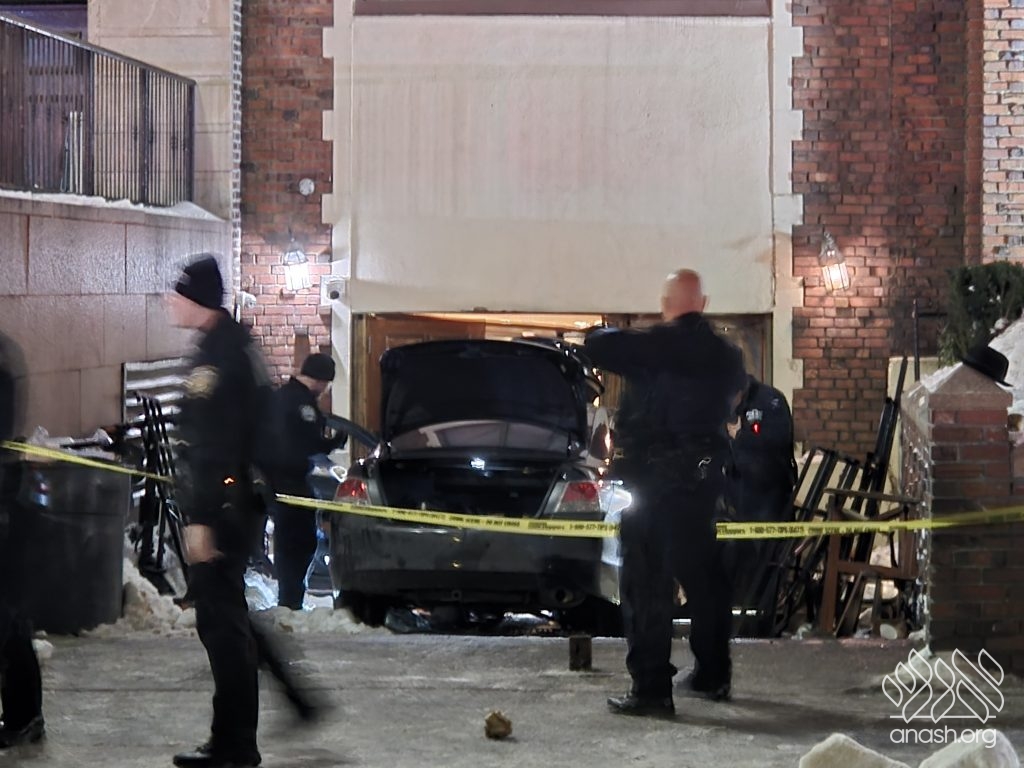
The man who rammed his car into 770 on Yud Shevat will be released from custody next week.
Dan Sohail, 36, of Carteret, New Jersey, was sentenced Wednesday by U.S. District Judge Eric Vitaliano to the six months he has already served, plus seven days. He must also pay $19,010 in restitution and undergo court-ordered mental health treatment.
Prosecutors sought a 14-month sentence, arguing that the normal sentencing range of zero to six months failed to reflect the dangerous manner of the crime or the need to deter attacks against Jewish institutions.
Vitaliano rejected their request.
“A property crime is what was charged here. Not a hate crime,” he said, adding that he was “somewhat saddened, perhaps even more than somewhat” by the government’s position.
The ramming took place shortly before 9:00 PM on Yud Shevat, as thousands of bochurim, Anash and guests were in Crown Heights. The Hour With the Rebbe program had ended only minutes earlier, and the entrance had been packed with bochurim filing out. Many people remained nearby, while 770 was still full ahead of the central farbrengen.
Sohail got out of his Honda Accord, removed protective stanchions and motioned for several people near the doors to move. He then returned to the car, accelerated into the entrance, reversed and rammed it four more times.
The impacts knocked a door from its hinges and destroyed the car’s front bumper. Boruch Hashem, no one was injured.
Prosecutors said Sohail’s warning to those immediately before the vehicle did not make the attack less dangerous.
“Though the defendant gestured for congregants to move out of the way, he did so precisely so he could complete a violent and dangerous crime,” they wrote.
During his post-arrest FBI interview, Sohail said he had “recently learned he had Jewish heritage,” was studying Jewish tradition and had been invited to the Yud Shevat gathering.
He then claimed that he had lost control because of “icy conditions” and because his “heavy boots” caused him to press the accelerator.
The footage showed Sohail moving the barriers before repeatedly reversing and accelerating into the same entrance. When he pleaded guilty in May, he abandoned the accident claim.
“I drove from New Jersey and intentionally damaged the building because it is the Chabad headquarters,” Sohail told the court, explaining that he did so “by driving into the door.”
Sohail had been making increasingly erratic visits to Jewish institutions for nearly a year.
In March 2025, he attended the Purim celebration at Chabad of South Brunswick and later returned twice seeking spiritual guidance. “I spoke with him briefly and could tell he was not exactly stable,” the local Shliach said.
Police were called to the same Chabad house in November after Sohail began yelling outside. Body-camera footage recorded him telling an officer, “I’m struggling. My family doesn’t like me. So I just came here to talk to the rabbi about it.”
He was not arrested. Officers recommended that he seek help from a mental health counselor.
Sohail later began appearing at 770. Approximately ten days before the attack, he was filmed dancing with bochurim, claimed he was Jewish and put on tefillin. Others at 770 had seen him there on two or three occasions.
Two days before the ramming, Sohail entered Yeshiva Gedola of Carteret for Mincha. Rabbi Eliyahu Teitz said Sohail declared that G-d had sent him and complained that Chabad had failed to help him.
When asked to leave, Sohail became angry and shouted curses. His vehicle then became stuck in the snow, and students from the yeshiva helped dig it out.
On Yud Shevat, Sohail was around 770 by approximately 4:00 PM. About an hour before the attack, he asked bochurim when the main farbrengen would take place and was told it would be held that night.
Government officials initially demanded a strong prosecution.
House Minority Leader Hakeem Jeffries called the ramming a “violent antisemitic incident” and said Sohail “must be prosecuted to the full extent of the law.”
When the federal charge was filed, Assistant Attorney General Harmeet Dhillon said, “The Department of Justice will not tolerate attacks on houses of worship, and will vigorously prosecute those who carry them out.”
Following Sohail’s guilty plea, Dhillon called his conduct “a targeted attack on the religious liberty and peace of worship to which every American is entitled.”
U.S. Attorney Joseph Nocella Jr. said Sohail had admitted deliberately attacking “a globally significant Jewish religious institution,” while FBI New York Assistant Director James Barnacle Jr. said he had “jeopardized dozens of lives.”
Sohail’s defense attorney, Mia Eisner-Grynberg, described the ramming as an “irrational cry for help.” Vitaliano concluded that Sohail’s conduct resulted from “an illness that needs treating,” rather than “moral turpitude.”
Prosecutor Eric Silverberg said Sohail’s mental illness was both mitigating and a source of continuing concern.
“It gives the government serious concern about whether he will commit crimes in the future,” Silverberg said.
While in custody, Sohail was involved in a physical altercation with another inmate and then refused to appear for his bail hearing.
Federal recidivism data show high rates of reoffending among released offenders. The U.S. Sentencing Commission found that 49.3 percent of federal offenders in its eight-year study were rearrested. Among offenders classified as violent, 63.8 percent were rearrested, with a median of 16 months before the first rearrest.
Among Lubavitchers in Crown Heights, Vitaliano’s decision to sentence Sohail to time served after emphasizing his mental illness has drawn comparisons to the 2014 attack at 770.
Calvin Peters, 49, had a decade-long history of bipolar disorder and visited 770 twice on the afternoon of December 8. During one visit, he asked whether he could pray and then whether he could convert.
Peters returned after 1:00 AM carrying a nine-inch serrated knife and stabbed bochur Levi Rosenblat in the head while shouting, “I’ll kill you!” Police shot Peters when he picked the knife back up and charged toward an officer. Rosenblat survived.
The parallel is hard to ignore. Peters had also appeared repeatedly at 770 while visibly unstable before returning and stabbing a bochur.
Vitaliano ordered Sohail to receive treatment after his release and concluded the hearing by telling him, “A hand of help has been extended to you. Please grasp it.”
Sohail plans to live with his mother in New Jersey after leaving federal custody next week.
 COMMENTS


We appreciate your feedback. If you have any additional information to contribute to this article, it will be added below.