




כ״ז ניסן ה׳תשפ״ו | April 14, 2026
Historic Lunar Mission Surfaces Space Lessons
With the historic Artemis II mission capturing the world’s attention, it’s worth revisiting what the Rebbe said nearly 60 years ago when humanity first reached the moon – and whether we should be reading the news in order to learn lessons in avodas Hashem.
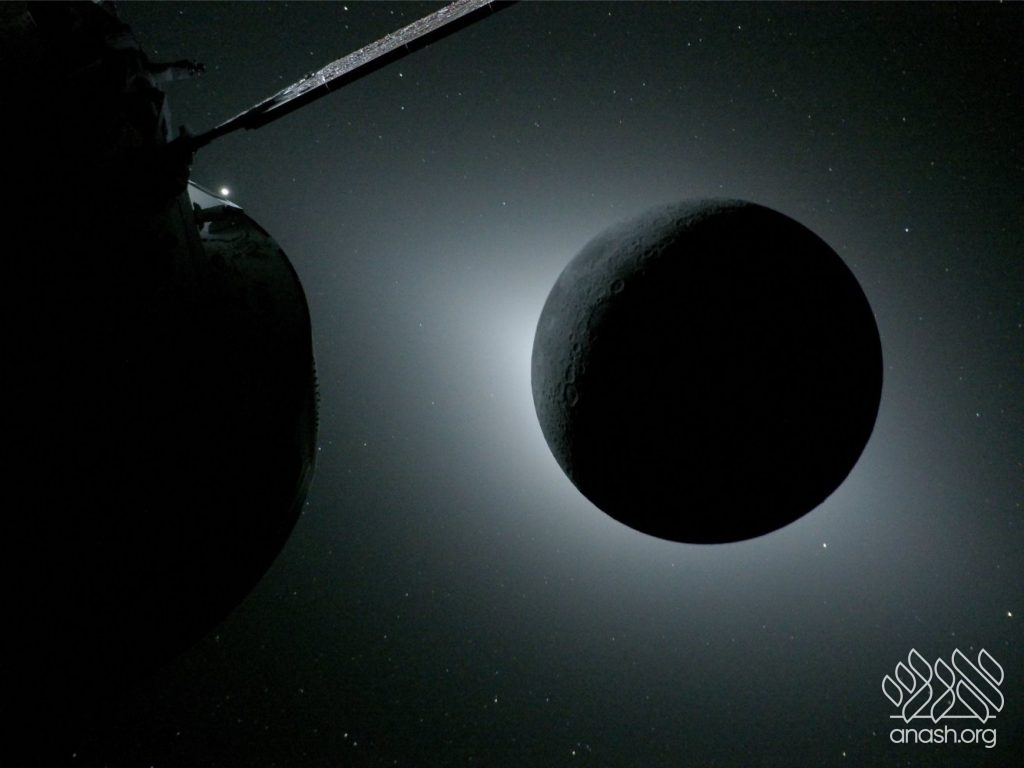
“Unless you’ve been living in Outer Space,” Rabbi Menachem Posner wrote in a recent article for Chabad.org, “and perhaps even if you have been, there’s a good chance that you are aware of the historic mission of Artemis II, which just took four crew members further from Earth than any human has ever been: a total of 252,756 miles.”
Of course, for many chassidim whose days are filled with Torah and Chassidus rather than general news headlines, such stories may pass unnoticed. But in light of this historic mission – the furthest that humanity ventured into space – it’s worth taking a moment to revisit what the Rebbe said when humanity first reached the moon nearly 60 years ago.
Or, in the words of the Rebbe regarding this “surprising and completely unusual occurrence”: “Everything that a Yid sees or hears contains a hora’ah in avodas Hashem. Not only should this event not distract from one’s avodah, it should add to and strengthen it.”
On 4 Teves 5729, December 24, 1968, humanity reached a moment that changed history. As millions around the world watched in awe, the impossible became reality when the Apollo 8 mission orbited the Moon for the first time. On Friday, December 27, they landed safely back on Earth.
At the next farbrengen (Shabbos Parshas Vayigash 5729), the Rebbe addressed the occurrence and the lesson to be learned.
First, the Rebbe noted, the event took place on Friday, when there’s an obligation to review the parsha Shnayim Mikra V’Echad Targum. However, because of this incident, some were disturbed to the point that they could not study Shnayim Mikra V’echad Targum!
Then the Rebbe proceeded:
“The Baal Shem Tov taught that from everything in the world one must draw a lesson in avodah – but this clearly does not mean that a person should run around to every place and event in order to learn lessons in avodas Hashem.
“Every free moment a Yid has should be used for learning Torah. The intention is only that if one has already seen or heard something, he should draw a lesson in avodah from it – but not that he should therefore go read newspapers.
“And certainly not like those who are eager to know every detail from reading the newspapers, never missing a single day – even after already hearing the general story on the radio in the morning, they rush out to buy the newspaper, in case there are more details they haven’t yet heard: what the names of the people are, their occupations, how many children they have, and so on.
“They try to catch the radio again, perhaps more details will be reported… And then when they come to shul on Shabbos, they feel they must show everyone that they are up to date on every detail – after all, they are not a ‘shlepper‘ or a ‘batlan,’ they are a modern person – and so they discuss it in shul, on Shabbos, when every moment is kodesh, disturbing not only themselves but others as well.
“Therefore, everything said above is in no way an endorsement of those who know all the details from reading newspapers – on the contrary, one should have great pity on them – as matters such as newspapers and the like, it would have been better for them had they never been created.
“The above discussion applies only to one who already knows about this event – in which case he must draw a lesson in avodas Hashem from it.”
At that time, Rabbi Zalman Posner, longtime shliach in Nashville, gave a radio interview shortly after the mission.
Rabbi Zalman had been invited onto a popular Jewish talk show, where the discussion focused on whether the Torah has the right to dictate how a person may act – and even punish them harshly for lighting a match on Shabbos or eating non-kosher food. Rabbi Zalman fielded the questions patiently, explaining how the seemingly severe punishments were very rarely, if ever, actually carried out in practice.
During the farbrengen, the Rebbe first acknowledged that it is indeed extremely rare for a person to actually be punished with these harsh punishments – perhaps only once in “many tens of years.” But the Rebbe said this was still not satisfactory. The question still stands: how can the Torah involve itself in a person’s private life over something so seemingly small – even if such cases are rare?
The Rebbe then proceeded to draw a lesson from the moon mission to answer the question.
“Three men were taken, and told from the outset that they would need to completely set aside their own wishes and do everything as instructed – what to eat, when to sleep, and even what kind of shoes to wear.
“And they were told that with every action they took – if they did not follow their instructions – they would be putting a billion dollars at risk.
“When one hears that a billion dollars is at stake, an immediate sense of awe and responsibility is aroused… He nullifies himself completely…
“He knows that he puts at risk not only himself, but those who are with him, and the entire purpose and goal for which they were sent… And even if he does not understand why he is forbidden to do a certain thing, or how it could possibly cause harm – since he heard this from an experienced person of sixty years who has studied and worked in this field for so long, he accepts it without question, knowing that a single action of his can put everything at risk.
“What would happen,” the Rebbe asked, “if one of those on board decided to light a cigarette? Does he not have the right to smoke if he wishes?” Of course not – as doing so, the Rebbe explained, would jeopardize the entire mission and put the lives of everyone on board at risk.
“And it would never even occur to him to argue that he is only one of a minority.. since he knows that his actions affect not only himself, but everyone around him as well.”
The Rebbe concluded that from this one can learn that the same applies to Torah and mitzvos – that every seemingly small, insignificant action of a Yid affects not only himself and his family, but “the entire city, the entire country, and the entire world.”
“When a person knows that when he commits an aveira he is not only endangering his own private life, but also his family, the entire city, the entire country, and the entire world – and yet, even after being warned in front of witnesses, he cannot restrain himself even for a moment – and “toch kdei dibbur” he commits the aveira and causes damage to himself, his household, the entire city, the country, and the entire world – this is not a small matter, a ‘kleinikeit,’ but rather he is the greatest of criminals, committing the most severe of offenses…”.
The Rebbe drew numerous lessons from the moon landing – both at this farbrengen and at several subsequent farbrengens. Yet, as the Rebbe clarified, it would be wrong to read newspapers to know the details to derive a lesson in avodas Hashem. Rather, as the Rebbe said, one who knows about the event must draw a lesson from it in avodas Hashem.
 COMMENTS


Here’s something someone messaged me:
There’s something incredible happening right now with Artemis II.
Human beings are traveling farther than ever before — pushing beyond the limits of what we’ve known, reaching distances no one has ever reached.
But here’s the surprising truth:
The most critical moment of the mission it’s actually happening TODAY:
And is not about how far they went.
It’s the return.
The reentry.
The precision.
The ability to come back down — safely — and bring that entire journey back to Earth.
Because going far is impressive.
But coming back… is what gives it meaning.
The main thing is the shuv after the rotzuy!