



ג׳ אלול ה׳תשפ״ו | August 16, 2026
Did You See The Crazy Weather Report for This Month?
“Chassidus gives us this beautiful moshol of Melech Basodeh. But yet at the same time, I see nothing! Where’s the king?! … Almost unexpectedly, the Rebbe started saying ‘Af al pi vos m’zet dos nisht mit fleishigeh oigen….’ I still remember that moment. I can’t even begin to tell you. Could it be that the Rebbe is actually about to address my concern?!”
By Shmuel ben Miriam Rivkah
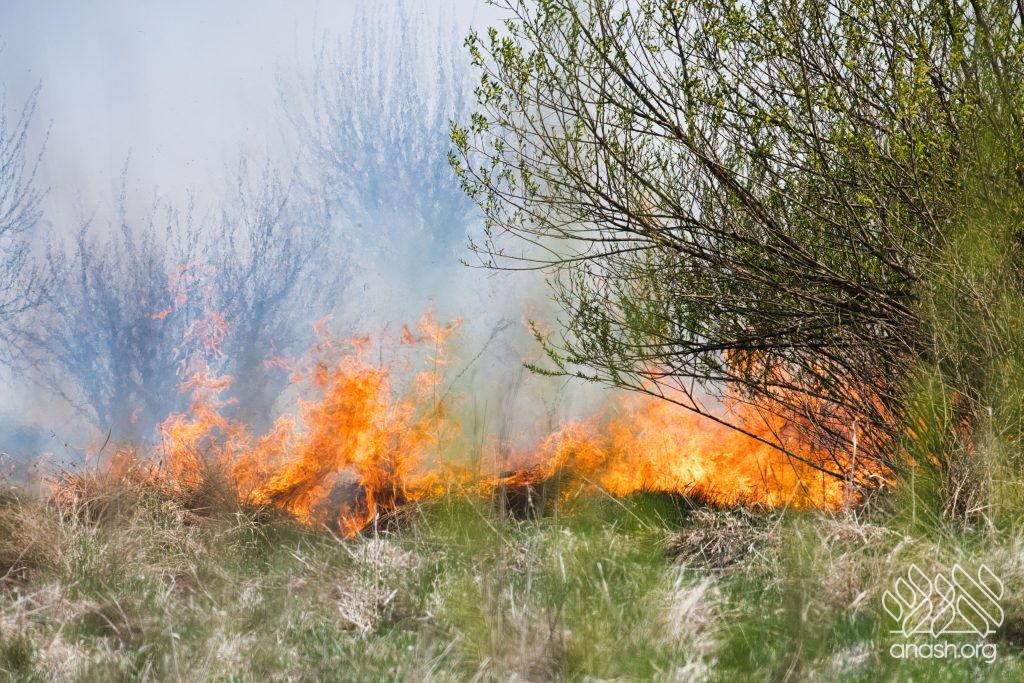
It’s fire season now, and things feel a bit heavier. The air is often smoky, there’s a ban on bonfires and campfires, and even BBQ’ing is somewhat regulated.
Signs are up with information on how to report wildfires, while instructions for evacuation as well as other protocols are made known.
I left for a bit to visit a senior Shliach in the hospital in a nearby city. As soon as I walked in, I was greeted with a huge smile, a “Sholom Aleichem,” and additional words that were filled with joy and warmth. He said to me, “Es iz baald Chodesh Elul! Es blozt shoin der Teshuvah vint” (It’s soon the month of Elul, the wind of Teshuvah is already blowing).
His expression and sincerity just lifted me right up into a bright energy. The whole room was filled with a freilechkeit and a real chassidishe warmth.
For a long time, whenever Elul would come, it would bring with it mixed feelings for me.
On one hand, Chassidus gives us this beautiful moshol of Melech Basodeh. Every year I see it in maamarim and sichos. The Rebbe reminds people of it in so many letters; perhaps one out of every two or three Igros Kodesh written during Elul contains a reminder of the preciousness and opportunities of Elul.
It’s really beautiful.
But yet at the same time, there’s something that makes me sad about the whole analogy, because in it the people actually see the king! That’s what makes the whole thing so powerful.
However, in the nimshal, I see nothing! It’s Elul, and I’m out in “my field” of life… and where’s the king?!
Then one morning, about five years ago, I was driving to Mikvah (our beautiful Lake), and I turned on one of my favourite pick-me-uppers…. the Rebbe via the Ashreinu App. The random selection that day was a sicha to children all about Elul… in 5747 (1987).
The Rebbe shared this famous moshol and began explaining it. I listened with only half an ear because I heard it so many times.
But then, almost unexpectedly, the Rebbe started saying….
“Af al pi vos m’zet dos nisht mit fleishigeh oigen….” (Even though we don’t see it with our own eyes of flesh…?)
I still remember that moment. It was so special, I can’t even begin to tell you.
Could it be that the Rebbe is actually about to address my concern?!
Even though I was in a rush, I just parked by the lake and listened.
Now the Rebbe had my full attention.
“Af al pi vos m’zet dos nisht mit fleishigeh oigen, rirt dos nit ohn ingantzen nit, di metzius fun di zach un di shtarkeit fun di zach… az farkert, dos iz noch shtarker, un poielt noch merer oif vi a zach vos m’zet dos beinei bosor… vibald az m’veist az di zach iz azoi hoich az einei bosor konen dos nit zen….”
“Even though we don’t see it with our eyes of flesh… that is of no consequence at all whatsoever and doesn’t impact the fact of the matter and the power of the matter… On the contrary, it’s even stronger, and it’s much more impactful than something that we DO see with our physical eyes, since we know that the matter is so great that eyes of flesh are unable to see it…”
Okay.
To be honest, my first reaction was hardly inspiring.
“Come on,” I thought.
Really?!
The King is here, and the reason we can’t see Him is because His love is SO great, and He is SO close! The revelation is TOO powerful for us to see!
What makes this any different from Hashem’s presence all the time… which is concealed from us?
Honestly, at first it sounded very discouraging.
What’s the gift of Elul?
But then another thought entered my mind just at that moment.
One second, who’s talking right now?
Who am I listening to? This is the Rebbe.
The Rebbe speaks the truth.
The Rebbe tells us what He sees, and quite often we can’t see what the Rebbe sees.
I believed the Rebbe, but I just simply had no idea what it meant.
How could hiddenness be a kindness, and how could seeing less allow a person to live more fully?
Maybe I need to ask the children. After all, it’s to them that the Rebbe was speaking that day.
So while on mivtzoim one erev Shabbos, we got talking. The conversation fit right in, and I asked the kids:
“Can you think of something Hashem hides from us because seeing it would overwhelm us?”
Slowly, some answers started coming in.
“What about germs?”
We all laughed.
Then we thought about it.
Imagine seeing every germ on every hand, on every surface, on every piece of food.
A doorknob would become terrifying to touch and food would be disgusting to eat.
The germs are there (and for a reason), but Hashem allows us to know just enough to wash our hands and protect our health while shielding us from a sight that could make ordinary life unbearable.
Our oldest daughter said, “What about everything happening inside our bodies?”
Imagine if our bodies were transparent and we would see the blood flow, the heartbeat, and every cell travelling through our body. Imagine watching food move through the body and become energy, blood and then waste!
Thousands of miracles are unfolding inside of us and all around us at every moment.
We receive the life and energy that they produce, while the internal process remains beyond our visual awareness… for our own benefit.
The conversation became fascinating.
We learned that our eyes see only a tiny band of the light that actually exists. Our ears hear only a narrow range of sound. The world around us is filled with realities that our senses cannot receive.
Our brains filter an enormous amount of information every moment, without which it would be impossible to think or function.
One of the kids brought up how Bilaam couldn’t see the malach standing right in front of him with the sword.
We found the Gemara in Berachos that says that if the eye were given permission to see certain spiritual realities that exist right in front of us, no creature would be able to survive seeing it.
Another child mentioned, “What about the tiny particles that we see in the air when the sun’s rays shine in front of us?”
Those particles are there all the time, but thankfully, we don’t see it. We would probably go nuts from it if we saw it all the time.
We also can’t see love, trust or commitment. Instead we see the hug, the sacrifice, and the promise kept. Through them we recognize something very real that the eye itself cannot see.
After about half an hour of talking, something so simple finally dawned on me:
Why had I ever assumed that seeing something was a measure of its reality?
Our eyes are remarkably good at showing us the surface of reality. They were never designed to show us all of its depth though. Reality is far greater than what the human eye can see.
Finally, I started to feel the meaning of the Rebbe’s words to the children that day.
In His kindness, Hashem reveals what we can contain and conceals what would overwhelm us.
(And perhaps the greatest proof that hidden never meant absent will come with Moshiach, when our physical eyes will finally see what was there all along: “V’ra’u chol basar yachdav ki pi Havaye diber.”)
Maybe we have been thinking about Elul backwards.
We wait for Elul to feel different. We expect some inner awakening to tell us that the month has arrived, and when life continues to feel surprisingly normal, it can seem as though all this talk about the King being in the field belongs to people on a much higher level.
But think about what a season actually is.
Fire season can arrive on a gorgeous day. There may be no smoke in the sky and no flames on the mountains. Yet the fire danger can be dramatically higher than it was a month earlier.
Nothing needs to be burning for the season to be real.
The conditions themselves have changed.
And once we know that, we behave differently. We become more careful, restrictions take effect, and activities that were perfectly reasonable a few weeks ago are treated completely differently now.
That was when I finally discovered what the Alter Rebbe is giving us.
“The King is in the field” is the spiritual weather report for Elul.
Hashem Himself has not changed. His love for us is infinite every day of the year, and He is always close to every Jew.
But Elul changes the opportunity He gives us to experience and respond to that closeness.
The bracha may have the same words and the siddur has the same pages. The mitzvah may look exactly as it did a month ago.
But we now know something about the spiritual conditions surrounding that moment, and it’s a reality that our eyes could never have told us:
When Elul comes, the King is in OUR field. Hashem makes this extraordinary opportunity available to us right where we are!
The experience with the elderly shliach in the hospital was extraordinary.
“Es iz baald Chodesh Elul! Es blozt shoin der Teshuvah-vint!”
He wasn’t trying to manufacture an “Elul feeling.”
He wasn’t saying, “I’m a big chossid, and I can feel the presence of Hashem in Elul.”
He simply knew what season was coming, and he started engaging with it.
That knowledge itself filled the room with such warmth and joy, I can’t begin to tell you.
Our awareness doesn’t create reality; it simply determines how much we experience it.
That realization has changed Elul for me. The question is no longer whether I can make myself feel that the King is in the field.
Torah has already told me that He is!
My avodah now is to learn to accept that reality, and to learn what it means to live inside of that reality.
And that is what Chassidim have always taught us to do: learn the weather of Elul and “dress” accordingly.
Read the maamarim of Elul. Learn the sichos. Pay attention to the spiritual climate Torah tells us we have entered. Allow that awareness to change the way we daven, the way we do a mitzvah, the way we speak to Hashem, and the way we look at these precious thirty days.
In Tishrei we might need to lift ourselves up to the heavens and try to enter the spiritual climate as it is in heaven.
But in Elul, the heavenly spiritual climate comes down and storms the earth.
The storm of love and closeness, the pouring rains of rachamim and selichos, the powerful winds of Hashem’s yearning to be part of our lives… literally fill OUR VERY PHYSICAL REALITY every year during the month of Elul.
The Frierdiker Rebbe once described what Elul felt like in Lubavitch.
“By Shabbos Mevorchim Elul, summer might still have been beautiful and nothing outwardly appeared different, yet the air itself seemed to have changed. There was already a fragrance of Elul; a teshuvah-vint, a wind of return, was blowing through the town.”
I used to read those words and yearn for the spiritual sensitivity of those Chassidim.
Today, I read them as a weather report.
They had learned to recognize the season they were living in.
It’s not fire season around the world, B”H, but it IS ELUL!
There are new steps that must be taken as this special season of unique spiritual weather arrives. It’s not about being on a high spiritual level, it’s about knowing that the spiritual climate is blowing all around us!
And perhaps that is what the Rebbe was trying to teach those children that day, and what I finally began to understand years later beside the Lake.
The spiritual weather in our world really DOES change.
Our eyes may not see it. Our hearts may take time to catch up to it.
But Elul does not wait for us to create it.
The King is in OUR field.
The season has arrived in OUR ATMOSPHERE…
All we need to do is follow the protocols and begin to live meaningfully inside of it.
L’Zchus Nechama Dina bas Chana Umishpachta Sheyichyu
 COMMENTS


Thank you for taking the time to write this. It definitely addresses so many relevant feelings in a very genuine way!
Thanks for taking the time to write your experience. ELUL is finally meaningful.