




י״ט אב ה׳תשפ״ו | August 2, 2026
A Life of Torah, Leadership, and Mesiras Nefesh
A towering gaon, mekubal, and chossid, Harav Levi Yitzchak dedicated his life to Torah and spreading Yiddishkeit under the Soviet regime. From his brilliance in Nigleh and Chassidus to his imprisonment and exile, his courageous leadership and mesirus nefesh continue to inspire generations.
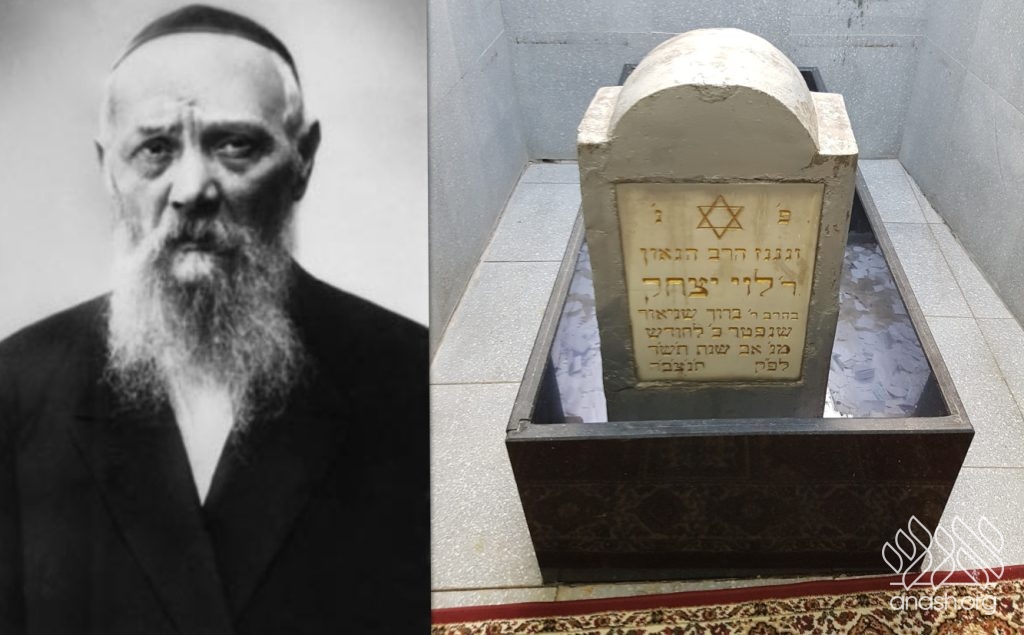
The gaon, chossid, and mekubal Harav Levi Yitzchak, the father of the Rebbe, was a great-grandson of the Tzemach Tzedek. He was the son of Harav Baruch Schneur Schneerson, son of Harav Levi Yitzchak, son of Reb Baruch Shalom, the eldest son of the Tzemach Tzedek.
From his earliest youth, Harav Levi Yitzchak displayed extraordinary talents and exceptional genius. He studied under his great-uncle, the rov of the Chassidishe town of Podobranka, Reb Yoel Chaikin, who was a devoted student of the chossid Reb Pesach of Malastovker, one of the greatest disciples of the Alter Rebbe, the Mitteler Rebbe, and the Tzemach Tzedek.
In addition to his tremendous genius in Niglah, Harav Levi Yitzchak was exceptionally knowledgeable in Kabbalah and deeply immersed in Chabad Chassidus. He possessed extraordinary Yiras Shomayim and was known for his refined character traits. He was among the renowned chassidim of the Rebbe Rashab, who cherished him greatly.
He received semicha from the leading geonim of his generation, including Reb Chaim Brisker and the Reb Eliyahu Chaim Meisel of Lodz, among others.
The Rebbe once related (Likkutei Sichos, vol. 9, p. 91; see there for the Rebbe’s explanation of the halachic discussion):
When Harav Levi Yitzchak visited Reb Chaim Brisker to receive semicha, Reb Chaim tested him thoroughly. In addition to the questions he himself asked, Reb Chaim suggested that Harav Levi Yitzchak answer several shailos that had been brought before him at the time.
Among them was the following shaila:
A Yid had a sukkah in his courtyard, alongside the sukkos of his fellow Yiddishe neighbors. It so happened that they forgot to make an eruv chatzeiros. The Yid came before Reb Chaim with a question: What should be done on Shabbos?
Reb Chaim turned the question over to Harav Levi Yitzchak, who immediately replied:
“The sukkah itself serves as the eruv!”
Harav Levi Yitzchak married Rebbetzin Chana, the daughter of the renowned gaon and chossid Harav Meir Shlomo Yanovsky, the rov of Nikolayev, and granddaughter of the renowned gaon and chossid Harav Avraham Dovid Lavut, author of Sha’ar Hakollel. The Rebbe Rashab served as the mesader kiddushin at their wedding.
Reb Shmuel Grossman related:
For several years, Harav Levi Yitzchak sat at his father-in-law’s table, completely immersed in Torah learning, with his lips never ceasing from study. He was accustomed to learning eighteen hours a day. Only at five in the morning would he go to sleep, after reciting the morning Krias Shema with tefillin, and by nine o’clock he was already davening with the regular minyan.
From 1902 onward, Harav Levi Yitzchak participated in all the public affairs gatherings led by the Rebbe Rashab. In 1904-1905, he played a major role in the campaign to provide matzos for Jewish soldiers during the Russo-Japanese War, as well as in collecting material for the defense of Beilis during the blood libel trial.
In 1909, at the age of thirty-one, Harav Levi Yitzchak was appointed as the rov of the major city of Yekaterinoslav (today Dnipro), Ukraine, a position he held until he was arrested by the Communist authorities for the “crime” of spreading and preserving Yiddishkeit.
Regarding his chassidishe hergesh, his wife, Rebbetzin Chana, wrote in her memoirs:
While I was in Moscow, and later in Paris, several people told me that they could never forget the stories my husband had told them about our Rebbeim. They reminded me of how my husband would repeat the story about Alexei, the Baal Shem Tov’s servant, who saw a shochet sharpen his knife by spitting on the sharpening stone, using that moisture to sharpen the blade. The non-Jewish servant told him: ‘Yisroelik [meaning, the Baal Shem Tov] would not do this. He would cry and sharpen the knife with his tears’…
When my husband would tell this story, his face would become very red, and streams of tears would flow from his eyes. Not every storyteller feels the inner meaning of a story so deeply and enters into the world of the person about whom he is speaking.”
The Rebbe once related the following story (Hisva’aduyos 5745, vol. 3, p. 1482):
When my father became the rov of the city of Yekaterinoslav, replacing the chossid Reb Bereh Volf, there were some people who were unhappy that they had again chosen a chassidishe rov. They searched for ways to ‘get rid’ of him…
One day the police commander himself arrived at our home, saying that he needed to speak with the rov privately, behind closed doors…
After he left, my father was asked what this was all about, and it became clear that this was a ‘mesirah’. The claim was that my father was not suitable to serve as rov of such an important city because they had seen him drinking mashke, holding the arm of a ‘shoemaker,’ and dancing with him!
For a city as important as this one, they explained to the police commander, the largest and most significant city in the entire region, it was improper that a ‘drunken rov’ should serve, one who dances with a shoemaker, a profession considered among the lowest at the time. Surely the police commander would know how to deal with such a rov, beginning with removing him from his position.
This ‘mesirah’ had some basis… What happened was the following:
That ‘shoemaker’ was not an ordinary shoemaker. He was a chossid who was a great lamdon who deeply understood Chassidus, especially matters of avodah. However, for his livelihood, he was forced to work as a shoemaker.
So when Yud Tes Kislev or Purim arrived, and a chassidishe farbrengen was held, that shoemaker was certainly there. At the farbrengen, they naturally drank a little mashke, as the saying of chassidim goes: ‘Nye pamaozhish, nye payedish’ [meaning, if you don’t help the mashke go down, you won’t be able to drink it]… The idea is that one must ‘oil the wheels’ with a cup of “chassidishe mashkeh.”
Later in the farbrengen, the participants began a chassidishe dance. When my father danced with the shoemaker, this became the basis for the accusation that he drank mashke until he reached the state of ‘when the king’s heart was merry with wine’ and danced with a shoemaker…”
This is how Reb Shmaryahu Nochum Sasonkin described him:
His name was well known. Everyone knew that ‘Levik’ [the name by which he was called in Lubavitch, without any titles or honorifics] was a phenomenal thinker and a great lamdan, both in Gemara and in Chassidus. He was similar to what Chazal say: “Greater than Rav is Rebbi, greater than Rebbi is Rabban, and greater than Rabban is his name” (Tosefta Eduyos 4, and the Aruch, entry ‘Abaye’).
The Aruch explains there that ‘Rav’ was the title given to the chachomim of Bavel who received semicha in their yeshivos, while ‘Rebbi’ was the title given to the chachomim of Eretz Yisroel who received semicha in their Sanhedrin, granting them authority to judge monetary cases. However, the earlier generations, who were exceedingly great, did not need any title. They were not called Rav, Rebbi, or Rabban, whether they were from Bavel or Eretz Yisroel. After all, Hillel came from Bavel, yet the title of Rav was not attached to his name.
The same was true of our Harav Levi Yitzchak. He was such a great person that when people said ‘Levik,’ everyone already knew that this name itself carried within it deep wisdom, extraordinary knowledge in every area: the wisdom of Gemara, the wisdom of Chabad Chassidus, the wisdom of Kabbalah…
Reb Nachum Sasonkin then relates:
I knew him personally when he was appointed as the rov of the large city of Yekaterinoslav. My father also lived there, and when I left Lubavitch, I came to live with my father. At that time, I would visit him frequently.
Once, I was present when he was invited to deliver a shiur in a large shul where a great talmid chochom had been giving a regular shiur. In order to strengthen the standing of the shiur, they invited the rov to speak. When it became known that Rabbi Schneerson would be delivering the shiur, a large crowd of talmidei chachomim gathered to hear him.
The shiur was on Maseches Shabbos, daf 5: ‘Rava asked: If a nut is in a vessel and the vessel is floating on top of water, do we follow the nut, and it is considered at rest, or perhaps we follow the vessel, and it is not at rest because it is moving? The question remains unresolved.’
He explained the sugya before the listeners with extraordinary depth, and everyone was amazed by his remarkable explanation. His depth of thought was revealed through an incredible simplicity. I would say about him what the Rambam wrote in his introduction to Seder Zeraim regarding Rabbeinu Yosef Halevi: “For that man’s mind in Gemara is frightening to one who examines his words, and the depth of his intellect in analysis.”
I was also once present when he gave a shiur on a perek of Tanya. He amazed all the listeners with his words, for he was a phenomenal maskil in Chassidus Chabad…
Similarly, the chossid and shochet Reb Yosef of Kremenchug, who was one of the chozrim by the Rebbe Rashab, related:
Once, he traveled to Kherson, and Harav Levi Yitzchak was also traveling in the same train car. At the beginning of the night, Harav Levi Yitzchak began saying Chassidus, and he only finished when the train stopped at a station, by which time dawn had already broken. Throughout the entire night, words of Chassidus and Kabbalah flowed from his mouth without interruption.
Harav Levi Yitzchak left behind thousands of pages of handwritten chiddushei Torah, in both Nigleh and Chassidus, and sadly, all of them were lost. The writings that he composed during his exile, with tremendous difficulty and under unimaginable conditions, without enough paper and with only the small amount of ink prepared for him by his wife, Rebbetzin Chana, were the only ones that eventually reached the hands of his son, the Rebbe, and were brought to print.
In her memoirs, Rebbetzin Chana describes, among other things, the moments of his arrest by the agents of the NKVD. In her description, she mentions his many Torah writings, writing:
On Tuesday, 9 Nissan 5699 [1939], at three o’clock in the morning, four NKVD agents arrived at our home at 13 Barikadne Street and asked where Rabbi Schneerson was.
As soon as I began walking toward the room where my husband was staying, in order to inform him about the ‘guests,’ they followed behind me. I then noticed that they had positioned themselves as guards at every entrance and exit of the house. Immediately, without any formalities, they called my husband into his study, and the oldest among them presented him with an order authorizing a search and arrest.
Without wasting a moment, they immediately began their work, meaning the search. They searched through and examined all the books, which stood in five large bookcases, without skipping even a single volume. One of them was knowledgeable in books, and whenever they became suspicious of a particular sefer, they called him over as an expert.
Sifrei Kabbalah, rabbinic responsa, extensive correspondence with abroad through letters and telegrams, all these they examined. Letters from the Rebbe Rashab, semicha certificates from Reb Eliyahu Chaim of Lodz and from Reb Chaim Brisker, a rabbinic appointment letter from Yaffo appointing him as chief rabbi with entry visas for the entire family, letters from the Joint regarding assistance for the Yekaterinoslav region, and other such documents, they took with them.
In a separate cabinet, among valuable seforim, there was a sefer containing a line handwritten by the Alter Rebbe, as well as a complete ‘bichel’ of Chassidus in the handwriting of the Tzemach Tzedek. They stamped these seforim with several seals, and I left them that way until I departed from there.
As for his own Chassidus writings, which numbered thousands of pages, they debated among themselves. In the end, they packed them into a bundle and left it in its place.
Three of them worked constantly, without stopping for even a moment. At six in the morning, after they had finished searching every room, the oldest among them said: “Rabbi, get dressed and come!”
Harav Levi Yitzchak had also played a major role in assisting the refugees from Poland and Lithuania who were temporarily settled in Yekaterinoslav and its surroundings. Later, he took an important part in the efforts of the Frierdiker Rebbe, which were carried out with the greatest mesirus nefesh, accomplishing tremendous things for the preservation of Yiddishkeit, the spreading of Torah, and communal needs in his city and surrounding areas.
After the Frierdiker Rebbe left Russia in 5687 [1927], he remained the only descendant of the Alter Rebbe, the Mitteler Rebbe, and the Tzemach Tzedek who was a leader in that country. Therefore, people turned to him for guidance and direction. Because of his efforts to spread Torah and Chassidus, he was arrested, exiled, and ultimately passed away in his place of exile. (Hisvaaduyos 5748, vol. 4, p. 158.)
The Rebbe once explained (Sichos Kodesh 5737, vol. 2, p. 381.):
My father’s avodah in this world was expressed in the area of ‘spreading Yiddishkeit,’ and because of this came the chain of events of his arrest and subsequent exile. The authorities had no complaints against him regarding his personal conduct. Their accusations against him were that he was involved in spreading Yiddishkeit, ensuring that matters of Torah and mitzvos would reach more and more Jews, wherever his influence extended, until they would reach every corner of that country.
His mesirus nefesh for the fulfillment of Torah and mitzvos, both his own and that of others, is engraved in the hearts of Russian Jewry. A small glimpse, only a fraction of the story, can be found in the excerpts from the writings of his wife, Rebbetzin Chana.
Harav Levi Yitzchak passed away in Alma-Ata, the capital of Kazakhstan, the country to which he had been sent into exile after completing his prison sentence, following tremendous physical and emotional suffering. He passed away on 20 Menachem Av 5704 [1944], and was buried in Alma-Ata.
Adapted from Maynotecha
 COMMENTS


We appreciate your feedback. If you have any additional information to contribute to this article, it will be added below.