



י״ב תשרי ה׳תשפ״ז | September 23, 2026
‘Chassidus Made Real’ Debuts with Sukkos Episode
The debut episode of “Chassidus Made Real” explores the deeper meaning of Sukkos and its makifim, offering a practical understanding of how to identify ideals in our avodas Hashem that remain makif and work to internalize them until they become pnimiyus.
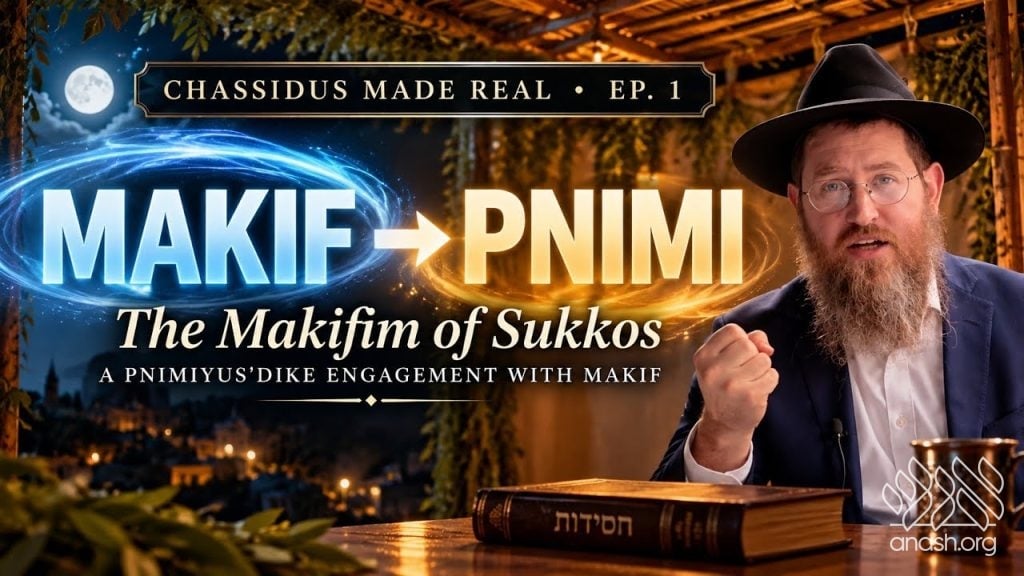
Welcome to Chassidus Made Real, Episode 1
The Makifim of Sukkos: A Pnimiyus’dike Engagement with Makif
In it we explore the central theme of Sukkos – המשכת המקיף בפנימיות.
- What are Makifim?
- What is the Avoda of בסוכות תשבו – which seems to mean being בהתיישבות and בפנימיות within the Makifim?
- What are the Makifim of Sukkos? Where do they come from? Why are they showing up now all of a sudden?
- Why is Sukkos specifically זמן שמחתינו and how does this tie in to the מקיפים?
- What is ניסוך המים all about? Why is it specifically on Sukkos. Why is the associated שמחת בית השואבה such a joyous occasion and experience? How does this tie into the מקיפים of סוכות?
- Why do we have אושפיזין specifically on Sukkos and how does this tie in to the מקיפים?
The key to understanding Sukkos is the idea of בכסה ליום חגינו. Meaning, whatever happened and whatever we accomplished on ראש השנה and יום כפור was only in a state of בכסה / concealment. The גילוי and actualization of these ideas is on סוכות.
What does this mean? What is lacking on R”H and Y”K, and what does it mean that the “גילוי” of these ideas happens on Sukkos?
We explore a beautiful explanation from the מיטעלער רבי in עטרת ראש that explains all of this.
The picture of סוכות we emerge with is one of tremendous power, excitement, joy and closeness with Hashem. Hopefully we can get some tangible and down to earth אותיות to really have an understanding and appreciation for the greatness, specialty, uniqueness and magic of Sukkos.
We conclude with a practical, relatable, and meaningful discussion about what it means to bring מקיף into פנימיות in our own lives. We explore several ways to identify an aspect of our עבודת השם that currently is a מקיף—an ideal that we aspire to but has not yet become part of who we are, and how Sukkos is about working to internalize that ideal until it becomes our new “normal.”
Please send all questions, follow-up, feedback, and comments to: [email protected].
As well, please send any questions or topics you wish us to discuss in future episodes to the above email address as well. Bez”H all relevant feedback will be discussed in the next episode.
The next episode will come out during the week of שבת בראשית. Check back on Anash.org to see it then, or subscribe directly to the new YouTube channel to receive future episodes.
Primary מראי מקומות:
ד”ה בסוכות תשבו תש”י, ותש”מ.
לקוטי שיחות ח”ט, וזאת הברכה, שיחה א.
עטרת ראש, עמ’ נז ואילך.
לקוטי דיבורים ח”א. שמח”ת תרצ”ד
WATCH

Spotify
 COMMENTS


Is the episode available on any platforms other then YouTube? I don’t have access the. YouTube on my phone.
Thank you
I can’t watch this because I Baruch Hashem am zoche to have a filter that blocks youtube.
??
Same here. Can’t watch youtube because of filter Baruch Hashem!
I can’t watch this, I don’t have YouTube, it’s time to start moving Yiddish and chasidish content to Jewish platforms, there are many BORUCH hashem, and there is no more excuses for blatantly following a standard that forces regular chasidim to access YouTube, time for everyone to make that change
100%
Time to make a filter shturem on anash.org
Maybe you could post a link to a drive to watch the shiur or a option to download the video
Will it be available on Apple Podcasts?
Just what I suspected: to the author, “Avodas Hashem” means to “push myself,” and all the rest is haskalah.
What about this shiur chassidus is any more “real” than your typical shiur chassidus by all the good mashpi’im?
Bimchilas kevodo, he is missing a lot.
He’s an intellectual who is uplifted by intellect, but not all are like that.
He said this would be part farbrengen, but this doesn’t sound anything like a farbrengen of R’ Shlomo Chaim.
This hour long shir chassidus is not in any way replacing the people he disparaged. The people who listen to that won’t be able to sit through five minutes of this.
Listen to the last 15 minutes.
If you can’t get through the beginning, start from there. It’s very practical.
I heard it. “Take your hachlatos and push them into pnimiyus” in a nutshell.
That doesn’t say anywhere in chassidus either (as the meaning of Sukkos)…
And that’s just not what avodas Hashem is all about.
“Chassidus iz Chayus!”
Do you actually fulfill this exercise when you walk into the sukkah?
Just admit that you get your chayus from haskala.
24Six?
This doesn’t come close to what people want. Another mashpia excited about haskala. The challenge is that to be great at Chassidus chabad you need to be very intellectually gifted, this makes it hard to relate to regular people.
Chassidus is relatable cause it’s the pnimius of Torah, which is one with Hashem Who we have a part of inside our neshama. So if it isn’t in tune then it’s not Chassidus. Its not pnimius. Its makif- which is good, but many need it drawn down into the essence right now.
I find that Rabbi Yoseph Vigler has amazing classes for those looking for alignment in ideas and avoda for the real human experience.
I’m excited to listen to this shiur. Even if I did not agree with some of the points in the original article.
Shocked by all the negative comments! If you don’t appreciate it, don’t listen. But discouraging a fellow chossid is for sure not the way of chassidus!!
Rabbi Kesselman’s passion for authentic chassidus is so refreshing to witness. We can all learn from his example. It is easy to stand on the side and criticize. It’s also cheap. We can do better.
Rabbi Kesselman gave some criticism of another approach. It was thought out, he actually saw the need and carried through.
That is incredibly important right now! When a need is seen, take action.
And of course a shiur in Chassidus and spreading Torah is a praiseworthy endeavor.
His approach may have been understood to imply that authenticity and attunement are incompatible. There has already been much discussion around this concern.
Its possible that this concern can still be heard within this very shiur.
For those who want action- Rabbi Kesselman did not stand on the sidelines. He gave a shiur.
And for those who look for a truth that resonates internally so that Chassidus can permeate their experience- some of these comments may be a cry reaching for that.
Thank you very much Rabbi Kesselman!
These next comments are not connected to your shiur. I dont have youtube.com so i couldn’t listen. This is connected to the previous discussion about how Chassidus is presented.
I get this question in some form or another from talmidim often.
“Why do I hear so many others, like Joey Rosenfeld speak in such a pleasant soft and easy to listen to “healing ” style when presenting Chassidus, whilst most Lubavitcher mashpim come across as intense, mufshat, and aloof”.
There is a certain “intensity” and very strong voice in Chassidus that some can feel is very demanding and in your face. Does our dor, even anash need a more chabad house tzimtzum of some of the original presentation?
This might be some of what is being asked in terms of making it relatable
Throughout this entire discussion, it becomes clear that people are not necessarily complaining about how we teach Chassidus. Rather, they are objecting to the very nature of Chassidus itself. We see complaints about “haskalah,” comments like “another mashpia excited about haskalah,” and other remarks of the same nature—remarks that, whether intentionally or not, stand in direct opposition to Chassidus.
What exactly do I mean by this?
Unfortunately, we do not have the authority to redefine Chassidus—to determine what it is, what it should be, or how it is meant to be approached. That is not within our ability; we are not the Rebbeim. What we can do is take what the Rebbeim gave us, learn it to the fullest extent possible, and live by it.
And that means understanding a fundamental point: Chassidus is Torah. It is the pnimius haTorah, but it is Torah nonetheless. Torah is meant to be studied, understood, analyzed, and grappled with—even when it requires us to break our heads over it. The Rebbeim spoke about Atzilus, about the deepest concepts of Elokus, and about the very truth of our world, so that we could understand these matters to the greatest extent possible. Not every maamar necessarily clearly states the avodah. Does that mean its not for everyone? No, because that would mean we dont trust the rebbe who conveyed that maamer.
Now, do not misunderstand me. I am not suggesting that avodah is unimportant, or that Chassidus should remain purely intellectual. Of course, avodah is essential. Learning is most effective when it is internalized and experienced, and without maaseh hu ha’ikar, something fundamental is missing. But that does not mean we can reduce Chassidus to avodah alone, or dismiss the intellectual depth of Chassidus because it does not immediately translate into a practical takeaway.
The point I am trying to convey is this: When people complain about “haskalah,” or argue that Chassidus is simply too deep, they are not necessarily criticizing Rabbi Kesselman or his particular approach to teaching. They are, in effect, taking issue with Chassidus itself.
Chassidus is Torah. Chassidus deals with these concepts. Just as it takes time, effort, and serious intellectual work to learn Gemara be’iyun, it takes time and effort to learn Chassidus be’iyun. You do not dismiss the depth of Gemara because it takes years to develop the ability to understand it. The same applies to Chassidus.
Those who make the kinds of complaints mentioned above have, in my view, failed to properly engage with Chassidus be’iyun—the very gift the Rebbeim gave us. It takes real work to appreciate what we have been given. The answer is not to dilute it, redefine it, or reshape it into something more comfortable.
The answer is to put in the work to understand and appreciate what the Rebbeim actually gave us—not to change it because we find it difficult.
I think this is a very important point that was not brought out yet which hopefully everyone involved in this discussion will see and read. Thank you for that! BH many people have became baalei yeshiva from chassidus, effected deeply by it, and live by it. Bh a lot of hafatza has been done and people who have appreciated it can testify. When a person breaks their head over the achdus of hashem and think about it it will surely effect us. We think that practical means something that tells me what to do. You must realize chassidus is much deeper and effects us more than just telling us practically what to do. It changes us to live achdus hashem. This is in addition to the fact that it is holy and effects us in ways we don’t even know. I hope people spread this persons message!!
For those interested there is an amazing letter of the freierdiker rebbe with a long discussion about chassidus and how the rebbe rashab never even thought to stop and think why he learns chassidus! He describes how those that are searching for what chassidus is are just looking for the richness of chassidus and its external effects. One who lives it and is involved it in his whole life will never question what and how it effects us. This letter is printed in the Seder migdal oz page 140.
There seems to be a lot of sensitivity, nuance and a deep search for truth here. And also fear:
One side fears that if we emphasize attunement, experience, and accessibility, we’ll lose the depth, rigor, and truth of Chassidus.
The other fears that if we emphasize rigor and intellectual depth without sufficient attunement, then Chassidus will remain external to people ch”v.
And fear has a way of creating false binaries.
So this discussion looks like:
intellect vs. heart
authenticity vs. attunement
haskalah vs. avodah
iyun vs. lived experience
I have a question and wonder if this holds truth:
Can it be that the purpose of understanding Elokus is not merely to accumulate concepts? And that the purpose of emotion is not merely to feel? That ultimately both are meant to bring a person into a deeper relationship with Hashem?
From how I understand the translation of moach shalit al halev, the mind rules the heart. A true ruler interacts with his subjects kindly and according to their capacity to lead them to a better place, to what is true and good for them. A true ruler also listens and tunes into his subjects to understand what their needs are. But ultimately he leads them based on a higher (makif) understanding. According to this idea I would understand that the heart is not controlling the mind and the mind is not destroying the heart.
Does this hold true in Chassidus?
No one is doubting that Chassidus entails both truth and application. But that application must be about avodas Hashem, not about my own wellbeing (without minimizing its importance).
Emotional wellbeing is like other human needs that can be utilized lsheim Shomayim. But that’s not Chassidus.
Chassidus is about living a G-dly life, and devoting our heart and mind to Hashem.
This is the aleph bais of everything, engage in the self growth of Chassidus, even for selfish reasons. מתוך שלא לשמה בא לשמה
So elementary
That was not the approach promoted by the Rebbeim or chassidim.
That statement was said about maiseh hamitzvos and limud haTorah (including the study of Chassidus). Even if you do it for the wrong reason, you nevertheless did a mitzvah, and hopefully he will come to do it for the right reason.
When it comes to avoda and pnimiyus, if you do it shelo lishma, you are not doing it at all. It’s like taking a lemon instead of an esrog.
If that is true, then is it possible to explain what exactly that means?
It almost sounds like we’re supposed to go against our nature. Which feels like the mind destroying and ignoring the heart instead of ruling it.
If I understand what was intended here correctly, and accept a claim that the primary purpose of Chassidus is not connected with permeating our emotions (whereas it would automatically positively affect our emotional health), then
1) what is Avodas Hashem?
(And at risk of sounding like kefira- but from the belief that there truly is an answer – Who is Hashem?
Because what serving Hashem means depends on the truth of Who Hashem is…)
2) how is that avoda a separate entity from individual/emotional well-being
3) what this avoda would it look like in practice
4) what do the different types of avoda (as described in tanya- meahava, yiraah, Ahavas hataanugim, etc.) mean in light of it?
5) how would someone personally understand the symptoms- people truly feeling unable to access this and feeling separated from Hashem?
After all this discussion seeks to know what is separated from Hashem or a misunderstanding of Who Hashem is. I assume to answer such a question one must experience closeness to Hashem and and a taste of understanding of Who Hashem is and what He wants in avoda
I believe that.
It now begs the question of what true avodas Hashem is. Who can define such a thing?
And yet… So many people are lost. How can afford not to define it?
BH
Thank you for this incredible and enjoyable Shiur!
why not start the shiur and ask people what it means to them that chassidus is real and for suggestions how to make it real.
I would love to hear a way to actually access everything you spoke about .
You say a shiur not on a topic but claiming that this will be real with no directions how to really access it.
It would be more real to me if these things would be explained:
Feel the makif -how?
I don’t believe Gd actually is here with me
How do you feel he actually forgave me?
Why would he forgive me if I didn’t change ?
If I’m not sad in yom kipper why be happy in sukkos?
Why should I care about my connection with Hashem in the first place ?
I’m sorry to say and I don’t mean this in a negative way but if this is what I was given as what Chassidus comes to teach, I would say I cannot relate to any of this in my life and it’s not for me.
And specifically at the end of the class and how to apply it it seems very off and absurd.
It’s another pushing myself harder. (Which is sometimes needed but not the childush of chassidus)
and there’s no discussion about deeper experience and feeling to these truths.
It all seems like it’s coming from the outside in and not the inside out.
Hopefully there’s enough real feedback from people how this is not real for many people ,so it could be made into some classes that are more real.
I am discouraged at such a class could be thought of as real for many people for me. It is so far from touching that inner self inside.
Thanks so much for this wonderful Shiur!
Just a few questions to make sure I understood correctly.
1. The main content of the shiur isnt really telling ne something practical, just sharing nice ideas in Avodas Hashem and just the last 15 min is the practical part?
2. If the main part also contains practical apication, A) what is it? And B) Why is the last 15 min necessary?
3. You mentioned there being this new “great light” on Rosh Hashana. Is it possible perhaps to clarify what exactly you mean by that? Is there any practical ramifications of getting this big light? If we dont understant what this light is, can we even attempt to make it “real” in our life? Is it even supposed to be something we can relatd to? Can we skip to Daas without chochma or Bina?
4. This idea of pushing yourself to apply hachlatos tovos, and specifically ones that are makif to you, is therd a source for this being the practical meaning of Makifim biHisyashvus? Or is it your own creative Mashal etc.?
4. With this shiur structure of 45 min “inyonim” and then 15 min of creative application therof (i.e. taking on to apply hachlatos tovos) it almost makes it sound that without modern creativity, chassidus indeed isnt realistically meaningful. And only if we can stretch our creativity ti find epes a way to “make it real” will it carry real life meaning. Is this correct? If yes, how is it different than the Rabbis you denouncd? If this is not correct, what is the ACTUAL real life meaning of Makifim bPnimi? (I.e. in Avodas Hashem, Not asking for a tool for Anxiety, kaposhut).
Looking forward to hearing from you,
Yakov Horowitz