80 Years From Shanghai: The Epic Journey of the Lubavitcher Bochurim
Today, 26 Tammuz marks 80 years since the arrival in New York of the Shanghai bochurim, the surviving talmidim of Tomchei Temimim in Poland. In honor of the occasion, From the Margins of Chabad History tells the remarkable story of their survival, their inspiring activities in Shanghai, and their joyous arrival in America.
In recent weeks, From the Margins of Chabad History has told the story of the Great Escape of a thousand chasidim from the Soviet Union after the Holocaust. Commemorating 80 years since the events, the series highlights the contribution these survivors of communism made to the constitution of the modern Lubavitch community. A third installment of this series is forthcoming.
Today’s installment of From the Margins honors the 80th anniversary of another group of survivors: the Polish bochurim from Tomchei Temimim who survived the Nazi Holocaust in Shanghai. This was a smaller group of 38 in total, but these survivors also went on to play a critical role in the formation of contemporary Lubavitch.
Appearing on the 80th anniversary of the group’s arrival in New York on 26 Tammuz 5706, this article will present outsider accounts and news reports about the experiences of the bochurim in Shanghai and their arrival in America. But before we can get to these sources, we need to lay out the background.
Bochurim outside the yeshivah in Otvotzk.
When the Nazis invaded Poland on 17 Elul 5699, there were around 170 bochurim learning in the flagship Lubavitcher yeshivah in Otvotzk, and over 500 spread out in a network of branches across Poland.
The outbreak of the war sent the bochurim scattering. Poland was quickly split between the German-occupied east and the Soviet-occupied west. For the Jews of Poland, both of these occupying powers spelled disaster.
Then a small window of opportunity opened up. The Soviets handed the city of Vilna, which had been under Polish rule before the war, back to the independent Lithuanian government. This presented an opportunity for Jews seeking to flee the Nazi invasion, but who were also fearful of the Soviets. Vilna could be a safe refuge from persecution.
But getting to Vilna wasn’t easy. Two borders needed to be illegally crossed: from the Nazi side of Poland to the Soviet, and then to Lithuania. Crossing through Soviet territory was especially worrying for Lubavitchers, who knew very well how the Soviets treated Jews and Yiddishkeit.
During the first months of the war, the Frierdiker Rebbe was in Warsaw, as chasidim worked feverishly to bring him to safety. When the news of the restoration of Vilna to Lithuania arrived, the Frierdiker Rebbe instructed all of his talmidim to flee there. He gave every bochur he could reach a sum of money to pay for the smuggling and other expenses of the journey, and implored them to send the urgent message to all of their friends: flee to Vilna at all costs.
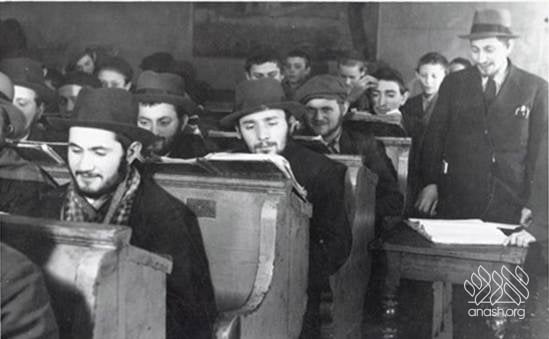
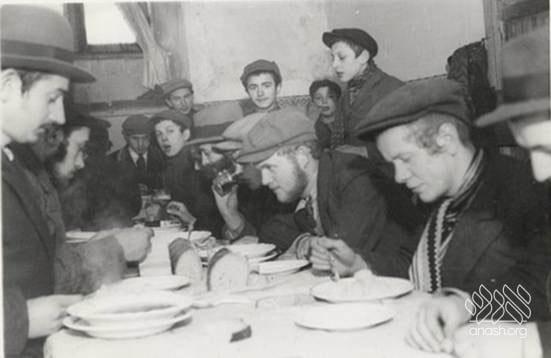
Bochurim at the Lubavitcher Yeshivah in Vilna, 5700. Courtesy of the JDC archives. Standing on the right is the mashgiach Harav Eliyahu Moshe Liss. Among the seated bochurim are Pinchas Blatt, Nachum Preger, Yossel Weinberg, Yosef Rodal, and Shmuel Tzvi Fox.
There had already been a branch of Tomchei Temimim in Vilna before the war, operating in Opatov’s Kloiz. Now this branch swelled, absorbing dozens of bochurim fleeing Poland. The director of the yeshivah before the war was Harav Yitzchak Dov Ber Ushpol, and he was now joined by Harav Shmuel Zalmanov and Harav Moshe Leib Rotshtein, with Harav Eliyahu Moshe Liss serving as the mashgiach.
After a few months of opportunity, the Lithuanian border was almost hermetically sealed. Only a few dozen Lubavitcher bochurim had successfully escaped, and the remainder were left stranded in Poland, where most of them were murdered by the Nazis—Hashem yikom damam.
Vilna was a temporary safe haven, but everyone was looking for a way out to a more secure destination. This became doubly urgent after the Soviets annexed Lithuania in Sivan of 5700. As soon as the Frierdiker Rebbe was saved from Nazi-occupied Poland, he began working on trying to extract his talmidim from Vilna to America, Eretz Yisrael, or any place far away from the war.
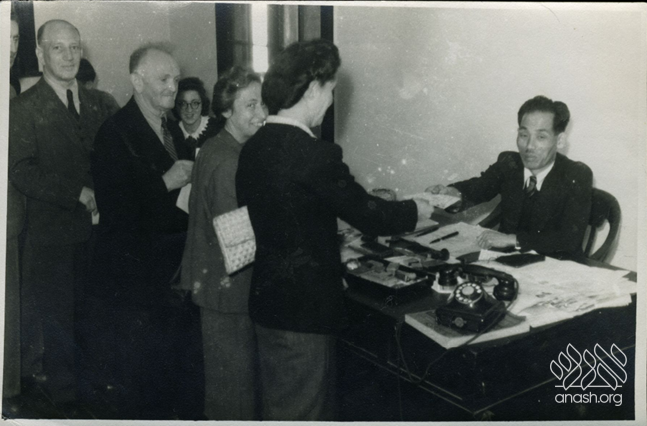
A path to safety then appeared, from a surprising source. The Japanese Vice-Consul in Vilna, Chiune (Sempo) Sugihara, began issuing Japanese transit visas, eventually just handing them out to anyone who requested, even if they had no paperwork for a final destination. 6000 people were eventually saved thanks to this heroic chasid umos ha’olam.
Bochurim at the Lubavitcher Yeshivah in Vilna, 5700. Courtesy of the JDC archives.
After receiving the Japanese transit visas, the bochurim in Vilna needed visas for a final destination in order to obtain permission to leave Russia. The Frierdiker Rebbe was able to obtain American visas and send them money to pay for their travels.
In Teves 5701, 30 Lubavitcher bochurim from Poland embarked on their journey out of war-torn Europe, with another 8 following them the next month. Their journey took them from Vilna to Moscow, across the full length of the Trans-Siberian Railway to Vladivostok, and from there, they took a boat to Kobe, Japan. One ordeal was finally over, but the next one had only begun.
Here is the full list of the 38 bochurim who reached Japan:
Bochurim at the Lubavitcher Yeshivah in Vilna, 5700. Courtesy of the JDC archives.
Pinchas Mordechai Blatt
Yosef Borenstein
Yehoshua Bronstein
Chaim Meir Bukiet
Gershon Chanowitz
Yisrael Chanowitz
Yechezkel Deren
Moshe Feder
Shmuel Tzvi Fox
Avraham Tzvi Fullman (Landa)
Shimon Goldman
Shlomo Hochler
Shmuel Moshe Lederhendler
Eliyahu Moshe Liss
Mordechai Lurie
Yosef Portowitz
Chaim Leibish Probst
Pesach Rabinowitz
Shmuel David Raichik
Yisrael David Rosenberg
Hirsh Rubin
Moshe Rubin
Moshe Sapochkinsky
Chaim Hersh Zak
Nochum Preger
Avraham Yitzchak Garfinkel
Mordechai Meir Bryski
Shmuel Chanowitz
Yonason Balter
Moshe Eliyahu Gerlitzki
Volf Greenglass
Yitzchok Hendel
Tzvi Yosef Kotlarsky
Leib Kramer
Yosef Rodal
Shmuel Stein
Yosef Mendel Tenenbaum
Yosef Wineberg
*
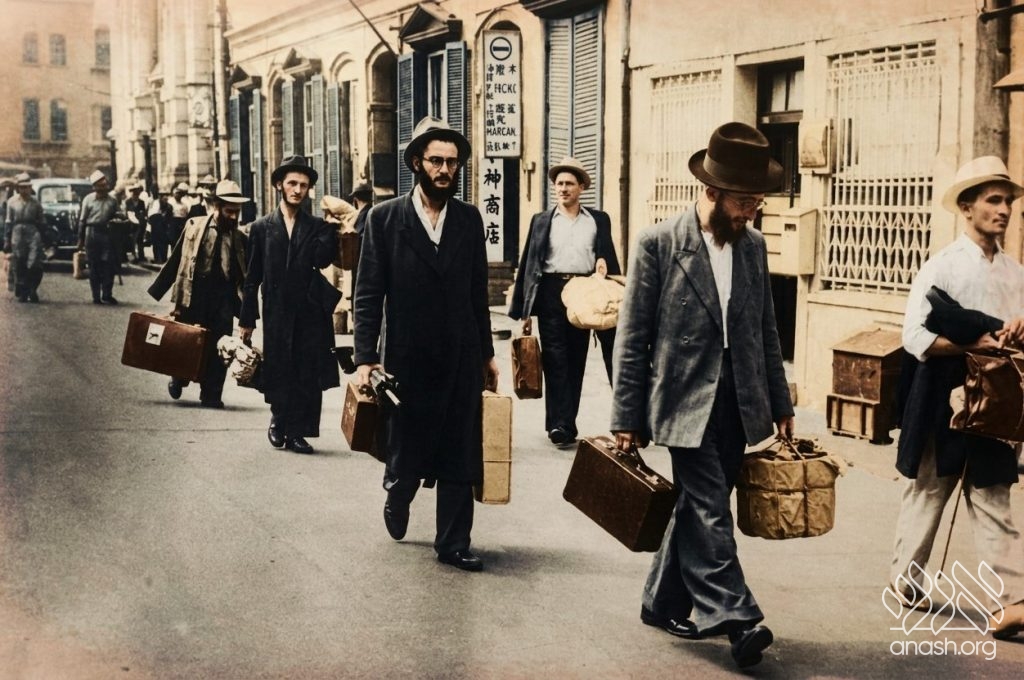
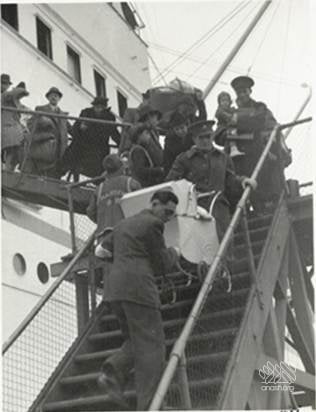
Lubavitcher bochurim departing Kobe for Shanghai. In the center, holding an umbrella, is R. Avraham Tzvi Landa (Fullman).
After arriving in Japan, the bochurim went to the American consulate in Tokyo to arrange their travel to America. They were given forms to fill out with their personal information, including the names and addresses of their parents and other family members. Unbeknownst to the bochurim, a new US State Department rule prohibited visas for refugees from Nazi-occupied Europe who still had close relatives trapped under Nazi occupation. The official rationale was that the Nazis could hold those relatives hostage to force the refugees into becoming spies.
Their American visas were now canceled, and the bochurim were stranded in Japan. After seven months in Japan, the Japanese had had enough of the refugees and expelled them to Japanese-occupied Shanghai, where there was already a large stateless refugee population.
Shortly after arriving in Japan in Elul 5701, Canada issued visas for 80 Polish refugees, and Lubavitch was able to obtain 9 of them. In Tishrei of 5702, 9 of the senior bochurim (numbers 30-38 on the list above) arrived in Montreal, where they immediately established Yeshivas Tomchei Temimim of Montreal.
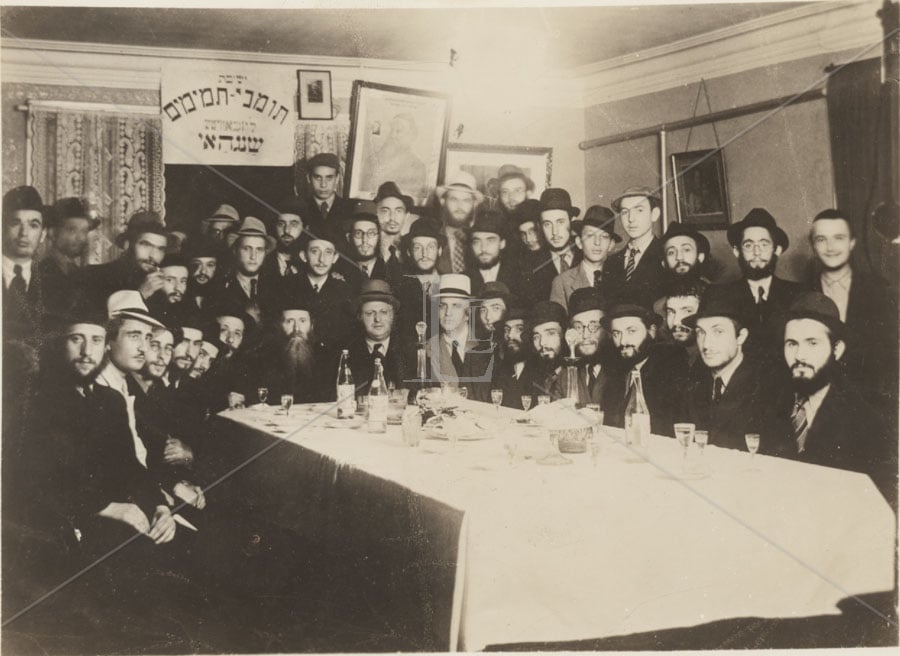
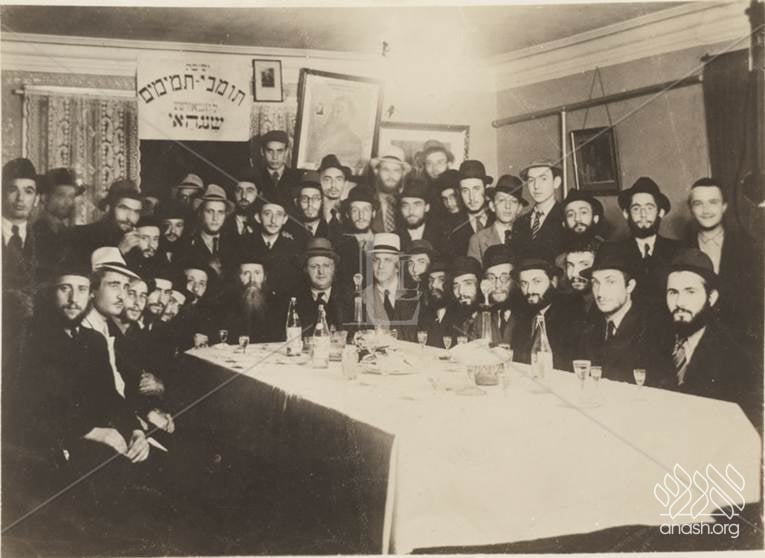
A group picture taken in Shanghai, before the departure of the bochurim for Montreal. Library of Agudas Chassidei Chabad.
Seated from right to left: Shmuel Tzvi Fox, Mordechai Lurie, Shmuel David Raichik, Yosef Rodal, Avraham Yitzchak Garfinkel, Yosef Weinberg, Shmuel Stein, Shmuel Moshe Lederhandler, Moshe Chaim Chanin, Baruch Stein, Meir Ashkenazi, Chaim Plotkin, Moshe Eliyahu Gerlitzky, Yosef Menachem Mendel Tenenbaum, Yitzchak Hendel, Tzvi Eisenberg, Tzvi Yosef Kotlarsky.
The Frierdiker Rebbe continued to work to try to obtain visas for the bochurim in Shanghai, but after Japan entered the war on Germany’s side with the attack on Pearl Harbor in Kislev 5702, there was no way out. The remaining group spent the next four and a half years stranded in Shanghai, almost completely cut off from the outside world, and unable to even communicate with the Frierdiker Rebbe in New York.
We won’t give a detailed account of the bochurim’s experiences in Shanghai here. A general overview of the period can be found in Toldos Chabad BePolin Lita VeLatvia, ch. 44-60. R. Shimon Goldman’s memoir From Shedlitz to Safety provides a compelling first-hand account in English. Shadar, Dovid Zaklikovsky’s biography about Harav Shmuel Dovid Raichik, the leader of the Shanghai bochurim, also relates the story of the period.
Simchas Torah in Shanghai
Throughout their travels and all of the hardship they endured, the bochurim operated a yeshivah at every one of their stops, doing their best to adhere to the traditional seder of Tomchei Temimim.
Shanghai was home to over 20,000 stateless Jewish refugees during World War II. Among them were the 300 talmidim of the Mirrer Yeshivah, and a group of 40 bochurim from Yeshivas Chachmei Lublin. Numbering fewer than 30 bochurim, the Lubavitcher group was small, and unlike other yeshivos, they weren’t accompanied by any of their hanhalah.
Back row, right to left: Nachum Preger, Shmuel David Raichik, Yosef Portowitz, Yehoshua Bronstein, unidentified, unidentified, Avraham Yitzchak Garfinkel, Menachem Zeev Greenglass, Moshe Rubin, Shmuel Stein, unidentified, Shimon Goldman, Shlomo Hochler, Mordechai Lurie.
Library of Agudas Chassidei Chabad.
Nevertheless, the Lubavitcher bochurim had an outsized influence in the Shanghai refugee community. There was something unique about these bochurim, and people realized this.
In a post-war report to the Frierdiker Rebbe recounting their ordeal and activities, the bochurim mention how their minyan for Tishrei attracted many bochurim from other yeshivos as well as German refugees. They describe how inspired they were by the Lubavitcher seder, particularly by the joyous farbrengens and dancing of Simchas Torah (Toldos Chabad, p. 321).
This paragraph in the bochurim’s report was about Tishrei 5705, but the same was true of the other years of their Shanghai sojourn.
Ber Yitzchak Rozen
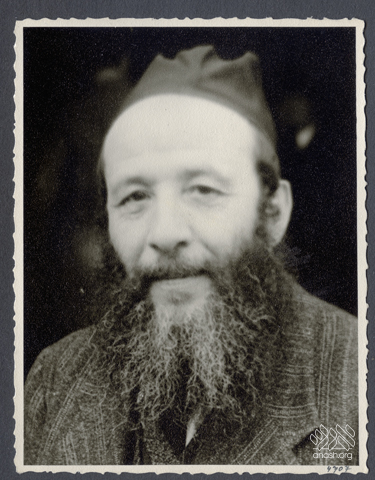
Ber Yitzchak Rozen (5660-5715) was raised in a chasidishe family in Otvotzk, Poland, and learned in the beis medrash of the Porisover Rebbe in his youth. Swept up in the winds of the time, he joined the socialist Bund in Warsaw. He survived the Holocaust in Shanghai, and lived the final years of his life in Melbourne, Australia, where he taught Yiddish literature.
In a chapter of his memoirs, Rozen gives a beautiful account of Simchas Torah 5704 with the Lubavitcher bochurim in Shanghai (Ber I. Rozen, Gekliben Shriften, pp. 61-65).
Here is the full chapter, translated from the original Yiddish:
You Need to Know Why You’re Dancing
By the night of Simchas Torah, the Lubavitchers could barely stay on their feet. All day they had been drinking, singing, and dancing. And when they drank, they drank in the chasidishe way. Not some delicate, ladylike drink, but real alcohol, 96%, and by the bottleful…
The Lubavitchers have sharp minds, and full ones too. Full not only of Torah, but of lofty ideas. 96% does not so easily gain mastery over such minds. And so, the drink makes its way mainly into the feet. They grow heavy and begin to tangle. The head is a little intoxicated, but not so much from the bitter drops as from an uplifted spirit. Is Simchas Torah a small matter?
Jewish refugees arriving in Shanghai. Courtesy of the JDC archives.
They sang and danced like men possessed: one intoxicated, unceasing dance, all of them together in a circle, and each one separately around himself. Mashkeh stirs the blood in the veins. For people with poor character, everyone agrees that mashkeh does not lead to elevation. It pollutes the mind. But not for the Lubavitchers.
There must be a reason to drink, an intention for which one drinks. Just plain drinking, for no purpose, is improper for Lubavitchers. On Simchas Torah one must drink. It is a mitzvah to drink, for the drink loosens the body, transforming the physical substance into something fluid that runs, dissolves, and disappears, until all that remains is pure spirit, pure Torah, and lofty ideas. These, in turn, are transformed into song and dance, leading gradually to the most complete attachment to the holiness of the world, to the beauty of netzach shebenetzach, true eternity.
The Lubavitchers know why they drink. They know and understand the meaning of drinking, of singing, and of dancing. When one has spent an entire year immersed in Torah, bound up with it by day and by night, then one has to, one must, one simply cannot do otherwise. One must truly drink, sing, and dance.
The tables were set with delicacies of every kind, but the crowd did not hurry to eat. The more the body becomes soaked with drink, the smaller the hunger becomes; the need to eat, merely to fill the physical self for no reason at all, disappears. Still, it is a seudas mitzvah, so you taste a little something, and in between you grab another dance.
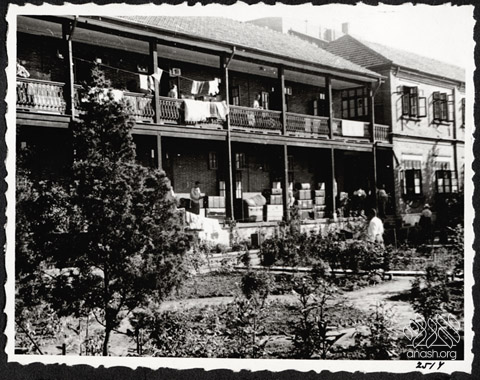
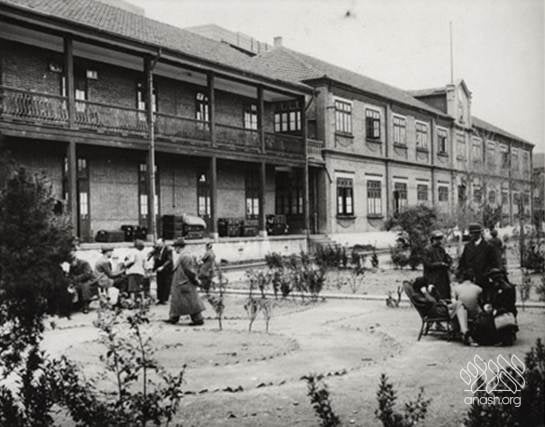
A view of living quarters for Jewish refugees in Shanghai, with a courtyard area for recreation. Courtesy of the JDC archives.
The Lubavitcher shtibel was located in the refugees’ home. Lubavitchers lived in that building, but so did all kinds of other refugees, people who were not Lubavitchers and far from chasidim. They stood in the doorways of the shtibel and watched the Lubavitchers dance.
The tables, laden with food, stood open to everyone. Whoever wished could come over and eat or drink a small glass of mashkeh. The refugees hadn’t eaten their fill for years already. The Lubavitchers invited the onlookers to the tables:
“Eat, Yidden. It is Yom Tov today. The tables are prepared for everyone, kol dichfin.”
They did not need much persuading. They ate, while in the middle of the hall, the Lubavitchers’ singing and dancing went on.
But when it came to dancing, none of the onlookers were rushing to join.
Perhaps there were some who were taken by the ecstatic singing, by the pulsating dance. Perhaps there were some who, deep in their hearts, danced along. But to step into the dance itself—that they did not do. Not because they wished to stand apart, but simply because, it seems, they felt they would not be able to keep up with the pace of the Lubavitchers. And when you feel yourself lagging behind, you must remain humble and keep your distance, not to disturb.
A 19 Kislev farbrengen in Shanghai.
Incidentally, dancing is not the same as eating. A dance with the Lubavitchers on Simchas Torah night is not like a piece of fish sitting on the table that anyone can come over and take.
A Lubavitcher understands human nature, the need to fill the physical self when it is hungry, to stuff it with food. But he also knows of another kind of hunger, a hunger that has absolutely nothing to do with the body. And that hunger is not so easy to quiet.
The human means for quieting that hunger are, in truth, quite limited. To still it entirely is not really possible, not even through dancing. But first of all, one must truly be hungry. Only then does the dancing have meaning. One must be a Lubavitcher to feel that.
The onlookers, it seems, sensed this and perhaps even understood the heart of the matter with simple common sense.
There was only one exception.
Among the watching crowd stood a young man who had come on Simchas Torah night to see the Lubavitchers with his own eyes. He was some kind of sophisticated nobody, with his hat tilted to one side, with a pair of big blank, she’eino yode’a lish’ol eyes, eyes that looked at you but neither said anything nor asked anything. They were just blank windows, not real eyes at all.
All polished and drenched in a heavy odor of perfume, just like in the good old days in Warsaw when he would go to the nightclubs to dance, he now came to the Lubavitchers.
Housing for Jewish refugees in Shanghai. Courtesy of the JDC archives.
The scent of perfume wafted through the entire hall, and the Lubavitchers caught the foreign odor, wrinkling their noses. What kind of affliction was this?
The young man also made himself at home. Seeing food on the table, he sat down and ate. He drank one cup after another and took something to bite with it. None of the Lubavitchers paid him any mind. He is sitting and eating, so let him eat. If only he had not brought along that strange smell, the sort that makes one feel faint, he could have been tolerated well enough.
When he had finished eating, the young man rose, stood there and chewed a little longer, wiped his satisfied lips with a handkerchief, and with a foolish smile looked around the hall at the dancers. Then he moved away from the table, rolled up his sleeves as though preparing to lift some heavy burden, and went over to the dancing group of Lubavitchers. He took one man by one hand and another by the other hand, and just like that, he found himself in the circle, dancing along with the entire crowd.
The dancers were absorbed in themselves. They did sense that someone new had entered, but the dance went on with the same passion.
Refugees moving to the Shanghai Ghetto in Spring, 5703.
In the middle of the dancing circle stood one of the Lubavitchers, a small man, thin and drawn, with long, lean hands and a small, worn face from which two large black eyes peered out, sharp and penetrating. He was dancing alone, by himself, in the midst of Anash.
The Lubavitcher stopped for a moment. Around him, a lively, song-filled wind swirled rapidly while he stood alone in the center, looking at the stranger in wonder. He watched him, studied him, trying to determine whether there was any meaning at all to this young man’s dancing.
Suddenly, he called out:
“Young man, young man!”
The young man did not answer. The Lubavitcher stopped and waited until the young man came closer to him in the course of the dance. Then the Lubavitcher gave a tug at his rumpled sleeve, and while still dancing, asked him:
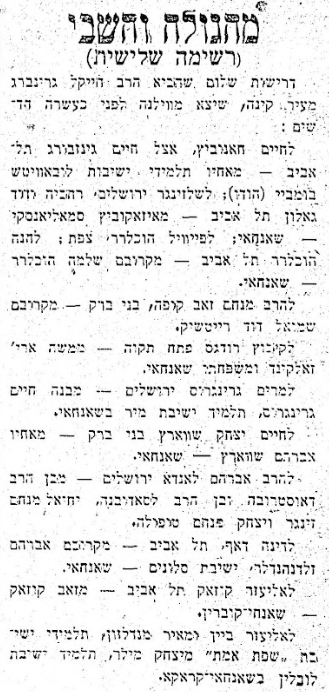
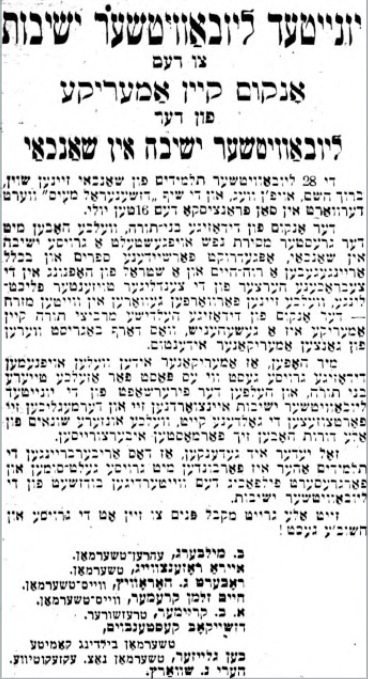
A list of Shanghai refugees sending regards to their relatives in Eretz Yisrael, including several Lubavitchers. Hatzofeh, 16 Adar 5702 (March 5, 1942).
“Tell me, please, young man, why are you dancing?”
The stranger did not answer him and went on dancing. But the Lubavitcher did not let him go.
“Why are you dancing?”
The stranger came to a stop and stared foolishly at the Lubavitcher.
“Why am I dancing? I don’t know. I see people dancing, so I dance too.”
“So,” the Lubavitcher said to him with contempt, “you truly do not know why you are dancing, and still you dance? Then know this: a man who dances and does not know why he dances is a nothing. Do you hear? A total gornisht!”
The stranger did not dance anymore. He stood there a while longer, staring calf-like at the dancers, and then quickly carried himself out of the Lubavitcher shtibel.
You don’t play games with Chabadniks.
Shanghai, 1943.
*
The Aftermath of the War
In Elul 5705, the Japanese finally surrendered, and the war was over. The American army entered Shanghai, and contact with America and the rest of the world was finally restored. For the Lubavitcher bochurim, this meant they could finally communicate with the Frierdiker Rebbe again. The bochurim in Shanghai sent a series of reports to the Rebbe detailing their wartime experiences. Selections of these letters are published in Toldos Chabad.
On 25 Tishrei 5706, a report appeared in two New York Yiddish daily newspapers, Der Tog and Morgen Zhurnal (October 2, 1945), about the wartime activities of the Lubavitcher bochurim in Shanghai. The fact that it was published simultaneously in two different newspapers indicates that it was supplied content, produced by Lubavitch in New York.
Lubavitch Yeshiva Students in Shanghai Have Established A Large Yeshiva
Still suffering from hunger and hardship—Lubavitcher Rebbe receives moving letters from his students there
From G. D.
The original entrance to the Ohel Moshe shul in Shanghai, the first home of the Lubavitcher yeshivah.
The first detailed report from refugee yeshiva students, who were exiled by the war to the lands of the Far East, has now reached the Lubavitcher Rebbe, Harav Yosef Yitzchak Schneersohn, in New York. Dated only a few weeks ago, these letters stand as a historical document from one of the most stirring periods in the history of Jewish galus—a record that bears witness to the enduring spirit of Yiddishe mesiras nefesh, the unbreakable spirit of the Jewish people, whom Divine Providence has charged with spreading Torah and G-dliness to every corner of the globe.
Here in America it has long been known that the Lubavitch yeshiva students in Shanghai are not idle: they are founding yeshivas and Talmudei Torah, opening kosher kitchens, and building mikvaos. Until now, however, we were unaware of the full scope of their work and the sorrowful conditions—conditions that could so easily have been avoided—under which all this was carried out. The letters that have now arrived lift the veil that concealed their activity from us, and they stand as compelling testimony to the spirit of mesiras nefesh that has been instilled in the talmidim of Lubavitch.
Close to thirty in number, most of them are young men from Poland who had been studying at the famed Lubavitch yeshiva in Otvotzk at the outbreak of the war. When war broke out, this small group set out on a wandering path: Vilna, Kovno, Vladivostok, and finally Shanghai. Wherever they stopped, they immediately did like the Jews of old in the desert and set up a mishkan—they began to learn and to bring Jewish children under the wings of the Shechinah.
The Talmud Torah in Shanghai, directed by Harav Eliyahu Moshe Liss.
Typical of Lubavitch yeshiva bochurim, they saw everywhere and in everything the yad Hashem that is guiding them toward a kavanah elyonah in this or that country. Under a hail of bullets, they studied Torah, and in the greatest hunger and deprivation, they did not forget their mission.
When the Lubavitcher Rebbe arrived in New York in 1940, he immediately began working to bring them over to America. One group of talmidim did in fact manage to reach here—these are the Lubavitcher talmidim who are now in Canada, where they have accomplished remarkable achievements in the field of chinuch.
The outbreak of the Pacific War blocked the route, and together with students from other European yeshivas, they were left stranded in Shanghai.
This report about their activity in Shanghai reads like a chapter of history filled with heroism and mesiras nefesh. Not only did they organize themselves and maintain the same seder of learning that they had in the yeshiva in Otvotzk, but they also established a large Talmud Torah, where more than two hundred children study, children of various Jewish refugees from Europe who had been trapped in Shanghai by the war.
The original building of the Shanghai Jewish Club, the second home of the Lubavitcher Yeshivah in Shanghai.
The rov of Shanghai, Harav Ashkenazi, himself a talmid of the old Lubavitch yeshiva in Russia, greatly assisted them. If not for him, they write, they would have perished from hunger long ago, chas veshalom.
Over the course of this time, they have already learned seven large masechtos, and they also list the topics they have learned in Chabad Chasidus. There in Shanghai, they also printed the Tanya and all the sichos of the Lubavitcher Rebbe up until the year 5699, as well as the seferPokei’ach Ivrim of the Mitteler Rebbe and the sefer Shaarei Teshuvah.
All of this they managed to achieve with the meager and limited assistance they received from the local relief efforts. Unfortunately, they didn’t receive any other support, aside from what they received from the Central Yeshivas Tomchei Temimim Lubavitch in New York.
Most of them are ill and suffering from various ailments. And yet, remarkably, they do not complain. They are content with their lot. “We are,” they write, “front-line soldiers, and our front is in Shanghai.”
Every line is overflowing with bitachon and emunah. They hope that a closer connection will now be established between them and American Jewry. They are happy to do their part. Let us do ours too.
Hanhalah of the Talmud Torah in Shanghai. Harav Eliyahu Moshe Liss is seated second from the right, and to his left are the shochet Harav Chaim Plotkin, Harav Meir Ashkenazi, and Russian Jewish community leader Leib Breilovsky.R. Plotkin was a Lubavitcher chasid, and Breilovsky was also from a Chabad family.
*
With the war finally over, the Frierdiker Rebbe worked to obtain visas for the bochurim and bring them to America. Of the original group of 38 bochurim, nine had left for Montreal in 5702, Yonason Balter had managed to travel to Eretz Yisrael in 5701, and Shmuel Avraham Chanowitz had tragically died of disease in 5703. The remaining 27 bochurim were also joined by two additions as Yosef Portowitz and Pesach Rabinowitz had married during the war years.
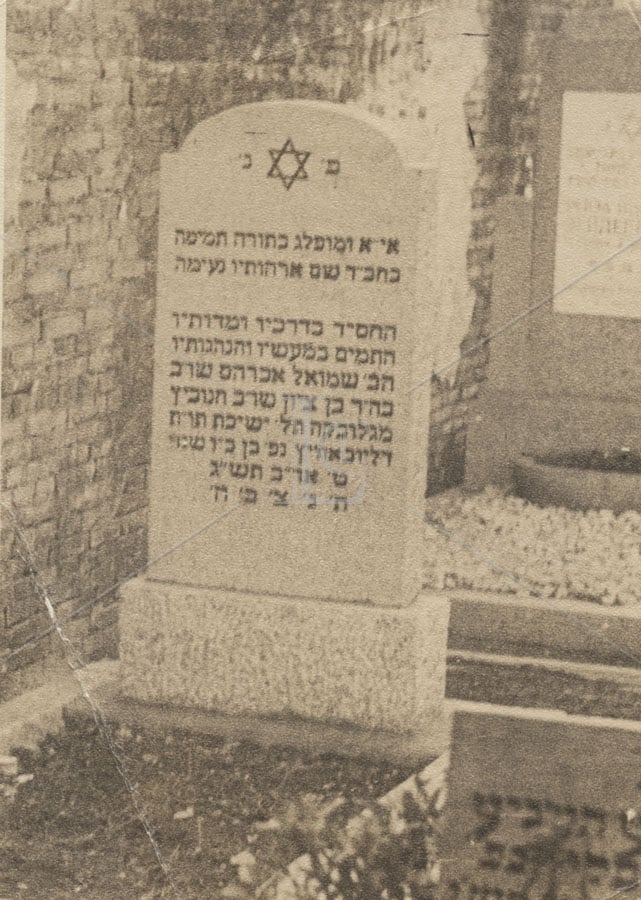
The kever of Shmuel Avraham Chanowitz in Shanghai.
To be more precise, one of the 27 wasn’t actually a bochur. Harav Eliyahu Moshe Liss had a wife and two daughters in Poland, where he had served as a Mashgiach in the Yeshivah in Warsaw. After the war broke out, he was able to cross the borders into Vilna, but his wife and daughters were stuck behind in Poland, where they were tragically killed in the war.
In Shanghai, Harav Liss threw himself into chinuch work with the refugee community, establishing a Talmud Torah and Beis Yaakov for hundreds of children, as well as a yeshivah ketanah. The talmidim of Lubavitch and Yeshivas Chachmei Lublin assisted by learning with the boys in the yeshivah ketanah.
The American government had strict restrictions and quotas on immigration, and visas were very difficult to obtain. After much hard work, the Frierdiker Rebbe succeeded in obtaining visas for the entire group of 29 in Adar II of 5706, but even with visas in hand, the bochurim couldn’t leave Shanghai because passenger boats weren’t traveling the route.
A letter from Shanghai, published in the Morgen Zhurnal on 10 Tammuz 5706 (July 9, 1946), humorously and perceptively conveys the feelings of the refugees during this waiting period. Part of the letter describes the envy everyone felt towards the Lubavitcher bochurim, who, thanks to the tireless efforts of the Frierdiker Rebbe in America, were among the very first to receive visas.
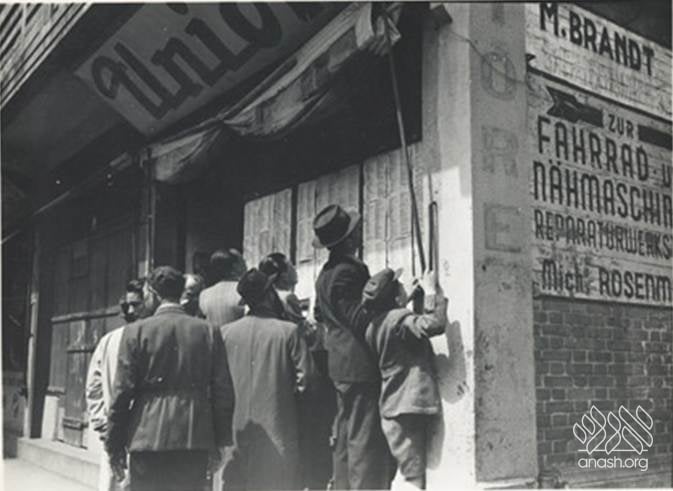
Jewish refugees in Shanghai look for names of relatives and friends who may have survived the war. Courtesy of the JDC archives.
News arrived that the Mirrer Yeshivah had received sixty-five Canadian visas, and the stock of Torah on the Shanghai refugee market rose sharply. People began to feel tangibly that “Torah is the best merchandise,” something the world needs. Not only Jews need it, but also, lehavdil, the non-Jews. And the proof? You see it yourself!
But the respect for a ben Torah grew even greater when the Lubavitcher yeshivah received visas to America. Had the gates been opened wide for “volunteers,” for new recruits, the Lubavitcher yeshivah in America would have had to build a new skyscraper.
And do not think that people would have streamed to the yeshivah only because of the crude olam hazeh of a visa. No, they would have streamed there also, and primarily, because of the spiritual olam hazeh of feeling that there is a place in the world where they are needed, where someone is waiting for them, where worlds are being moved on their behalf.
Harav Chaim Plotkin, the Lubavitcher shochet and mohel in Shanghai. Courtesy of the JDC archives.
When a refugee in those gray, sweaty days would say melancholically, “For them, someone is waiting…” there was more to it than visa envy. It was the envy of one orphan toward another, whose close relative—even if only a poor one—has suddenly come looking for him.
But now those days of visa agony, though for most they have not yet passed, have been replaced by travel agony. Visas have fallen sharply in value. It turns out that even with visas, one cannot travel. The Canadians are still sitting there. One of them was already told to pack and come to the ship, but then they changed their minds and told him to unpack.
The Lubavitchers have already gone to the ship several times, and their visas too have lost their prestige. The grave question, “Where does one get a visa?” has been replaced by an even graver one: “Where does one get a boat?”
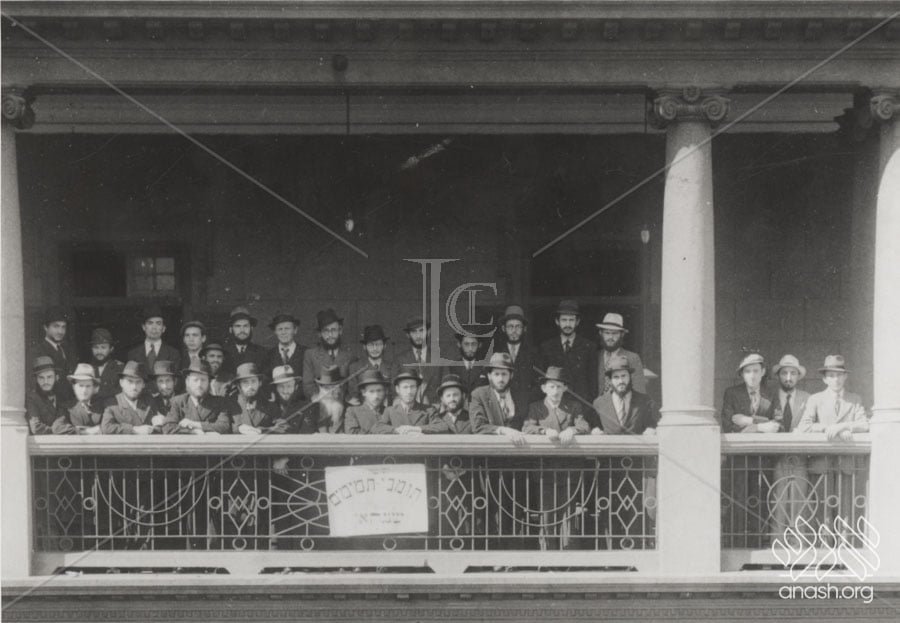
The bochurim in Shanghai in 5706, at the end of their stay. Seated, R-L: Chaim Tzvi Zak, Gershon Chanowitz, Yosef Borenstein, Avraham Yitzchak Garfinkel, Eliyahu Moshe Liss, Shmuel David Raichik, Chaim Meir Bukiet. Standing, R-L: First row: Moshe Feder, Avraham Tzvi Landa, Mordechai Lurie, Moshe Chaim Sapochkinsky, Pesach Rabinovich, Pinchas Blatt, Yisrael David Rosenberg, unidentified, Yisrael Chanowitz. Second row: Shlomo Hochler, Chaim Leib Probst, Moshe Rubin, Mordechai Bryski, Yosef Portowitz, Yechezkel Deren, Shmuel Tzvi Fox. Third row C: two local children, Shimon Goldman, Yehoshua Bronstein, local child.
*
The First Bochurim Arrive
As the bochurim kept waiting for a place on a ship, three of them traveled ahead by plane due to illnesses that would have made the ship voyage too difficult for them. Nochum Preger and Avraham Yitzchak Garfinkel were the first to arrive, on around 5 Sivan, 5706. Mordechai Meir Bryski followed them on 21 Sivan.
Harav Shmaryahu Gurary and Tomchei Temimim in New York welcome Nochum Preger and Avraham Yitzchak Garfinkel, the first of the Shanghai bochurim to arrive in America. Der Tog, 5 Sivan, 5706 (June 4, 1946).
These bochurim were among the very first survivors from Shanghai to reach America, and their arrival generated much media interest. At a special press conference held at Tomchei Temimim on Bedford Ave., R. Avraham Yitzchak Garfinkel gave a report about their ordeals. The following article, written by Nisson Gordon, appeared in Der Tog, 18 Sivan 5706 (June 17, 1946):
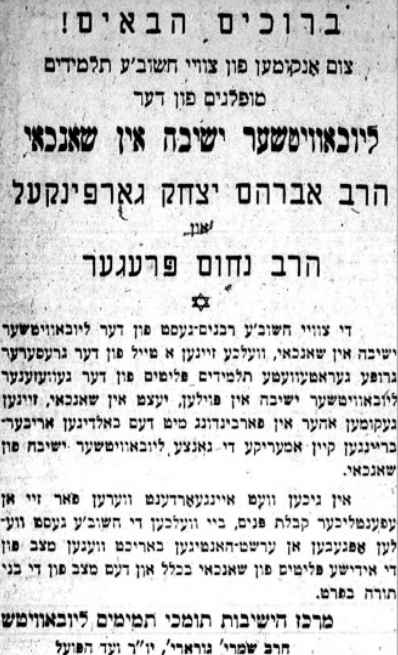
Last Thursday evening, a voice was heard from the wandering Jewish yeshivah students who had lived through the full horror of the war and found themselves carried all the way to distant Shanghai. There they established a large yeshivah for the first time, and hundreds of Jewish children from the great refugee community that had gathered there came to learn.
That voice was Harav Avraham Yitzchak Garfinkel, one of the leaders of the Lubavitch yeshivah in Shanghai, who has now arrived by plane from the Far East with an urgent appeal to American Jewry. Harav Garfinkel, himself a native of Warsaw and a student of the destroyed Lubavitch yeshivah in Otvotzk, was among the fortunate group of Polish yeshivah students who escaped the Nazi rampage that pursued them across Europe and cast them as far as Japan, where they endured unbearable suffering and hardship, cut off from the surrounding world because of the war.
Harav Garfinkel described his experiences and ordeals at a special press conference held at the central office of the Lubavitcher yeshivos on Bedford Avenue, at the corner of Dean Street, in Brooklyn. The guest was introduced to the assembled journalists by Harav Shmaryahu Gurary, chairman of the Lubavitcher yeshivos, who gave a basic overview of the work of the Lubavitcher Rebbe here in America to rescue his talmidim.
Harav Garfinkel began his remarks by expressing gratitude to American Jews, who, through various relief organizations, had kept them alive until Japan’s final capitulation. He then declared: “The Lubavitcher talmidim, together with all the other bnei Torah, strengthened the spirit of the twenty thousand Jewish refugees in Shanghai, who had escaped there with nothing but their lives.”
Harav Avraham Yitzchak Garfinkel, pictured in Vilna. Library of Agudas Chassidei Chabad.
Under the most difficult conditions, Rabbi Garfinkel continued, the yeshivah students, under the leadership of Shanghai’s chief rabbi, Harav Meir Ashkenazi, himself a talmid of the old Lubavitcher yeshivah in Russia, established a yeshivah for the children of the refugees and the local Jews.
The Lubavitcher students were not satisfied with merely learning on their own. They also established contact with the Jewish communities of Harbin, Tientsin [Tianjin], and others, bringing with them a Jewish revival and a renewed bond with klal Yisrael.
Since the end of the war, Harav Garfinkel said, we are now in constant contact with the Lubavitcher Rebbe and his son-in-law, Harav Shmaryahu Gurary, who immediately began efforts to bring the yeshivah to America. “My mission now,” Harav Garfinkel concluded, “is to awaken American Jews to fulfill their duty to these heroes, who, in the shadow of death, did not let go of our Torah, our Tree of Life.”
A public reception welcoming the first two arrivals was held a few days later, on 24 Sivan. R. Garfinkel also spoke at a fundraising dinner for the Mirrer Yeshivah in Brooklyn, relaying a message from the mashgiach Harav Yechezkel Levenstein, who was still in Shanghai with his talmidim.
R. Nochum Preger, pictured in Vilna. Library of Agudas Chassidei Chabad.
Nochum Preger paid a visit to Chicago shortly after his arrival, where he spoke to a reporter from the local English-language Jewish newspaper, The Sentinel. In the article, published on 5 Tammuz (July 4, 1946), Preger recounted his experiences, including those of the Shanghai Ghetto, established in Adar I, 5703, and its cruel overseer, Kanoh Ghoya.
A Japanese general who established a Ghetto in Shanghai especially for Jews and who called himself the ‘Jewish King’ was only one of a series of oppressors from whom Nachman Prager escaped. Prager, a middle-aged Polish Jew, is one of the first of a contingent of Talmudic scholars to come to Chicago from the Far East.
Mr. Prager, whose appearance belies the tortuous experiences he suffered in making his way to Russia, then across the treacherous steppes of Siberia to Shanghai and then, finally, to the United States, quietly told a reporter of his escape adventures during a brief stop in Chicago on his way to New York.
When the Nazis invaded Poland in 1939, many of the students of the Lubavitcher Yeshivas, which were established throughout Europe, escaped from Poland and Russia and found their way to Shanghai. Among the first of these to arrive in Shanghai was Nachman Prager. He watched the Jewish population of Shanghai grow to 18,000 during the war years.
Jews in line to get passes from Kanoh Ghoya in order to leave the Jewish ghetto in Shanghai.
Although living conditions under the Japanese became increasingly difficult, the Jews of Shanghai succeeded in establishing a Yeshiva in Shanghai.
“Just preceding the Japanese surrender,” Mr. Prager related, “Rumors were being circulated that the Gestapo had sent one of its infamous leaders to prepare gas chambers and crematoria to inflict the same fate upon the Shanghai Jews as had befallen their brothers in Europe. They were disconsolate, having already suffered from lack of food, wretched housing and heavy bombings. When the first news of surrender filtered through the Jews of Shanghai were wild with joy.”
“Today,” Mr. Prager concluded, “The leader of the Jewish community in Shanghai is Rabbi Aryeh Lev Ashkenazi, a graduate from one of the Lubavitcher Yeshivas in Russia.” Rabbi Ashkenazi has been instrumental in helping the Jews of China; he is the official consultant to the Government of China and UNRRA on all matters pertaining to the community.
As to General Kura, the Japanese General who called himself a Jewish King, he is now being tried for his war crimes, and Mr. Prager says, the noose may soon end his delusions of grandeur.
*
Arrival in S. Francisco
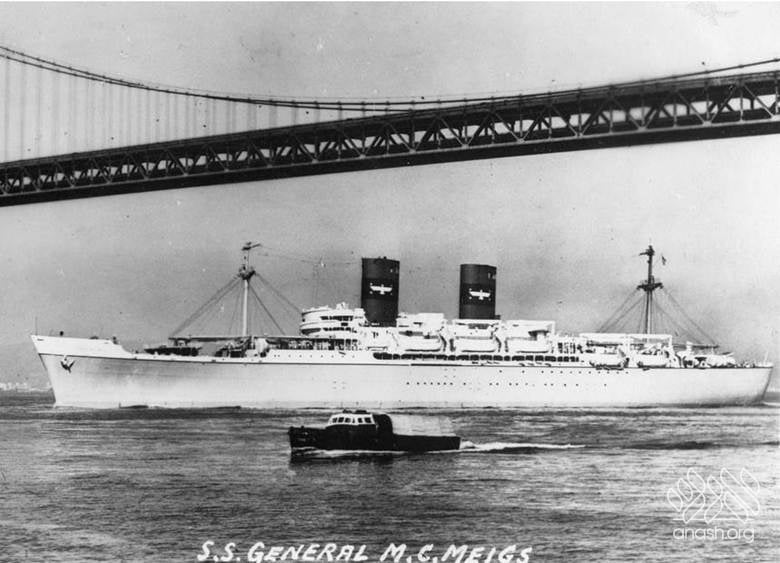
After months of waiting, the remaining 26 members of the Lubavitcher contingent (numbers 1-26 on the list above) finally secured passage on the USS General M. C. Meigs, a decommissioned U.S. Navy ship hastily converted into a passenger ship.
A notice from the United Lubavitcher Yeshivos announcing that the Shanghai bochurim are on their way to America. Der Tog, 13 Tammuz, 5706 (July 12, 1946)
On Thursday, 19 Tammuz 5706, the group finally arrived in S. Francisco. The Lubavitcher bochurim were part of a group of 98 Jewish refugees, most of them talmidim of the Mirrer Yeshivah, who had visas to Canada. A prominent passenger on the boat was Harav Shmuel David Walkin, who had served as the rov of Lukatch before the war and survived the war in Shanghai with his young family. He later served as a rov in Crown Heights and Kew Gardens.
The local media carried several reports on the arrival of the Jewish refugees. The San Francisco Call Bulletin (July 18, 1946), reported:
98 Refugee Jews Welcomed Here
On the last leg of a six year journey to peace and freedom, a group of ninety-eight refugee rabbis and Hebrew scholars arrived here today aboard the SS General Meigs from Shanghai, together with 1,079 civilian and 360 Army passengers.
Driven from their native Poland by the Nazis six years ago, the survivors of 600 persecuted rabbis, the rabbis and scholars fled first to Japan by way of Russia and Siberia, and then were interned in Shanghai by the Japanese in what they termed a “ghetto” of 20,000 refugee Jews.
USS General M. C. Meigs, the boat that brought the bochurim to America.
Welcomed here by the San Francisco Committee for Service to Emigres, the Council of Jewish Women and the HIAS, the group is en route to serve in rabbinical colleges in the East and in Canada and South America. Thirty will go to the Central Lubawitz Rabbinical College at Brooklyn, New York.
Speaking for the group, Rabbi Elias Moses Liss of the Lubawitz College, said:
“For more than six years our aim has been to come here. We have been like men waiting for water in the desert. It is because of American efforts in Poland that we are free and we are glad to be in a country where freedom is 100 per cent.”
The San Francisco News also reported on the arrival, and their report included a picture.
Lubavitcher Bochurim and other refugees upon arrival in S. Francisco. The older man in the center is Harav Shmuel Walkin. Picture from The San Francisco News.
*
The local English-language Jewish newspaper, The Jewish Community Bulletin (27 Tammuz, 5706—July 26, 1946), carried a more detailed report, including quotes from members of the Lubavitcher group, Pesach Rabinowitz and his wife Lina, and Moshe Sapochkinsky.
Young Rabbi And Wife Tell Of Life In The Shanghai Ghetto
“We stayed up all night to see the Golden Gate bridge. It is so beautiful.”
It was Lina Rabinowitcz speaking, 22-year-old bride of one of the rabbinical students, who arrived in San Francisco last week from Shanghai.
She and her husband, Peisach, were sitting at a table in Temple Keneseth Israel having their first meal on American soil.
Theirs had been a marriage born of the Shanghai ghetto for they met and were married there one year ago. She left Berlin with her parents and an aunt, and came to Shanghai in 1939 because they were refused entrance to the United States. Her scholarly husband come to Shanghai with his fellow students from Japan in 1941.
I asked her about life in the ghetto.
“It was not easy,” she shrugged her shoulders, “one needed a pass to get out and sometimes the Japanese guard would not give the pass or he would do this.” She tapped her cheek.
A picture from the Jewish Community Bulletin article.
“We had to wear a red badge as well,” Mowsza Sapoczinski, 22-year-old student sitting next to Lina, said, “that was something the Japanese learned from the nazis.”
Lina’s husband Peisach, joined the conversation, “I spent one day in jail for losing my badge.”
Just then, little Moses Walkin danced up. Moses, who is seven but looks five, is the son of Rabbi Samuel Walkin, white bearded patriarch who will teach in the seminary in New York. Peisach and Mowsza fussed over the little boy and made him talk so I could hear how well he spoke English.
All of them spoke English well. “In Shanghai,” Lina said, “everyone speaks English.”
Several of the children ran around the room calling “Okay, hello, okay, hello,” to show off their linguistic ability.
Peisach, Mowsza and their fellow scholars continued their studies all during their internment. Money for food and clothing came from the American relief societies and from the United Lubavitzer Leshivoth whose American branches they will join.
“The school pays for everything,” Peisach said, “we have nothing to do except to learn. Even in Poland, it was free for those whose families could not afford a contribution to the school.”
I asked Lina about the trip in the S. S. General Meigs.
“It was not so nice,” she said, “We could not eat anything because the food was not kosher. All we had were eggs and apples and the soldiers on board looked at us strangely. But,” again her shoulders moved in a shrug, “we are used to it.”
She felt badly that she had to leave her parents in Shanghai. “It is hard to get to America,” she told me, “we were lucky because of the help of Vaad Hatzala and the Joint Distribution Committee, but even we had to wait more than six months after we got our visas.”
“Still,” she continued, “at least I know where my parents are and that they are safe. My husband hasn’t heard from his parents in many years and Mowsza’s parents were killed by the nazis.”
Peisach, his wife, Mowsza, and thirty-eight students are now on their way to New York to live.
Welcome Receptions
The Frierdiker Rebbe instructed that public receptions be held for the arriving bochurim in various cities. Before continuing on to New York, the bochurim were split into three groups and hosted for a few days in S. Francisco, Los Angeles, and Seattle, where receptions were held to welcome them. From New York, Harav Yossel Wineberg and Harav Moshe Yitzchak Hecht were sent to greet them.
Los Angeles’s B’nai B’rith Messenger reported (20 Tammuz 5706—July 19, 1946) on the preparations for the local reception.
Ex-Yeshiva Students Shanghai Refugees Awaited Here
Fleeing the death chambers and concentration camps of Poland, only to find hardships and misery in Shanghai, as prisoners of war, about thirty former students of the Lubavitcher Rabbi, Joseph I. Schneerson, have been enabled, through his efforts to come to the United States.
About seventeen of them will arrive in Los Angeles on the 16th or 17th of July, and a reception is being planned in their honor by Los Angeles Jewry.
At a meeting held in the home of Mr. and Mrs. Max Wecksler, Monday night, a group of distinguished rabbis and laymen laid plans for the forthcoming reception, and for the maintenance of these refugees until steps can be taken for their future welfare in the country.
Principal speaker was Rabbi Maurice I. Hecht, a personal representative of Rabbi Schneerson, who came to Los Angeles for the purpose of meeting these refugees.
Reception Sunday
Arrangements have been made for a reception in their honor by a committee headed by Harry Altman and Max Weksler, to be held Sunday evening, July 21, in the Jewish Home for the Aged, 325 South Boyle Ave., at a dinner. Others on the committee are Harry Dunitz, Joseph Friedman, Abe Morantz, Sam Shuken, Sol Tishineff, Joseph Sklar, Julius Braun, Louis Casselman, Frank Rosenblum, Louis Udko, Sol Weitz, Boris Levitus, Herbert Becker, Jacob Maler, A. Dubin, A. Matusow, Emil Brown, Jack Bayer, Sam Goldman, Rabbi Max Kert, Rabbi A. Maron, Louis Peale, Harry Blank, Mrs. Max Weksler and Julius L. Samson.
Among those who will entertain at the program will be Cantors Itzikel Schiff and Joseph Czykowski, accompanied by the world renowned composer Cantor Paul Discount.
For reservations call Mrs. Weksler at WA 4995, or WY. 8269.
On 27 Tammuz (July 26, 1946), B’nai B’rith Messenger reported on the reception:
Yeshiva Students, War Refugees—Welcomed Here
“Forget us! Remember our brothers and sisters in Poland, in Russia and in China!”
That was the earnest statement of Rabbi Liess, one of the ten Yeshiva students, the first of a group of former students of the Lubavitcher Yeshiva in Poland, whose blood-stained flight from Nazi invaded Poland, through Russia, Siberia and to China, at long last ended in the safety of American soil.
Show Hardships
Speaking before a capacity filled auditorium at the Jewish Home for the Aged Sunday night, Rabbi Liess, spokesman for the group of bearded, emaciated, hollow-eyed young students of the law, simply but graphically told of their flight and their years of exile in Shanghai, and how Rabbi Schneersohn, the Lubavitcher Rabbi, now in New York worked to get visas for them to come to America.
The ten young students for the rabbinate arrived in San Francisco last week, and were escorted to Los Angeles by Rabbi Maurice I. Hecht, of Worcester, Mass., a representative of Rabbi Schneersohn, who was sent to the West Coast to bring them to New York. A committee of Los Angeles orthodox and lay leaders arranged a reception for them for Sunday night, at which time an appeal was made by Rabbi Hecht for funds to help these ten, and several others who arrived in New York by plane to rehabilitate themselves, to regain their health so that they may continue their studies.
Refugees Sing
Highlight of the evening was the chanting by the ten Yeshiva students of several Hebrew songs, one of them composed by one of their own number while in a Japanese concentration camp in Shanghai.
Harry Altman was chairman of the evening, and welcomed the students as well as the guests of the evening, and Joe Friedman, president of the Los Angeles Lodge, B’nai B’rith acted as master of ceremonies.
Funds Raised
Approximately seven thousand dollars was received by the committee that night. On the committee were the following: Mr. and Mrs. Weksler, Mr. and Mrs. Harry Dunitz, Julius Samson, Emil Brown, Frank Rosenbaum, Jack Kishinoff, Abe Morantz, H. Wilkin, and A. Matusow.
Present at the dinner were most of the orthodox and conservative rabbis of Los Angeles. Itzikel Schiff, well-known Cantor, sang accompanied by Cantor Paul Discount.
The “chanting of several Hebrew songs” was certainly the highlight of the event for the local Jewish reporters. A separate article in the same edition of the B’nai B’rith Messenger was devoted specifically to the singing and the message of courage and emunah it conveyed.
We Shall Live!
“Ani Ma’amin! We shall live!”
A song of stubbornness—a song of confidence—a song of courage—a song of defiance! This was the song sung by ten bearded, emaciated, almost shabby Yeshiva students, Sunday night, at a reception given them by the Los Angeles Orthodox Jewish community, at the Old Folks Home. This was a song chanted, not by those who have lived in comfort, but by those who have lived with death—to whom life is no longer a personal matter.
These ten Yeshiva students, chassidim of the famous Lubavitcher Rabbi, deprived through Nazi murder and starvation of every one near and dear to them—these hollow-cheeked, sunken eyed students of the Torah, miraculously saved from the slaughterhouses of Europe, surviving the hegira of horror from Poland and China, only to be flung again into the concentration camps by the Japs—still sang their song of “Ani Ma’amin! We shall live!”
Not of themselves did they sing—but of their people—the Jewish people. They have no desire to live—but for one thing—to help save the several hundred other Yeshiva students scattered throughout Europe and Asia, and to devote the rest of their lives to the study of the Torah. Not for their own salvation nor for the opportunity they now find in America for material advancement did they thank G-d—but for the opportunity of saving their brethren and spreading of the Holy Word, did a song of praise come to their lips—and a song of defiance and courage, “Ani Ma’amin!” come from their hearts!
And fortified by such spiritual strength a people must live!
A report on the Seattle reception appeared in the Seattle Post-Intelligencer on 25 Tammuz (July 24, 1946), accompanied by photos of the group.
This picture appeared in the Seattle Post-Intelligencerunder the headline “They Pray For World Peace.” Standing, from left to right: Moshe Lederhendler, Yechezkel Deren. Shmuel David Raichik, Moshe Rubin, Chaim Meir Bukiet, Moshe Chaim Sapochkinsky, and Yossel Weinberg. Front row: Lina Rabinowitz, Pesach Rabinowitz, and Shlomo Hochler.
*
Rabbis From Germany Here
Eight black-bearded and hatted men who have known little of peace since they fled Poland and their Nazi persecutors in 1939, prayed in Seattle this morning for good will among all men and an end to bloodshed. They will pray again before sunset and again after sunset.
The eight are the last of the group of teachers and students of the Lubavitcher Rabbinical College of Otwotzk, Poland, who slipped across the Russian border the year Hitler invaded Poland, moved into Lithuania in 1941, traveled across Russia to Japan and thence to Shanghai a few days before Pearl Harbor. Thirty of the rabbis and rabbinical students landed at San Francisco last week and Seattle Jewry brought eight of them here for a brief welcome before they continue on to Brooklyn, N. Y.
There they will be reunited with their mentor, Rabbi Joseph I. Shneershon, head of the college in Poland, who reestablished the rabbinical college in Brooklyn four years ago. Rabbi Shneershon and a group of his faculty were able to leave Shanghai on Canadian visas at that time and made their way to this country.
In the home of Ben Biolostotsky, 165 23rd Ave., the refugee scholars, the wife of one and Rabbi Joseph Weinberg of Chicago, who fled with the original group, testified unanimously today that it was “good to be in a country where one can breath.”
They were met on arrival here last night by Fred H. Bergman, chairman of the reception committee named by the Seattle Jewish community; Rabbi Baruch Shapiro, Rabbi CH. J. Levene and Rabbi Solomon Maimon. They will leave for New York at the end of the week.
In the group are Rabbis S. M. Lebererhendler, S. D. Rajczyk, Moses Rubin, CH. M. Buket and Paischa Rabinowitz. The students are CH. Deren, M. CH. Sapoczkinski and Solomon Hochlerer. The wife is Mrs. Rabinowitz, who met her husband in Shanghai.
From right to left: Harav Baruch Shapiro of Seattle, Yossel Weinberg, Moshe Rubin, Shmuel David Raichik, Shlomo Hochler, Pesach Rabinowitz, Moshe Chaim Sapochkinsky, Chaim Meir Bukiet. This picture appeared in The Seattle Post-Intelligencer.
*
Arriving in New York
After a few days on the West Coast, the bochurim continued on to their final destination, the place they had been yearning and davening to reach for all these years: New York, where the Rebbe lived.
The most detailed report about the group’s arrival in New York appeared a few weeks later in The Detroit Jewish Chronicle on 19 Av (August 16, 1946)
Joyful Chassidic singing and dancing by rabbinical scholars highlighted a fervent welcome accorded by representatives of orthodox institutions in New York to 40 European refugees, including noted rabbis and their students who recently arrived via San Francisco from a wartime ghetto in Shanghai. Part of the first large group of refugees from the Chinese seaport to reach haven in the United States since the war, they had been stranded in Shanghai after fleeing almost seven years ago from Nazi persecution.
The newcomers were warmly embraced by their elated welcomers as they stepped from Pullman cars chartered for the cross-country journey by the United Service for New Americans, principal national agency serving the foreign born in the United States. The refugee group had been cared for on arrival on the West Coast and furnished with an escort to New York by the San Francisco Committee for Service to Emigres, which acted for USNA and which had the cooperation of the San Francisco Section of NCJW.
The new arrivals, who had been sheltered in San Francisco for several days to avoid traveling on the Sabbath, were provided on the train with kosher food. On reaching New York they were welcomed in behalf of USNA by Commander Joshua L. Goldberg, Jewish chaplain of the Third Naval District and descendant of a famous rabbinical family.
Harav Moshe Leib Rotshtein, Mordechai Meir Bryski, and Pinchas Blatt at the trains station in New York. This picture appeared in Der Tog.
As they alighted from the train, the bearded rabbis with their families and the rabbinical students formed a picturesque group. Many of the younger men, who had fled to Shanghai from Polish and Lithuanian Yeshivas while still in their teens, wore the long coats and broad-brimmed black hats, typical of the Old World Yeshiva student. Some wept for joy as they were embraced by friends now attending New York Yeshivas whom they had last seen in Europe as fellow seminary students.
Immediately after the first greeting on the station platform, the welcoming Yeshiva students started their circular dance, each holding with outstretched hand the shoulder of the dancer ahead of him. As they danced they chanted Chassidic melodies while other welcomers clapped hands in accompaniment.
The newcomers included one young couple, a refugee scholar from Poland and his beautiful young wife who had fled from Germany to Shanghai, where they met and were married. Another young couple and their child had previously been provided by USNA with airplane transportation from San Francisco to an uncle in New York because the woman was about to give birth to her second child.
Famous Polish and Lithuanian seminaries which had maintained branches in Shanghai during the difficult war years, including the Lubovicher, Lublin, Mirer, Kletzk and Bialystok Yeshivas, were represented by members of the rabbinical group when it reached this country. Many of them are now guests of the Lubovicher Yeshiva in Brooklyn, and of the Mirer Yeshivas in New York City and Montreal, Canada.
On arrival in San Francisco, this initial contingent of Shanghai refugees numbered 143 from a total of some 600 orthodox Jewish religious leaders and students who had carried on their religious and scholarly activities while suffering internment by the Japanese in the Shanghai ghetto, where they spent the last four years. The group of newcomers included a number of non-rabbinical immigrants joining relatives in various parts of the United States for some of whom transportation and other expenses were also paid by USNA. About a dozen others proceeded from San Francisco to Central and South American countries to be united with kin there.
The Brooklyn Eagle also carried a report about the arrival, including quotes from representatives of the group (5 Av, 5706—August 2, 1946)
27 Rabbinical Students Hail Boro As Home After 7-Yr. World Flight
A seven-year quest over half the globe for a home where they could follow their faith unmolested was realized today by 27 Polish rabbinical students who plan to settle in Brooklyn after they finish their religious studies here.
Their journey started when Hitler invaded Poland and they were forced to flee from the Warsaw Lubavitcher Yeshiva and seek refuge in various parts of Siberia, Japan, China and finally Shanghai.
Meanwhile, the young men’s spiritual leader, Rabbi Joseph Isaac Schneersohn, founder of their school in Poland, had sought refuge in Brooklyn where he organized the Central Lubavitcher Yeshiva five years ago “to make America a Torah center to take the place of the ruined Jewish communities of Europe.”
School Grew Quickly
The school, located at the time of its founding at 770 Eastern Parkway, expanded so quickly that it had to be moved last May to its present more commodious headquarters in the former Unity Club at Bedford Ave. and Dean St.
Glowing accounts of this town Brooklyn where Jews are free to worship without anti-Semitic riots came to the unbelieving ears of the five young religious students. For in the course of their journeys and especially in Shanghai, where they organized a Yeshiva of their own, they often saw malicious evidences of anti-Semitism.
“The Japs left their mark there and we encountered anti-Semitism all around us,” Abram I. Gorfinkel, the spokesman of the group, declared shortly after the group’s arrival at the Central Yeshiva here yesterday. They were received by Rabbi Schneersohn’s son-in-law, Rabbi S. Gourary, chairman of the Yeshiva’s executive committee, and other members of the committee.
Heard of ‘Land of Plenty’
“We had heard of the land of plenty, where you could live and worship in peace,” he said. “It seemed so incredible to us, but the happy news from our rabbi convinced us.”
The group’s two-week journey by train from the West Coast became a triumphal procession, with Jewish and Gentile organizations sending delegations to meet the train when it stopped along the way, he said. By the time they got to their destination there could be no doubt that “America is a friendly country where the Jew can find his place.”
Await Still Stranded Brethren
Their joy, however, is tempered with the knowledge that fellow-students of their yeshiva are still stranded in Shanghai. The young men have solemnly sworn to forego any of the advantages of “this wonderful land” until their brethren are here to partake of them.
Two of the students, who were married to German refugees also stranded in Shanghai, brought their young brides with them. Joseph Poltovich’s wife, Gerda, left immediately to stay with relatives in the country.
But Pesach Rabinowitz bride, Lena, a tall brown-eyed girl who left Berlin with her parents in 1938, will stay with him while he completes his studies.
Mrs. Rabinowitz is fond of cooking and is looking forward to her visit to a grocery store where she will be able to purchase all the necessary food articles for “a good home-cooked meal.”
A group of the Shanghai bochurim upon arrival in New York, together with talmidim of the Yeshivah in 770. Seated in the front row, from right to left: Mordechai Meir Bryski, Chaim Hersh Zak, Yisrael Chanowitz, Pinchas Blatt, Yosef Portowitz and his wife, Gitel. Chaim Leibish Probst is standing on the left. This picture appeared in Der Tog and other newspapers.
*
New York Welcomes
In New York, most of the bochurim joined the Yeshivah in 770, lodging at the dormitory on Bedford Ave.
A few weeks after their arrival, Nisson Gordon reported in Der Tog about the group and their experience. The noteworthy part of his article, published on 11 Av (August 8, 1946) is his description of a farbrengen he attended with the bochurim on Shabbos afternoon.
Last Shabbos in the evening time, I was at the shalosh seudos of the newly arrived Lubavitcher yeshivah bochurim in Brooklyn. The entire tish, which was also attended by Harav Shmaryahu Gourary, the executive chairman of the yeshivos, with the bochurim’s zemiros and Chabad nigunim, their gartlach and kapotes, brought back to me the memory of the old chasidishe Warsaw, that Warsaw which went up in smoke and flames, and who knows whether it will ever return.
Among the students is one named Yisrael David Rosenberg, who has a fine musical talent, and writes and reads musical notation. While in Shanghai he fitted a tune for a special Shir Hageulah, and they all sang it together in full voice, drawing the attention of the evening strollers on the aristocratic Eastern Parkway.
I noticed on the faces of the young men themselves that they wanted to forget, for a brief while, that they were in America. It seemed as though they were in the old chasidim shtibel somewhere on Muranowska Street, and that soon, right after Maariv, they would go home, home to their own families and loved ones, and make Havdalah.
But the noise from outside, the electric lights shining in, and the rumble of the underground subway reminded them that they were very far from that old world…
The Shir Hageulah Gordon mentions is a poem that appeared in Hakeriah Vehakedushah, published in New York by the Frierdiker Rebbe. The poem was printed in the Erev Rosh Hashanah 5701 edition, before Japan entered the war, so it reached the bochurim in Shanghai.
The Rebbe at the chasunah of R. Yisrael David Rosenberg on 26 Kislev, 5708.
R. Yisrael David Rosenberg (5679-5754) was raised in Levertov (Lubartów), Poland, where his father was a gabbai of Harav Moshe Yechiel Elimelech Rabinowitz, a rebbe from the Biala dynasty.
After the war, R. Yisrael David settled in New York and worked for many years as the Ritual Director at Kehilath Jeshurun in Manhattan, where he taught generations of bar mitzvah boys to lein.
The Shir Hageulah is most probably the song mentioned earlier in the report from the Los Angeles reception as “composed by one of their own number.”
A recording of R. Yisrael David singing his composition for the Shir Hageulah can be found on the website of his son, R. Moshe Rosenberg.
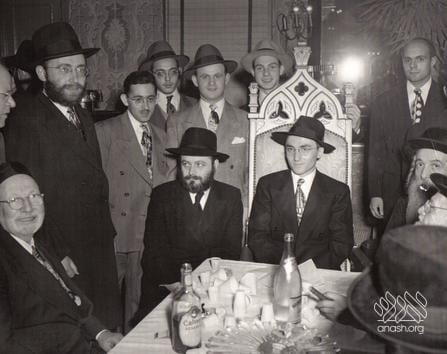
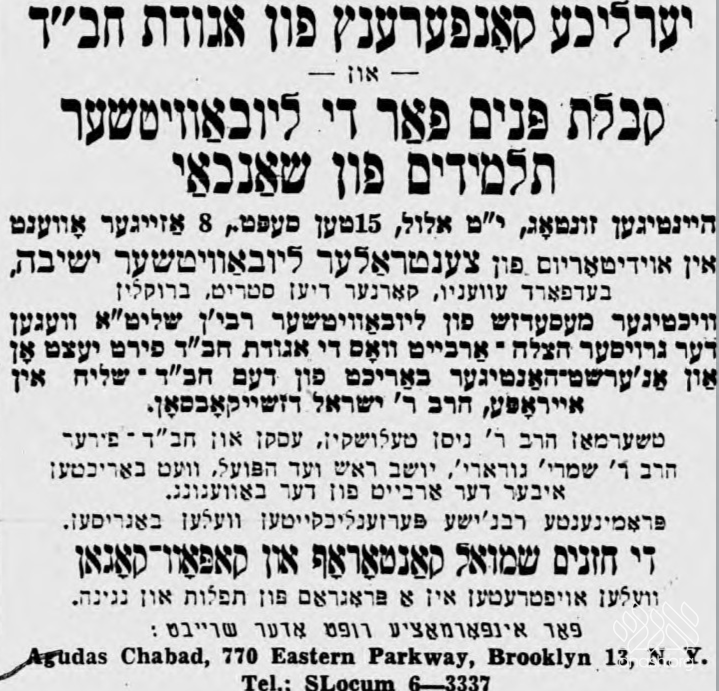
An official public reception for the Shanghai bochurim was held on 19 Elul, as part of the annual national conference of Agudas Chassidei Chabad.
A report on the conference and reception appeared in both Der Tog and Morgen Zhurnal on 20 Elul (September 16, 1946), clearly supplied by Lubavitch.
Chabad Conference Hears Urgent Appeal from Polish Jewry
An appeal to American Jewry not to delay rescue efforts for the Jews of Poland, who are in grave danger, was heard at the annual Agudas Chabad conference, held yesterday in the auditorium of the Central Lubavitch Yeshiva in Brooklyn.
The event drew more than two hundred delegates, along with a large number of guests. The appeal regarding Polish Jewry was delivered by the special Chabad representative currently in Europe, the well-known Brooklyn rabbi Harav Yisrael Jacobson.
An advertisement for the reception. Der Tog, 17 Elul (September 13, 1946).
The conference was opened by chairman Harav Nissan Telushkin, after which the assembled audience heard a message from the Lubavitcher Rebbe, Harav Yosef Yitzchak Schneersohn, president of Agudas Chabad HaOlamis. Harav Shmaryahu Gurary, chairman of the executive committee, presented an overview of the extensive activities of the Chabad movement in America, particularly in the areas of education and the rescue of Jewish lives.
This year’s Chabad conference also included a welcoming reception for the Lubavitcher talmidim who had recently arrived from Shanghai, where they had operated a large yeshivah throughout the war. Harav Yisrael Dushowitz, chairman of the New York rabbinate, greeted the guests from Shanghai and introduced them to the audience. Rabbi Eliezer Predmesky offered greetings on behalf of the Agudas Harabbonim.
Two of the Shanghai talmidim, Harav Garfinkel and Harav Lederhendler, spoke briefly and warmly. They described how the Lubavitcher Rebbe had sought every possible means to rescue them, and they expressed gratitude for his help and support. The Shanghai students also took the opportunity to appeal to American Jews to assist the local Lubavitch yeshivas, especially with the approaching High Holy Days.
Substantive addresses on the work and mission of Chabad in America were delivered by several prominent rabbonim, including Harav Shmuel Levitin, Harav Moshe D. Rivkin, Harav Eliyahu Simpson, and Harav S. A. Kazarnovsky, among others. A number of resolutions were adopted and will be published.
Thanks to Dovid Zaklikowsky, Shraga Homnick, and Yehuda Chanowitz for their help in locating some of the newspaper reports.
The heroic figure of Harav Meir Ashkenazi, the rov of Shanghai, is mentioned several times in this article. Ahead of his yartzeit next month, we will dedicate a full article to the story of this remarkable chasid.
To view all installments of From the Margins of Chabad History, click here.
For additional exclusive content, follow the column on X: x.com/ChabadMargins
COMMENTS
We appreciate your feedback. If you have any additional information to contribute to this article, it will be added below.
Pesach Rabinowitz and his wife didn’t merit to have children
ויהיו הדברים לעילוי נשמתם
The Rabinowitzes were very close friends with parents. My oldest son is named also Mordechai after Peach’s father. Another son is named Pesach. They were wonderful people!
The clipping from Hatzofeh mentions a Lubavitcher Yeshivah in Bombay. Did some of the bochurim wind up there instead of Kobe and Shanghai? What was their story?
“A path to safety then appeared, from a surprising source”
For the sake of historical accuracy, the path to safety came when the Ductch Ambassador L. P. J. de Decker in Riga, Latvia, authorized the honorary Dutch consul in Kovno, Lithuania Jan Zwartendijk to enter into the passports of a few refugees, that “no entry visa was required for admission to the Dutch islands of Surinam and Curacao in the Caribbean”. This however, was only a half truth, in reality though, while entry to the Dutch possessions did in fact not require an entry visa, entry however, depended solely on the Governor of those islands granting a landing permit upon arrival. For all practical purposes, all those who had the “no visa required” stamped into their passports, did not actually have permission to enter those islands.
Ambassador de Dedecker consented to drop the second half of the sentence, thanks to the repeated requests of a Dutch bochur by the name Nathan Gutwirth learning in the Telsher Yeshiva.
Through tremendous Hashgacha Pratis, Gutwirth had developed a personal friendship with Zwartendijk, prior to him assuming the position of honorary Dutch counsel, and upon the urging of others, Gutwirth used his good influence to prevail upon Zwartendijk to enter the “no entry visa required” into the passports to anyone who would ask for it.
Only once the destination of Curacao and Surinam was created, was Sugihara approached, and under the assumption that the Dutch “no entry visa required” valid, he issued Japanese transit visas.
That was how the Litvishe Bocheim got out. the Lubavitcher Buchrim had American Visas from the Freirdiker Rebbe and were just lacking transit Visas which Sugihara supplied.
It was not only the Litvish bochurim, close to 2500 Dutch non-visas were issued.
But that’s not the point, the point of the previous comment was, that the Sugihara Japanese (and the Trans-Russian) route came to be as a result of the Curacao non-visa, it was than used by those with other end destinations as well.
Incidentally, the Lubavitch bochurim had yet to receive their American visas, and regrettably never did end up receiving them.
HaRav HaChosid, shochet u’bodek R. Mordechai Lurie was my maternal grandfather.
This article reveals details I’d never heard, not from my Zaidy and not from anyone else.
Thank you, rabboisai, for the time and effort in recording this history. Much appreciated.
Just would like to add one thing: The article mentions a child being named Pesach after R. Pesach Rabinowitz, who was not zoicheh to children. Reb Pesach was a dear friend of Zaidy Lurie and as such, my uncle Avrumie Lurie named his son, my cousin Shua Lurie, Yehoshua Pesach in his honor and memory.
The Lubavitch bochurim had yet to receive their American visas, they were only to receive them in Moscow. They didn’t end up receiving them in Moscow either, and were told that they would receive them in Japan. Regrettably, in the end they didn’t receive in them in Japan either, in a twist of fate, the Americans canceled their visas.
At that point in time*, one had to have a destination visas in order to receive a Japanese transit visas, they certainly had to have one in order to enter Japan. The only one available, was the Curacao non-visa.
It could be assumed that the families of some of these Bochurim still have the passports, and it should be easy to verify whether they did or didn’t receive the Curacao non-visa.
*based on the places of the Lubavitch bochurim on the Sugihara list, it is fair to assume that at that point in time, Sugihara wasn’t issuing transit visas to those who didn’t actually have a destination visa, something he only did towards the end.
The Lubavitchers were approved for American visas, they just had to complete the process in the American consulate, they also needed a transportation visa, Sugihara gave them the transit visas because of their American Visas. At first they planned on finishing the Visas in Moscow, however there wasn’t enough time for it to be completed there, so they went to do it in Japan, however between that time the Americans canceled all Visas od people with relatives in Europe. So in Japan they found out that they were canceled.
The Lubavitch students never received American visas. There is no source that they ever did, or even had official papers that they will be given. All they had were assurances that visas will be given, but that never did happen amd they are not called visas.
They could not leave the Soviet Union, or enter Japan without a final destination in hand. In fact, at the time they got Sugihara visas, which was closer to the beginning, he demanded one too. They therefore like everyone else had to get visas to Curacao. This fact is not some kind of secret and mentioned by the students in their stories too. See Shadar, p. 52, and many other places.



















 COMMENTS


Pesach Rabinowitz and his wife didn’t merit to have children
ויהיו הדברים לעילוי נשמתם
The Rabinowitzes were very close friends with parents. My oldest son is named also Mordechai after Peach’s father. Another son is named Pesach. They were wonderful people!
Thank you. My grandfather Shmuel Tzvi Fox was one of these bachurim. He had a story of getting stuck in quicksand while the bachurim were escaping.
The clipping from Hatzofeh mentions a Lubavitcher Yeshivah in Bombay. Did some of the bochurim wind up there instead of Kobe and Shanghai? What was their story?
There was nothing in Bombay, it must have just been a mistake in the newspaper.
“A path to safety then appeared, from a surprising source”
For the sake of historical accuracy, the path to safety came when the Ductch Ambassador L. P. J. de Decker in Riga, Latvia, authorized the honorary Dutch consul in Kovno, Lithuania Jan Zwartendijk to enter into the passports of a few refugees, that “no entry visa was required for admission to the Dutch islands of Surinam and Curacao in the Caribbean”. This however, was only a half truth, in reality though, while entry to the Dutch possessions did in fact not require an entry visa, entry however, depended solely on the Governor of those islands granting a landing permit upon arrival. For all practical purposes, all those who had the “no visa required” stamped into their passports, did not actually have permission to enter those islands.
Ambassador de Dedecker consented to drop the second half of the sentence, thanks to the repeated requests of a Dutch bochur by the name Nathan Gutwirth learning in the Telsher Yeshiva.
Through tremendous Hashgacha Pratis, Gutwirth had developed a personal friendship with Zwartendijk, prior to him assuming the position of honorary Dutch counsel, and upon the urging of others, Gutwirth used his good influence to prevail upon Zwartendijk to enter the “no entry visa required” into the passports to anyone who would ask for it.
Only once the destination of Curacao and Surinam was created, was Sugihara approached, and under the assumption that the Dutch “no entry visa required” valid, he issued Japanese transit visas.
Thanks! Fascinating!
That was how the Litvishe Bocheim got out. the Lubavitcher Buchrim had American Visas from the Freirdiker Rebbe and were just lacking transit Visas which Sugihara supplied.
It was not only the Litvish bochurim, close to 2500 Dutch non-visas were issued.
But that’s not the point, the point of the previous comment was, that the Sugihara Japanese (and the Trans-Russian) route came to be as a result of the Curacao non-visa, it was than used by those with other end destinations as well.
Incidentally, the Lubavitch bochurim had yet to receive their American visas, and regrettably never did end up receiving them.
HaRav HaChosid, shochet u’bodek R. Mordechai Lurie was my maternal grandfather.
This article reveals details I’d never heard, not from my Zaidy and not from anyone else.
Thank you, rabboisai, for the time and effort in recording this history. Much appreciated.
Just would like to add one thing: The article mentions a child being named Pesach after R. Pesach Rabinowitz, who was not zoicheh to children. Reb Pesach was a dear friend of Zaidy Lurie and as such, my uncle Avrumie Lurie named his son, my cousin Shua Lurie, Yehoshua Pesach in his honor and memory.
The Lubavitch bochurim had yet to receive their American visas, they were only to receive them in Moscow. They didn’t end up receiving them in Moscow either, and were told that they would receive them in Japan. Regrettably, in the end they didn’t receive in them in Japan either, in a twist of fate, the Americans canceled their visas.
At that point in time*, one had to have a destination visas in order to receive a Japanese transit visas, they certainly had to have one in order to enter Japan. The only one available, was the Curacao non-visa.
It could be assumed that the families of some of these Bochurim still have the passports, and it should be easy to verify whether they did or didn’t receive the Curacao non-visa.
*based on the places of the Lubavitch bochurim on the Sugihara list, it is fair to assume that at that point in time, Sugihara wasn’t issuing transit visas to those who didn’t actually have a destination visa, something he only did towards the end.
The Lubavitchers were approved for American visas, they just had to complete the process in the American consulate, they also needed a transportation visa, Sugihara gave them the transit visas because of their American Visas. At first they planned on finishing the Visas in Moscow, however there wasn’t enough time for it to be completed there, so they went to do it in Japan, however between that time the Americans canceled all Visas od people with relatives in Europe. So in Japan they found out that they were canceled.
The Lubavitch students never received American visas. There is no source that they ever did, or even had official papers that they will be given. All they had were assurances that visas will be given, but that never did happen amd they are not called visas.
They could not leave the Soviet Union, or enter Japan without a final destination in hand. In fact, at the time they got Sugihara visas, which was closer to the beginning, he demanded one too. They therefore like everyone else had to get visas to Curacao. This fact is not some kind of secret and mentioned by the students in their stories too. See Shadar, p. 52, and many other places.