




ל׳ ניסן ה׳תשפ״ו | April 16, 2026
Trump Announces 10-Day Ceasefire Between Israel and Lebanon, Hezbollah Fire Rockets
U.S. President Donald Trump announced on Thursday a 10-day ceasefire between Israel and Lebanon, effective 5:00 p.m. EST, in a bid to “achieve lasting peace.” But after Hezbollah fired rockets at the North minutes before the pause took effect, widespread skepticism remains, with most Israelis wanting the IDF to complete its mission.
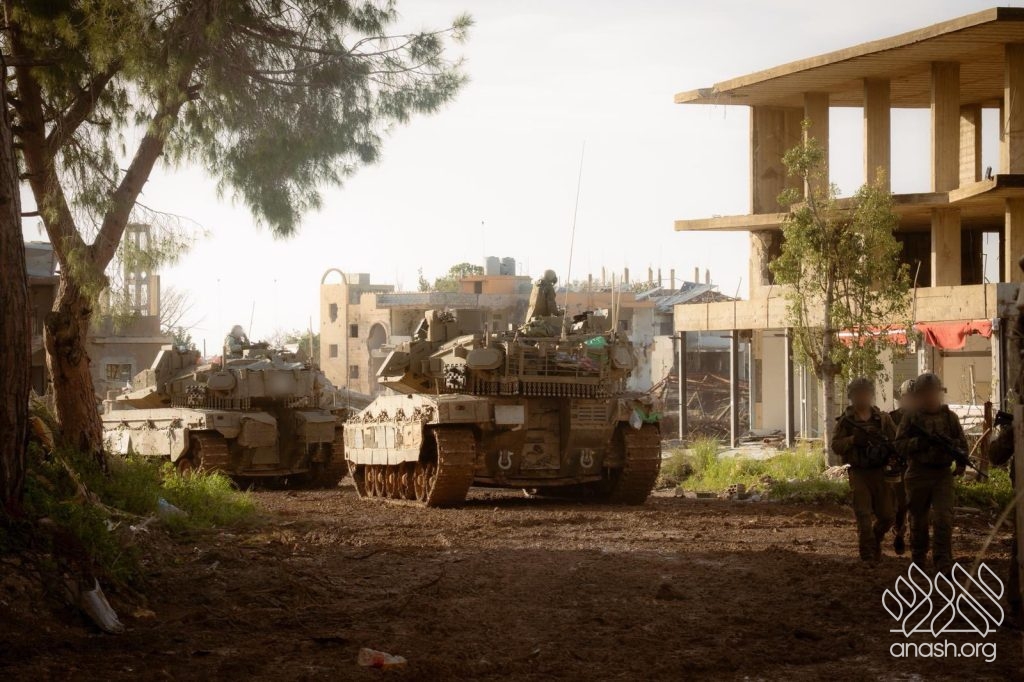
A 10-day ceasefire between Israel and Lebanon officially took effect Thursday at 5:00 p.m. EST, after a day of heavy fighting and just minutes after Hezbollah terrorists fired five rockets at the Galilee Panhandle. Most were intercepted, and one landed in an open area.
President Donald Trump announced the ceasefire Thursday after speaking with Lebanese President Joseph Aoun and Prime Minister Bibi Netanyahu.
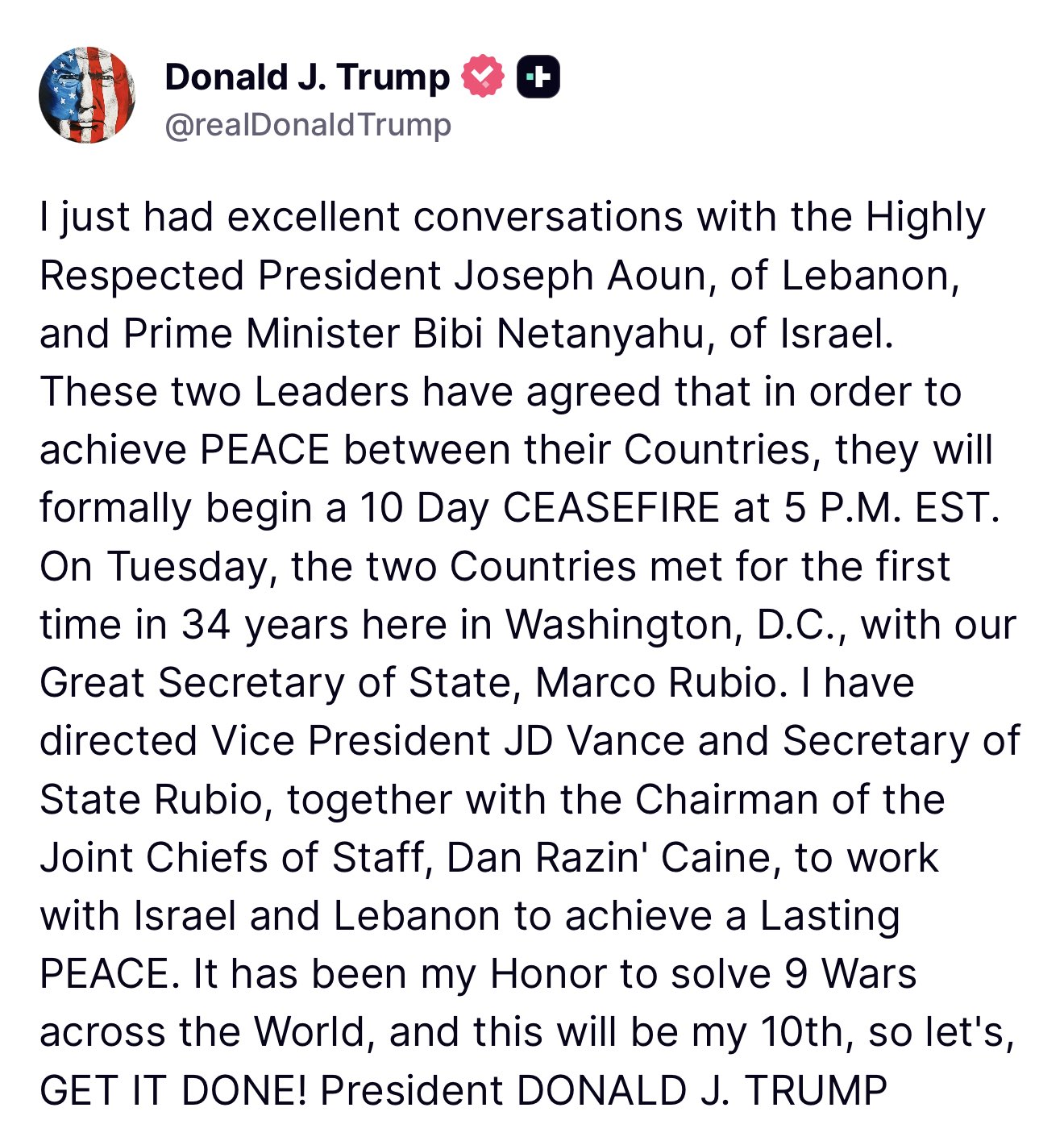
“I just had excellent conversations with the Highly Respected President Joseph Aoun, of Lebanon, and Prime Minister Bibi Netanyahu, of Israel,” Trump wrote. “These two Leaders have agreed that in order to achieve PEACE between their Countries, they will formally begin a 10 Day CEASEFIRE at 5 P.M. EST.”
Trump said the two countries had met Tuesday in Washington “for the first time in 34 years,” and added that he had directed Vice President JD Vance, Secretary of State Marco Rubio, and Chairman of the Joint Chiefs of Staff Dan Razin’ Caine “to work with Israel and Lebanon to achieve a Lasting PEACE.” He added, “It has been my Honor to solve 9 Wars across the World, and this will be my 10th, so let’s, GET IT DONE!”
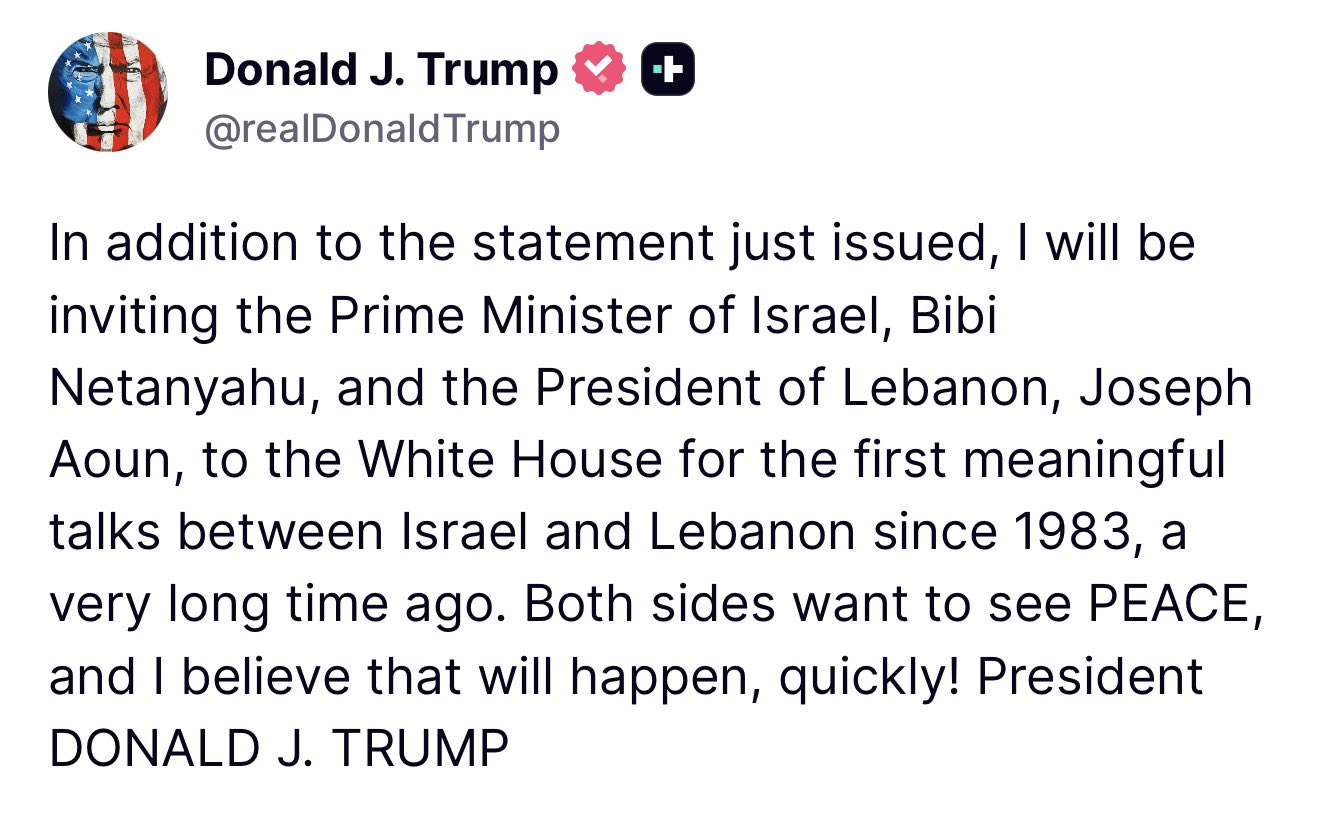
In another post, Trump later added that he would invite “the Prime Minister of Israel, Bibi Netanyahu, and the President of Lebanon, Joseph Aoun, to the White House for the first meaningful talks between Israel and Lebanon since 1983, a very long time ago. Both sides want to see PEACE, and I believe that will happen, quickly!”
Trump also insisted this time would be different from earlier failed efforts to reach calm between Israel and Lebanon. Asked outside the White House what would make the difference this time, he answered confidently, “Me. I’m the difference.”
The U.S. State Department said Lebanon is to take “meaningful steps” to prevent Hezbollah and other armed groups from carrying out attacks against Israel, and that the only forces authorized to bear arms in Lebanon are to be the country’s official security bodies. The statement also stressed that “Israel shall preserve its right to take all necessary measures in self-defense, at any time, against planned, imminent, or ongoing attacks.”
In a lengthy statement Thursday evening, Prime Minister Bibi Netanyahu said Israel agreed only to a temporary pause, and only after fundamentally changing the situation in Lebanon through force.
“We have an opportunity to forge a historic peace agreement with Lebanon,” Netanyahu said. “President Trump intends to invite me and the President of Lebanon in order to try to advance this agreement.”
“This opportunity exists because, since the ‘War of Redemption,’ we have fundamentally changed the balance of power in Lebanon,” he said. “We activated the pagers; we eliminated the massive arsenal of 150,000 rockets and missiles that Nasrallah prepared to destroy Israel’s cities. We eliminated Nasrallah.”
Netanyahu added that “over the past month, we began receiving calls from Lebanon to hold direct peace talks between us,” something he said had not happened in more than 40 years. “I answered that call,” he said, “and I agreed to a timeout, or more accurately, a temporary ten-day ceasefire, to try and advance the agreement we began discussing during the meeting of ambassadors in Washington.”
He stressed that Israel did not accept Hezbollah’s terms. “First, that Israel must withdraw from all Lebanese territory, back to the international border. Second, a ceasefire based on the ‘quiet for quiet’ model. I agreed to neither of these, and indeed, those two conditions are not being met.”
Instead, Netanyahu said Israel is remaining in southern Lebanon in a “reinforced security buffer zone.” He described it as a strip stretching from the sea to Mount Dov and the foothills of Mt. Hermon, up to the Syrian border. “This is a security strip ten kilometers deep,” Netanyahu said. “That is where we are and we are not leaving.”
He added that the zone is meant to block “the danger of an invasion into our communities” and prevent “direct anti-tank fire into the communities.” At the same time, he acknowledged that Hezbollah still retains some rockets. “Of course, there are still problems,” he said. “They still have rockets left. We will have to deal with that as well.”
The ceasefire was met in Israel with deep skepticism. Recent surveys found overwhelming Jewish Israeli support for continuing the war against Hezbollah, not pausing it. For many, it sounded like the same old story: another ceasefire, another promise that Lebanon will somehow restrain Hezbollah, and another arrangement presented as a breakthrough even though Hezbollah remains entrenched and Lebanon has never truly shown that it can disarm it. An INSS and Tel Aviv University poll found that 69% support continuing the war against Hezbollah regardless of developments on the Iranian front, while only 23% wanted Lebanon included in any ceasefire. Maariv reported that 77% of Israelis reject a ceasefire with Lebanon and want the war to continue, while Channel 12 found 79% support continued attacks in Lebanon, including 92% of coalition voters and 83% of opposition voters.
Promises like these have been made before: Under Resolution 1701 in 2006, Hezbollah was supposed to be pushed north of the Litani and disarmed, yet instead it rebuilt into a far larger terror army, with its rocket and missile arsenal growing from roughly 15,000 after the war to more than 150,000 in the years that followed. And after the November 2024 ceasefire, Israeli figures said Hezbollah violated the arrangement more than 1,900 times by mid-December 2025, with over 1,200 violations reportedly flagged to the monitoring mechanism.
That skepticism only deepened because Hezbollah fired rockets just before the ceasefire took effect, and because many Israelis felt they were hearing about the deal from Trump before hearing it from their own government. Criticism also mounted over the handling of the move, with the ceasefire announced publicly before any cabinet vote, and Netanyahu only laying out the details after Trump had already spoken.
Senator Lindsey Graham voiced concern over the deal. “The Lebanese military has been woefully inadequate in credibly disarming Hezbollah,” he said. “Hezbollah’s goal is not peaceful existence with Israel. Hezbollah’s goal is the utter destruction of the one and only Jewish state.” He added, “I will not support any agreement regarding peace in Lebanon that fails to convince me that it will result in the disarmament and demise of Hezbollah as a terrorist organization.”
The IDF said it struck more than 380 Hezbollah targets in the final 24 hours before the ceasefire, including launchers, headquarters, and terrorists, and entered the pause on high alert. Chief of Staff Lt. Gen. Eyal Zamir said Israel is striking Hezbollah “in a multi-front manner” and directed that the area in southern Lebanon up to the Litani line become “a kill zone for Hezbollah terrorists.”
 COMMENTS


We appreciate your feedback. If you have any additional information to contribute to this article, it will be added below.