




כ״ג אב ה׳תשפ״ו | August 6, 2026
The Rebbe Banged on the Bimah with a Message From Above
As a talmid in 770, R’ Yisroel Gordon was sitting in the Zal when the Rebbe walked in and banged on the bimah. He had a message from the Frierdiker Rebbe who received a heavenly message from the Rebbe Rashab.
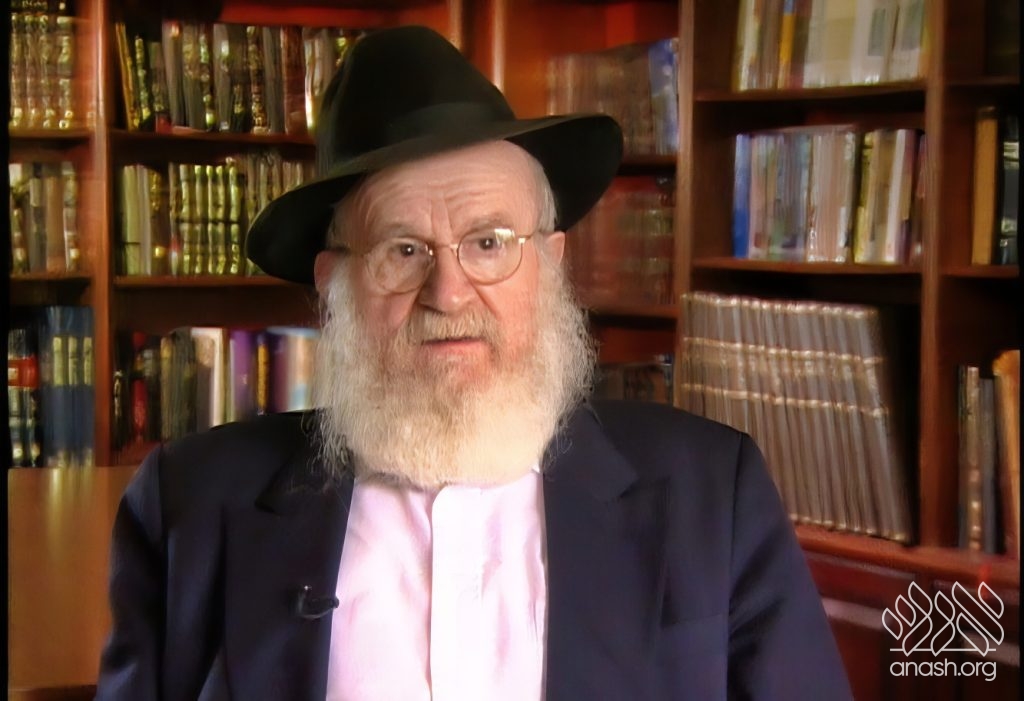
Rabbi Yisroel Gordon was a Chabad emissary and educator in Worcester, Massachusetts, and Morristown, New Jersey, for over sixty years. He was interviewed in May 2005. He passed away in 2023.
Let me tell you a short story that happened in a small Belarusian town called Dokshitz in 1930. Dokshitz was what you might call a chasidic fortress. It had five or six shuls for the two thousand Jewish people who lived there, and all but one of them were Chabad shuls. One of those Jewish people was a chasid who served as the town shochet, like his father had before him, and his father had before him.
At the time of this story, this chasid’s wife became pregnant. She was past forty — which is not very old, but neither is it very young for a woman to give birth. She had already lost one or two pregnancies, besides having a child pass away in infancy, so the couple was worried. The woman traveled to Vilna, which was the nearest big city with a hospital, to consult a doctor there.
“This time,” the doctor said after conducting his examination, “you should do something different — give birth in a hospital, not at home with a midwife as you usually do. Not only that, but you must spend the entire ninth month here in the hospital. Otherwise you and your baby will both be in jeopardy.”
Back then, this was considered radical advice. To go give birth in a hospital? So the husband asked the Previous Rebbe what they should do.
“Let her give birth at home the way she always does,” said the Previous Rebbe, “and she’ll have a healthy child.”
The couple was concerned no longer. The doctor had given his opinion, but if the Rebbe said differently, they were going to listen to the Rebbe. The woman stayed home and had a healthy child — me.
I consider myself fortunate to have been born with the blessing of the Previous Rebbe. Not only that, but the blessing was for a child who will live and be well, which has also held true: Thank G-d, I’ve been around for quite a number of years now.
Around the time that I was born, the Previous Rebbe instructed my family to move to America.
“I’m afraid to go to America,” my father, Reb Yochanan Gordon, had told the Previous Rebbe. He had heard that America was no place to raise a Torah-observant family. In those days, people who came here would cool off in terms of their Jewishness, their study of Torah, and observance of the mitzvos. Why would he want his children to be exposed to such a land?
“I promise that your children will remain faithful Jews,” the Previous Rebbe told him.
But my father wasn’t satisfied. He wanted his children to study in Tomchei Temimim, the yeshivah network headed by the Previous Rebbe, and in the 1930s, it had no presence in America.
“Your children will learn in my yeshivos,” the Rebbe reassured him.
My father assumed this meant that when my brothers and I grew up, we would go back to Europe — maybe to Warsaw, or to Vilna — to study in a Tomchei Temimim yeshivah there. He couldn’t imagine that the yeshivos would come to America. But in the end, our whole family arrived in New York in 1934, and in 1940, my older brother Sholom was one of the first ten students of the new Tomchei Temimim yeshivah that was founded there. After the yeshivah had moved to 770 Eastern Parkway, they opened a class for younger boys in 1941, which I joined as a ten-and-a-half-year-old.
By then, World War Two had broken out, and the Previous Rebbe had come to America with some of his immediate family. His daughter, Rebbetzin Chaya Mushka, and her husband Rabbi Menachem Mendel Schneerson, our Rebbe, were still stuck in Europe.
To make a long story short, they managed to get out, and when they arrived in America in the summer of 1941, we were all elated.
The future Rebbe, who was then known as the Ramash, began to join us yeshivah students for the 9:00 AM prayers in 770, and a couple of days after arriving, he was with us for the morning prayers on Rosh Chodesh, the first of the month of Tammuz. In the middle of the Rosh Chodesh service, before the Musaf prayer, men remove their tefillin. Now, most Jewish men wear one pair of tefillin, following the accepted opinion of the sage Rashi. Some put on a second pair, as well, in accordance with the opinion of Rabbeinu Tam — which meant putting them on and removing them before Musaf as well. However, there are actually two more versions of the head tefillin, following the views of the Raavad and the Shimusha Rabbah, although they are only worn by such a select few that most people haven’t even heard of them.
As we were about to learn, the Previous Rebbe’s newly arrived son-in-law donned all four every morning, having been instructed to do so by the Previous Rebbe himself.
Not wanting to stand out, however, the Ramash practically hid in a corner of the room and, with his body covered by his tallit, started the whole procedure of putting on these three other sets of tefillin. Of course, we yeshivah students noticed, and we couldn’t understand why he was taking his tefillin on and off; we didn’t even know that there was such a thing as four sets of tefillin. We were just flabbergasted.
There was also an elder chasid by the name of Dovid Shiffrin who was present. He had been a chasid of the Rebbe Maharash, and had known the Previous Rebbe as a child. He watched how the Ramash conducted himself, as he was doing things quietly, trying not to be noticed or observed, and he recognized that this was someone very special.
“Children,” he said to us about the future Rebbe, “this is the real merchandise — the real thing.”
A few years later, there was another interesting thing that happened in 770 with the future Rebbe. One day, he suddenly came into the study hall from upstairs, where the Previous Rebbe’s quarters were, walked over to the large Torah-reading table in the center of the room, and gave a little bang on it with his hand to get our attention.
“I have an announcement to make,” he began. “I am coming from my father-in-law, who told me that his father just visited him, and that I should tell you what he said.” The Previous Rebbe’s father, the Rebbe Rashab, had passed away twenty-five years earlier, in 1920. And yet, somehow he had come to his son and asked him a question: “Why is it that in your synagogue, people are talking during the Torah reading?”
Having made this announcement, the Ramash left the room.
For a long time after that, maybe ten or fifteen years, you could hear a pin drop in 770 during the services, although once our family of chasidim grew a little bigger and there were more little children around 770, things began to change.
I still remember the way the Rebbe gave us that message. We realized then that 770 was truly a holy place. G-d is there, as He is in every synagogue, and along with Him were the saintly founders of our yeshivah. We had to behave differently there.
 COMMENTS


We appreciate your feedback. If you have any additional information to contribute to this article, it will be added below.