



כ״ו אלול ה׳תשפ״ו | September 8, 2026
The Longest Possible Year: The Unique Kvius of 5787
Once every few decades, the Jewish calendar produces a year with an unusual combination of shleimus. The year 5787 is one of them. It is a leap year with both Cheshvan and Kislev being full, giving it the maximum possible length of a Jewish year, 385 days. In addition, it begins on Shabbos. The next time won’t be until 5814.
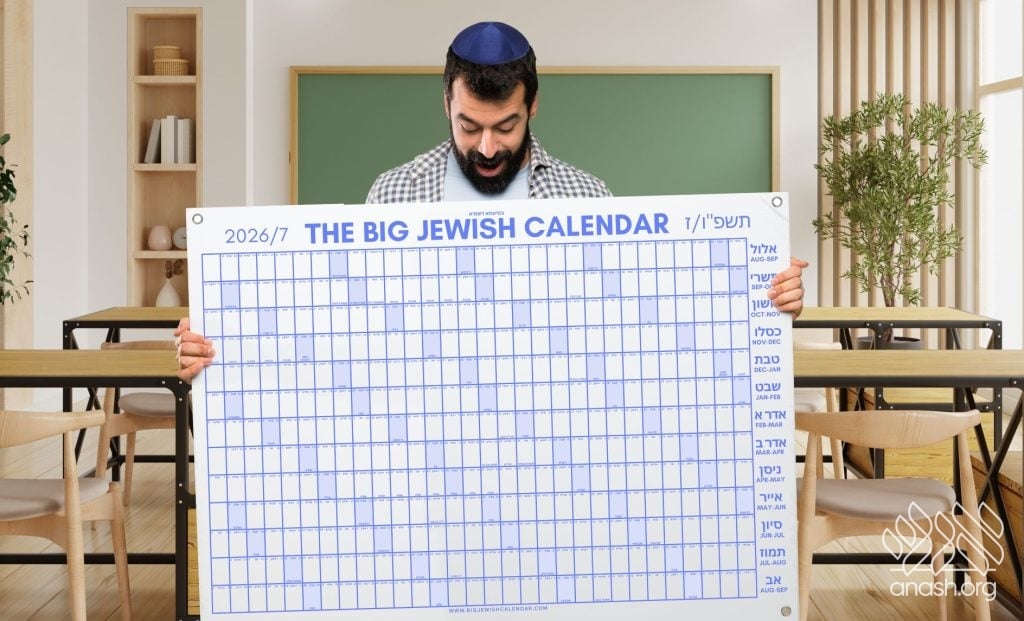
Once every few decades, the Jewish calendar produces a year with an unusual combination of shleimus. The year 5787 is one of them.
It is a leap year with both Cheshvan and Kislev being full, giving it the maximum possible length of a Jewish year, 385 days.
It also begins on Shabbos, and many Yomim Tovim throughout the year likewise fall on Shabbos. The last time a 385-day year began on Shabbos was 5763, and the next time will not be until 5814.
In general, the Rebbeim, and the Rebbe in particular, placed strong emphasis on the significance of a year that begins on Shabbos.
When Rosh Hashanah falls on Shabbos, we don’t blow shofar. The Rebbe explains that Shabbos itself accomplishes what the shofar normally accomplishes, drawing down the same, and in a deeper revelation of Hashem’s kingship, because it comes automatically through the kedushah of the day itself rather than through a person’s individual avodah. The year therefore begins with a much higher level from the very first moment.
In addition to the year beginning on Shabbos, this year also concludes in connection with Shabbos.
Although 5787 technically concludes on a Friday, in a sicha of Erev Rosh Hashanah 5737, the Rebbe notes that halacha requires tosefes Shabbos, adding a bit of weekday time onto Shabbos before and after. Therefore, the year’s final moments are absorbed into Shabbos as well, with the year opening with Shabbos and closing with Shabbos.
In addition to the beginning and end being connected with Shabbos, Chanukah begins on Shabbos, and Chamishah Asar B’Shevat falls on Shabbos.
At the Shabbos farbrengen of Zos Chanukah 5747, the Rebbe speaks about the importance of Chanukah coinciding with Shabbos:
“In Chanukah of this year, this is something which extends out extremely, that there are two Shabbosim on Chanukah, and this expresses itself in the fact that we therefore have two separate haftaros of Chanukah as well, a chidush we don’t find by the other Yomim Tovim.”
The Rebbe notes that this draws a person’s attention and feelings. The lesson the Rebbe derives is that we have added koach to transform the darkness on Chanukah.
Regarding Chamishah Asar B’Shevat falling on Shabbos, on 15 Shevat 5746, the Rebbe explains that this represents both the shleimus of the moon, through the 15th day of the month, and the shleimus of the sun, through falling on Shabbos, the seventh day of the week.
The fusion of both sun and moon carries a lesson for our avodah: We must include both aspects in our avodah, both the regular daily avodah of “temidim k’sidram,” represented by the sun, and the chidushim and added dimensions of avodah, represented by the moon.
In addition, Chof Ches Sivan, the day of the Rebbe’s arrival in America, falls on Shabbos this year, as does Chof Cheshvan, the birthday of the Rebbe Rashab.
Beyond the shleimus of the year beginning on Shabbos and having many Shabbosim throughout the year, there is the added shleimus of the number of days, making it the longest possible year.
A Jewish year can have between 353 and 385 days. The maximum is reached when the year is a leap year, with an extra month, and both Cheshvan and Kislev contain 30 days. This creates the longest possible year, with the largest number of months, 13, and the largest number of days, 385.
“This year is a shana shleima,” the Rebbe said at the Yechidus Klolis of Motzaei Yud Tes Kislev 5752, “as Cheshvan and Kislev are both complete, and it is also a shana temima because it has an additional leap year month. With the two of them together, it has 385 days, the longest and most complete amount of days.”
In the maamar Kloli of 6 Tishrei 5736, the Rebbe notes that a 385-day Jewish year that starts on Shabbos also contains an exact number of weeks: 55 weeks with zero remainder. A year that starts on Shabbos will always end on Friday, causing the following Rosh Hashanah to land on Shabbos as well.
The fact that this year has this exceptional combination of shleimus, together with the longest possible number of days, is not merely a coincidence. The Rebbe spoke about the tremendous opportunity and koach that this gives us.
“It is not only an abundance and shleimus in quantity, but also an abundance and shleimus in quality,” the Rebbe said at the above-mentioned Yechidus Klolis. “From this it is understood that all the inyanim of this year are in a way of shleimus and temimus.”
Because of the large number of days, the Rebbe explained that this gives us the opportunity to carry out our avodah in the most complete manner, using every day of this special year to its fullest.
In a letter to the administration of the Chevra Gemilas Chassadim Shomrei Shabbos (Likkutei Sichos, Vol. 16, p. 590), the Rebbe writes that the lesson in avodas Hashem from the fact that this is the longest possible year of 385 days is that one needs to perform gemilas chassadim in a way of shleimus.
Similarly, in the farbrengen of Shabbos Bereishis 5727 (1967), the Rebbe said that because this year has a larger number of days, it is therefore necessary to increase the amount of tzedakah in the daily giving to Keren Hashanah.
In another letter to the Gemach, the Rebbe points out that 385 is the gematria of Shechina.
On Erev Rosh Hashanah 5752, after Hataras Nedarim, the Rebbe said a short sicha. After the Rebbe went off the bimah, the Rebbe then abruptly stopped and began another sicha. The Rebbe pointed out the incredible shleimus in that year: that it has the largest number of possible months and days (as well as the fact that Pesach that year began on Shabbos).
“This triple shleimus of the new year gives additional koach that teikef u’miyad mamash; already in the beginning of the year, we should merit to all the inyonim of shleimus, including the shleimus of Torah, chadasha me’iti teitzei, as teikef u’miyad mamash the complete Geulah is coming,” the Rebbe said.
“And teikef u’miyad mamash we will merit a kesivah vachasimah tovah for each Jew – l’shana tovah u’mesukah.”
 COMMENTS


Thank you for this beautiful and thorough piece. I had no idea 5787 was so extraordinary — a 385-day leap year beginning on Shabbos, with Chanukah and Tu B’Shevat both falling on Shabbos, and 385 being the gematria of Shechina. The Rebbe’s sichos you quoted gave me so much to think about heading into the new year. Yasher koach for putting this together so clearly.
The next leap year with a full Cheshvan and Kislev is 5795, not 5814 as stated in this article. Although 5795 starts on Thursday, the amount of days is the same as 5787.
Not the next full leap year, but the next full one that begins on Shabbos (i.e., kevius זשה). The next one is indeed scheduled for 5814.
“The last time a 385-day year *began on Shabbos* was 5763, and the next time will not be until 5814.”
He did say that that’s not what he meant
Also the last ones we had were not the year 5737 but rather 5762 and 5763 of which like this year Rosh Hashanah was back to back on Shabbos and the 1st being a full leap year too with cheshvsn and kislev both having 30 days.