Living With the Chasidim in Samarkand and Tashkent
During World War II, around 1500 Lubavitcher chasidim from across the Soviet Union found refuge in Samarkand and Tashkent. From the Margins of Chabad History presents accounts by fellow refugees who were deeply impressed with the chasidim’s devotion and vibrant chasidishe life.
In recent weeks, From the Margins of Chabad History has told the story of the Great Escape of a thousand chasidim from the Soviet Union after the Holocaust. A third installment of this series is still forthcoming.
In the introduction to the Great Escape series, we described how Germany’s invasion of the Soviet Union in 1941 drove more than 1.5 million Jews, along with many millions of non-Jews, eastward to Siberia, Kazakhstan, Uzbekistan, and other parts of the Soviet interior.
Many of the refugees were Polish Jews who had fled into Russian territory when the Nazis invaded Poland. Others were Russian Jews, including around 1500 Lubavitcher chasidim. Both groups included a broad range of Jews, from very frum to completely secular.
The Lubavitcher chasidim, along with many other Jewish refugees, concentrated in the Bucharian cities of Samarkand and Tashkent. These cities had well-established Bucharian Jewish communities, and Lubavitch had strong ties with them, as the Rebbe Rashab and Frierdiker Rebbe had already sent shluchim to strengthen these communities decades earlier (see Admurei Chabad VeYahadus Buchara).
A train of Polish refugees departs from Buchara to Poland, 2 Sivan 5706. United States Holocaust Memorial Museum, courtesy of Shlomo Liwer.
With the Russian authorities’ attention turned to the war, the chasidim enjoyed a period of relative relief from persecution and were able to live with some measure of freedom. The chasidim established chadarim and yeshivos, and their vibrant chasidishe life drew the attention and respect of the refugees and locals. Many of the refugees joined the Lubavitch community, and their descendants feature prominently in contemporary Chabad communities around the world.
After the war, in 5706, the Russians allowed the Polish refugees the opportunity to return home. Many Lubavitchers took advantage of this, orchestrating the Great Escape discussed in the aforementioned series.
The present article serves as a prequel to the Great Escape series, telling the story of chasidishe life in Samarkand and Tashkent, as related by outside observers from varying backgrounds and lifestyles.
The article is published in honor of the upcoming yartzeit on 19 Av of Harav Nochum Shmaryahu Sassonkin, a protagonist of the article.
Yom Kippur with R. Shmerel Batumer
Harav Nochum Shmaryahu (Shemerel) Sassonkin was born in Propoysk (now Slawharad), Belarus, in 5650 to a Chabad family. In 5666, he arrived at Yeshivas Tomchei Temimim in Lubavitch, where he learned for almost four years.
In 5681, the Frierdiker Rebbe sent R. Shmerel to the Soviet east, to strengthen Yiddishkeit among the local Jews. He first lived in Derbent, where he established a Talmud Torah for the local Caucasian (Kavkazi) Jewish community, also known as the “Mountain Jews.”
A year later, R. Shmerel was sent to serve as the rov of Batum, Georgia, where there were kehilos of Ashkenazi and Gruzini Jews. He was forced to leave Batum in 5688, but the five years he spent there gave him the lifelong nickname of R. Shmerel Batumer, or the Batumer Rov. He spent the next few years in Charkov, Leningrad, and Moscow, before fleeing to Samarkand as the Germans advanced on Moscow. R. Shmerel relates the fascinating story of his life in his excellent autobiography, Zichronosai.
A farbrengen in Kfar Chabad. L-R: Israeli President Zalman Shazar; the rov of Kfar Chabad, Harav Shneur Zalman Garelik, and Harav Sassonkin. Library of Agudas Chassidei Chabad.
It was in Samarkand that Moshe Grosman met R. Shmerel. Raised in Warsaw in a traditional Jewish family, Moshe Grosman became a member of the Labor Zionist movement and worked as a journalist for the Warsaw-based Haynt newspaper.
With the outbreak of World War II, Grosman fled into Soviet Russia, where he was arrested and deported to labor camps. After the war, he lived in Poland, Paris, and eventually in Eretz Yisrael, and continued to write books and newspaper articles.
On Erev Yom Kippur 5709 (October 12, 1948), Grosman published an article in the Forverts newspaper titled “Four Yom Kippurs in Soviet Russia,” under the pseudonym P. Grim. In this article, he tells the moving stories of how he observed Yom Kippur during his years in Soviet exile. The fourth and final Yom Kippur he describes is that of 5706, in Samarkand with R. Shmerel Batumer.
We present here the beautiful and moving account:
In the Bucharian Jewish quarter, on Sharubadzka Street, near their little market, the “Machalia,” which today stands empty, there is a small shul for the Polish and Russian Jews in the corner of a little lane. On a regular day, the Batumer Rav gives a shiur there in the evenings.
Moshe Grosman (5664-5722)
Young intellectuals come to this little shul. In their youth, they once studied in yeshivos. Later they went off to the universities, thirsty to drink from the wellspring of knowledge and to be illumined by its light. Now they seek a tikun in the yellowed pages of the Gemara.
Young men from Poland, Ukraine, White Russia, Lithuania, and Bessarabia come. The Batumer Rov learns a shiur with them. They don’t learn about timely matters at all—they are learning Gemara Pesachim. Yet the students listen attentively with great thirst.
The Batumer Rov receives no salary from anyone. His two sons work as bookbinders. They take the files of the cooperatives home to bind, and as a result they are exempt from working on Shabbos and Yom Tov. After their work, they write calendars on boards and sell them. There is no set price. Each person gives as much as he can and wishes.
There are actually a few modestly well-to-do people, even among the Lubavitcher chasidim. Last year they managed to buy an esrog for Sukkos, smuggled out by the gardener of the experimental botanical department at the university in Tashkent. They paid thirty thousand rubles for it! That was an enormous sum, as an average worker earned three hundred rubles a month. So yes, there were also men of means. For such a calendar, someone might sometimes pay a nice sum.
But from all of this, the Rov and his family can barely make ends meet. The Rov looks as though he fasts at least two days a week.
The Kanesoi Gumbaz Synagogue in the historic Jewish quarter of Samarkand.
The Batumer Rov is also the baal tefilah. It has already been three weeks since I was freed from prison and camp. Tonight, we will be able to hear the Batumer Rov say Kol Nidrei.
The shul is packed, and hundreds of Jews stand in the courtyard, their bodies leaning toward the shul. The women in the courtyard are separated by a mechitzah made of reed mats.
At the first note of Kol Nidrei, the women immediately broke down crying. Each one was counting her dead: sons and husbands who had fallen at the front. The weeping tore their wounds further open, until they began shaking and convulsing. By now all the women were crying. Every one of them had close relatives who had perished: fallen at the front, dead of hunger or typhus, or murdered by the Germans.
The baal tefilah collects the tears, gathers them at the amud, and sends them on to G-d. If you want to know what the essence of a Jew is, you must look now at the Batumer Rov.
His white beard trembles and glistens with tears. His face is refined and pale, even as the glow of the candles rests upon it. His kind, childlike eyes, soft and deep, are filled with pleading, compassion, pain, and holiness.
He appeared even more striking when I saw him the next morning, as he davened Musaf at the amud. The old talis now cast a yellow, parchment-like glow over his face. He does not look into the siddur. He looks upward toward the amud. He says the tefilos slowly; he speaks the tefilos, blending them with simple Yiddish words.
Harav Sassonkin at the American embassy in Tel Aviv, receiving his visa to travel to the Rebbe for the first time ahead of Tishrei 5621.
Everyone who is able to see can see it clearly now: the Batumer Rov sees G-d before his eyes. He speaks to Him like a child to a father, pleading with Him, weeping before Him:
“Ribono shel olam, how much longer? How much longer will You punish us? The cup of sorrow is full, full! We carry Your yoke, and we do not cast it off, even in the hardest moments of life, through the hardest nisyonos. Keil rachum vechanun! We are waiting for geulah, for the complete geulah! We have been waiting like this for thousands of years, and we do not grow weary. We wait, and wait, and wait!
“Have rachmonus already on Your tormented people, Yisrael!”
His blue eyes fill with tears. The tears slip down his cheeks and glisten again in his beard.
Before ne’ilah, the same Batumer Rov gives a speech about the matters of the day. He speaks about keeping kashrus, about the Jews who had fallen al kidush Hashem, and about those who had fallen for the Soviet land in the struggle against the German murderers.
Finally he blesses Stalin and the entire “Soviet authority,” sending them his blessings that they should be successful in working for the welfare of the fatherland. . . .
Such a Yom Kippur gives Jews strength, emunah, bitachon, and endurance for an entire year, until the next Yom Kippur.
May we live to see it.
Harav Sassonkin in his later years.
Grosman mentions two sons of R. Shmerel Batumer living in Samarkand, but in fact only one of his sons, R. Asher, was living in Samarkand at the time. His other two sons, R. Moshe and R. Chaim, had been sent to Siberia before the war and died there.
R. Shmerel and his wife Malka raised a houseful of young orphans. R. Asher’s daughter Rachel lived with them after her mother died, and Moshe’s widow Itta joined them with her two children, Avraham Yitzchak and Chanah Feiga. After Itta’s brother Yaakov Kleiman and his wife died of hunger during the war, their three yesomim, Feiga, Rachel, and Zalman joined the family. Itta was killed in a tragic incident after the family escaped from Russia in 5706, and R. Nochum and his wife raised all of the young orphans themselves.
After the war, Harav Sassonkin settled in Yerushalayim, where he served as a rov and mashpia for Anash, attracting many to Chabad with his Torah and avodas Hashem. He passed away on 19 Menachem Av, 5735.
The Sassonkin family after leaving Russia. Standing (L–R): Feiga Sassonkin (Friedman), Rachel Kleiman (Zamir), Avraham Yitzchak Sassonkin, Zalman Kleiman. Seated (L–R): Feiga Bart (née Kleiman), Rebbetzin Malka Sassonkin, Harav Nochum Shmaryahu Sassonkin, Mordechai Bart. Seated on the floor: Rochel Sassonkin (Dunin). Library of Agudas Chassidei Chabad.
*
R. Yechezkel Pinson
Moshe Grosman also wrote a book about his wartime experiences, sarcastically titled In Farkisheftn Land fun Legendarn Dzhugashvili [In the Enchanted Land of the Legendary Dzhugashvili (Stalin)].
In this highly acclaimed book, Grosman mentions additional encounters with Lubavitcher chasidim. The most interesting one is his description of R. Yechezkel (Chatche) Pinson (c. 5674-5762), with whom he worked for a period of time in a shoemaker’s cooperative in Samarkand (p. 105).
The management of the cooperative workshop consists of eight men, only three of whom are Party members. One of the eight is Chatche Pinson. Like the others, he wears an official’s uniform, with a broad belt and leather boots, and his hair is closely cropped. He does not come to work on Shabbos.
As the warehouseman, he is responsible for providing leather from the storeroom to the workers. When he didn’t leave enough material in the workshop before Shabbos, they sent for him. He came, but a small boy walked behind him carrying the storeroom keys. On Shabbos, he does not carry. He is a Lubavitcher chasid.
Every day after work, he goes to learn a perek Mishnayos. The anniversary of the day on which the Alter Lubavitcher Rebbe was set free, in the time of Tsar Nicholas I, is a great Yom Tov for the Lubavitcher chasidim. They spend the entire night discussing Torah, drinking lechaim, and dancing a chasidishe dance.
The present Lubavitcher Rebbe also spent time in a Russian prison, in the “Cheka,” though little is said about it. The warehouseman has already told me all the details of his Rebbe’s arrest: how he conducted himself in the Cheka and how he answered his interrogators.
He also tells me about his own father, who was arrested in 1937. To this day, no one knows what became of him. At any rate, he has already recited Kaddish for him.
The Pinson family. Standing (L-R): Yechezkel, Nissan, Sonia (Kaplan), Tanchum. Seated (L-R): Yehoshua, R. Nochum Yitzchak, Chera.
Later one of the founding settlers of Kfar Chabad, R. Chatche was a young man at the time, without any children of his own. The young boy who carried his keys was presumably a non-Jewish child. His father, R. Nochum Yitzchak, was sent to Siberia in 5699, where he passed away three years later.
Rosh Hashanah in Tashkent
From Samarkand, we move to Tashkent. Yisrael Vitzentovski was born in Lodz to a chasidishe family. He learned at local yeshivos and then became a member of the socialist Yiddishist Bund movement, although he maintained a lifelong love for the Chasidus of his youth. After spending the war years as a refugee in Russia, he emigrated to Australia. He was a contributor to various Yiddish newspapers, often under the pen name Yisrael Gitelson, and many of his articles are imbued with deep Yiddish and Chasidic feeling.
In an article published in Melbourne’s Di Yiddishe Post, Vitzentovsky describes his Rosh Hashanah experiences in Tashkent in 5702. He davened in a Buchari shul, but later he met a group of Lubavitcher chasidim. Here is the relevant section of the article (September 28, 1951):
As I continued walking, simply wandering down the street, a Russian Jew approached me and asked, “Where are you from?”
“From Poland, Warsaw,” I answered.
“Is that so? From Warsaw?! Did you know, did you see our Rebbe, may he live? The Lubavitcher tzaddik, Reb Yosef Yitzchak Schneersohn?”
I told him that, as it happened, I had known him. I had been to see him in Warsaw several times.
The Jew was overcome, stunned and bewildered. He was almost blinded with joy that now, after years of being cut off, he could receive live regards from his holy Rebbe.
He led me into a nearby kibitka (clay hut), where several Lubavitcher chasidim had gathered. Within a few short minutes, the little room was overflowing with chasidim who wanted to see the man who had recently seen their Rebbe.
Rarely in my life have I encountered such exalted, fiery, and joyful enthusiasm as I did at that chasidishe gathering. They simply did not know what to do with me, where to seat me, how to honor me, and how to please me. It is no small matter at all: regards from the Rebbe!
Polish Jewish refugees at a shoemaker’s cooperative in Buchara during the war years. United States Holocaust Memorial Museum, courtesy of Pessia Polak.
I answered their questions about the Rebbe’s life in Warsaw, at 7 Muranowska Street, with whatever I knew. I could feel in the plainest, most tangible way how every episode I related about the Rebbe’s life gave these people a measure of health, fresh blood pulsing with longing.
A longing began to burn and flicker in their hearts. In a spontaneous, exalted burst, they linked hands and formed a karahod dance, singing a song that had been composed when the Lubavitcher Rebbe was already living in Warsaw.
Something of the song remains in my memory, more or less. If it has not been transmitted exactly, the Lubavitcher chasidim who are here in Australia, in the kehilah kedoshah of Shepparton, can correct it. I very much ask them to.
I saw their thirsting desire, their dream of freeing themselves from such a life, a life that threatened them at every turn. True, they had somehow managed to make a parnasah, but their life brought them no peace.
One of them said to me:
“We bear no ill will toward the government, toward the Soviet regime. But we would rather be far away and hear good news from a distance…”
In time, many of them managed to escape, by various routes and means. Today they are scattered across France, America, Israel, Australia, and elsewhere.
One chasid, a man of considerable influence at a textile factory in Tashkent, went to great lengths to secure me a “job” there, a dependable source of parnasah.
Sukkos in Tashkent
Another Jewish refugee from Poland who encountered Lubavitcher chasidim in Central Asia during the war years was R. Avraham Yisrael Arenberg.
R. Avraham Yisrael (5669-5747) was born in Gorlitz, Galicia, to a family descended from Harav Menachem Mendel of Rimanov, and devoted chasidim of the Tzanz dynasty. During the war, R. Avraham Yisrael fled into Russia, spending time in Siberia and Tashkent. He settled in Bnei Brak after the war, where he wrote his memoir Karasi Shimcha Hashem Mibor Tachtiyos, a beautiful account of unwavering bitachon in the most difficult of circumstances.
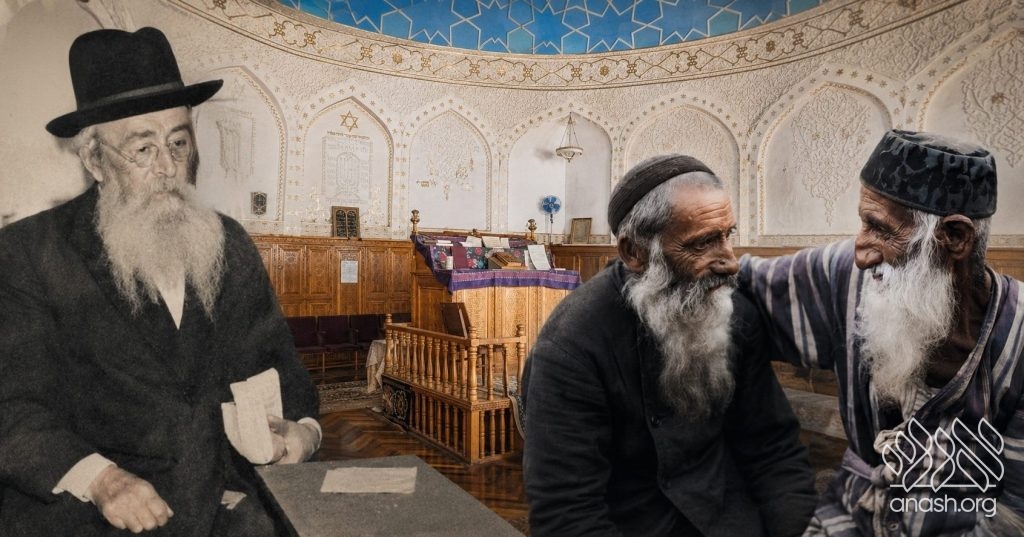
Two elderly Jewish Buchari men. Photo by Max Penson.
R. Avraham Yisrael relates many stories about the Chabad chasidim he encountered in Russia, and was deeply impressed by them. A chapter of his book titled “A Journey to a Chabad Tzadik” (pp. 112-124) movingly relates the story of the Yamim Noraim of 5705, which he spent in Chimkent (now Shymkent), Kazakhstan with R. Berel Yafeh, a tamim and chasid who made a very deep impression on him. This account has been republished in Beis Moshiach, issue 572, pp. 59-63, and as an appendix to R. Berel Yafeh’s book of sipurei chasidim, Zichron Tzadikim Vechasidim.
We will cite here a brief section about Sukkos in Tashkent, 5702 (p. 72).
Several days after Sukkos, we set out together with the rest of our Jewish brethren, bound for Tashkent. After an arduous train journey lasting close to two weeks, we arrived there, with Hashem’s help, alive and well.
At that time, Tashkent was still a city with bread in abundance and bustling with Jewish life, infused by the Chabad chasidim who had arrived from every corner of Russia.
In this regard, it is worth recounting something I heard from people who had reached Tashkent before Sukkos. That year, they merited to fulfill the mitzvos of sukkah and the daled minim, mitzvos they had been unable to observe during the war years.
One day during Chol Hamoed, as they passed through an alleyway, they heard someone calling to them. The man approached and said, “Dear Jews! Surely you would like to fulfill the mitzvos of the Yom Tov, sukkah and lulav. I am ready to help you.”
They stood there in astonishment, unable to believe that such a possibility could exist in the place and circumstances in which they found themselves.
The man understood what they were thinking and said, “Dear Jews, please, come into the sukkah. You can see with your own eyes that I am not a robber chas veshalom. Hashem has helped us, and through various means we managed to obtain the daled minim. We want every Jew who cherishes Hashem’s commands to be able to fulfill His mitzvah.”
They continued their story:
The historic Jewish quarter in Samarkand.
“When we entered, we indeed saw all of the daled minim before us. We asked him, ‘How did you manage to obtain them in such a time of crisis?’
“He replied, ‘When there is a little will and a little mesirus nefesh, Heaven helps. Whatever we do, we do through the power of the inspiration and mesirus nefesh of the Alter Rebbe, the Baal HaTanya זצ”ל, and through the power of the inspiration and mesirus nefesh of our Rebbe, שליט”א. I bless you and all the members of your families that, in the merit of the mitzvah you have fulfilled, you should merit the complete Geulah, speedily in our days.’
“This remarkable man then brought out several slices of bread, enabling us to fulfill the mitzvah of sitting in the sukkah as well. We made the berachah and departed, accompanied by the berachos of a Chabad chasid whom we had never met before.
“When we left, we felt as though we were dreaming. We could scarcely believe that all of this had truly happened while we were awake. But that is exactly what happened.”
An additional story about Chabad Chasidim is related in Mibor Tachtiyos, pp. 127-130. Another book about this period that contains a great deal of Chabad-related material is Aryeh Avivi’s Ve’ani Begolat Sibir. This material is excerpted in Oholei Lubavitch, vol. 3, pp. 125-135. Thanks to Harav Nochem Grunwald for pointing us to the latter two sources.
To view all installments of From the Margins of Chabad History, click here.
For additional exclusive content, follow the column on X: x.com/ChabadMargins
COMMENTS
We appreciate your feedback. If you have any additional information to contribute to this article, it will be added below.







 COMMENTS


We appreciate your feedback. If you have any additional information to contribute to this article, it will be added below.