



ז׳ אב ה׳תשפ״ו | July 21, 2026
It’s Time for the Rebbe’s Solution to Christian Influence in Schools
As states move to bring Bible study into schools and Jewish children are being exposed to Christian ideas, the Rebbe’s unique approach provides the solution to restoring awareness of G-d without negative repercussions.
By R’ Hillel Hellinger – Heal The Nation
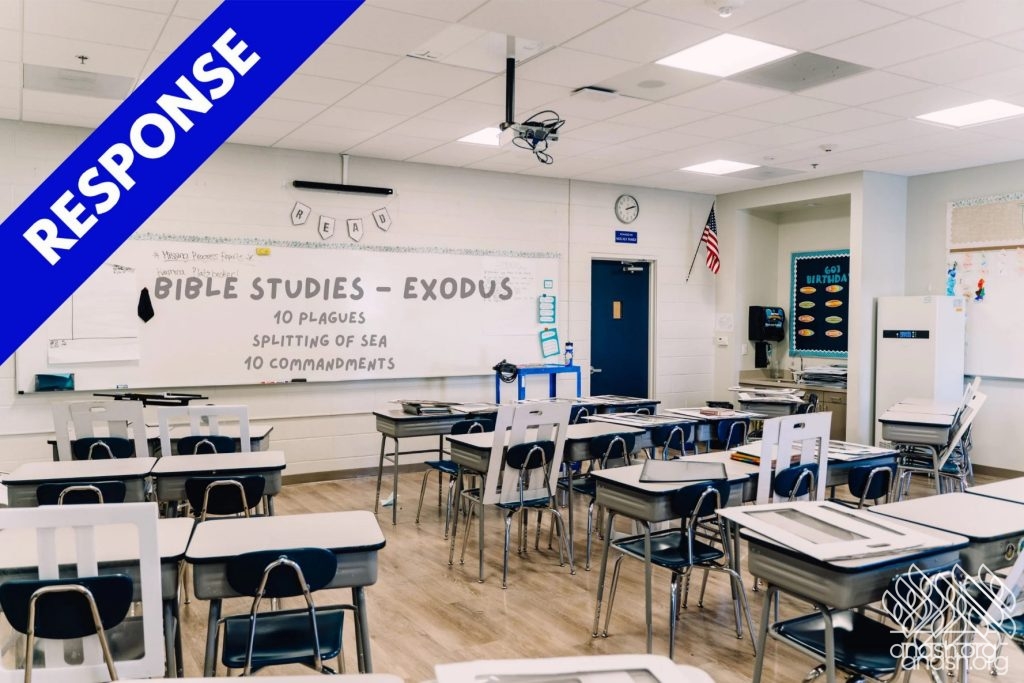
Recent developments in several states have once again brought the issue of religion in public schools to the forefront: Texas has moved to include Bible passages in required public-school reading material; Utah has passed legislation requiring the study of Bible passages connected to America’s founding documents and early political thought; and Florida law permits public schools to offer a study of the Bible and religion.
For Chassidim, the question isn’t whether religion in public schools sounds good to us. The real question is: What did the Rebbe say?
The Rebbe’s position was clear. The Rebbe opposed Bible study in public schools, even just the “Old Testament,” and he opposed prayer in public schools that was connected to a specific religion.
Yet, at the same time, the Rebbe strongly opposed the attempt to remove the mention of G-d from public education. Unlike others, the Rebbe didn’t see the removal of G-d’s name as a victory for religious liberty. On the contrary, the Rebbe warned that such an extreme position would create a strong counter-reaction by religious Americans.
In a 1964 letter, the Rebbe addressed this very point. The Rebbe wrote that the “vehement opposition to any kind of prayer and to mention of G-d’s name in the public schools” was, in his opinion, “unjustified and ill-conceived.” The Rebbe explained that this extreme opposition had led to a counter-effort to introduce a constitutional amendment that would permit sectarian prayer and Bible readings in public schools.
In other words, when all mention of G-d is pushed out of the classroom, the response can become an effort to bring in something far more dangerous: specific religious prayer and Bible study. That is exactly what the Rebbe sought to avoid.
The Rebbe then spelled out the proper solution: a “non-denominational prayer” – one that mentioned G-d, but nothing connected to any specific religion. The Rebbe writes that had a voluntary non-denominational prayer been promoted from the beginning, it could have resolved the controversy in a way that would be acceptable to everyone (aside from a few fanatical anti-religionists). Since such a prayer would be voluntary, any student with a conscientious objection could be excused from participating.
Some argue that by 1983, the Rebbe had changed his position and moved away from non-denominational prayer in favor of a moment of silence. But that is inaccurate.
The Rebbe’s push for a moment of silence came in a specific context. In 1982, President Ronald Reagan supported a constitutional amendment to restore organized prayer in public schools. The prayer would be chosen by teachers or students, which, in many parts of the country, would become tied to a specific religion. In plain English, Jewish children could find themselves sitting through Christian prayers in a public-school classroom.
The moment of silence was a way to defuse that danger. Instead of a teacher or student composing or leading a prayer, each child would have a silent moment to think about G-d in the way his or her parents would direct. That removed the danger of a Christian prayer being imposed on Jewish children.
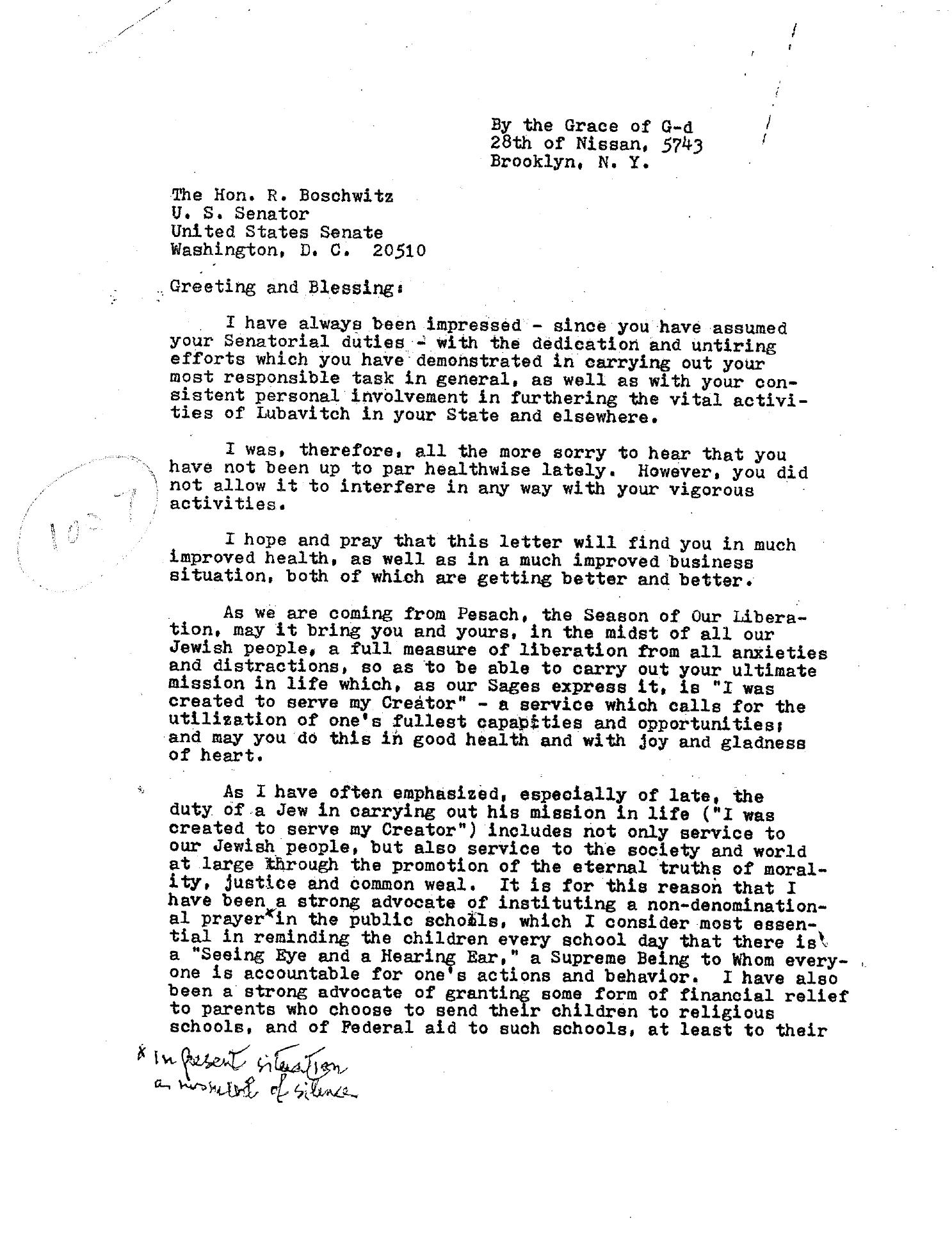
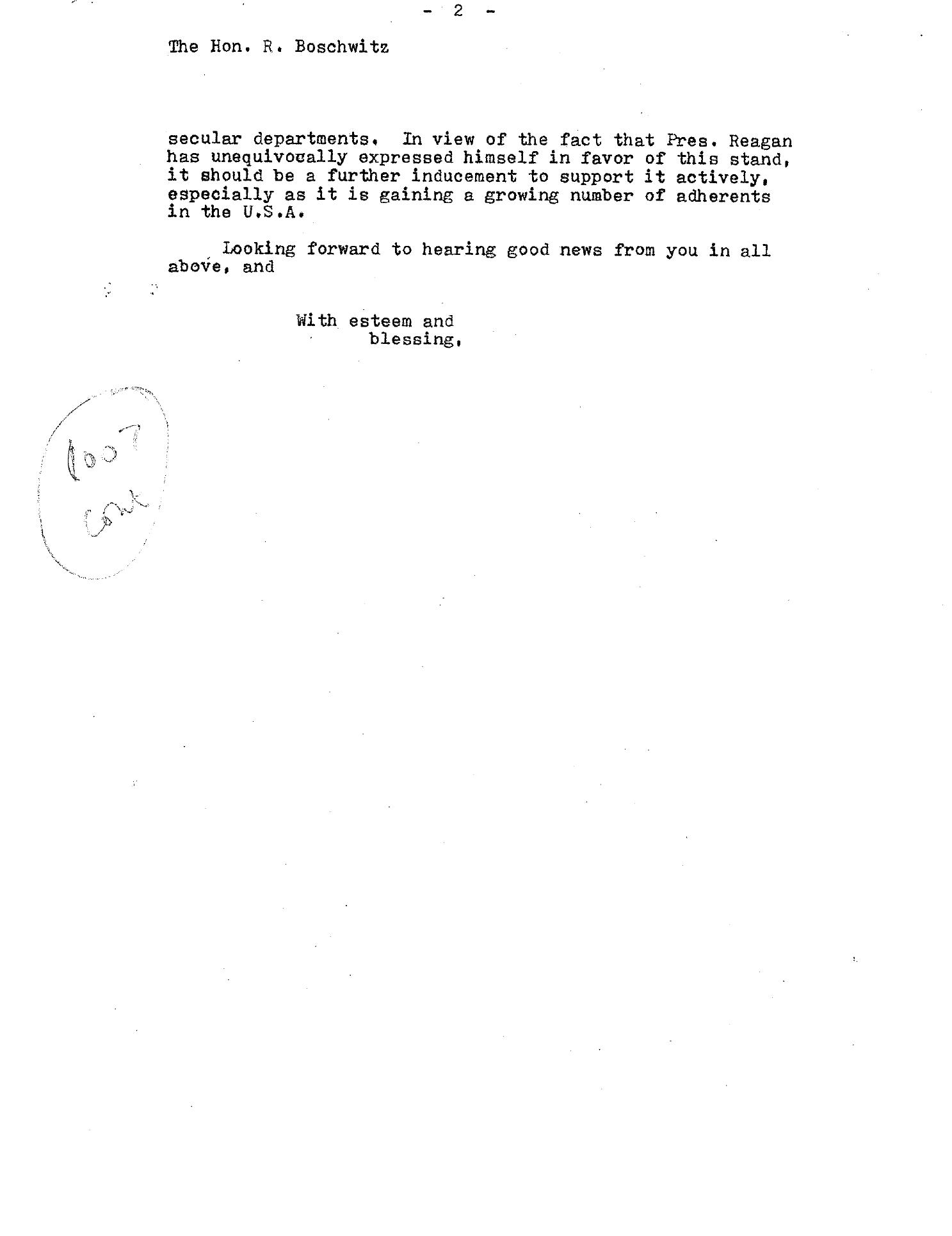
However, the Rebbe never abandoned the plan for a non-denominational prayer. In the 1964 letter, the Rebbe stated that his position on non-denominational prayer was based on Torah and would not change. And in a letter to Senator Rudy Boschwitz, from April 1983 (months after publicly promoting a Moment of Silence), the Rebbe wrote that he was an advocate of non-denominational prayer, adding in his own handwriting that he advocated a moment of silence “in present situation.”
The moment of silence was not a rejection of the Rebbe’s earlier position (which he said would not change). It was the response to the danger at the time that organized school prayer would become sectarian and expose Jewish children to Christian religious influence.
How is this all relevant today?
When states seek to introduce Bible study, Bible readings, or religiously flavored public-school curricula, our response should not be to erase G-d from the public square. That was not what the Rebbe said. It should also not be to support Bible instruction in public schools. That, too, was not the Rebbe’s approach.
The Rebbe’s approach was a third path: public recognition of G-d in a way that is non-denominational and voluntary.
This approach is also consistent with the founding spirit of the United States. The Declaration of Independence speaks clearly of the Creator, but it does not promote a specific denomination. Its language reflects belief in G-d without turning the state into an arm of any religion. That is precisely the kind of approach that can strengthen morality and faith (“an eye that sees and an ear that hears”) while protecting Jewish children from religious coercion.
This is where shluchim and askanim come in. In states where public officials are discussing Bible studies, school prayer, or religious instruction, they should be encouraged to adopt the Rebbe’s practical solution: a voluntary, non-denominational recognition of the Creator.
It is up to us to educate officials on the merits of the Rebbe’s approach. We must explain to them that pushing religious texts into public-school classrooms will only create conflict and put minority children at risk. For children to grow up with moral clarity and awareness of G-d, they should support a simple expression of faith in G-d that belongs to no denomination and imposes no religion on anyone.
That was the Rebbe’s position then, and it remains the needed answer now.
 COMMENTS


Just take note. In states that are pushing strongly against any mention of G-d, introduce the moment of silence for it’s other value— students benefit so much from silent time to relax/reboot and develop self regulation while they think freely, or “just” experience some peace and quiet. For individual educators who are open to it, one can add on that students may choose to use that minute to include nondenominational private prayer in sync with their individual backgrounds or feelings. See the “moment of silence, parkland” video within the momentofsilence.info website where a crown heights public school principal went to Florida after the school shooting to share the value and importance of the Rebbe’s initiative of a moment of silence as introduced to him by a chossid.
“At some point in this crusade there were well-meaning representatives in government who . tried to introduce a “Moment of Prayer” — this was doomed to fail, for “If you grab a lot you cannot hold it.” (Rosh Hashanah 4b) In fact, that bill has recently been rejected. Good that it was — for a “Moment of Prayer” might create a scenario where a teacher or supervisor could impose his particular form of prayer, or his religion’s version of prayer on the students — something which would be wholly unacceptable.
Now that the first bill has been defeated the time is propitious to work for a “Moment of Silence.””
– Society’s Great Hope: “A Moment of Silence” – Simchas Torah, 5746 (1986)
I think the Rebbe’s words are pretty clear. If the preferred approach had been a non-denominational prayer, the Rebbe could have advocated for that instead.
The Rebbe writes clearly “in present situation” – that this was something that was connected to that time.
There is nothing in what you quote that indicates that the Rebbe had given up on a non-denominational prayer.
(Also what you quote is an essay based on the sicha, not the Rebbe’s exact words.)
According to what I heard from people involved, the reason the Rebbe moved from non-denominational prayer to moment of silence was due to those arguing that any prayer in public schools was unconstitutional. The Rebbe clearly said that even if it is unconstitutional there should be an amendment because this counrty was founded on belief in G-D. It seems that the Rebbe realized that the legal issues were too much for prayer so he moved to moment of silence instead which is much harder to claim that it is unconstitutional. That is what I understand “the present situation” to be.
Not sure who those people are and what actual knowledge they had. Regardless, the political situation is subject to change, as the Rebbe writes.
Regardging Simchas Torah 5746:
1) The Movement of Prayer the Rebbe mentioned in the sicha was a prayer that would have been made by the students and teachers which would have been a definite threat to Jewish children. This threat would not occur in a truly formulated non denominational prayer that would be kosher for Jews.
2) In reaction to this threat the Rebbe pushed for a Moment of Silence.
3) The political reality at that time was if the Rebbe had pushed for a non-denominational prayer the Moment of Prayer would have become law and it would exposed Jewish children in public schools to Christian Prayer.
Regarding the comments of not exactly
I don’t know who these people you heard from.
The Rebbe wrote in a 1964 letter his desire for a non-denominational prayer will not change.
The Rebbe spoke about a non-denominational prayer as least as late as 1980.
It wasn’t until President Regan wanted to make a prayer in public schools in April 1982 did the Rebbe voice support for a moment of silence 9 months later. And that is clearly what the Rebbe meant in his 1983 letter in the present situation.
The Rebbe clearly outlined that Moment of Silence became the preferred option. Yud Beis Tammuz 5744, and other times.
Obviously the Rebbe gave preference to MOS at that time. But the Rebbe emphasized that it was temporarily.
I think the opinion hits the nail on the head.
If you think that the Rebbe really wanted the Moment of Silence for itself, you need to read this article: https://anash.org/heal-the-nation-actualizing-the-rebbes-vision-for-america/
The question is raised there that the Moment of Silence was made law by New York State in 1971 allowing teachers and school boards to have a moment of silence in public schools, but for 12 years (!) the Rebbe never encouraged it. It was until 9 months after Reagan announced his campaign for prayer in public schools did the Rebbe mention a moment of silence. This explains why the Rebbe wrote to Senator Boshwitz, “In present situation a moment of silence.”
Just like not all meats are the same – some are kosher and some are not – so too not all “prayers” are the same – some are kosher and some are not.
That which the Rebbe clearly outlined that Moment of Silence became the preferred option (on Yud Beis Tammuz 5744 and other times) was because the alternative that was being presented was Reagan’s moment of prayer which was a prayer formulated by the students and teacher: a prayer which could easily become non-kosher, presenting the danger of a spiritual train wreck for Jewish children in public schools.
If you carefully read why the Rebbe was against a verbal prayer in those sichos, it was due to wording of teacher or students, not a standardized non-denominational prayer. If there is a formal non-denominational prayer that is kosher for Jews, there would be no concern, as the Rebbe writes in a 1962 letter.
This essay was prompted by ” legislation requiring the study of Bible passages”, but you write very little about that.
Just – “The Rebbe’s position was clear. The Rebbe opposed Bible study in public schools, even just the “Old Testament,””
Who is it clear to? I’m not fluent in every igros, sicha, etc.
Also about “prayer in public schools that was connected to a specific religion” you write about a Jewish child in public school with a Christian prayer, but don’t indicate or demonstrate that this was a reason, at the time, that the Rebbe opposed it.
More sources and discussion about two central claims of the essay would be very helpful.
In the Rebbe’s 1964 English letter linked in the article, the Rebbe writes clearly:
“Likewise must Bible reading in the public schools be resolutely opposed for various reasons”
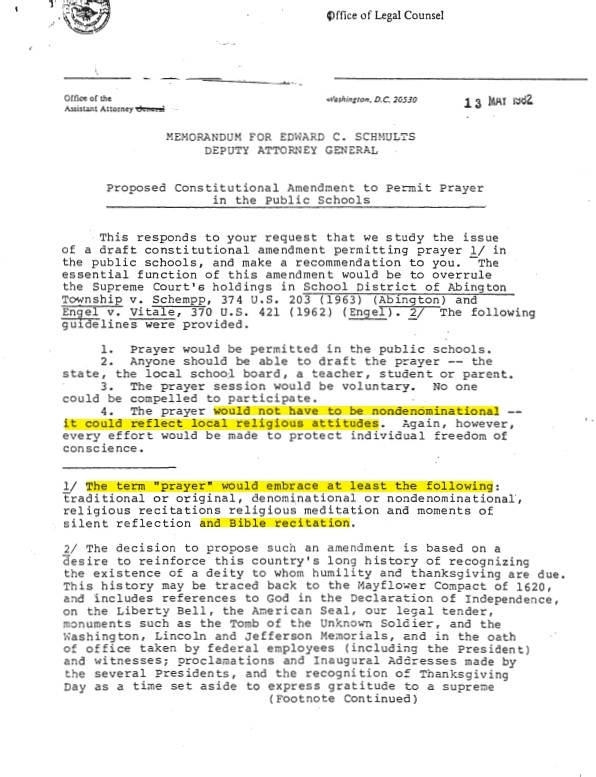
Regarding the threat of Jewish children in public schools being exposed to Christian prayer, here is an internal White House memo from the President Reagan’s closest aids about the President’s call for prayer in public school. It clearly notes that “The prayer would not have to be nondenominational it could reflect local religious attitudes” (which would of course be Christian in most of America) and they include “Bible recitation.”
https://drive.google.com/file/d/1vbQ2pWOBynuSZsq_7Kgotlli2-J4CzEm/view?usp=sharing
Thank you.
Here is the full paragraph from that letter (chabad.org/2051611)
“On the other hand, as I have emphasized on more than one occasion, only a strictly non-denominational prayer, and no other, should be introduced into the public schools. Any denominational prayer or religious exercise in the public schools must be resolutely opposed on various grounds, including also the fact that these would create divisiveness and ill-feeling. Likewise must Bible reading in the public schools be resolutely opposed for various reasons, including the obvious reason that the reading of the Koran and the New Testament will arouse dissension and strife. Moreover, the essential objective is a religious expression that would cultivate reverence and love for G‑d, and this can best be accomplished by prayer, while Bible reading is not so important in this instance.”
It is unfortunate that the “various reasons” aren’t spelled out, but the point of the letter that the goal is to “cultivate reverence and love for G‑d, and this can best be accomplished by prayer, while Bible reading is not so important in this instance” is fascinating. My understanding is that the Rebbe is saying that non denominational prayer is not a cop-out; denominational prayer / Bible study doesn’t have superior qualities that we have to forgo because of other risks. Rather, non denominational prayer fully realizes the purpose of religious instruction in public schools. I think that could be a subject of its own essay.
I saw after in the previous article https://anash.org/heal-the-nation-actualizing-the-rebbes-vision-for-america/ a link to https://files.anash.org/uploads/2024/04/Prayer.pdf which has a letter from a Jewish boy regarding Christian prayer.
“DEAR PRESIDENT REAGAN: I am Justin Ross.
I am 8 years old and I live in Pittsburgh. I
am Jewish. We lived in Canada because my
Dad had a job there but we are American. I
went to school in Canada. In my school we
had to say a prayer. Some of the Children
stood in the hall instead of saying the
prayer. Everybody thought they were bad.
One boy told me that I was going to Hell.
Please don’t make people hate me because I
am Jewish. I do not hate you because you
are not Jewish. It made me feel terrible to
say the prayer”