




א׳ אב ה׳תשפ״ו | July 15, 2026
House Passes Bill to Make Daylight Saving Time Permanent
America moved a major step closer Tuesday to ending the twice-yearly clock change, after the House approved permanent daylight saving time by a 308-117 vote. For Yidden, winter zmanim would appear one hour later on the clock, making early Shacharis more difficult while moving sof zman Krias Shema, candle lighting, and other daily times later as well.
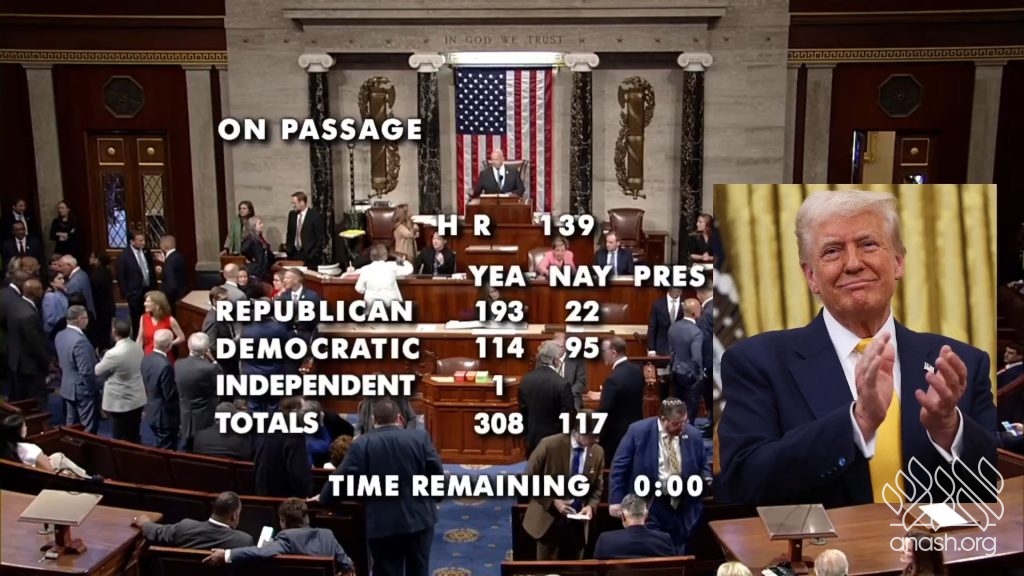
The House approved the Sunshine Protection Act by a 308-117 vote, advancing a permanent end to seasonal clock changes. despite concerns that late winter sunrises would disrupt schools, work schedules and daily Jewish observance.
The U.S. House of Representatives voted Tuesday to make daylight saving time permanent across most of the country, passing the Sunshine Protection Act by a vote of 308-117.
The legislation would end the practice of moving clocks forward each spring and back each fall. Instead, clocks would remain on daylight saving time throughout the year, including during the winter months when most of the country currently returns to standard time.
The bill now heads to the Senate. If it passes there, it would be sent to President Donald Trump, who has strongly supported ending the twice-yearly clock changes.
States that currently do not observe daylight saving time, or that adopt legislation choosing permanent standard time before the bill takes effect, would be permitted to opt out.
Supporters say changing the clocks twice each year disrupts sleep, contributes to accidents and workplace injuries, and creates unnecessary inconvenience. They argue that keeping clocks ahead would provide families and businesses with additional daylight during winter afternoons and evenings.
Opponents warn that the extra evening daylight would come at the cost of far darker mornings. In some parts of the country, particularly near the western edges of time zones, the sun would not rise until after 9:00 a.m. for weeks during the winter.
The United States attempted permanent daylight saving time in 1974 during the energy crisis. The measure initially enjoyed broad public support, but became deeply unpopular after Americans experienced a winter of children traveling to school in darkness. Congress reversed the change later that year.
For Yidden, the change would not alter the actual astronomical zmanim, but would cause every winter zman to appear one hour later on the clock.
In New York City, sunrise could occur as late as approximately 8:20 a.m., with sunrise after 8:00 a.m. on 55 days of the year. In Detroit, sunrise could be as late as 9:02 a.m., while Indianapolis and South Bend could see the sun rise after 9:00 a.m. for extended periods.
The later clock would delay misheyakir, the earliest time for a tallis and tefillin, as well as netz hachama and the proper starting times for Shacharis. Early minyanim that currently allow mispallelim to daven before commuting to work could become difficult or impossible during parts of the winter.
At the same time, sof zman Krias Shema and sof zman tefila would also appear one hour later on the clock, providing a later civil-time deadline for completing Krias Shema and Shemoneh Esrei. Chatzos, mincha gedola, plag hamincha, shkia and tzeis hakochavim would likewise all occur one clock hour later than they currently do during the standard-time months.
The change would therefore affect the entire daily schedule. Winter Mincha and Maariv would take place later by the clock, while candle lighting, the beginning of Shabbos and Yom Tov, and the conclusion of Shabbos would also be listed one hour later. During the summer, when daylight saving time is already observed, there would be no change.
Agudath Israel of America released the following statement after the vote:
“Today the U.S. House of Representatives passed the Sunshine Protection Act by a wide majority. Agudath Israel of America and its constituents understand the popular desire to ‘lock the clock.’ We are concerned, however, that by choosing permanent daylight saving time (DST) for the entire country it will put children at risk and affect our religious practices.”
“Permanent DST would mean sunrises after 9 am in some parts of the country for weeks in the winter thereby causing many of America’s schoolchildren to head for school, by foot, by bicycle, or by bus, in the pre-sunrise darkness and putting them at increased risk.”
“For the Orthodox Jewish community, an unintended, yet compelling, consequence of such legislation is the effect it will have on our fundamental religious practices. In Jewish law, morning prayers, and the rituals associated with them, must be recited no earlier than at specified times. The later sunrise occurs; the later synagogue services must begin. The extension of DST will create an extreme hardship on observant Jews. It would be extraordinarily difficult, if not impossible, to arrive on time for a job and will affect the start time of our schools.”
“The last time this happened in the 1970s the popularity of the measure dropped dramatically once Americans experienced one dark winter and Congress had to reverse itself within a year.”
“We are hopeful that the Senate will consider all of the effects of DST and compare them to the effects of permanent standard time or maintaining the status quo before rushing into this major change.”
 COMMENTS


perhaps the solution is to create Jewish time
From now Kiddush on Friday nights in the winter will be a problem between 7 to 8 instead of 6 to 7.
Why do we need to start school or work at 9. If sunrise is later, make it at 10
Leave the time the way it is now no more changes
Why not just scrap DST altogether? Leaving the time as is actually is… That would leave no clock changes too!