




ט״ו מרחשון ה׳תשפ״ז | October 26, 2026
Four-Hour Interview Takes Listeners Behind the Scenes of Hei Teves
In a special episode marking forty years since Hei Teves, Rabbi Kasriel Shemtov of West Bloomfield, Michigan, takes listeners through the entire story in a four-and-a-half-hour conversation, from when the sefarim began going missing in 5745 through the court case, the appeals, and the ultimate Didan Notzach.
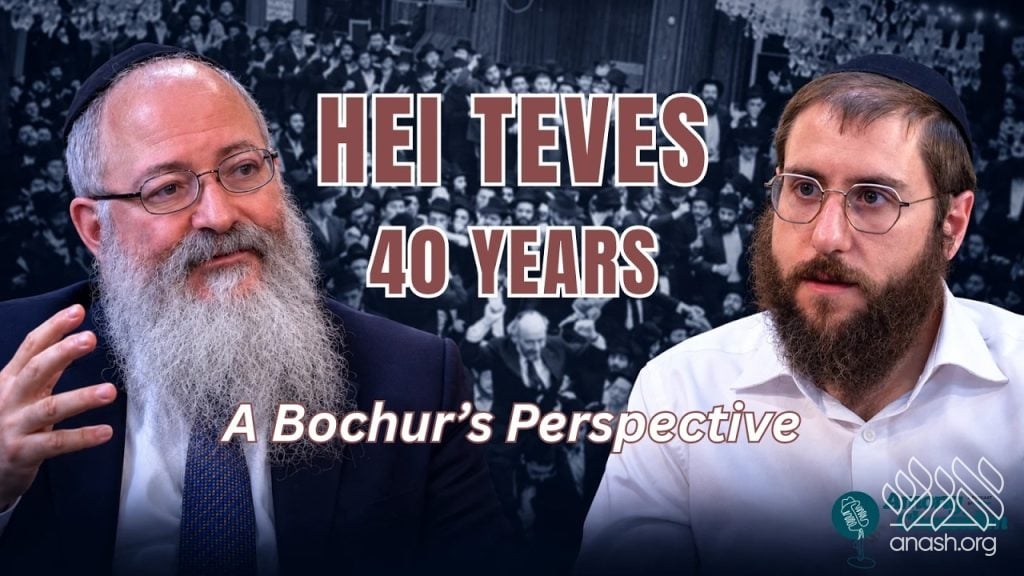
In a special episode released in honor of forty years since Hei Teves, Rabbi Kasriel Shemtov of West Bloomfield, Michigan, takes listeners through the entire story of Hei Teves in a four-and-a-half-hour deep-dive conversation.
As a bochur, he lived through every stage, from when the sefarim began going missing in the summer of 5745 (1985), through the court case, the Didan Notzach, the appeals, the second case, and more. Along the way, he shares the tension, the pain, the dancing, and the simcha of those years, closing with what Hei Teves means for Chassidim today, after Gimmel Tammuz, and especially as we mark forty years.
Rabbi Shemtov was 19 and at a camp in Michigan when he first heard about the case. The bochurim gathered in a tiny trailer room to watch the cable broadcast of the Rebbe’s farbrengen, and someone wired a pay phone in the room so everyone could hear. They did not know the details, but they could tell from the Rebbe’s words and tone that it was painful and urgent. When he arrived at 770 soon afterward, the mood hit him hard.
“It shocked the system, and I remember that was very painful,” Rabbi Shemtov recalls. Bochurim began gathering every morning to say Tehillim, and he describes how the events of the case weighed on the entire year.
He recalls that the farbrengens that year kept returning to the one theme that the answer is to do more. In Tishrei, the Rebbe spoke openly about Moshiach and about every Jew becoming a shliach. The Rebbe later called for Chabad houses to be opened in places that lacked one.
He also recalls how, on Yud Kislev, ten days before the court case began, the Rebbe spoke with visible pain in front of thousands. That night, the bochurim stayed up dancing through the night, and the niggun of Didan Notzach began to take shape.
Rabbi Shemtov also recalls the days surrounding the Rebbetzin’s deposition and the Rebbe’s assurance that she would pass “with flying colors.” When it appeared that the Rebbe himself might have to testify, signs went up in 770 calling for Tehillim at seven in the morning.
The Rebbe was ultimately spared that, and Rabbi Shemtov remembers watching him walk back from the library afterward, looking up at the building with a relaxed expression he had not seen before.
He attended the trial almost every day. He recalls Nathan Lewin’s cross-examinations, the testimony of Elie Wiesel, and Rabbi Krinsky taking the stand with a full page from The New York Times announcing the Rebbe’s farbrengen, so that the judge would understand whom he was dealing with.
“I used to come out of court with a splitting headache,” he says. At the same time, the bochurim knew that the Rebbe was going to the Ohel every day, adding to the strain.
He also describes the Chanukah rally held while the court was in session. He left the courtroom and rushed to 770 to hear the Rebbe call for Chabad houses to be expanded around the world. The rally was followed by two photo albums, “Let There Be Light” and “And There Was Light.”
Then came Hei Teves. Rabbi Shemtov was in the middle of a written test in yeshiva when someone whispered that there might be news. He slipped out and ran to 770.
“I was running between Kingston and Albany, and all of a sudden I’m hearing the niggun playing from the windows. It was like beyond anything, and we were just running to 770,” he recalls.
He describes the dancing that continued for seven days and how the Rebbe invited everyone to send in their names so he could daven for them. Bags of tzetlach were loaded into the Rebbe’s car, and Rabbi Shemtov recalls passing faxes down from a fire escape to be added to the growing piles.
The story did not end there. When the other side later appealed, the Rebbe spoke with great pain at a farbrengen, and a vaad of askanim was formed, which included Rabbi Shemtov’s father. Rabbi Shemtov was then on shlichus in Australia, and he describes the longing he felt while being away from the Rebbe during those months.
When the sefarim were to be returned, he and a group of bochurim made a dramatic last-minute flight to New York, arranged with the help of a local supporter. He watched the truck arrive from a window in Rabbi Yudel Krinsky’s office, where he had gone to learn. Later, he was asked to obtain the lawyers’ signatures on documents related to the court case’s settlement and he recalls flying to Washington aboard the Trump Shuttle to collect the signatures on the settlement papers.
Looking back, Rabbi Shemtov says Hei Teves matters even more for today’s generation than it did for his own. He recalls how the Rebbe spent those years teaching that the sefarim are alive and that the Rebbe is with us. He says this is what gave Chassidim the ability to live with the Rebbe after Gimmel Tammuz.
“I would say that Hei Teves has to be the yom tov of this generation, a day to celebrate that we have a Rebbe and that we can live with the Rebbe,” he says.
Among Chassidim is a podcast by Derher, hosted by Rabbi Yossi Kamman, director of A Chassidisher Derher. The podcast captures the vibrancy of dor hashvi’i through immersive, in-depth conversations. To view all episodes, visit the Among Chassidim YouTube channel.
WATCH
 COMMENTS


We appreciate your feedback. If you have any additional information to contribute to this article, it will be added below.