



ט׳ אב ה׳תשפ״ו | July 23, 2026
Did the Rebbe Want Lubavitcher Chassidim to Speak in Yiddish?
For generations, Yiddish was the language of Chassidim. On multiple occasions, the Rebbe spoke passionately about preserving Yiddish, even questioning why Chassidim who knew the language chose to speak English. Did the Rebbe want every Lubavitcher chossid to speak in Yiddish?
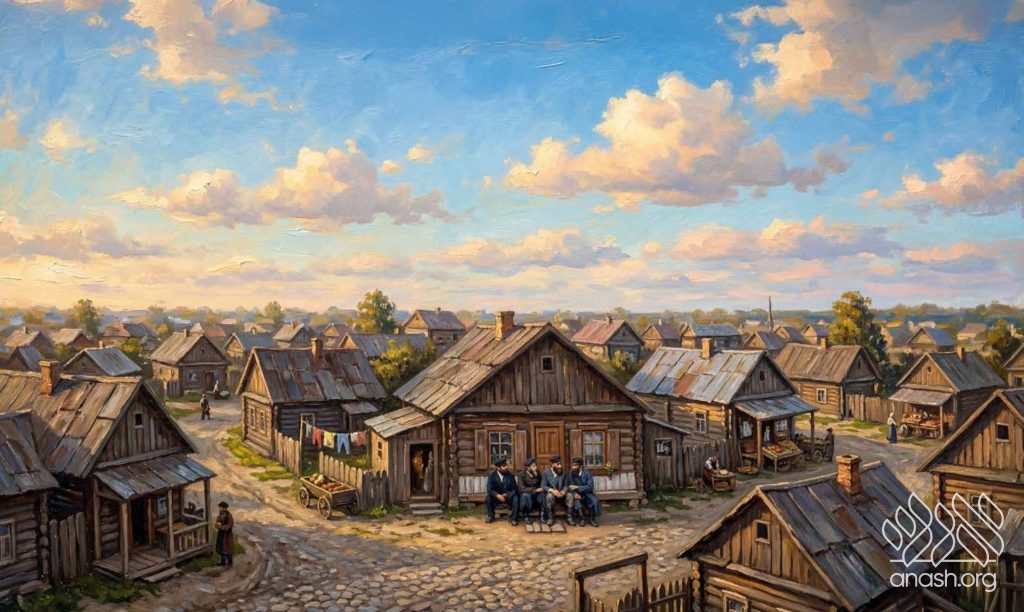
For generations, Yiddish was the language of Chassidim. But was it simply a practical means of communication, or did the Rebbe see it as something much deeper?
The Rebbe encouraged translating Torah and Chassidus into every language to reach every Jew. Yet, on multiple occasions, he also spoke passionately about preserving Yiddish, even questioning why Chassidim who knew the language chose to speak English instead.
What was the Rebbe’s actual view? Should every Lubavitcher strive to speak in Yiddish? Should schools teach in Yiddish? And how do the Rebbe’s many letters, sichos, and personal interactions fit together?
Drawing on rarely discussed stories, correspondence, and firsthand accounts, this fascinating article explores the Rebbe’s nuanced approach to Yiddish and reveals what it means for us today.
Click here to download the full article.
*
Mameh Lashon
A Look at the Place of Yiddish in the Rebbe’s Teachings and Directives
By Rabbi Mendy Greenberg (Twinsburg, OH)
Is Language a Factor?
Should the importance of the Yiddish language be a topic for this magazine?
The Rebbe never announced a “Mivtza Yiddish”; the Rebbe didn’t campaign for people to learn it and didn’t speak incessantly about the problem of its decline. Indeed, there is no mitzvah in the Torah dictating which language to speak. One can devotedly serve Hashem with genuine ahava and yira without knowing the language at all.
The Rebbe often spoke about the importance of translating Chassidus into other languages so that it could reach the broadest possible audience. The Rebbe spoke many times about the novelty introduced by the Frierdiker Rebbe in having maamarim translated to other languages, explaining that it represented a whole new stage in hafatzas hamaayanos.
In fact, the Rebbe once concluded such a sicha with an explanation for why he himself didn’t deliver sichos in English! Consider this statement: “The fact that I speak in Yiddish and not in English is for several reasons, and most simply—because it is my mameh lashon, and it is simply easier to express myself and explain ideas in this language…”
So why would we write about the importance of Yiddish? Indeed, the entire purpose of A Chassidisher Derher magazine is to bring the Rebbe’s inyonim to the broader English-speaking audience!
But there is more to the story.
The Sicha and the Back Story
“I was once standing in the foyer of 770 on a Friday night,” relates Rabbi Asi Spiegel. “In those years, before the histalkus of the Rebbetzin, the Rebbe would remain in his room after Kabbalas Shabbos for an hour or more before heading to the library for seudas shabbos with the Rebbetzin.
“It was a common practice for bochurim to do the same; we would remain in 770 as long as the Rebbe was there. Some would learn in the small zal, and others would wait in the foyer to see the Rebbe leave. After the Rebbe went to the library, we would go to the yeshiva cafeteria to make kiddush.
“On this particular week, I noticed that the situation in the foyer—in the main lobby at the entrance to 770—was livelier than usual. A discussion had begun about the new maamar or likut that had just been released, and a heated argument was raging among the bochurim over its contents.
“Watching the scene, a passing thought crossed my mind. This conversation was being held very close to the Rebbe’s room. Only a few thin doors and walls separated us from the Rebbe, and it seemed almost certain that the Rebbe could hear everything….”
The next day at the farbrengen, the Rebbe spoke about the Frierdiker Rebbe’s innovation of translating Chassidus into other languages, when suddenly the sicha veered in a different direction.
“There is something very surprising,” the Rebbe began.
“When shpitz-Chabad’nikes meet and discuss even holy matters, in Chassidus etc.—they speak only in English!
“And not because they face the obstacle of not knowing Yiddish; they were raised in chassidishe homes, and learned in yeshivos where the rosh yeshiva spoke in Yiddish—he didn’t speak English at all!
“So they have no real obstacle or limitation. Nevertheless, when they discuss a concept in Chassidus, they speak and explain the idea specifically in English, except for a few terms of Chassidus that they do not know how to translate into English, so they say them in Yiddish or in Lashon Hakodesh.”
The Rebbe returned to the main discussion about translating Chassidus for the uninitiated, but even then, returned to the topic of Yiddish in the middle of his sentence, and spoke about the correction needed:
“We have the hora’ah from the translation of Chassidus into other languages, that even if you would say (im timtzi lomar) that this situation of speaking in English needs to be changed and corrected— “And it’s not actually an im timtzi lomar; this indeed needs to be changed and corrected, and conversing should be done specifically in Yiddish, especially in light of the concept of lo shinu es leshonam [that the Jewish people spoke their own distinct language, even in Mitzrayim].
“Nevertheless, when one comes to speak Chassidus with other Jews who, for the time being, do not yet know Yiddish—and certainly do not know Lashon Hakodesh— one should not wait until they learn Yiddish… ” (at this point in the sicha, the Rebbe explained why he himself doesn’t speak publicly in English, as mentioned above).
This sicha is unique. The Rebbe didn’t often speak about the importance of Yiddish, and when doing so, it was almost always as an aside, while speaking about the importance of translations.
Nevertheless, it was clear from the Rebbe that a Lubavitcher chossid, especially one who was raised knowing the language, should speak in Yiddish. It was almost obvious, and taken for granted. Of course, we speak in Yiddish.
Here are several stories in this regard:
How Many Years Have You Been in Lubavitch?
Rabbi Yossi Groner, son of the Rebbe’s secretary Rabbi Leibel Groner, shared the following story with A Chassidisher Derher: “My mother was once standing in line for dollars. As she entered the main lobby, the Rebbe was in the midst of a conversation, so she used the opportunity to exchange a few words with my father, Rabbi Leibel Groner, who was standing in his usual place next to the Rebbe. She said something to him, he answered, and that was it.
“A few moments later, she was standing in front of the Rebbe.
“‘Farvos redt ir nit kein Yiddish? Why don’t you speak in Yiddish?’ the Rebbe asked her. ‘Ir kent doch redn Yiddish, you are capable of speaking Yiddish…’
“As a result, my parents began to speak only Yiddish with one another.”
Rabbi Chaim Melul related a story in this regard as well: “A friend of mine, a fellow baal teshuvah from France, was in yechidus. At the beginning, the Rebbe asked him if he spoke Yiddish, and he said that he did not.
“The truth was that he spoke a decent Yiddish, but he was afraid that he might misunderstand the Rebbe, and was therefore hoping that the Rebbe would speak to him in French. At any rate, he told the Rebbe that he didn’t understand Yiddish, and the Rebbe responded, ‘And how many years are you in Lubavitch?’”…
Here’s a third example:
The Rebbe would edit the entire English portion of Di Yiddishe Heim magazine. Once, the authors prepared an article that dwelt on the differences between Jewish life in America and in Europe before the war. One paragraph read as follows:
An American Jew behaves differently from his European counterparts. He is more at home in his environment than his European forebears. The decreasing use of Yiddish, which has become almost negligible in the new generation, is a symptom, criticized by some, of a greater acculturation. Be that as it may, it is so. English is the language of the rabbi’s sermon. It is very much the language of the yeshiva. It is the dominant language at the symposia, conferences, and conventions. It is practically the sole medium of communication.
As usual, the article was submitted to the Rebbe for his edits and approval. The Rebbe crossed out this entire paragraph and wrote the following on the margins:
“אפילו את”ל [=אם תימצי לומר] שכן הוא %001 ,אין צורך והכרח להכריז עד”ז [=על-דבר-זה] ובמשמעות שכן יקום וכו'”.
Even if you were to say that this is 100% true, there is no need or necessity to announce it publicly in a way that implies that ‘this is how it’s meant to be’ etc.
Clearly, the Rebbe was not pleased with even the description of the “decline of Yiddish.”
But why is Yiddish so important?
The Adjacent Language
In a muga’dike sicha about Tanya on the radio—which was taught in Yiddish—the Rebbe explains that in addition to simply being the language which many Yidden speak, Yiddish has a special connection to the revelation of Pnimius Hatorah: “The Alter Rebbe writes in Iggeres HaKodesh that the Baal Shem Tov would say Torah in Yiddish, not Lashon Hakodesh. This was also famously the practice of his talmid, the Mezritcher Maggid, as well as of the Alter Rebbe and the Rebbeim who followed him, down to the Rebbe der shver—they would say Chassidus in Yiddish.
“To truly grasp the meaning of the divrei Torah of the Rabbeim, it is not sufficient to learn them as they were later translated into Lashon Hakodesh by others. One needs the original words as they were spoken in Yiddish…”
The Rebbe added that the fact that this is so, b’hashgacha pratis, means that there is a deeper spiritual quality to this language: “First, the fact that the Rabbeim said Chassidus specifically in Yiddish is itself an indication that the language possesses a unique capacity—even before it was used for this purpose—for the saying of Chassidus. Second, by actually saying Chassidus in Yiddish, the Rabbeim elevated the language itself beyond its prior state.
“This is similar to what the Mitteler Rebbe explains in Shaarei Orah: when a physical object is designated for a mitzvah, the very act of setting it aside already draws a lofty spiritual light into it. Then, after the mitzvah is actually performed, an even higher light is drawn into the object—infinitely greater than what it received at the initial designation.”
In the muga’dike sicha of Vayeshev 5748 (the same occasion mentioned earlier, when the Rebbe spoke about Chassidim conversing in English), the Rebbe places Yiddish on a unique pedestal—as a language adjacent and uniquely connected to lashon hakodesh.
“Although it is not Lashon Hakodesh, it has nevertheless been elevated by the Jewish people over the generations through their speaking it—even in everyday matters (in keeping with the directive, ‘All your actions should be for the sake of Heaven,’ and ‘In all your ways, know Him’), and all the more so through its use in matters of Torah and mitzvos, and especially in the study of Torah (in chadarim and yeshivos), and in particular, in Pnimius Hatorah.
“As a result, Yiddish has a unique distinction, importance, and chavivus. In this sense, it can be compared to Targum, [the Aramaic] which is closely related to Lashon Hakodesh—to the extent that even Torah Shebiksav contains words in Targum, and certainly Torah Shebaal Peh….”
The Stamps from the Rebbetzin
The Rebbe mentioned those spiritual qualities of Yiddish—being the language of the Rabbeim and Pnimius Hatorah for so many generations—on numerous occasions. However, for Chassidim, the quality of Yiddish should be uncomplicated and straightforward: it’s the Rebbe’s language.
Rabbi Chaim Boruch Halberstam, the founder of WLCC, has become known in recent years for his campaign encouraging the use of Yiddish. In an interview with A Chassidisher Derher, he explains: “The importance of Yiddish is so obvious, it doesn’t even need to be stated,” he says. “To be a chossid, you need to listen and understand the words of your Rebbe—and the Rebbe spoke in Yiddish!
“Of course, so much has been translated over the years, but there is no substitute for listening to the Rebbe’s words, as he spoke them, in their original language. No hanacha, translation, or printed book can really convey the hergesh, the chayus, the nuances of the Rebbe’s sichos—and certainly not when they are translated into a second language. Kli sheini aino mevashel, the second-hand repetition just isn’t the same.
“For me, there is a personal element as well. My life’s work, since I was a bochur in 770, was to bring the Rebbe’s voice directly to the public. We began broadcasting and regularly recording the Rebbe in 5730, and we also invested significant effort in compiling all the recordings of the farbrengens from earlier years, so they would be accessible to the public.
“Today, you have all the Rebbe’s sichos at your fingertips—and young bochurim tell me that they cannot listen to the Rebbe… because they don’t understand Yiddish!
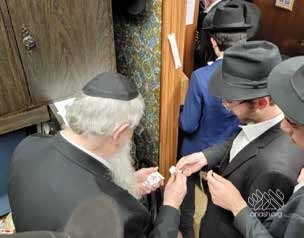
“Because of that, I decided that I would give a special gift to anyone who commits to speaking Yiddish—a stamp from the Rebbe’s stamp collection, which I once received from the Rebbetzin. Baruch Hashem, I’ve already had the opportunity to give out many such stamps, and I know that they’ve made an incredible impact.”
The Shortest Yiddish Speech Ever
The Rebbe’s request for Yiddish was not limited to “typical Chassidim.”
On 17 Elul 5748, the crowd at 770 was preparing for a momentous occasion—the groundbreaking for the expansion of 770. Being the year of aveilus for the Rebbetzin, the Rebbe spent most of his time at home, but there was hope that he would come to 770 in honor of the occasion.
After Mincha, Mr. David Chase—a philanthropist known for his warm relationship with the Rebbe— approached the Rebbe at the foot of the staircase with a request that the Rebbe grace the event with his presence, “at five o’clock, right near your office.”
The Rebbe’s response caught Mr. Chase off guard.
“A Jew is always making a deal,” the Rebbe said. The deal was: “If you will say a few words at five o’clock in Yiddish.”
Mr. Chase paused for a few moments, confused, so the Rebbe smiled at him and said, “It is your mameh lashon…”
Mr. Chase was a Holocaust survivor from Poland. Yiddish had been his first language. As he regained his bearings, he responded to the Rebbe by repeating his invitation in his Polish-style Yiddish, “Yu, finef a-zeiger, Yes, five o’clock…”
Lest he think that speaking Yiddish right there would suffice, the Rebbe clarified: “For all the gathering, not only for me… Then you will remember your mameh-tongue, and it will be a good start for all the year round—this year, and the year after that.”
The conversation (in English) continued for another few moments, and as the Rebbe prepared to go up the stairs, he said to Mr. Chase, “I will see you at five o’clock.”
“And don’t forget to prepare a good speech in Yiddish,” the Rebbe added with a smile.
Later that afternoon, a vast crowd gathered on the service lane of Eastern Parkway. A platform was set up with the Rebbe’s stender, and some earth was spread for the hanachas even hapina. Soon, the Rebbe arrived and delivered a sicha in honor of the occasion.
As the Rebbe concluded the sicha, he turned towards Mr. Chase, who was standing near the Rebbe’s platform, prepared with his own podium and microphone.
Mr. Chase began his remarks in English.
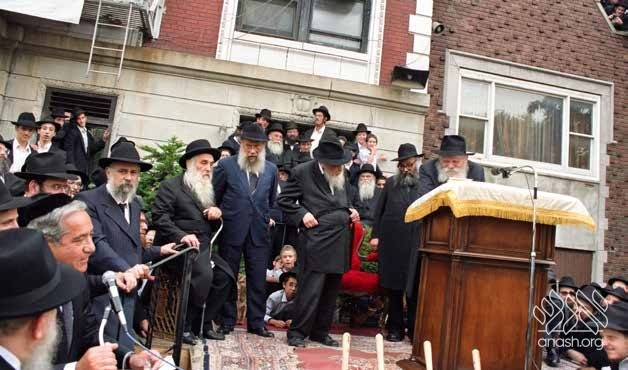
In a touching speech, he described his memories of the Germans burning down the shul of his town, and of witnessing the horrific killings of Jewish children. At the time, he said, he couldn’t possibly imagine that he would witness a day of rebuilding—when a new shul is erected, when Jewish children scamper about, proud of their Yiddishkeit.
Then, turning to the Rebbe, he spoke about the privilege it had been for him to be connected to the Rebbe.
“Rabbi, you’ve blessed us all with your wisdom; you’ve blessed us all with your leadership, and to me it’s been a privilege to work under your direction…”
All this time, the Rebbe was listening intently. But when he began the next sentence, a beautiful smile began to spread on the Rebbe’s holy face.
“Rabbi, I don’t know what to tell you, except that I promised you that I’m going to say a few words in mameh lushon, so I’m going to have to say it…”
Mr. Chase continued to speak about his love for the Rebbe and the privilege he felt to have had this connection. Then, he finally got to his Yiddish speech.
“All I can tell you is, ich libe dich, zayer zayer asach…”
I love you, very, very much.
Throughout this unusual scene, all eyes were glued to the Rebbe. Everyone watched as a smile began to spread once again on the Rebbe’s face.
Mr. Chase then continued with his final statement: “Next time we get together, I promise I will be able to speak more mameh lushon…”
This earned him the biggest smile of all.
An Honor For You
The Rebbe’s glowing countenance during this encounter created one of the most iconic moments in Lubavitch history on film—but less famous is the continuation, which took place several weeks later, again on the topic of Yiddish.
On 8 Tishrei, the Rebbe held yechidus for the supporters of the Machne Israel Development Fund. Usually, the Rebbe would speak a short sicha of just a few minutes in English, but this time, the Rebbe delivered a longer sicha.
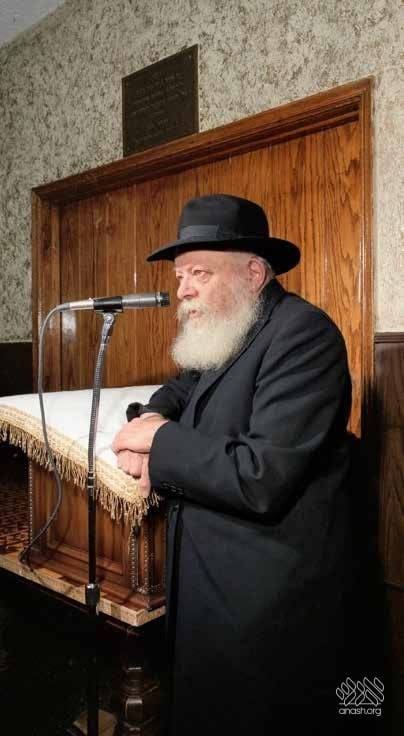
The sicha began in English, but after a few minutes, the Rebbe said that he would now switch to Yiddish—and explained why.
This is, perhaps, the best way to conclude this article.
Here are the Rebbe’s words, in the original.
“After my endeavors in English, I permit myself—after you are meeting for so many years, I believe it will be more to your honor when I will consider every one of you—as certainly you are anyway—that for you the mameh lashon, the Yiddish lashon, is familiar as it was to your mother, or to your grandmother.
“And that will be a good start—not only not to be ashamed of it, but to use it in everyday life, and to influence also your family and children and grandchildren to do likewise, and to do so happily; proud to being a Jew, having a language that belongs to the Jews—and to use it in everyday life, as an example of your pride to being a Jew…”
As the Rebbe says, so clearly: We should all use it in everyday life—with our families, children, and grandchildren, and we should do so happily—as an example of our being proud to be Jewish—proud to be Chassidim of the Rebbe.
*
Teach In Yiddish?
Any discussion about the importance of Yiddish brings along with it an adjacent question: what is the place for Yiddish in Chinuch?
For so many generations, Jewish children learned Torah in their mother tongue, in Yiddish, and they translated the Chumash and Gemara into Yiddish in the cherished, age-old tune.
This tradition continued into the new world in many chadorim—to a greater or lesser extent—but as fewer and fewer children understood the language, this custom began to raise questions. Many such questions arrived at the Rebbe’s desk.
The Early Letters
The first (known) mention of Yiddish in the context of chinuch appears in a letter from 5713 to Reb Avraham Pariz. Describing his pain at the lack of activism in Chabad, and how much more could be accomplished, the Rebbe made the following observation:
“Surely you know that the Satmar Chassidim have established several talmud torahs—where the learning takes place specifically in Yiddish—and these were established just in the recent past…”
This is only a passing mention, but there are two letters in Igros Kodesh with a much clearer stance, both dated just one year later, in 5714.
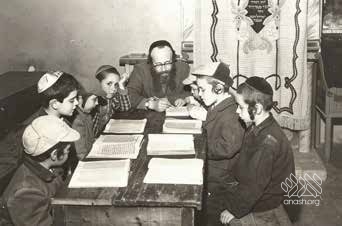
The first letter is a response to a letter from the administration of the Talmud Torah in Kfar Chabad, which wrote that they were considering changing the language of instruction from Yiddish to Hebrew.
“Despite the considerations you raise,” the Rebbe responds, “it is essential that you continue these classes specifically in Yiddish, just as until now.”
In the second letter, the Rebbe writes quite sharply: “Despite the ‘claims’ of certain ‘educators’ who argued, supposedly in the students’ ‘best interest,’ using the reasoning cited in your letter, it is both better and easier for the teacher candidates to be taught Yiddish.”
These statements might seem to be unequivocal in their support for Yiddish instruction, but the full context of these letters (and many other letters, as included below) paints a very different picture. The Rebbe’s opposition seems to be not as much the abandonment of Yiddish as it is to the adoption of Ivrit B’Ivrit, an entirely different problem—as we shall explain.
Lashon Kodesh—New and Improved
In the early generations of the Zionist movement, a campaign was made to educate the masses in a new, modern Hebrew, and there sprung up an educational program called Ivrit B’Ivrit, where school teachers would speak solely Hebrew throughout the day, immersing their students in the language and helping them to learn it quickly.
The use of Lashon Hakodesh as a mundane language is anathema to Yiddishkeit, and the Rebbe Rashab was at the forefront of the opposition to it, alongside his opposition to the broader Zionist movement and its secular messaging.
Both of these letters seem to reflect—not so much the absolute necessity of Yiddish—but the fight against encroaching secular forces and the need to preserve the purity of Jewish education. Here are the citations, in their entirety.
The first letter: “Despite the considerations you raise, it is essential that you continue these classes specifically in Yiddish, just as until now. At a time when we see that the le’umas zeh (the “other side”) fights over every detail, and nothing is considered insignificant so long as they achieve victory— our Torah cannot be treated with less seriousness than their causes. We need to guard even the ark’sa d’m’sana [the most insignificant minhagim]; how much more so in a matter of education—where it is exceedingly difficult to foresee the effects of even a slight change during the years of childhood on the course of a person’s entire life.”
In the second letter: “Regarding Ivrit B’Ivrit: It is well known how strongly our Rabbeim opposed this—despite the ‘claims’ of certain ‘educators’ who argued, supposedly in the students’ ‘best interest,’ using the reasoning cited in your letter. It is both better and easier for the teacher candidates to be taught Yiddish.”
What about places where Ivrit B’Ivrit is not a factor?
What about places where children do not speak Yiddish at home?
The Crying Injustice
In his interview with A Chassidisher Derher, Rabbi Shabsi Alpern of Brazil shared that in the early days of his shlichus, he taught Gemara to a group of children who were more advanced than the rest of his school. Some parents insisted that he teach in Yiddish, but in yechidus, the Rebbe didn’t approve.
“The Rebbe said we should use the language that achieves the best results,” Rabbi Alpern said. “When I returned to Brazil, I switched to Portuguese, and Baruch Hashem, we saw immediate results. There is a lamdan in Eretz Yisrael who still thanks me today, because the switch finally allowed him to enjoy the classes, and they were the impetus for his real growth in Yiddishkeit.”
In a fascinating recording of a lengthy yechidus— one of the only such extant recordings—with Mr. Frank Lautenberg, the Rebbe makes a similar point: “I am not for the Yiddish of the yeshivah. There are many in the Yeshivah who are very enthusiastic about forcing the people to teach all subjects in Yiddish, Gemara etc. I am not enthusiastic about it. We are spending a lot of time to learn a new language; after they have learned it, they have a language barrier. They cannot speak fluently—they are thinking in English, and it is a pity on the time lost, as I said before, ‘the building is burning!’ It is not a normal time.
“And to say it in a good way: it is a computer era; a computer must have the results in one second.”
There are letters in Igros Kodesh with similar directives.
For example, in this letter to a menahel in Uruguay: “Regarding the language in which to teach the bochurim and the talmidim: “…There is no time to wait until they come to understand another language. They must be taught in the language they understand now, and all available time should be used—not to teach a language, but to instill in them a spirit of yiras shomayim, ahavas Hashem, and ahavas haTorah.”
In this final example, the Rebbe makes an explicit comparison between Ivrit B’Ivrit and what we might call ‘yiddish b’yiddish.’ This letter was drafted by the Rebbe in Lashon Hakodesh, and then prepared by the secretary in English. The Rebbe writes:
“האם ילמוד הנ”ל בביה”ס בו לומדים עברית בעברית וכיו”ב—ומבלי להכנס להשקו”ט בכלל בנוגע לעברית בעברית ואפילו באם ס’ הלימוד יהי’ כולם עטה”ק—לדעתי ע”פ השעות המצומצמות ביותר ללימודי קודש, ה”ז עול משַוֵֵע כשלוקחים עוד משעות אלו ללַמֵֵַד את הת’ שיוכרח דוקא להעתיק במח’ כל הענינים שלומד לשפה שהיא חדשה בשבילו.
“הערה מטעם זה—אין גם להכריח את הת’ ללמוד כל לימודיו באידית—באם אין זו שפה המדוברת בביתו.”
In the English rendering: “Whether your son should learn in a school using the ‘Ivris-b’Ivris’ method, and the like? —without getting into the controversy about the advantages, or otherwise, of this method in general, and even if the curriculum etc. be completely al taharas hakodesh—it is my opinion that considering the very limited time allotted to Limudei Kodesh, it is a crying injustice to further deprive the students of this precious time in order to teach them in a way which compels them to translate in their mind the subject matter of their lessons into a language unfamiliar to them. (Note: For the same reason, the student should not be compelled to learn everything in Yiddish—if this is not his spoken language.)”
How To Incorporate Yiddish
However, this does not mean that we need to give up on Yiddish entirely.
In 5717, Rabbi Sholom Dovber Popack—then living in Pittsburgh—wrote to the Rebbe, asking if he should insist that his son’s language of instruction be Yiddish.
The Rebbe answered: “Since you and your wife know Yiddish, and there are only a limited number of hours your son spends in Cheder, as customary in this country, it would be appropriate that you and your wife be involved in your son’s becoming accustomed to Yiddish and understanding it, and Cheder now—until he will become accustomed to Yiddish—should be in the language he knows best.”
There are also opportunities to teach Yiddish to children at school. This letter to Rabbi Hirshel Fogelman (then in Buffalo), for example, suggests a separate time for learning Yiddish: “Based on your description, our advice is that, for the time being, all subjects should be taught in English. At the same time, efforts should be made that, over time, the students also learn Yiddish, and then it will be possible to transition the language of instruction to Yiddish.
“You can accustom the students to Yiddish as you see fit—either by conducting the review of the material in Yiddish (which will also make the review more engaging, even for those students who already remember well what they learned the first time), or by setting aside a specific time for learning the Yiddish language—(and it is possible to combine both approaches).”
Similarly, in a yechidus with Rabbi Aharon Dov Sufrin, the dean of the Lubavitch Day School in England, the Rebbe rejected the idea of using Yiddish as the language of instruction, but then added, “It is appropriate to speak to them in Yiddish during their playtime, recess, breaks, or when telling them a story—as this will help expand their familiarity with the language; however, not when teaching them formal Yiddishkeit subjects.”
Beware of Machlokes
Some parents in London asked the Rebbe for permission to secede from the Lubavitch Day school entirely and open a cheder al-taharas-hakodesh, where no limudei chol would be learned, and Yiddish would be the language of instruction. This suggestion was categorically rejected by the Rebbe.
Interestingly, a “Cheder Yiddish” was established in Kfar Chabad in the early 5730s under the assumption that the Rebbe supported the idea of chinuch al-taharas-hakodesh, but there were indications that the Rebbe was not pleased with the idea of a second institution weakening the existing mosad chinuch which had been established by the Frierdiker Rebbe, and its establishment was indeed quite controversial.
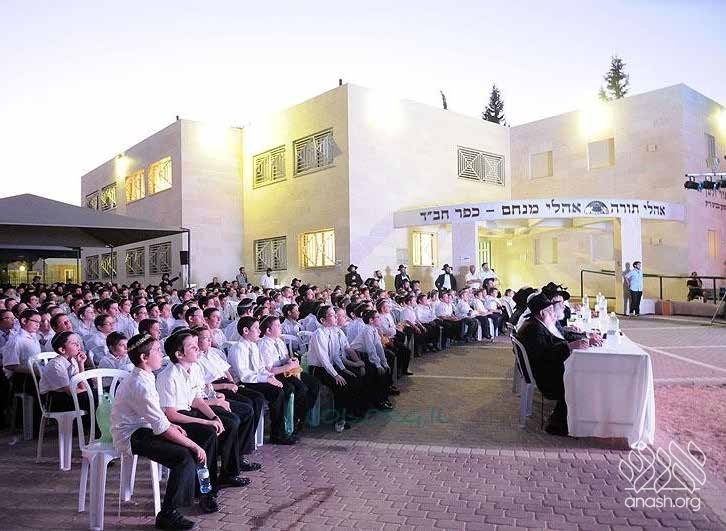
In fact, in light of the controversy, one visitor came from Kfar Chabad to New York with the specific goal of asking the Rebbe about the new cheder, but the Rebbe answered every question on his pa”n aside from that one!
When the visitor raised the question directly, the Rebbe told him that instead of two chadorim, the original cheder should provide an exclusively limudei kodesh track.
Several years later, when the cheder’s principal was in yechidus with his son, the Rebbe began to speak to the child in Yiddish, only to discover that he didn’t speak Yiddish at all—despite learning in the breakaway mosad that had ostensibly been created with the goal of learning in Yiddish!
The Rebbe turned to his father with a very serious face and asked sharply, “How does the boy know lashon kodesh so well? M’lernt nit in cheder oif Yiddish?! The cheder doesn’t teach in Yiddish?!”
In Summary
The question of chinuch in Yiddish was actually addressed by the Rebbe in a letter directly to parents in Kfar Chabad a full five years before the Cheder Yiddish was established, and does well to sum up the entire issue.
The Rebbe writes: “In my opinion, since the primary purpose of the Talmud Torah is to educate the students in yiras Hashem and ahavas Hashem, and to teach them Toras Hashem and His mitzvos, which is ‘longer than the earth and broader than the sea,’ and for this reason Chazal warned so strongly against the neglect of the learning of tinokos shel beis rabban, to the point that it is forbidden even for the building of the Beis HaMikdash— “It is obvious that the main point is not the language in which the students are taught, but those above-mentioned matters: the effectiveness and the increase, both in quantity and quality, in the knowledge of Torah and mitzvos. [It is also understood that in a place where the language of instruction has an effect on matters of yiras Shamayim and the like, then the choice of language carries importance in that respect]…
“A particular point regarding Kfar Chabad: to my great regret, there are those who seize every opportunity to turn matters into a source of dispute and divisiveness. This is the craft of the kluginker (the “wily one”, the yetzer hara)—to disguise everything in a cloak of yiras Shamayim. From the style of the letters of the administration and the parents, it appears that this has occurred in the present case. Therefore, it is proper to conduct an examination … to determine the interests of each of those involved in this new dispute.
“…As for the special advantages you mention regarding Yiddish, it requires consideration whether the acquisition of these advantages is the role of the school or the responsibility of the parents and the home environment.”
 COMMENTS


Parents that know and speak Yiddish but don’t speak to/ them in Yiddish….
Some how we find money for everything–siyum horambam, chidon etc. etc. Why can’t we invest money in creating ways to teach Yiddish? The problem lies in that our schools are being run by people who don’t have the hergesh for things like this. They’re businessmen.
Are you a parent?
Do you speak yiddish at home?
The schools can & should, but for this, itll be so much easier & more productive if the home speaks Yiddish.
Im not contred your comment im supporting it with the home (combined)
Yiddish is no longer the first language of the teachers
The Rebbe spoke about the importance of speaking Yiddish several times. Once at yechidus, the Rebbe expressed surprise at the fact that in Russia no Yid would think of speaking in Russian among themselves, while in America it has been considered acceptable even among fluent Yiddish speakers to converse in the goyishe language…
(תו”מ תשמ”ח ח”ב ע’ 73, יחידות תשכ”ח)
From The Weekly Farbrengen 863
You can’t compare a school in Uruguay and Brazil to a chassidishe anash cheder.
It’s embarrassing when a Lubavitcher bochur isn’t comfortable in the language that the Rebbe spoke.
The practical benefit of Yiddish is twofold:
1) It’s more refined, and doesn’t include all of the slang and expressions from the street that have crept into English (even among frum people).
2) It creates a natural barrier between Yidden and goyim.
Send you children to yidish speaking mosdos, total immersion is the only way to b pick up a language. My son is right now in a yidish speaking camp, and his yidish has improved drastically.
Unfortunately, there are no Yiddish speaking camps in Lubavitch in the USA. Perhaps they exist in Europe.
Tzeirei Hatemimim. Look it up.
For background: I am a baalas tshuva, Yiddish was spoken in my childhood home although not exclusively, and I had also learned German in college, so I was easily able to read and understand the sichos in the early volumes, only having to look up some of the Hebrew words the Rebbe would intersperse. I was shocked and disappointed to find that many of the later volumes I had purchased were published entirely in Hebrew. I would understand publishing a separate Hebrew edition to reach a wider audience but THE REBBE SPOKE TO US IN YIDDISH, I THOUGHT (AND STILL THINK) WE SHOULD BE ABLE TO READ THE WORDS HE SPOKE. I don’t understand why the sichos were not all published in Yiddish.
Because that way the sichos will reach a much wider audience. The Rebbe was consulted about that decision
Interestingly, now more then ever, all (non-english speaking) chassidim should be gearing up to learn English, with the Igros Kodesh – English letters set just around the corner (with 10,000 letters!)
Also I once told the Rebbe that in the English translation of his Pesach or other messages, some words were so difficult to understand that one needed a dictionary handy. The Rebbe said that the purpose of my letters is not to study English
To clarify, the last paragraph is from Zalman Jaffe in his My Encounter with The Rebbe.
The whole assumption that the Rebbe opposed the Cheder Yiddish in Kfar Chabad has long been disputed. Reb Mendel Futerfas held that the Rebbe was in full support.
See the book Harav Ashkenazi volume 1.