




כ״ח אלול ה׳תשפ״ו | September 10, 2026
Chabad Rabbonim Warn of Common Mistake in Shofar Blowing
As Anash brush up on their shofar-blowing skills, Beis Din Rabbanei Chabad are pointing out a common mistake in blowing shevarim. The issue was first raised by Wisconsin shliach Rabbi Yisroel Shmotkin.
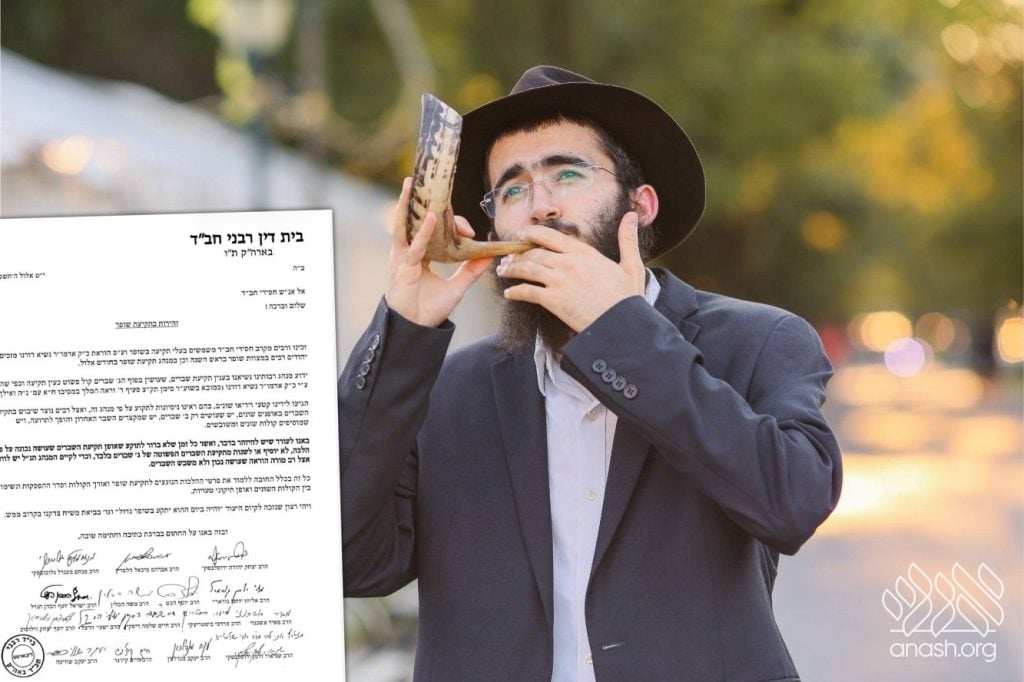
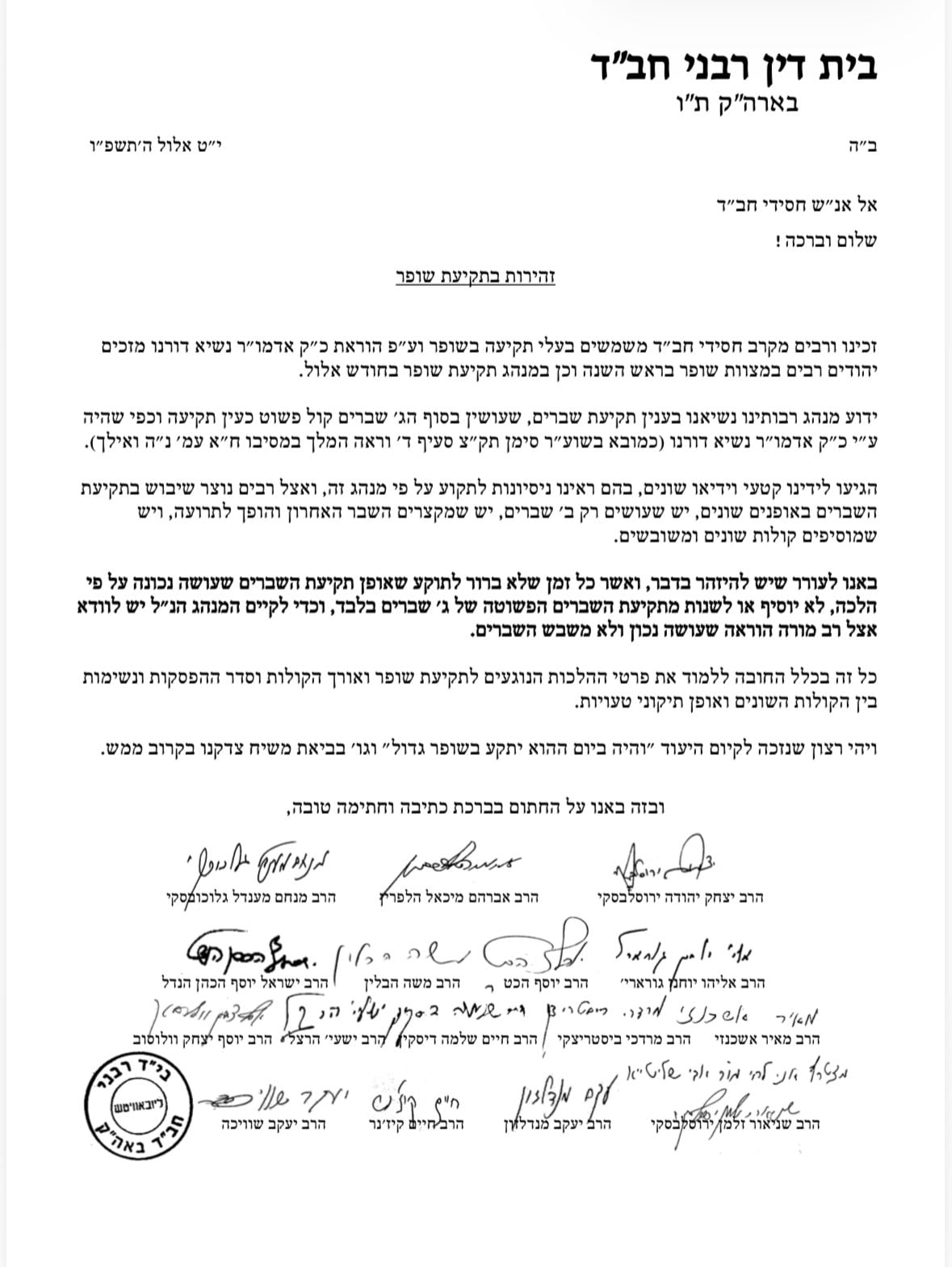
Ahead of Rosh Hashanah, Beis Din Rabbanei Chabad of Eretz Yisroel issued a letter to Anash, cautioning that a mistake has taken hold among many baalei tekiah in the way they are blowing shevarim, as they try to follow the minhag of the Rebbeim.
The letter notes that our Rebbeim’s minhag was to add a short sound at the end of the shevarim, described as a “kol pashut k’ein tekiah,” a simple sound resembling a tekiah, as the Rebbe did, brought in the Alter Rebbe’s Shulchan Aruch.
The Beis Din writes that it has received video clips showing that this minhag is not being followed consistently.
“Some do only two shevarim, some cut short the last shever,” the letter states, warning that this has “created confusion in the way of blowing shevarim.”
“As long as it is not clear to the one blowing, he should not add or change from the simple way of doing shevarim of three alone,” the letter states. “In order to properly keep this minhag, one should consult with a rav who is expert in the matter, since a rav who himself is unclear cannot guide others correctly.”
The letter is signed by the members of the Beis Din Rabbanei Chabad.
The concern echoes a point Wisconsin shliach Rabbi Yisroel Shmotkin has been raising for some years.
“As shluchim and many of anash want to and are running to give our fellow Yidden the zechus of hearing shofar, on Rosh Hashanah and now during the month of Elul,” Rabbi Shmotkin shares, “unfortunately only a few, among those whose blowing I have heard, blow correctly. Many blow incorrectly, and most have not learned the halachos of tekias shofar. Without that, it is not possible to blow correctly.”
He notes that many baalei tekiah believe they are copying the way the Rebbe did it, but says this is not accurate. “That is not how the Rebbe blew.”
Speaking about the kol katzar he explains: “Some turn this short sound into the third shever itself. Others make two short sounds after the first two shevarim. In both cases the third shever is missing, and if the required length is not there, then shevarim was simply not done.”
He also points to another halacha that is frequently missed: the requirement to pause and breathe at specific points during the tekios. “Many do not know what is written in Shulchan Aruch about the requirement, and the order, to pause and breathe between the tekiah and the shevarim, between the shevarim or teruah and the tekiah, and so on.”
As for trying to imitate the Rebbe’s own tekios directly, Rabbi Shmotkin says that anyone who was present knows this cannot be fully done. “Regarding the Rebbe’s own tekios, anyone who was present knows it cannot be imitated, except for the way the Rebbe blew teruah, which was not tiny, rapid sounds, but slow and deliberate.”
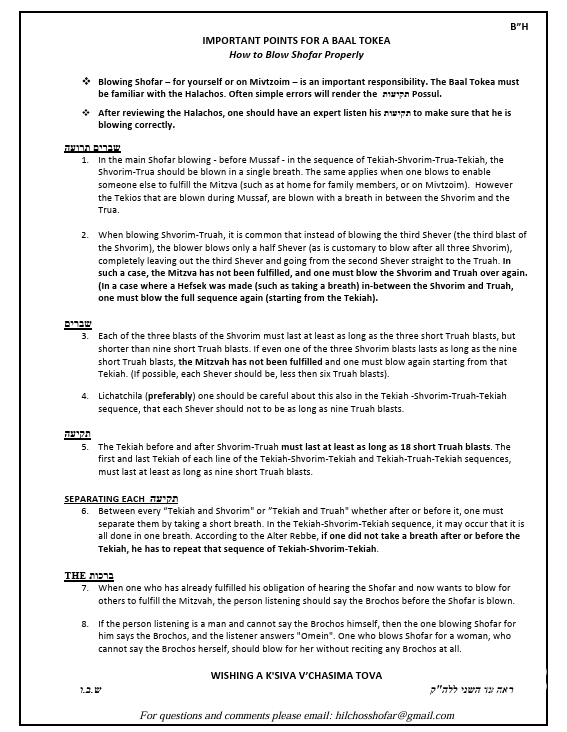
Attached is a recording demonstrating the correct way to blow shofar, including the kol katzar, along with a summary of the relevant halachos for anyone preparing for Mivtza Shofar this Elul and Rosh Hashana.
“Publicizing this information is itself considered a mitzvah,” Rabbi Shmotkin adds.
The following is a sample of the way the shofar should be sounded:
 COMMENTS


I think the shevorims in that recording are too long. They shouldn’t be longer than three turmitin lechtchila.
Possibly the recording was slowed down to demonstrate the sound but not the length.
It’s not too long. It might be exact or maybe slightly longer and it’s practically impossible to calculate exactly and you need to make sure it is at least 3
I would do them slightly longer than these
From this recording is sounds like there are four shevarim plus another short one before the teruos/tekiah.
i hear various recordings of people imitating the Rebbe’s shvorim, from people who were there, and sometimes there are 4 shvorim plus a kol kotzer, and sometimes there are 2, and sometimes there are 3 with 2 short ones at the end. None of those ways make sense to me.
From asking people who were there myself i have gathered from their careful responses that:
1. it was 3 shvorim of equal length with a kol katzer at the end, exactly as described in sefer haminhogim. In the earlier years there may have been more kneitchen but esp in the later yrs – after mem ches etc they were more poshut and not complicated. (the earlier years maybe had more kneitchen BUT also the tekios didn’t go as easily as the later years. so it’s hard to say exactly what kneitchen were bediyuk – especially if that is something that was not always the same – and which ones were from difficulty blowing. in the later yrs the tekios were biderech klal smooth and easy and more poshut in general.)
2. many people were there in 770 but it was not easy for everyone to hear tekios properly especially in the later years when the Rebbe’s tekios were blown softer in general and the crowd was ginormous thereby absorbing a lot of the sound. Add to this that the Rebbe’s shvorim uniquely include a slight change in pitch that is not common in other kreizen. So when you have these factors together it’s possible for someone to be there, and takkeh hear the Rebbe’s tekios, but he may interpret various points in the shvorim where the pitch changes as a break between one shever and the next when in reality it’s the same kol because some of the sound poshut doesn’t reach him.
As only a lubavitcher would understand the following language — If you are standing in the washing machine, you can see the tekios and maybe hear them too but anywhere else lav davka.
והעיקר משיח נאו