



כ״ג תמוז ה׳תשפ״ו | July 8, 2026
50 Years Apart, a Smile Opens Doors for Chabad
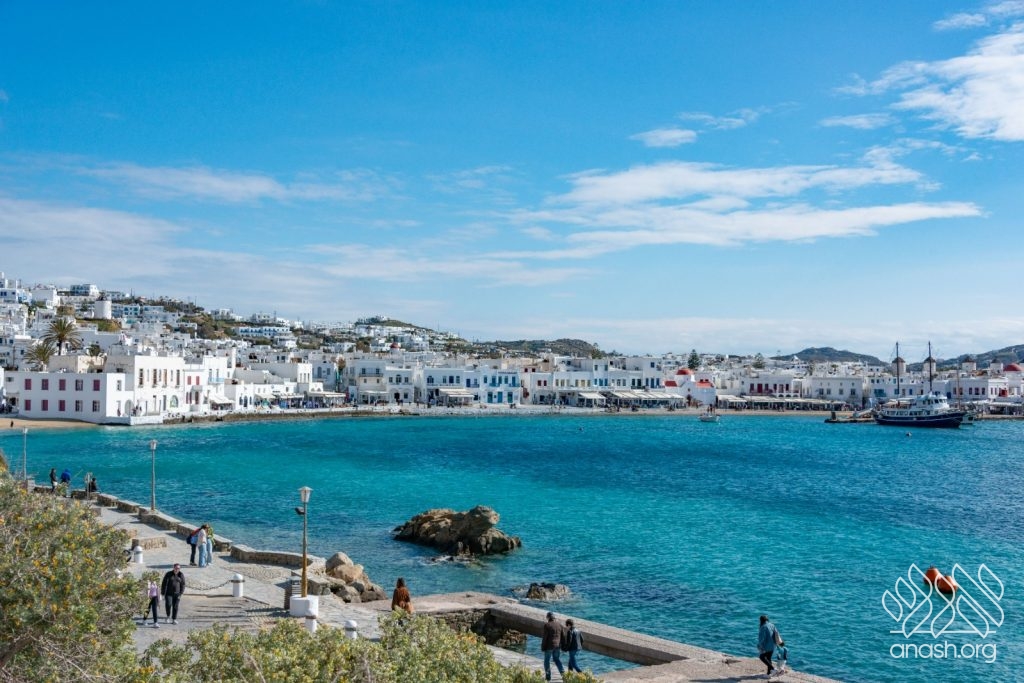
Fifty years after a smile helped a shliach secure a building for Jewish education in Lyon, the same message from the Rebbe opened the door to a new Chabad house on a Greek island.
By Yerucham Yitzchak Landsman – Mishpacha Magazine Hebrew
When R’ Shlomo got married, he and his wife knew that soon they’d be leaving Eretz Yisroel to carry out the Rebbe’s shlichus somewhere in the world. They’d each grown up as children of shluchim, raised on the Rebbe’s teaching that a yid doesn’t live for himself, but to help more and more yiddishe neshamos come closer to Hashem, learn Torah, and keep mitzvos.
Soon enough, they found their shlichus in a large city in China, where a Jewish school was needed for the Israelis, businesspeople, and diplomats living there, along with classes for adults and children, to supplement what the city’s veteran shliach was running on his own.
For seven years, they lived in that city, building up a school and a community they could be proud of, reaching the souls of local Yidden and visiting businesspeople alike, and giving them a taste of real Yiddishkeit.
Then COVID hit, and the community they’d built nearly came apart. A large portion of the families left, and the institutions they’d spent years building were badly weakened. In the years that followed, they tried to bring the school back, but it eventually became clear that most of the families were gone for good. They closed the school and continued with their smaller shiurim. The Rebbe’s shluchim follow in the footsteps of the meshaleiach, not giving up on a single Yid.
But eventually, their shlichus was not sustainable. They returned to Eretz Yisroel, where they’d both grown up, and started looking for their new place of shlichus.
This time it was a lot more complicated. R’ Shlomo and his wife were nearing forty, with children of their own, and starting from scratch somewhere new, planting Yiddishkeit from the ground up, wasn’t a simple matter. Yet it never crossed their minds to do anything else.
In the winter of this year, they discovered a new potential place for shlichus: a popular Greek island, a tourist destination that draws huge crowds. Plenty of Jews live there, earning a living from the tens of thousands of tourists who pass through each year. As well, thousands of Jewish travelers are glad to meet Yidden providing kosher food, tefillin, and shiurim along the way.
The opening of the new Chabad was set for Pesach. They would assist families and young Jews spending Pesach away from home with the mitzvos of the night – matzah, the Haggadah, and the four kosos. What greater start could there be for a new Chabad house?
But just as everything was set for their flight in Adar, war broke out with Iran. The skies shut down, and the whole plan got pushed off until after Yom Tov.
After Pesach, R’ Shlomo flew out to start looking for a building to rent for the Chabad house. He went from place to place, asking around, but came up empty every time. The locals explained how things worked there: “All the real estate here, buying, selling, renting, gets done over the winter. The second spring hits, tourist season starts, and everything’s already booked.”
For a moment, he felt discouraged. But a shliach doesn’t give up so quickly. For two days, he kept at it, meeting with brokers the locals had pointed him to, but nothing came of it. By the third day, he was starting to feel real despair. It was Thursday, the 13th of Iyar.
He called a close friend, a shliach in Ashkelon, but the call went unanswered. Half an hour later, the friend called back and listened to him out. Shluchim understand each other’s language, and not being able to find a building for a new Chabad house is a difficult kind of struggle.
“Listen,” he said, in a calming voice, “I’m on my way right now with a few of my students to the kever of the Arizal and Rabbi Shimon bar Yochai for Lag B’Omer. We moved our trip to Meron up a few days because of the expected closure of the mountain over the war. I missed your call because we’d just stopped to farbreng a bit with Reb Yosef Yitzchok Gurevitch, the mashpia in Migdal HaEmek, and I have a message for you from the Rebbe.
“At the farrbengen, we had asked him to share a story about the Rebbe, and he told us a story about his brother, Rabbi Shmuel Gurevitch, the Rebbe’s shliach in Lyon, France.
“About fifty years ago, the Rebbe sent Rabbi Shmuel Gurevitch to Lyon, which at the time was a spiritual wasteland. Rabbi Gurevitch gave himself no rest, and today Lyon has a large Jewish community, with schools for all ages and shuls throughout the city, the fruit of his far-reaching work.
“Not long after he went out on shlichus, he spent a few days in New York and went to the Rebbe for yechidus. The Rebbe turned to him with a touch of displeasure and said, ‘I don’t know what’s going on with you. You were sent on shlichus to Lyon, and now I hear that one time you’re off to Paris, another time to Toulouse, another time somewhere else.’
“What was happening was that family matters had forced Rabbi Gurevitch’s wife to be with her mother in New York, leaving him alone in Lyon, so for Shabbosos he’d travel to nearby cities to spend time with other shluchim and learn from how they ran their Chabad houses. The Rebbe knew the reason, but didn’t accept it. He went on:
“‘Had they sent me on shlichus to Lyon, I wouldn’t know what to do with myself, every single moment I’d use to bring in one more child to a Jewish education. You need to decide if you want to be a shliach there, and to do it with joy!’
“Rabbi Gurevitch didn’t know what to say. Then the Rebbe gave him an encouraging smile and added a few words: ‘Remember, the French don’t like sour faces.’
“Rabbi Gurevitch took it as a clear instruction. He went back to Lyon and threw himself into the shlichus with everything he had, and, in line with the Rebbe’s words, he made a point of smiling and bringing joy wherever he went and to whomever he met.
“His first and most urgent project was building a Jewish school. His acquaintances in the city tried to talk him out of it, explaining that it was hopeless since the French government didn’t encourage new private schools. ‘Don’t waste your time,’ they told him. But the Rebbe’s words kept echoing in his head: ‘Had I been in Lyon, I’d use every moment to bring a child into a Jewish education.’
“He put in a request for an allocation for a school, and just a few days later got an official invitation to meet with the mayor, something that, by all accounts, wasn’t supposed to happen that fast.
“At the meeting, the mayor told him he’d decided to give him a large, newly built building, originally meant for a regional school. It turned out the area didn’t actually need another school, so he handed it over gladly.
“‘To be honest,’ the mayor said, ‘there were other groups that wanted the place, even a church that applied. But I chose to give it to you because in your application, you wrote that you’re a chossid of the Lubavitcher Rebbe. I didn’t know what a chossid was, so I looked it up, and it said a chossid is a joyful Jew.
“I like a positivity and joy. I saw your smile and understood that that’s what you are. So I decided to give you the school, and do what I could to help.’
“Rabbi Gurevitch heard that and immediately thought back to the Rebbe’s words: ‘The French don’t like sour faces.’
“The school went on to develop into a large educational campus, which today fills several buildings where Lyon’s Jewish children are educated.”
The Ashkelon shliach finished telling the story which had happened over fifty years earlier, and then added: “So there’s your message from the Rebbe: go out with a smile, and with Hashem’s help, everything will work out.”
Less than a day later, Reb Shlomo got a call from a local broker he’d already spoken to before, conversations that hadn’t led anywhere. “I’ve got an amazing property for you,” the broker told him, “right in the area you wanted.”
It was early morning on Friday, Pesach Sheni. R’ Shlomo hurried over to the main street and found the exact spot he’d been looking for: two spacious floors, perfectly suited for a Chabad house, an upper floor for a shul and a lower floor for a Shabbos seudah room and a kosher restaurant. It was a perfect fit. He was getting excited about the place when a nearby neighbor sighed and said, “I know the owner. He’s basically already closed with another family who saw the property. He’s probably just showing it to you to use as leverage in the negotiation.”
R’ Shlomo was taken aback. He called the broker again, who admitted as much, but said the owner wanted to hear one more offer before closing.
Sure enough, the owner spoke with him pleasantly and asked for a price. The new shliach named a figure.
“I’m sorry,” the owner said, polite but firm, “I already got a much better offer, and they’re willing to pay a full year upfront.”
R’ Shlomo was disappointed, but he pulled himself together and rushed to the airport to fly back to Eretz Yisroel for Shabbos with his family.
After Shabbos, he got a call from the broker: the owner of that building changed his mind. He wanted to close at the price R’ Shlomo had offered, and was even willing to drop the demand for a year’s rent upfront.
They met, and Reb Shlomo couldn’t contain himself. “I don’t understand,” he asked the owner. “You had a much higher offer, with full payment upfront. Why come back to me?”
“How can I explain it?” the owner said. “You showed up here with a huge smile. You gave off a positive energy. I just felt it would be good to close this deal with you.”
A few days later, they signed the contract. At the signing, the owner told R’ Shlomo that he’d gone, on his own initiative, to the registry office and changed the zoning on the property to general use, so it would work for a Chabad house. R’ Shlomo thanked him, and asked, “What did I do to deserve you taking care of that for me, instead of leaving me to deal with all that bureaucracy?”
“Because you’re a happy person, and your energy is so positive. I felt like I had to do this for you, to help you with the good work you’re going to do here.”
The shliach stood there stunned. It was almost a copy of what had happened in Lyon. A message from the Rebbe had once again helped a shliach secure a building for his Chabad house, simply because he’d kept a bright face and spread joy, just like Rabbi Shmuel Gurevitch had done in Lyon decades earlier.
 COMMENTS


Thanks for sharing!
B”H Very true and inspirationa. I see how in teaching students and reaching parents, a smile and positive attitude makes all the difference. Yasher koach for a well written and detailed story that was truly human.
The achievements of Hagaon Harav Shmuel Gurewitz Shlita are measured not only by the thousands of lives he has inspired and brought closer to HaKodesh Boruch Hu through his lifelong devotion to Torah and avodas Hashem. They are reflected just as profoundly in the remarkable dynasty that has flourished within his own family – a generation of children and descendants who embody his ideals and continue his sacred mission.
Among them is Harav Lippe Gurewitz Shlita, whose life and work, together with his Rebbetzin Shetichye’, have become a powerful source of Torah, “chessed”, and inspiration. They have become the Ribbono Shel Olam’s devoted shluchim through whom, He literally saved both my physical life and my spiritual life.
May this extraordinary dynasty continue to bring kedushoh into the world, illuminating Klal Yisrael with Torah, emunah, and ahavas Hashem, until the day when we merit the coming of Mashiach במהרה בימינו.