




ל׳ מרחשון ה׳תשפ״ז | November 10, 2026
The White House Call That Transferred an Army Doctor to 770
In a podcast interview, Rabbi Raleigh Resnick of Pleasanton, California, recounts how his father, Dr. Larry Resnick AH, came to care for the Rebbe following the heart attack of 5738. He also shares the story of his parents’ shidduch, their relationship with the Rebbe and Rebbetzin, and the lessons he learned from the Rebbe’s constant guidance to push beyond one’s best.
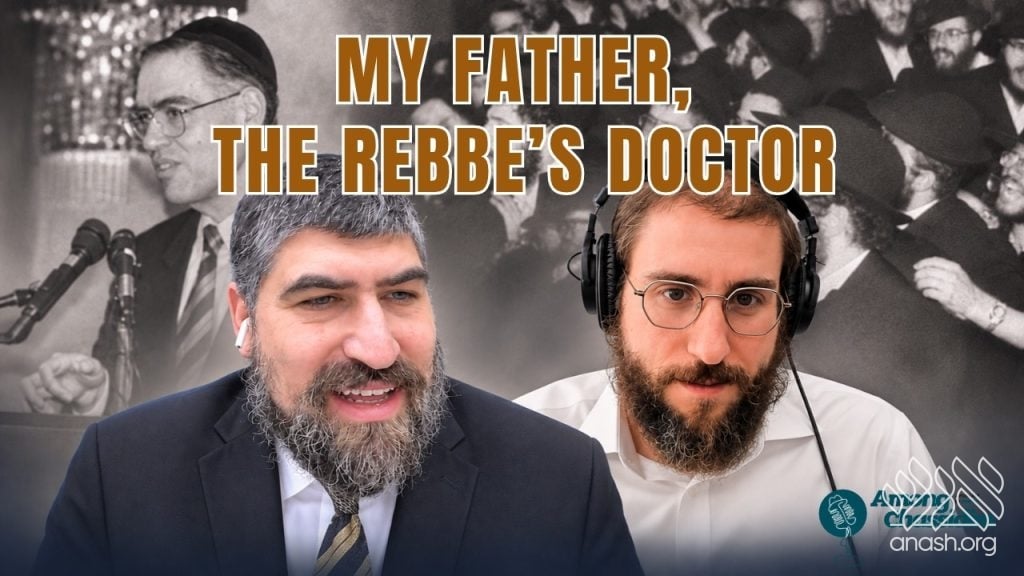
In a podcast interview marking Rosh Chodesh Kislev, Rabbi Raleigh Resnick of Pleasanton, California, shares the story of how his father, Dr. Larry Resnick AH, was called upon to join the Rebbe’s medical team. He also recounts how his parents met, the Rebbe’s involvement in their lives over the years, and what he learned from the Rebbe’s constant demand to give more than one’s best.
Dr. Resnick grew up in an ordinary Chicago family, with a cousin who was close to Lubavitch. After being proclaimed the youngest doctor in the country in his year, he was drafted into the army as a physician and placed in charge of a clinical research center at Tripler Army Hospital in Honolulu.
When Rabbi Leibel Groner called him following the Rebbe’s heart attack, Dr. Resnick provided names and suggestions, assuming that would be the extent of his involvement. A week later, he was in Crown Heights.
The other doctors had practices and families to return to, and someone needed to remain in 770. Dr. Resnick was unmarried, and he could stay, but there was one problem: overstaying his army leave could result in a court-martial.
One day, the phone rang in the mazkirus office. On the other end was the office of Hamilton Jordan, President Jimmy Carter’s chief of staff. Through various efforts, Dr. Resnick remained in the Army, assigned to 770 Eastern Parkway.
He moved from a three-bedroom condo into Reb Dovid Raskin’s small office, while members of the mazkirus staff were taught to monitor the EKG machines and alert him if anything looked irregular.
Even after Rosh Chodesh Kislev, Dr. Resnick did not leave. He remained in Crown Heights, where he learned with young bochurim and grew closer to Chassidus and the Rebbe. He spent many hours with the Rebbe, including long walks as the Rebbe regained his strength, and continued to be involved in the Rebbe’s medical care for years afterward.
“He was there in one capacity, as a doctor,” Rabbi Resnick says, explaining that his father took that responsibility very seriously. The doctors’ job was to limit how much the Rebbe spoke, and his father described the negotiations over the exact amount of time.
On one occasion, he asked the Rebbe who dictated the format of a farbrengen, including when a nigun should end. The Rebbe turned to him with a smile and replied, “That’s my job. I run the farbrengens.”
His parents’ shidduch also came about through the Rebbe. His mother, a television producer at NBC, had become a baalas teshuva, and the Rebbe took it upon himself to serve as the shadchan. At one point, his mother wanted to interview the Rebbe, and she merited an hour-long yechidus in 1980.
The wedding was held at Rabbi Gansburg’s home across from the Rebbe’s, with the Rebbetzin watching through binoculars. It was timed so that as the Rebbe returned from 770, he would pass by and wish the kallah mazel tov. The Rebbe in fact asked that the wedding be scheduled for Tes Shevat rather than Yud Shevat, so that it would not create a conflict of interest. A sheva brachos was held at the Rebbe’s farbrengen.
Years later, when the Rebbe suffered a stroke at the Ohel on Chof Zayin Adar, Rabbi Resnick remembers the phone ringing at home.
“My father got into a taxi. The taxi driver had actually once been a race car driver. My father gave him a big tip and said, ‘I really need to get to Crown Heights as soon as possible.’ My father got there before the ambulance arrived.”
Throughout the years, the Rebbe was closely involved in the family’s lives. The Rebbe pushed Dr. Resnick to excel in his research, even encouraging him to aim for a Nobel Prize. Whenever his father would say he was trying, the Rebbe’s response was always the same: “Not only your best, but much more.”
During Dollars, the Rebbe would repeatedly ask his mother whether she was speaking publicly. When she replied that she had not received any invitations, the Rebbe told her to get herself invited.
In one exchange, his mother asked the Rebbe for “a little” bracha, while his father asked for a “small” bracha for his research. The Rebbe wondered what was wrong with them. Hashem is great and can give abundantly, he explained, so why ask for so little? Big is the main thing.
When a bochur asked Dr. Resnick what it was like spending all this time around the Rebbe, he answered, taking an example from a professional football game, “You play a game, and people play really, really hard, but then there’s the two-minute warning. And after the two-minute warning, everyone goes into overdrive. Being around the Rebbe was being around someone who lived life after the two-minute warning. There’s always an intensity. There’s always an immediacy. There’s always an urgency.”
Rabbi Resnick warns against falling into the modern trap of avoiding pressure for ourselves or our children. Pressure, when applied correctly, is a very good thing and brings out the best in us. A person is only satisfied after he exerts himself and goes beyond his limits.
“We all know that the more selfless we are, the more we give of ourselves, and the more dedicated and devoted we are, the better we ultimately feel. Are we producing a happier society by becoming more selfish, more self-indulgent, and taking more time for ourselves? Can anybody honestly say, ‘I feel so great today because I thought about nobody other than myself’? It’s not true. A day when you feel good is a day when you forget to eat. What happens on a not-so-good day? All you do is eat. That’s human nature, and how Hashem created us.
“For 40 years, the Rebbe told us this day in and day out. The Rebbe didn’t sleep, and he didn’t let us sleep. I’m old enough to remember finishing the Shabbos meal and running right back to 770. Everybody was running back.”
Among Chassidim is a podcast by Derher, hosted by Rabbi Yossi Kamman, director of A Chassidisher Derher. The podcast captures the vibrancy of dor hashvi’i through immersive, in-depth conversations. To view all episodes, visit the Among Chassidim YouTube channel.
WATCH

Spotify: https://tinyurl.com/AC71SP
Apple Podcasts: https://tinyurl.com/AC71AP
Google Drive: https://tinyurl.com/AC-GoogleDrive
 COMMENTS


We appreciate your feedback. If you have any additional information to contribute to this article, it will be added below.