




כ״ו סיון ה׳תשפ״ו | June 11, 2026
The Interview of a Lifetime with Rebbetzin Chaya Mushka
In a rare personal conversation, Rebbetzin Chaya Mushka shared with Rabbi Sholom Ber Levine the remarkable story of the Rebbe and Rebbetzin’s wartime escape from Nazi-occupied Europe, revealing firsthand details of their thirteen-month journey that culminated in their arrival in America on Chof-Ches Sivan 5701.
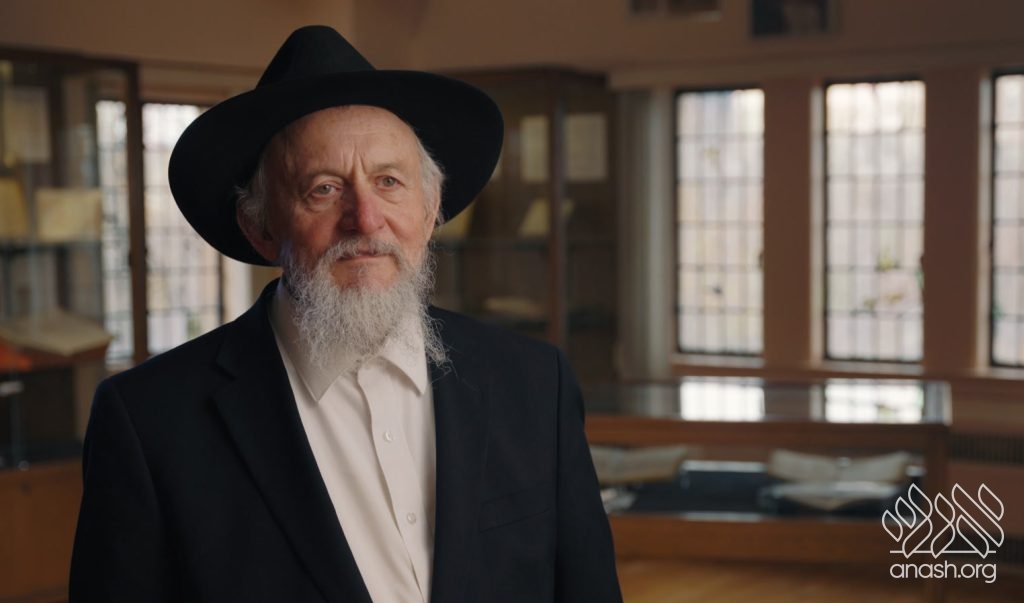
Rabbi Sholom DovBer Levine is an author, historian and researcher, who has published many books pertaining to the Chabad Movement and its leadership. He serves as the director and curator of the Chabad-Lubavitch Library. He was interviewed three times, in 1994, 2007 and 2023.
Six years after I started working in the Rebbe’s library at Chabad Headquarters, where one of my tasks was gathering letters and manuscripts of the past Rebbes and preparing them for publication, I developed a connection with Rebbetzin Chaya Mushka.
This came about because, starting in about 1982, the Rebbe and the Rebbetzin began staying in the library for Shabbos. By then, the Rebbe was in his eighties and had survived a very serious heart attack. During the week, he could be driven back and forth from his home on President Street to 770 Eastern Parkway, but on Shabbos, this was obviously impossible.
To accommodate the needs of the Rebbe and the Rebbetzin, my office in the library was turned into a living room, and other areas into a dining room, kitchen and bedroom. Because the Rebbetzin was now a frequent visitor in my workspace, I got to know her and began to feel comfortable speaking with her.
In 1983, I was working on the fifth volume of the letters of Rebbetzin Chaya Mushka’s father, the Previous Rebbe. These letters had been written at the beginning of World War Two, between 1939 and 1941, and some of them concerned the extraction of the Rebbe and the Rebbetzin from France during the Nazi occupation.
As I read the various letters, I was confused about their travels through France. The cities named in the letters were Paris, Vichy, Nice, Marseilles, and Lisbon, Portugal. I felt that it would not be appropriate for me to ask the Rebbe about details of his personal life, but I needed to know the background in order to make sense of the letters. So, instead, I decided to ask the Rebbetzin.
The occasion presented itself one Friday just before the onset of Shabbat, after the Rebbetzin lit Shabbat candles and the Rebbe went off to pray. I requested to speak with her then, and I explained to her that I was editing her father’s letters and needed to write an introduction describing the background, but I could not quite grasp what had happened. Could she help me?
She heard my question and thought about it for a while in silence. In truth, I expected her to tactfully decline, but to my surprise, she began to recount the whole story.
She said that, in those days, before the Nazis occupied Paris, it was quite dangerous for a young man to walk on the streets. The French police could grab him and take him away to fight in the war. So the Rebbe enlisted in the civilian guard and received a certificate that he was a registered recruit. With this certificate, he could walk on the streets without being harassed.
But when the Nazis occupied Paris, and indeed most of France, every Jew was in grave danger, not to mention a Jew who was also a recruit, and so the Rebbe and the Rebbetzin had to flee. The first place they went was Vichy in the Free Zone, which the French still controlled. They left Paris just before Shavuot and arrived in Vichy when twilight had already begun.
To reach their hotel, the Rebbe hired a horse and wagon for the Rebbetzin and all their many suitcases. Although one is not normally allowed to ride on a holiday, when one’s life is at risk it is certainly permissible. Nevertheless, the Rebbe walked alongside the carriage all the way to their destination.
Now here I must explain why they had so many suitcases.
Some years before this, the Previous Rebbe told his secretaries that for every letter of public interest that he wrote, they should make an extra carbon copy and send it to his son-in-law, who would become the future Rebbe. So this is how the Rebbe acquired hundreds of letters written by the Previous Rebbe.
In addition, the Rebbe had also made photostat copies of many manuscripts of discourses by the Previous Rebbe’s father, the Rebbe Rashab. This was a lot of precious material. But he brought it all with him from place to place, even though it was wartime.
The Rebbe and the Rebbetzin remained in Vichy for several months, but with the French cooperating with the Nazis, it was not safe for Jews there, so at the end of the summer of 1940, they moved to Nice, which was under the occupation of the Italian government and somewhat safer.
While in Nice, they applied for papers to immigrate to the United States, but these were a long time in coming.
Meanwhile, the Previous Rebbe, who was already in America, was doing all he could to get them permission to immigrate. He was writing letters to various individuals, trying to get them exit visas, entry visas and all the necessary papers.
Some of this correspondence went to Nice, but I noticed that at some point, during the winter of that year, it was sent to Marseilles, although they remained in Nice. The Rebbetzin clarified that it was easier to receive travel documents from the American consulate in Marseilles, and these finally came through at the end of Passover of 1941.
However, although they now had the correct papers to enter the United States, they had no way to get there from France. It turned out that the best option was to board a ship in Portugal. For this, they required a transit visa, which was hard to obtain.
The Previous Rebbe contacted Rabbi Nissan Waxman in Lakewood, who had a brother-in-law with connections, and this individual was able to arrange a transit visa for them. And that is how, after thirteen months of effort, they finally managed to get out of Europe, arriving in America on the 28th of Sivan.
The Previous Rebbe was overjoyed, and that very day he wrote a thank-you letter to the people involved in their extraction, notably to Rabbi Dovid Meir Rabinowitz, whose son was instrumental in getting them some of the necessary papers. Incidentally, it is from this letter that we know the exact date of the Rebbe and the Rebbetzin’s arrival in the United States.
I recounted this entire story in my introduction to the collection of letters of the Previous Rebbe from this period, but I did not state there that all this information came from Rebbetzin Chaya Mushka because I knew that, being such a private person, she probably would not have liked that. But I think now, after so much time has passed, I can testify that it all came from her.
 COMMENTS


We appreciate your feedback. If you have any additional information to contribute to this article, it will be added below.