




ח׳ אלול ה׳תשפ״ו | August 21, 2026
Start Treating Your Yeshivah Like a Chabad House
In a candid interview, Rabbi Uri Perlman, founder of the Wilkes Yeshiva, discusses why the tone and approach of yeshivos toward bochurim needs to shift, and explains how his yeshiva was built on a diffrent model.
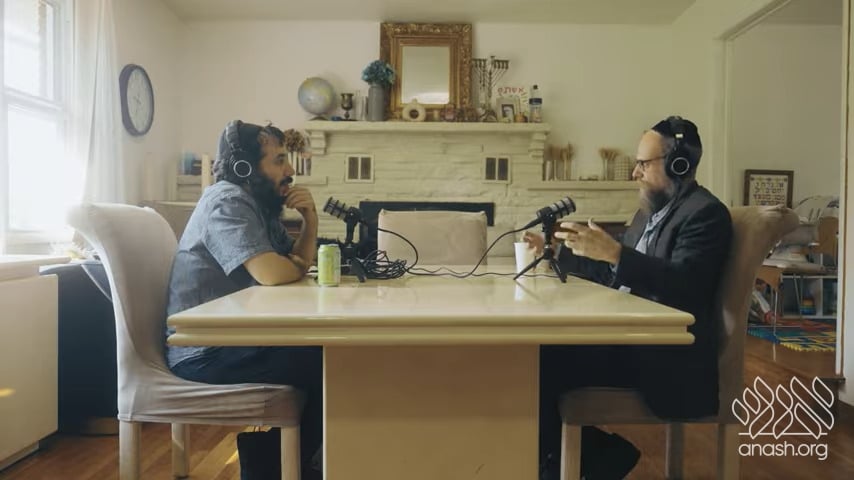
In a podcast interview, Rabbi Uri Perlman, founder and director of the Wilkes Yeshiva, now based in Canadensis, Pennsylvania, shares his own journey from a struggling teenager to the head of a yeshiva built around treating bochurim the way a Chabad house treats its guests.
Rabbi Perlman grew up in Kingston, a small town outside Wilkes-Barre, where his father served as the local shliach, ran the mikvah, and occasionally filled in as rabbi. “It wasn’t this strong identity of a Chabad House; we were just a family in town, low-key,” he recalls.
As a teenager, he began wrestling with questions of identity and belief, a struggle that deepened when he went away for high school in Los Angeles.
R’ Uri describes the disconnect he felt there as mostly religious rather than social. When he asked to spend his day learning seriously alongside older bochurim instead of sitting through secular studies he had already mastered, he was turned down and threatened with expulsion if he pushed the issue.
“Sincere wanting more and better and authentic was met with, ‘How dare you question the way we do things?'” he says.
The experience pushed him further away, and after three difficult years he left yeshiva altogether, drifting for a period through Boston and elsewhere.
A turning point came when he enrolled in a yeshiva in Melbourne, Australia, under Rosh Yeshiva Rabbi Binyomin Cohen. Placed in an environment that gave him space instead of scrutiny, he began learning seriously. That year in Melbourne, he says, became the single biggest influence on how he would later run his own yeshiva.
At twenty-two, while still a bochur himself, Rabbi Perlman started what would become the Wilkes Yeshiva with seven students, in the same small Pennsylvania town where his parents were shluchim. He had intended it only as a pilot, expecting established mechanchim to take over once he proved bochurim who didn’t fit the standard mold could succeed.
His mashpia told him otherwise. “No one else is going to do it, so do it. You have to keep doing it.”And he did, despite having little interest in management and administration.
During those years, the bochurim became visible assets to the town, leading the bochurim to feel productive and successful. One of the first major donors, a doctor unaffiliated with the community, gifted a building after watching a group of the yeshiva’s bochurim rollerblading down the street in their tzitzis.
Rabbi Perlman describes the core philosophy behind the yeshiva as an extension of the Chabad house model as applied to chinuch itself. “Start treating the bochurim as your community; make their life your priority,” he says of how mainstream yeshivos should operate.
Structure and standards, while necessary, should never be the point in themselves. “It’s not order versus chaos,” he explains. “Is there order so that the bochurim can be better people or so that the hanhala can sleep better at night?”
He cites internal data tracking of many bochurim who don’t make it through yeshiva, and argues that even among those who do, many are merely surviving rather than genuinely engaged.
Rabbi Perlman describes how his great-grandfather, the renowned mashpia Reb Shilem Kuratin, came to Lubavitch as a boy from a secular gymnasium dressed in shorts. Lacking background, he was driven simply by a search for truth.
He closes by pointing to what he sees as the real obstacle facing mainstream yeshivos: not indifference, but fear of criticism and judgment from parents. Still, he remains hopeful that reality will force change.
“People don’t want to suffer themselves, they don’t want to watch their kids suffer, they don’t want to watch their students suffer,” he says. “We tell ourselves stories to push off the reckoning, but it’s going to come.”
The podcast was conducted by Homesick for Lubavitch.
WATCH

 COMMENTS


Didnt listen to the podcast, but just reading the article. I couldn’t agree more.
I want a chassidishe chinuch for my son bezras Hashem, but honestly I worry about sending him to yeshiva, will they bring out the best in him. Will they just care if he came on time, or will they show love and care as a person, and accept him and bring him in, vs being cold, only awarding academics
I dont have any children that went the mesivta/zal yeshiva system yet, but this point is so beyond important
Children need kiruv, they need you to want them, and be there for their happiness and wellbeing, and love them,
Yemin mekareves, and love is the foundation of chinuch today as the Rebbe so many times emphasised
Please can say Yeshivos reading this make sure this approach happens in your Yeshiva. Lots and lots and lots of Love to each Talmid, wanting the best for them, wanting them to shine.
Btw this is a general approach also for many parents to interanlize.
You need to love your child.
Then they’ll be open to anything your telling them.
You cant be mechanech a child without the foundation of love
Well done for speaking his voice!
Im wondering how the students come out of his Yeshivah? Yes we always need open eyes for improvements but a chassidishe yeshiva must never become a Chabad House whose job is to accept a lower standard of its clients.
lowering standards and caring deeply about the talmidim are not and should never be a “stira”.
this idea that the two are a stira is deeply steeped in our system and imho needs to be clarified.
yes, the yeshivas that deal with struggling students are forced to actually care doesn’t mean that yeshivas who have high standards should somehow care less and show less attention (which is currently the situation) because they can.
like the famous story in gemara השתא נמי דעתאי עלויהו.
also there is a difference between changing standards as a moisad and dealing with an individual where they are holding.
He doesn’t say that we should lower standards. He is only saying that we should change our tone from force to influence. Yiddishkeit and Chassidus can and should be taught in a way that makes students WANT it.
Of course a yeshiva needs rules, but you need to differentiate between Yiddishkeit and policy. Bochurim understand that you need to have rules, but they resent when those rules are packaged as holy.
This interview has a lot to teach to many people B”H. Years ago, my son, one of the top in his class, went off to a yeshiva gedola that taught Gemara on a high level but, as I was told in advance, the hanhala wasn’t known for warmth, love or putting personal effort into the students. His father was not in the picture, and he, of all people, needed that warmth, love, hadracha and answers to his questions. I couldn’t convince him to find a different yeshiva, because his chavrusa/s and friends were going to that one. So he went there. He became influenced by loving, religious non-Lubavitcher relatives who lived near that yeshiva. After Shiur Daled, he dropped out of yeshiva. He has always been on the derech B”H… today he’s pursuing a professional career. The outcome is not bad B”H — but a very talented boy who could have shone as a shliach, Rav, etc. chose to leave yeshiva before Shlichus year and not to go in that direction. Yes, everything is Hashgacha Pratis. Yes, my son does his shlichus in his own way now B”H. Yes, I am very proud of him B”H. I still feel — Where was the hanhala of that yeshiva when he needed THEIR warmth and love and hadracha? I hope that yeshiva has trained their teachers, and brought in new ones by now, to make sure every single bochur gets all that he needs.
Being an excellent learner doesn’t automatically translate to a desire to become a Shliach or Rabbi, roles that would put your son in the public eye and require him to handle people’s problems daily.
Had such a Yeshiva existed for MAIN STREAM, would anyone here be willing to cover its budget?