



י״ח תשרי ה׳תשפ״ז | September 28, 2026
Since When Was Chassidus Meant to Be Self-Serving?
“In the past few weeks, we have had three thoughtful articles wrestling with essentially the same question: What is Chassidus supposed to do to a person? The articles disagree with one another in important ways. But I think they all miss the most basic point.”
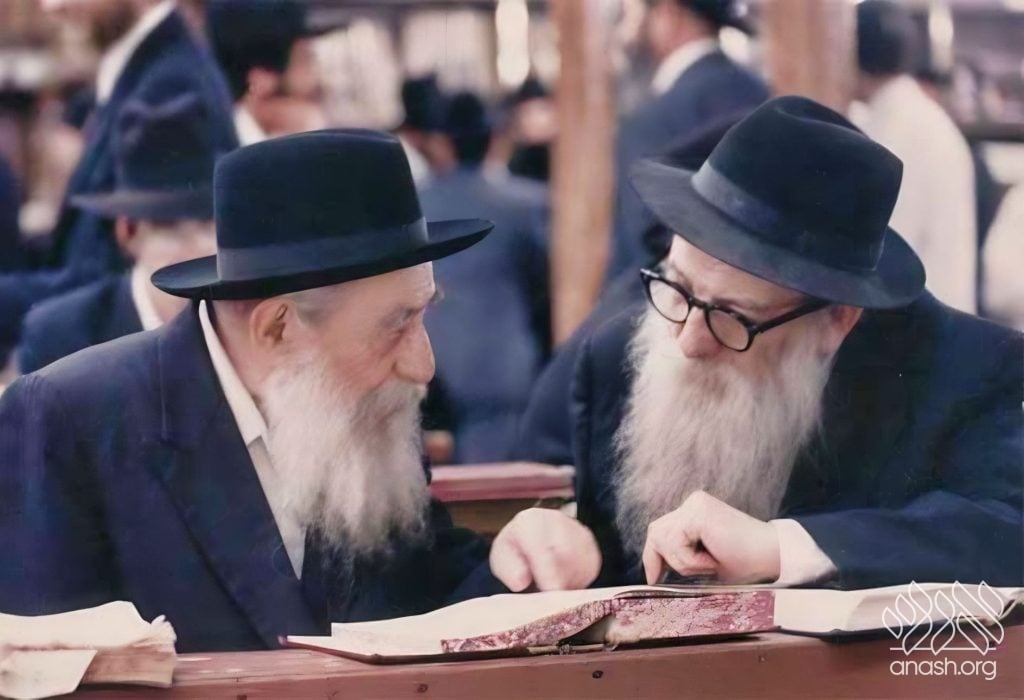 Elder chassidim R' Yudel Chitrik and R' Meir Itkin learning together.
By Rabbi Yosef Y. Cohen
In the past few weeks, we have had three thoughtful articles wrestling with essentially the same question: What is Chassidus supposed to do to a person? Is it supposed to speak to our emotional lives? Should it be “relatable”? Can we have authentic Chassidus that also addresses the person sitting in the room?
The articles disagree with one another in important ways. But I think they all miss the most basic point.
Imagine we were having the same discussion about Gemara. “What is the point of learning Gemara if it doesn’t change you?” “Gemara has to lead to practical avodah.” “We need to make Gemara relatable to people’s lives.” “Learning Gemara is meaningless if the person remains exactly the same.” We would rightly respond: What kind of question is that?
We learn Gemara because it is Torah. Because this is what Hashem taught Moshe Rabbeinu. Because the chochmah of Torah is the chochmah of Hakadosh Boruch Hu. Certainly, the Torah changes a person. It is supposed to change a person. But that is not why Torah is Torah.
Nobody would suggest that a person who sits for three hours learning a sugya in Bava Kama has somehow failed because he cannot point to an emotional or spiritual benefit he received from it. He learned Torah.
So why do we suddenly need a different justification for Chassidus? Chassidus is Torah all the same.
But there is more to it. The Rebbe addresses this issue in the Kuntres “ענינה של תורת החסידות.”
The Kuntres discusses the many different maalos that are found in Chassidus. Chassidus enables a person to understand Elokus. It brings the deepest concepts of Torah closer to human understanding. It affects the person. It has implications for avodah. One could easily take all of these things and say: This is what Chassidus is for. But the Rebbe says precisely the opposite.
“מובן ופשוט כדלקמן, אשר תורת החסידות היא נקודה אחת שאינה מורכבת מפרטים שונים.”
The different maalos do not define what Chassidus is.
“מהותה של החסידות היא נקודה עצמית המופשטת מענינים פרטים, אלא – מצד נקודתה העצמית, נמצאות ומסתעפות ממנה מעלות הנ”ל.”
The various qualities of Chassidus are not its essence. They are הסתעפויות from its נקודה העצמית. They are extensions stemming from its quintessential point. And what is that נקודה עצמית? The Rebbe describes it as “המשכת בחי’ א”ס שנמצא ברדל”א.” And then comes the line that is especially relevant to our discussion:
“כי מכיון שהחסידות היא המשכת בחי’ א”ס, הרי מובן ופשוט אשר ‘אין סוף’ הוא העצמי, וכל שאר הענינים אינם אלא נמצאים ומסובבים ממנו.”
In other words, even when we speak about the many things Chassidus accomplishes, we must not confuse those things with what Chassidus essentially is. They are הסתעפויות. They are consequences. They come from the נקודה העצמית. They do not define it.
We have become used to asking what Chassidus is for. Is it for avodah? Is it for bittul? Is it for better middos? Is it for emotional health? Is it for meaning? Is it for personal transformation? But the Rebbe is telling us that even the greatest מעלות that we can name do not define the essence of Chassidus.
Chassidus certainly has to affect avodah. The Rebbeim demanded avodah. Chassidus is not meant to remain an intellectual exercise disconnected from a person’s life. But that doesn’t mean avodah is the reason that we learn Chassidus.
There is a difference between “Chassidus leads to avodah” and “I learn Chassidus in order to produce avodah.”
If I sit down to learn Chassidus because I want to become a better oved Hashem, I already changed the nature of the learning. I’m taking something that should be learned because it is Torah and making its effect on me the purpose. That’s a form of shelo lishmah. Chassidus should certainly make me a better oved Hashem, but I learn it because it is Torah. The avodah comes because of what Torah is.
And if that’s a subtle form of shelo lishmah, how much more so when the stated purpose is emotional well-being: “I’m learning Chassidus because it helps me feel better,” or “because it gives me emotional stability,” or “because it helps with my anxiety,” or “it helps me understand myself.” Now the Torah has become a means toward my own emotional state. The learning has turned toward me, and that’s the opposite of what Chassidus teaches.
This is especially relevant because we are living in a time when “wellness” has become almost a religion of its own: “How am I feeling? Am I okay? Am I fulfilled? Am I regulated? Am I healing?” And now even Torah is being asked to answer those questions: “What does Chassidus do for my anxiety? How does it help my self-esteem? How can it improve my relationships? How can it make me happier?”
There’s nothing wrong with being healthy. There’s nothing wrong with getting therapy when therapy is needed. There’s nothing wrong with dealing responsibly with genuine emotional difficulties. But there’s another phenomenon, and that is when the obsession is with emotional wellness itself. We can become anxious about our anxiety. We can become preoccupied with whether we’re sufficiently healthy.
We can spend our entire lives checking our internal dashboard: “Am I okay? Am I sufficiently happy? Am I processing my feelings properly?” At a certain point, the person has become completely preoccupied with himself.
One of the greatest things Torah can do for us is take us out of ourselves: Look at Hashem. Look at Torah. Look at another Yid.
The irony becomes particularly striking when this is done with Chassidus. Chassidus is the part of Torah that teaches bittul. It is the Torah that replaces the self (אני) with “אין עוד מלבדו.” And somehow we turn it into a sophisticated system for becoming more preoccupied with the “אני.”
Despite their thoughtful insights, the recent articles are all missing the same point. One warns against reinventing Chassidus through psychology and emphasizes that Chassidus is about Elokus and avodas Hashem. Another responds that the nimshal of Chassidus must ultimately reach the person and that Chassidus cannot leave the person behind. The third argues that perhaps we can have both authenticity and relatability.
These are important discussions. But all three are still largely taking for granted that the fundamental question is what Chassidus is supposed to do to the person.
Kuntres ענינה של תורת החסידות demands to take one step back. Before asking what Chassidus does to me, perhaps we should ask what Chassidus is. And the answer is not another function, not even “avodah.” The various מעלות we can identify in Chassidus do not define its essence. They all come from the נקודה העצמית.
That means that even “Chassidus changes a person” is not a definition of Chassidus – it’s a result. “Chassidus brings a person to avodah” is a result. Even the fact that Chassidus can illuminate a person’s inner life is a result. And certainly emotional wellness cannot become the definition.
This also changes the way we should understand the word “relatable.” If relatable means understandable, accessible, well taught, and properly communicated, absolutely. If it means that a mashpia should know how to explain a maamar to the person sitting in front of him, certainly. If it means showing how the truth of Chassidus actually enters into avodah, of course.
But if “relatable” means that the Torah must first become relevant to my psychological world in order for me to value it, we have gotten the order backwards. Perhaps I don’t need to make Chassidus relatable. I need to learn to relate to Chassidus.
Perhaps I need to encounter something that is bigger than my emotional world, something that does not exist to validate me or to make me feel better, something that simply is אמת.
I don’t have to walk into a maamar asking, “What am I going to get out of this?” I can walk into a maamar asking, “What does Torah have to tell me about Hashem?”
And then something remarkable may happen. I may become a different person. I may daven differently. I may become more battel to Elokus. I may become more sensitive to another Yid.
I may even become less anxious. But that’s not why I learned it. I learned it because it is Torah.
We’ve been arguing about whether Chassidus is about us or not about us, whether it should be authentic or relatable, whether it should change us or speak to us. Perhaps the answer is much simpler.
Chassidus isn’t something we were given to make our lives better. It is something we were given because it is Torah, because it is Elokus, because it is a גילוי of the deepest נקודה of Torah. And precisely because of what it is, all those other things can come from it. The avodah, the bittul, the refinement, the transformation, the ability to see another Yid differently, even the healing of parts of ourselves.
But let’s not confuse the הסתעפות with the נקודה. Let’s not turn Elokus into therapy or Torah into wellness. Let’s not make avodah the reason to learn Chassidus, and certainly not our emotional well-being.
Let’s learn Chassidus because it’s Chassidus. Because it is Torah. Because it is Elokus. Because “אורייתא וקוב”ה כולא חד.”
And then, please G-d, let it change us.
 COMMENTS


I would just add that “mitoch shelo lishma bah lishma- from doing it not lishma it will come to lishma” so if the only way a yid will learn chassidus cause it will help him- that’s great too. So we can use this article to help ourselves not get stuck with shelo lishma and even that yid can know that eventually that’s what he can aspire to. Makes sense?
100%
Nice article and addition in the comment
Quote from article:
“There’s nothing wrong with being healthy. There’s nothing wrong with getting therapy when therapy is needed. There’s nothing wrong with dealing responsibly with genuine emotional difficulties.”
Wait.
There is nothing wrong with being healthy? Are you sure? What does healthy even mean in this context?
And then the second two lines imply that:
A) Genuine emotional difficulties are outside the parameters of Chassidus.
B) The way to “Deal responsibly” with these emotional difficulties is getting therapy.
Hashem Yishmor.
You are suggesting that we keep chassidus separate from emotional health and run to secularly trained therapists for our deepest challenges…
And THAT’S the real way? That is what the Rebbe had in mind for us?!
Many people know how to learn chassidus in a way of chochma, binah and also da’as… a way that actually changes our experience of reality. Even our deepest emotions and “emotional difficulties.”
And if you believe that chassidus has limitations and it can’t make a difference to real emotions… that is sad and tragic.
Have you learnt Chasidus or have you only bought lokshen?
If I would learn more chassidus, would it help me realize that it doesn’t apply to my “emotional difficulties”? Would it inspire me to deal with those difficulties “responsibly” by going to a secularly trained therapist?
You are missing the whole point of the article and making a massive deal out of a tiny detail, the only explanation I can think for such a comment is that it was written by the author of one of the other articles and are offended by an article which was written better and more true than their article
The fact that 3 lines in the article represent a disconnect… it’s only a detail of the article, so it doesn’t matter?
Did I get that right?
When you have an ailment you seek out a dr who learn chassidus? If there’s an emotional illness and it really needs help, it belongs to a professional. What does that have to do with chassidus?
משתמש בכתרו של מלך לצורך עצמו, רחמנא ליצלן
Yes, there are multiple sichos about the benefits of chassidus, as related to avoda, I don’t think we can find anything about how it helps us in therapy. Even so, the. Rebbe tells us in many places, thst even avoda is not whst chassidus is about, yes, it is oxygen and coals and pearls. . But it is really more than all of that. As explained in the article.
Without Torah as explained in Chassidus, being oriented in the world properly, a person has symptoms. And those can look emotional too. Because living with a substitute ego and sense of orientation in the world does show up in all areas- intellectual, the way things are understood and related to emotionally, and even sometimes subtly in behavior.
But those things, even if subtle, have far reaching effects.
I think this can be seen in the positive effect learning Chassidus has as well.
Its a serious issue when a therapist is being asked to treat the symptoms of this problem. Especially when the therapist – who could be literally anybody with any value system – doesn’t have a healthy Chassidus inspired orientation themselves.
I personally know many therapists and nearly became one myself. Sometimes they have even used Chassidus as a way to explain their own personal way of orientating themselves in the world…
That being said, if that is not the source of the issue, then clearly professional help is needed. Differentiation is key.
Regarding what you wrote:
“A) Genuine emotional difficulties are outside the parameters of Chassidus.
B) The way to “Deal responsibly” with these emotional difficulties is getting therapy.”
I don’t think that’s what the author meant in this article. And to Explain:
Regarding point A) He was simply saying that these aren’t the main point of Chassidus, but can definitely achieve those things.
And regarding point B), I’m not sure if this is what he meant, but I remember when learning perek chof vov in tanya (which talks about dealing with “atzvus”) with a famed mashpia, he said ” atzvus is NOT CLINICAL DEPRESSION, if you have clinical depression, go see a therapist”.
The way I understood this is that Chassidus can only help you when you’re not clinically compromised, Chassidus is here to bring out the best you, which by the way that’s what bittul means, Rabbi Yossi Paltiel says this in literally every shiur of his (check out inside Chassidus btw, really recommend) that the translation of “nullified” for bittul is inaccurate, because it has a negative connotation (“derech shelila”) and its really positive, as the Rebbe says in countless Maamorim, that it brings out your neshama, which is the best version of you.
Therefore, if you have something clinically wrong with someone, emotionally or mentally, than the Chassidus can go in them but THEY can’t express THEMSELVES not that Chassidus can’t go in. It’s like saying that a mentally compromised person Lo Oleinu can be fixed if he learns Chassidus, no he can’t, Chassidus affects and brings out your Neshama, which again is the best version of you. But if the neshama can’t express itself in its body, due to a technical difficulty that the body is unwell chas”v than its not a troubleshooting of Chassidus Chas”v ts a troubleshooting OF THE BODY. And B’H there are ways of dealing with that this day and age through therapy etc.
Which by the way is the same about Hashem. See Mitzvas Ho’emonas Elokus se’if 2 and 3.
I have been in yeshivas for many years, and I’ve seen this time and time again with many bochurim who came from broken homes or had a lot of emotional/mental issues, and they got very involved in learning Chassidus, thinking that it’ll heal them, and in the end crashed. It can only help someone if they’re clinically healthy. and again its not a Chassidus problem chas”v its a them problem, and a lot of them got help b”h and now learn Chassidus.
I tried to be as clear as possible, and would be happy to hear your feedback.
What about the famous sicha where the Rebbe compares learning chassidus to oxygen and to pearls? Chassidus is like ruchnius oxygen. And chassidus gives us a taste of Geula.
The Rebbe clearly describes many benefit to learning chassidus. Many benefits. Multiple times.
Learning Chassidus is different from learning a blatt gemorrah.
Yes, chassidus is Torah.
Yes, the value is the troah itself.
Yes, the focus cant be “me me me me…” the focus needs to be the chassidus itself.
And also, when you learn this way, chassidus gives you ahavas Hashem and Yiras Shomayim, and so many other clear benefits the Rebbe taught about learning chassidus.
Nigla is also ruchniyus oxygen, like the moshal r akiva said that stopping to learn is like taking a fish out of the water But that’s not meant to be why we learn Nigla or chasidus rather just because it’s Hashem’s Torah
As we can see clearly by by the context of that comparison to pearls that it’s not taking about שלימות העבודה rather trying to “convince” people how essential it is to learn chasidus ומתוך שלא לשמה בא לשמה
Thank you Rabbi Cohen,
You nailed it. This is the way we learned Chassidus in yeshiva and this is what brings about true lasting transformation.
Chay Amar
I want a simple answer: if chasidus is the essence why cant I learn everything from it l? If its the essence isn’t equally far and on the other hand close to everything that it isnt meant for one thing more than it is another?
Is there a single Farbrengen in which the Rebbe didn’t mention that Torah is called Torah because it’s Milashon Hora’ah?
Do the words “Toras Chaim — Hora’ah Bachaim” ring a bell by anyone?
Learning Torah in order to become a better person may be the highest form of Torah Lishma. It’s For me to be a better person/yid and be able to create a better dirah b’tachtonim, which is the ultimate goal of the “ein sof” mentioned in the article.
The Rebbe refers to that as shelo lishma bdakus
“But that doesn’t mean avodah is the reason that we learn Chassidus.”
Pretty sure the Frierdiker Rebbe disagrees on that one:
די אלא רייכסטע השכלות פון תורת החסידות, די אלע ברייטסטע השגות פארשטאנדען פון תורת החסידות, די אלע טיפסטע עמקות פון תורת החסידות וואס נעמט ארום די ג’ מוחין חב”ד שבנפש האלקית, וואס ער איז א חלק אלק’ ממעל ממש, איז דאס אלץ לשנות טבעי’ מדותיו.
(סה”ש תרצ”ד עמ’ 267)
The quote you bring is mentioned in that very kuntres. And the Rebbe says they’re that even this is not really what Chassidus is.
The Rebbe says that is not what chassidus “is” doesn’t mean that is not what chassidus “is here to do”.
And I don’t understand the whole discosion all of the Rebbe’s and the Frierdiker Rebbe and the Rebbe Rashab’s torah מלאים בדבר זה
In the לשון the Rebbe Rashab about י”ט כסלו (in the beginning of the Hayom Yom)
“זה היום תחלת מעשיך, שלימות הכוונה האמיתית בבריאת” האדם עלי ארץ, להמשיך גילוי אור פנימיות תורתינו הקדושה, אשר נמשך ביום הזה בבחי’ המשכה כללית על כללות השנה, ועלינו להעיר לבבנו ביום הזה בבחי’ חפץ ורצון פנימי ועצמי באמיתת נקודת לבבנו, שיאיר נפשנו באור פנימיות תורתו ית’.
ממעמקים קראתיך ה’, ——–להמשיך בחי’ עומק ופנימיות תורת ה’ ומצות ה’ מבחי’ פנימיות ועצמות אוא”ס ב”ה שיאיר בפנימיות נפשנו,———– אשר כל עצמותינו (ר”ל כל מציאותינו, העצם וההתפשטות כו’) יהיו אליו ית’ לבד, –לגרש מאתנו כל מדת רעה ומגונה מהמדות הטבעיות,– כ”א כל עשיותינו וענינינו (הן בעבודה היינו תפלה ותומ”צ [ותורה ומצות], והן בעניני עולם המוכרחים לקיום הגוף) יהיו בכוונה אמיתית לשם שמים אשר חפץ ה’ כו'”
in english:
“”This day is the beginning of Your works,” the fulfillment of the true intention behind the creation of man on earth, which is to call forth revelation of the light of the inward part of our holy Torah.
On this day, that light is called forth, in a general way, for the entire year. It is our duty, on this day, to awaken our hearts with an innermost, elemental desire and will, in the very core of our heart, that G‑d illuminate our souls with the light of His Inner Torah.
“From the depths I called to You, O G‑d, to elicit the depth and inwardness of G‑d’s Torah and G‑d’s mitzvot from the inwardness and essence of the Infinite (May He be blessed),—- to illuminate the inwardness of our souls—-. That all our being (meaning our total existence, the essence and the extensions) be devoted to Him alone, —to banish from within us any of the natural traits that are evil and unworthy—-. Instead, all our works and affairs (our Avoda, meaning – davening and Torah and mitzvot, and our worldly undertakings necessary for the maintenance of the body), be with sincere intention for the sake of Heaven, as G‑d wishes.”
Not that i am taking a side about therepy, כמובן learning חסידות to be a משכיל or an עובד have nothing to do with the argument about therepy.
I’m sorry it’s not very clear it’s hard to do it in a comment section.
Regarding what you wrote: “But that doesn’t mean avodah is the reason that we learn Chassidus.” is definitely true, and there’s even sharper leshonos in the Frierdiker Rebbes sichos, such as “someone who learns Chassidus without Avodah is “okee tzelem baheichal” don’t remember the source but its quoted in the Book “Hamashpia” of R’ Shloime Chaim Kesselman(Hebrew version).
But the Rebbe has a very different approach. In Chelek Alef Likkutei Sichos Parshas Mishpotim, the Rebbe says that these days, as a preparation for Moshiach, there’s a new derech in limud hachassidus which only comes to add not take away from the way it existed for generations in chabad. Which is to learn Chassidus just for the sake of its ideas and to quote “even to learn just for understanding the loftiest ideas of Elokus without any avodah, is also an inyan”
And the earlier Rebbeim had a very different approach to this, as you mentioned.
These discussions seem to be coming from a good place. Yet I wonder if people went around to the regular chossid and asked him if he loves Chassidus. In my anecdotal polling about 70% don’t really connect in a deep way.
Yes, we are marketing Chassidus to the generation in עיקבתא דמשיחא. A better job needs to be done at making Chassidus appealing, alive and alluring.
Yes, in Torah presentation we are competing with alot of fluff. As someone reasently said if our presentation of Torah and Chassidus is not as exciting and appealing as a NFL game we got worm to do.
I’d love to sign my name but don’t want to be canceled by my purist colleagues.
Respectfully,
Regular Lubavitcher
I respect the discussion and passion. But frankly if you don’t pin point an actual example of what you’re referring to it’s hard to debate.
It would be helpful if someone made a list of 2-3 concrete examples. Rabbi or Mrs x in this class 11 min in said this concept and connected it to therapy concept xyz then you can have a more fruitful conversation.
One man’s opinion
Finally, someone gets it. Maybe I’m uneducated but these articles have honestly just made me more confused.
We must be מחלק between what חסידות is and what its purpose is. Its אין סוף, but its purpose is עבודה בפועל, and the עניני השכלה are ment to serve עבודת האדם
Very well said.
There are two madreigos in limmud hachassidus lshem avoda and lishma mamosh כמבואר בדא״ח בכ״מ
Regarding what you wrote “and the עניני השכלה are ment to serve עבודת האדם” I would just like to point out what the rebbe writes in Chelek Alef Of likkuttei Sichos Parshas Mishpotim. That these days, even just to learn Chassidus for the sake of its ideas is also a huge deal. See over there, at length.
Why is it that we outsiders were also jealous of Lubavitch, that they had a Chassidus with a tradition from generation to generation, with a derech in avodas Hashem that passed all trials?
For proof, look how many hundreds or thousands of yungeleit are learning Chassidus, especially in Eretz Yisroel, Mayanei Yisroel, etc., and are ready to invest everything in it, which is the best proof that authentic Chassidus is fresh and alive.
So why, in Lubavitch itself, do we hear different voices?
There is an answer, and I think that that answer is also the answer to all those who, because of a lack of knowledge, are revolting against Chassidus.
The greatest giluy of ein sof in this world is not chassidus, and not a rebbe per se, and not Torah – it is a neshama.
The article is speaking from a בתי point of view – where we, neshamos, are mekabel from Torah, and that lower consciousness of thinking is ok, it’s discussed in chassidus.
But the rebbe wanted us to reach to a higher understanding, where we are אמי, and נמלך בנשמותיהם, that we, our neshamos, are the ultimate.
We’ve seen the results of revamping chinuch based on diyukim and hergeshim. The Rebbe did not adapt such foolishness. Read the Rebbe’s sichos to children where he teaches practical avodas Hashem.
Please don’t experiment on your children.
Regarding what you wrote “The article is speaking from a בתי point of view”, I’m not sure what you’re referring to. if you’re referring to the maamer “Rani Vesimchi” from likkutei torah (which it sounds like) I definitely suggest you learn the rebbes from Sefer Hamaamorim Melukat gimmel, which explains these terms with a very different light.
Also what you wrote: “But the rebbe wanted us to reach to a higher understanding, where we are אמי, and נמלך בנשמותיהם, that we, our neshamos, are the ultimate.” I would like to point out what it says in the maamer “kiyimei tzeischa 5712” that in order to bring out our ultimate, which is our neshama it has to be through learning torah and Chassidus, and Avodah pnimiyos.
Learn this weeks mamor in לקווי תורה and see the other flip side of things .
It can’t just be one sided
No one would ever get to this level and openness to chassidus if there weeent people that have the essence and the light of chassidus
Both are needed